Best RC Plane Brands of 2026
Unlike an RC car—where letting go of the trigger simply brings the vehicle to a stop—an RC airplane demands constant forward airspeed and spatial awareness, especially when it is flying straight back toward you and left and right appear reversed. Twenty years ago, solo beginners routinely shattered balsa-wood trainers on their first 30-second flight. Today, resilient EPO foam airframes and six-axis flight stabilization have transformed the learning curve completely.
Choosing the right brand now hinges on two factors: your flight-control ecosystem and how easily you can replace a snapped propeller, wing, or nose gear. HobbyZone and E-flite anchor the U.S. beginner-to-intermediate ladder, FMS and Arrows RC deliver crisp scale foamies with built-in gyros, Freewing leads ducted-fan jets, Multiplex dominates precision foam gliders, Flite Test turns cheap foam board into a creative workshop, and VolantexRC / Eachine shrink stabilized warbirds down to $100 park flyers.
Quick comparison of the best RC plane brands
| Brand | Signature Models | Core Niche | Stabilization Tech | Typical Format | Parts Support (US) |
|---|---|---|---|---|---|
| HobbyZone | AeroScout S 2, Apprentice STOL, Carbon Cub S 2 | Dedicated Beginner Trainers | Spektrum SAFE | RTF / BNF | Industry-best (Horizon Hobby) |
| E-flite | Timber series, T-28 Trojan, UMX micros, Viper EDF | Intermediate, Bush, Scale, Jets | Spektrum AS3X & SAFE Select | BNF / PNP / RTF | Industry-best (Horizon Hobby) |
| FMS | Ranger 1220/1800, PA-18 Super Cub, Warbirds | Scale Bush, Trainers, Warbirds | FMS Reflex V3 | RTF / PNP | Strong (online & U.S. dealers) |
| Freewing (Motion RC) | F-22, F-16, L-39, A-10, P-51 | EDF Jets & Large Scale Foamies | Optional gyro / open | PNP / ARF+ | Strong (Motion RC U.S. warehouse) |
| Arrows RC | Bigfoot, Pioneer, Marlin EDF, Husky | Value Trainers, Bush, Sport EDF | Arrows Vector | RTF / PNP | Good (HobbyZone.com / online) |
| Multiplex | EasyStar, EasyGlider 4, FunCub NG | Dense Elapor Gliders & Trainers | Open (user choice) | Kit / RR (PNP) | Moderate (specialty U.S. shops) |
| Flite Test | Tiny Trainer, Simple Cub, FT Explorer | DIY Foam-Board Kits & STEM | Open (user choice) | Unbuilt Foam Kit | Unlimited (dollar-store foam board) |
| VolantexRC / Eachine | 400 mm P-51, T-28, Spitfire, Sport Cub | Ultra-Budget Micro Park Flyers | Xpilot 3-mode gyro | RTF | Online only (cheap spares) |
RTF vs. BNF vs. PNP—and what stabilization actually does
Before comparing brands inside RC planes and helicopters, decode the three acronyms printed on nearly every box:
- RTF (Ready-to-Fly): Includes the airplane, motor, servos, receiver, transmitter, and usually a battery and basic charger. Best for your very first plane.
- BNF (Bind-N-Fly): Includes everything except the transmitter (and usually battery/charger)—designed to pair wirelessly ("bind") to a compatible radio you already own, most commonly Horizon Hobby's Spektrum ecosystem.
- PNP (Plug-N-Play): Includes the airframe, motor, ESC, and servos, leaving you free to plug in any brand's receiver (Spektrum, RadioMaster/ELRS, FrSky, Futaba) and battery. Once you own a good multi-model transmitter, PNP gives you brand freedom across FMS, Freewing, Arrows, and E-flite alike.
Equally important is modern gyro stabilization. In a beginner plane, SAFE (Sensor Assisted Flight Envelope, by Horizon Hobby), Reflex (FMS), and Vector (Arrows) provide three distinct flight modes on a transmitter switch:
- Beginner / Stabilized Mode: Limits how steeply the plane can bank or pitch—so you cannot accidentally flip upside down or stall into a spin—and automatically levels the wings the instant you let go of the sticks.
- Intermediate / Optimized Mode: Removes self-leveling so you fly naturally, while still smoothing out gusty wind bumps (called AS3X in Spektrum's lineup).
- Experienced / Off Mode: Gives full unassisted aerobatic authority, often keeping a Panic Recovery button handy that snaps the plane upright if you lose orientation.
Brand-by-brand breakdown
HobbyZone: the undisputed beginner training ground
HobbyZone is Horizon Hobby's dedicated entry-level marque, and its AeroScout S 2 (1.1 m) is widely regarded as the single best first RC airplane ever designed for self-taught pilots. Its pusher-propeller layout mounts the spinning prop behind the wing instead of on the nose—meaning rough nose-first landings rarely bend a motor shaft or shatter a propeller. Pair that with tricycle landing gear (which tracks straight on paved runways), big tires for short grass, and SAFE stabilization with a Panic button, and beginners solo successfully on their very first weekend.
Other standouts like the Apprentice STS (a larger 1.5 m trainer that handles breezy fields effortlessly) and Carbon Cub S 2 share the same Horizon parts warehouse, so replacement wings, fuselages, and landing gear stay available at local hobby shops across the country.
E-flite: the lifelong upgrade ladder
Once you outgrow a basic trainer, E-flite (HobbyZone's sister brand) offers arguably the broadest lineup in electric flight—from palm-sized UMX (Ultra Micro eXtreme) park planes to large bush flyers, aerobatic 3D planes, warbirds, and sleek EDF (Electric Ducted Fan) jets that use a high-RPM shrouded fan inside the fuselage instead of a nose propeller.
E-flite's Timber family (Turbo Timber Evolution, Night Timber X, UMX Turbo Timber) is legendary as a "second plane" because STOL (Short Takeoff and Landing) slatted wings and oversized tundra tires let it lift off in ten feet of grass, float slowly like a trainer when flaps drop, and still perform loops, rolls, and inverted flight when you push the throttle. Its T-28 Trojan is likewise the benchmark gentle first low-wing warbird. The main caution: E-flite's BNF planes integrate Spektrum Smart telemetry cleanly, which feels seamless if you invest in a Spektrum transmitter, though PNP versions still let multi-protocol radio users fly them easily.
FMS: scale detail and bush-plane value
FMS has elevated foam airplane engineering over the last decade with crisp panel lines, clever screw-together assembly (little or no glue required), and bright scale paint schemes. Beginners love the FMS Ranger 1220 mm and 1800 mm high-wing trainers—sturdy, forgiving, and bundled with the Reflex V3 gyro that works seamlessly whether you buy RTF or plug in your own receiver on a PNP model.
Beyond trainers, FMS excels at detailed warbirds (P-51, Corsair, Zero) and scale bush planes like the PA-18 Super Cub. Because FMS ships mainly as PNP and RTF without locking you into one proprietary transmitter protocol, it pairs effortlessly with modern open-source transmitters (such as RadioMaster EdgeTX radios) as well as Spektrum or Futaba receivers.
Freewing (Motion RC): king of EDF jets and big foam warbirds
If your dream is hearing the turbine-like whoosh of an F-22 Raptor, F-16, A-10 Thunderbolt II, or classic warbird slicing past at 100 mph, Freewing—distributed in the U.S. exclusively through Motion RC—sets the standard. Freewing pioneered multi-blade high-efficiency 64 mm, 70 mm, 80 mm, and 90 mm EDF jets with electric retractable landing gear, shock-absorbing trailing-link struts, LED navigation lights, and clean internal wiring harnesses ("Blue Box" control boards) that simplify wing removal for car transport.
Be honest about skill level: EDF jets are never first planes. They lack propeller airflow over the control surfaces at slow speeds, carry higher wing loading (weight per square inch of wing), and require brisk, committed landings on smooth runways. Master a high-wing trainer and a sporty low-wing prop plane first, and Freewing's L-39 Albatros or Avanti S makes an unforgettable first jet.
Arrows RC: budget-friendly scale foamies
Arrows RC targets a sweet spot right below E-flite and FMS in price while still delivering modern EPO foam construction, ball-linked control surfaces, and its Vector three-mode flight stabilization system. Models like the Arrows Pioneer (620 mm micro trainer), Bigfoot (1300 mm bush plane), and Marlin (64 mm beginner-friendly EDF jet) offer strong performance per dollar. Detail finish and landing-gear hardware are slightly simpler than top-tier Freewing or E-flite equivalents, yet for everyday park and club flying they punch well above their price tag.
Multiplex: German Elapor durability and soaring precision
German manufacturer Multiplex builds airplanes out of Elapor—a denser, smoother, significantly tougher expanded foam than typical budget EPO. Its EasyStar (pusher motor glider) and EasyGlider 4 are iconic European trainers and thermal-soaring gliders that float effortlessly on light updrafts and shrug off rough field landings, while the FunCub NG is a wildly versatile aerobatic bush plane. Multiplex kits require hands-on assembly with cyanoacrylate (CA) foam glue and your own radio gear, and U.S. parts distribution is narrower than Horizon's, yet builders prize their longevity and crisp flight characteristics.
Flite Test: DIY foam-board creativity and fearless learning
Flite Test changed RC aviation for makers, classrooms, and budget pilots by proving you can build genuinely great-flying airplanes out of $1.50 water-resistant dollar-store foam board and a hot-glue gun. You can either buy laser-cut Mighty Mini and Master Series speed-build kits ($30–$60) or download free plans and cut them by hand.
The psychological benefit is huge: when a hard crash destroys a nose section, you cut a fresh $2 piece of foam board, transfer your modular cardboard Power Pod (holding the motor, ESC, and battery), and fly again the next afternoon. Start with the FT Tiny Trainer or FT Simple Cub if you enjoy building as much as flying—and check our best soldering iron brands guide if you plan to wire your own ESC connectors and power pods.
VolantexRC and Eachine: the $100 stabilized park-flyer phenomenon
Tiny 400 mm (~16-inch wingspan) stabilized warbirds sold under VolantexRC and Eachine labels (P-51D, T-28, Spitfire, F4U Corsair) became viral hits for good reason. They weigh under 100 grams, fly in a modest soccer field or park, use magnetic prop-saver hubs that pop off on impact instead of snapping shafts, and include a remarkably effective Xpilot gyro that makes a tiny warbird fly as calmly as a high-wing trainer in Beginner mode.
Keep them in perspective: they are ultra-light foamies meant for calm mornings (under 6–8 mph wind), with simple toy-like transmitters and small brushed motors. As an inexpensive, low-intimidation first taste of RC flight—or a trunk plane to toss in the car—they are shockingly capable.
Airframe fundamentals: high-wing vs. low-wing and foam repair
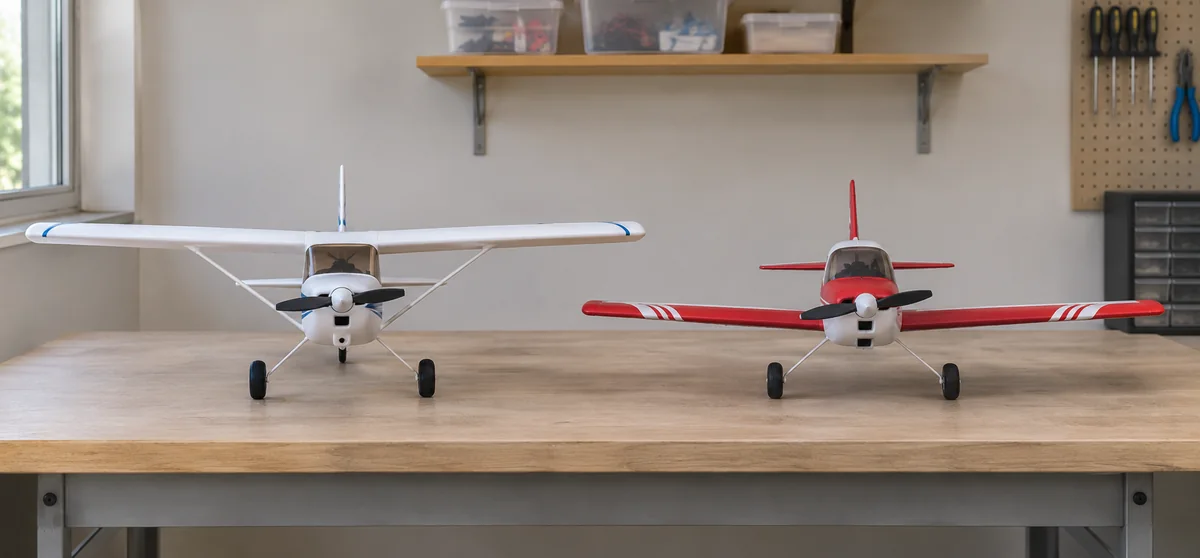
- High-wing vs. low-wing: A high-wing trainer mounts the wing above the fuselage. In a low-wing design, the wing meets the lower fuselage. Many trainers also have dihedral, an upward angle from the wing root to the tip that can help the plane resist a roll disturbance. Compare the model’s handling and stabilization modes as well as its wing position.
- Why EPO foam wins for 90% of pilots: Traditional balsa-and-film wood airplanes look gorgeous and fly crisply, yet a cartwheel on landing turns wood ribs into matchsticks. EPO (Expanded Polyolefin) foam flexes on impact, glues back together in ten minutes with Foam-Tac or foam-safe CA, and even pops crushed noses back into shape when dipped briefly in hot (not boiling) water.
- U.S. airspace and FAA TRUST basics: In the United States, recreational RC pilots must pass the free, quick online FAA TRUST (The Recreational UAS Safety Test) before flying outdoors, follow community-based safety guidelines (such as the AMA — Academy of Model Aeronautics), and register aircraft weighing 250 grams (0.55 lbs) or more on FAA DroneZone (a single $5 recreational registration covers your entire fleet). Flying at an AMA-chartered local club field also gives you smoother runways, mentorship, and FRIA (FAA-Recognized Identification Area) exemptions from Remote ID broadcasts.
Which RC plane brand fits your stage?
- Best true first airplane (zero experience): HobbyZone AeroScout S 2 (RTF) for open fields, or a VolantexRC 400 mm T-28 / Sport Cub if you only have a small park and a $100 budget.
- Best second plane / all-purpose bush & aerobatic flyer: E-flite Turbo Timber Evolution or T-28 Trojan 1.1 m, or FMS Ranger / PA-18 Super Cub.
- Best value PNP scale planes for multi-protocol radios: FMS and Arrows RC.
- Best EDF jets and large warbirds: Freewing via Motion RC.
- Best hands-on DIY build for families and makers: Flite Test (Tiny Trainer or Simple Cub).
- Best glider and thermal soarer: Multiplex EasyGlider 4.
If you want to practice stick orientation indoors before risking a real airframe—or you are also curious about rotorcraft—pair your transmitter with a flight simulator (much like the practice tools in our best FPV drone simulators guide) and keep reliable packs on hand via our best LiPo battery brands guide.
Sources
- FAA — Aerodynamics of flight and dihedral
- Horizon Hobby — HobbyZone & E-flite Aircraft
- FMS Model — RC Airplanes & Reflex Stabilization
- Motion RC — Freewing EDF Jets & Warbirds
- Flite Test — DIY Foam Board Planes & Beginner Guides
- Multiplex Modellsport — Elapor Aircraft
- Academy of Model Aeronautics (AMA) — Club Locator & Safety Code
- FAA — Recreational Flyers & TRUST Certification
Frequently Asked Questions
The HobbyZone AeroScout S 2 is the consensus leader for solo beginners. Its rear-mounted pusher propeller protects the motor in rough landings, its high-wing design glides predictably when you cut power, and SAFE Beginner mode prevents over-banking while keeping a one-button Panic recovery switch under your finger.
Yes—even two or three hours on a simulator (such as RealFlight Evolution or Phoenix/PicaSim) builds automatic muscle memory for reverse orientation (steering accurately when the airplane flies back toward your face). That single mental habit prevents the majority of first-day crashes.
It depends on airplane size, weight, and local rules. Sub-250 g micro planes (like VolantexRC 400 mm models or E-flite UMX aircraft) fit comfortably in an empty soccer field when nobody is nearby, provided local park ordinances allow RC aircraft and airspace isn't restricted near an airport. Larger 1.1 m–1.5 m planes need wide-open fields or a dedicated AMA flying club runway.
A propeller plane pushes a large volume of air relatively slowly, giving strong low-speed thrust, quick takeoff acceleration, and 7–12 minutes of flight time. An EDF (Electric Ducted Fan) spins a small, multi-bladed fan at very high RPM inside the fuselage for jet-like sound and high top speed, at the cost of shorter flights (typically 3.5–5 minutes), heavier battery current draw, and faster landing speeds.
You do not need a pilot's license for recreational flying, but the FAA requires every recreational flyer to pass the free online TRUST safety test (which takes about 15 minutes and cannot be failed) and carry the completion certificate while flying. Any RC plane weighing 250 grams or more at takeoff also requires a $5 recreational FAA registration number marked on the outside of the airframe.