Best LiPo Battery Brands of 2026
If you want the most reliable LiPo batteries without paying a proprietary ecosystem tax, SMC and Gens Ace (along with its sister FPV brand, Tattu) sit at the top of the hobby. Both brands match their cells tightly, maintain low internal resistance, and publish specifications that hold up under real throttle loads. For pilots and bashers who want maximum punch per dollar, CNHL delivers remarkable high-discharge value, while Spektrum Smart and Traxxas iD trade higher prices for plug-and-play simplicity that removes charger setup guesswork for beginners.
Shopping for lithium polymer (LiPo) batteries is notoriously confusing because almost every shrink-wrapped brick looks identical on a product page—and many budget brands print wildly inflated "120C" or "150C" numbers right on the label. Understanding a handful of real electrical basics—voltage, capacity, internal resistance, and connector ratings—lets you see straight past marketing hype, protect your speed controller, and get hundreds of safe cycles from your packs.
Reading a LiPo label without getting fooled
Every LiPo pack carries four headline numbers on its wrapper—for example, 3S 5000mAh 50C 11.1V. Two of those numbers are hard physics, one is an estimate, and one is routinely exaggerated.
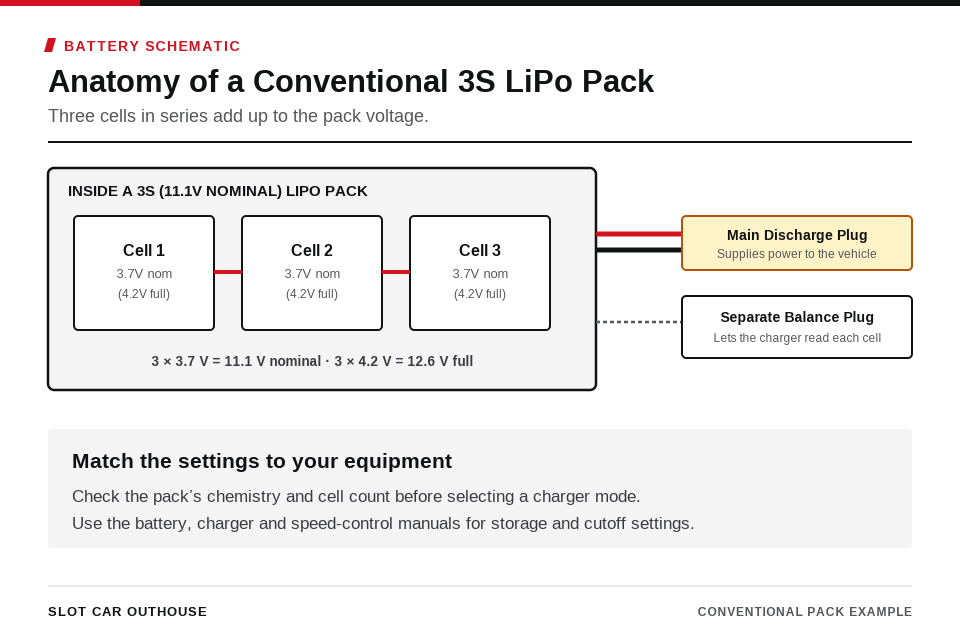
- S-count (cell count = voltage = speed): A conventional LiPo cell is rated 3.7 V nominal and 4.2 V at full charge. Use the battery and speed-controller manuals to set the low-voltage cutoff. Putting cells in series ("S") adds their voltages together: 2S = 7.4V nominal, 3S = 11.1V, 4S = 14.8V, 6S = 22.2V. Think of voltage as water pressure in a hose—higher S-count spins your motor faster, provided your ESC and motor are rated to handle it. (Note: LiHV "high-voltage" packs charge to 4.35V per cell, which requires a charger with a dedicated LiHV mode.)
- Capacity in mAh (fuel tank size = run time): Milliamp-hours tell you how much energy the pack holds. A 5000mAh (5.0Ah) pack holds roughly twice the energy of a 2500mAh pack at the same voltage, giving you longer run time—at the cost of extra size and weight.
- C-rating (the most abused spec in RC): In theory, C-rating multiplied by capacity in amp-hours tells you the continuous current the pack can safely deliver. A true 50C 5000mAh (5Ah) pack would theoretically supply 250 amps continuously. In reality, there is no standardized independent testing body enforcing C-ratings in the RC industry. A reputable brand's honest 45C–60C pack frequently outperforms a budget brand's "130C" pack because the budget label measures a fleeting burst rating—or invents a number to match competitors.
- Internal resistance in milliohms (mΩ — the spec that actually tells the truth): Imagine trying to drink a thick milkshake through a coffee stirrer versus a wide boba straw. Internal resistance (IR) is the electrical narrowness of that straw. Lower milliohms mean less voltage sag when you punch the throttle, less heat inside the pack, and crisper acceleration. A fresh, healthy 5000mAh basher cell typically reads around 1.5–4 mΩ on a good balance charger; as cells age or get mistreated, IR climbs into double digits and the pack feels sluggish and runs hot.
Best LiPo battery brands compared
| Brand | Best Known For | Spec Honesty | Typical Internal Resistance | Case & Connector Options | Price Tier | Best Fit |
|---|---|---|---|---|---|---|
| SMC | Low-IR race & high-amp basher packs (HCL / True Spec) | Excellent (published test data) | Very Low | Hardcase & softcase; custom connector soldering | Mid | Performance-minded drivers, racers & fast boats |
| Gens Ace | Consistent everyday RC car/boat packs (Bashing, Redline) | Very High | Very Low to Low | Hardcase, Bashing softcase; XT60/XT90/EC5/Deans | Mid to High | All-around reliability across surface RC |
| Tattu | High-discharge FPV drone packs (R-Line, FunFly) | Very High | Very Low | Softcase; XT30/XT60 | Mid to High | FPV quadcopters & weight-sensitive aircraft |
| CNHL | Punchy high-C packs at aggressive sale prices (G+Plus, Racing) | Good to High | Low | Hardcase & softcase; XT60/EC5/QS8 | Budget to Mid | Budget bashers & FPV pilots wanting real punch |
| Spektrum Smart | Auto-configuring microchip packs (G1 & G2) | High | Low to Moderate | Hardcase & softcase; IC3/IC5 (EC-compatible) | High | Horizon Hobby / Arrma / Pro Boat beginners |
| Traxxas iD | Single-plug balance & charge convenience | Good | Moderate | Softcase; Traxxas iD proprietary | High | Traxxas owners prioritizing zero-hassle charging |
| Zeee / Ovonic / Hoovo | High-availability budget packs on Amazon | Low (inflated C-ratings) | Moderate to High | Hardcase & softcase; Deans/XT60/EC5/Traxxas | Budget | Casual backyard bashing & crawler trail runs |
| GNB (Gaoneng) | Micro & sub-250g LiHV FPV packs (1S–4S) | High | Low (for small cells) | Softcase; BT2.0/A30/XT30 | Budget to Mid | Tiny whoops, toothpick drones & micro planes |
Deep dive into the top LiPo battery brands
SMC: the benchmark for spec honesty and raw punch
Among experienced surface racers, speed-runners, and RC boat hobbyists, SMC enjoys a reputation few brands match. Rather than playing the 150C sticker game, SMC publishes straightforward discharge ratings and prioritizes low internal resistance and tight cell balancing across its packs (such as its HCL and True Spec lines).
Because SMC sells largely direct-to-consumer, you get racing-grade cell chemistry at midrange pricing—and you can often order packs pre-soldered with your exact connector (XT90, EC5, QS8, or 5mm bullets) rather than stacking adapters. Availability can fluctuate during peak season because batches sell out quickly, so when your preferred size is in stock, grab a matched pair.
Gens Ace & Tattu: the gold standard for consistency
Manufactured by Grepow, Gens Ace (surface and general RC) and Tattu (FPV and aerial) are the industry's reliability yardsticks. You rarely hear horror stories of a dead cell out of the box or wild cell-to-cell voltage drift after ten cycles.
- Gens Ace Bashing Series: Wrapped in a tough, slightly flexible polycarbonate-like shell that shrugs off gravel impacts without the bulk of a rigid race brick.
- Gens Ace Redline: Built specifically for competitive 1:10 and 1:8 track racing, featuring ultra-low IR and 5mm bullet sockets.
- Tattu R-Line & FunFly: R-Line packs are built for competition FPV drones where sustained full-throttle climbs would sag lesser cells instantly, while FunFly packs offer a slightly softer, more affordable blend for daily freestyle practice.
Gens Ace also offers its own G-Tech smart ecosystem, which adds smart-charger recognition while still keeping a standard balance plug so you aren't locked out of normal chargers.
CNHL (China Hobby Line): high-discharge performance on a budget
If you fly FPV drones or drive heavy 4S–8S monster trucks and want crisp throttle punch without paying flagship prices, CNHL is tough to beat. Its Racing Series and G+Plus packs consistently deliver lower internal resistance than similarly priced Amazon packs, holding voltage higher deeper into a run.
The trade-off with CNHL is mostly physical: their packs tend to be slightly heavier and boxier than equivalent Tattu or SMC packs, so double-check your battery tray dimensions before ordering. Watch their regular sales—when discounted, CNHL is arguably the best performance-per-dollar value in the hobby.
Spektrum Smart & Traxxas iD: convenience versus ecosystem lock-in
Both Horizon Hobby (Spektrum Smart) and Traxxas (iD) built smart battery ecosystems to solve the single biggest hurdle for newcomers: plugging in the wrong charger settings.
When you connect a Spektrum Smart or Traxxas iD battery to its matching brand charger, an embedded chip automatically tells the charger the exact cell count, chemistry, and safe charge rate. Spektrum's Smart G2 packs go a step further: they eliminate the separate white balance wire (balancing through a data pin inside the IC3/IC5 plug) and automatically self-discharge down to safe storage voltage after a set number of idle days (typically 72 hours).
That convenience is genuinely valuable for families and casual weekend drivers—especially auto-storage, which prevents the #1 mistake that ruins LiPos. The downside is lock-in and cost. You pay 30% to 60% more per battery, and while Traxxas iD and Spektrum G2 batteries require their brand's chargers to balance properly, Spektrum G1 packs still include a standard JST-XH balance lead for universal chargers.
Zeee, Ovonic, and Hoovo: realistic expectations for budget Amazon packs
Walk onto any casual basher forum and you will see thousands of people happily running Zeee, Ovonic, and Hoovo packs purchased in two-packs online. For moderate-draw vehicles—trail RC crawlers, 2S/3S brushed or mild brushless trucks, and casual backyard driving—they are hard to argue against. They cost half as much as premium packs and arrive fast.
Just calibrate your expectations accurately: ignore the "100C" or "120C" labels printed on the case. In heavy high-current setups—like a 6S monster truck pulling 120+ amps on thick grass or a fast brushless RC boat—budget cells exhibit higher voltage sag, run noticeably warmer, and tend to puff sooner than SMC, Gens Ace, or CNHL equivalents. Think of them as reliable commuter tires rather than track-day slicks.
GNB (Gaoneng): the micro FPV specialist
Tiny whoops, micro airplanes, and sub-250-gram drones live and die by grams. GNB dominates the small-cell world (1S through 4S, 300mAh to 1500mAh), offering modern folded-cell LiHV packs equipped with low-resistance BT2.0, A30, and XT30 connectors. If you fly micro quads indoors or in small parks, GNB's weight-to-punch ratio is consistently ahead of generic micro packs.
Hardcase vs. softcase—and picking the right connector
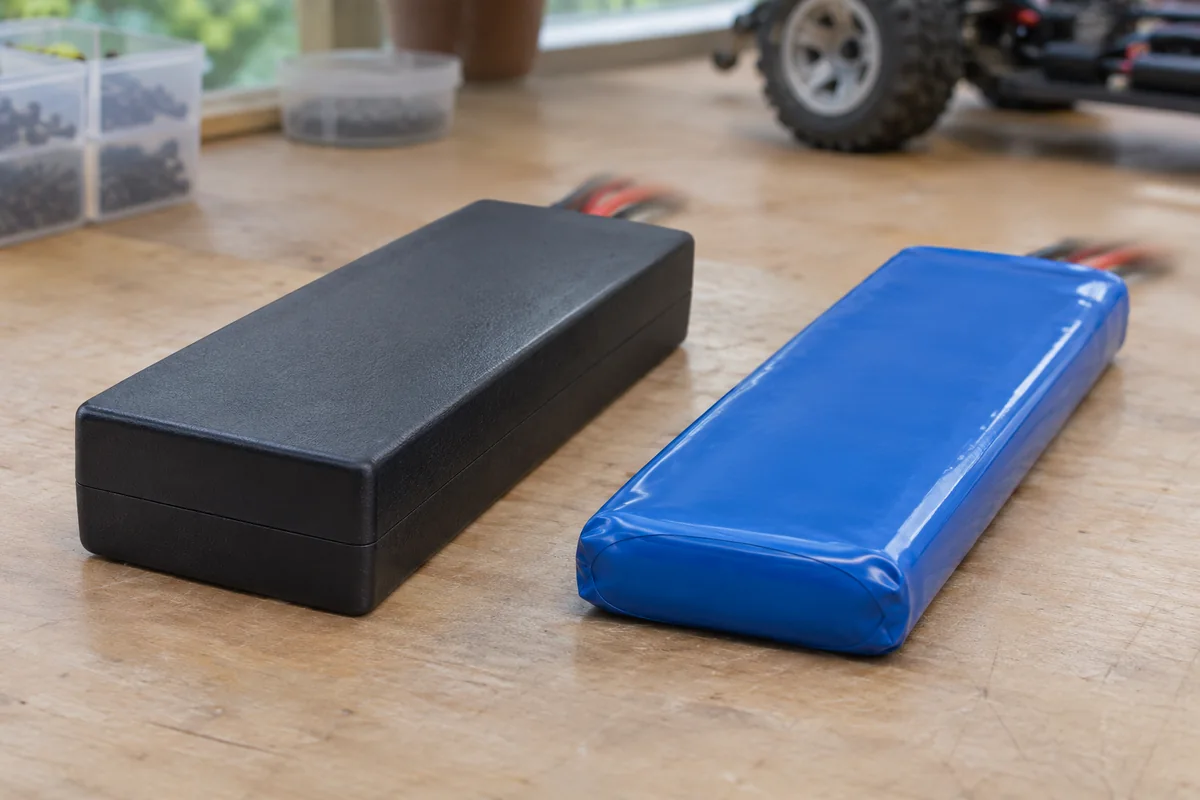
Choosing the right shell and plug matters as much as the cells inside:
- Hardcase packs enclose the cells in a rigid ABS plastic shell. Use them in RC cars, buggies, and basher trucks where chassis flex, pebbles, and tumble crashes can puncture a soft pouch.
- Softcase packs save weight and fit tight spaces. Use them in airplanes, drones, and tightly packed boat hulls where weight and snug foam cradling matter more than rock impact protection.
- Connector amp ratings matter: Never push 6S monster-truck amperage through an undersized plug. As a practical rule of thumb:
- XT30 / BT2.0: Micro drones and small 1S–3S models (up to ~30A).
- Deans (T-Plug): Legacy 2S–3S standard (~50–60A), harder to grip and unplug cleanly.
- XT60 / EC3 / IC3: The sweet spot for 2S–4S cars, drones, and mid-size planes (~60A continuous).
- XT90 / EC5 / IC5: Heavy-duty 4S–6S bashers and fast boats (~90–120A continuous). (Good news: Spektrum IC3 and IC5 plugs are physically cross-compatible with standard EC3 and EC5 plugs.)
- QS8: Extreme 6S–8S speed-run rigs and large twin-motor boats (150A+ with built-in anti-spark resistors).
If you ever decide to standardize your fleet onto a single plug like XT60 or EC5, a temperature-controlled station from our best soldering iron brands guide makes clean, safe joints—just remember to cut and solder one wire at a time so the positive and negative leads never touch.
Five non-negotiable LiPo safety and longevity rules
LiPo batteries pack extraordinary energy density into thin foil pouches. Treated with basic discipline, they last hundreds of cycles safely. Treated carelessly, they swell ("puff") or vent fire.
- Use the storage setting specified for the pack: Follow the battery and charger instructions for storage. Standard LiPo and LiHV can use different targets, so confirm the chemistry before choosing the charger’s Storage mode.
- Charge at 1C unless you have a real reason not to: A 1C charge rate equals the battery's capacity divided by 1,000 (5.0 amps for a 5000mAh pack; 1.5 amps for a 1500mAh pack). Even if a wrapper advertises "5C fast charge," sticking to 1C keeps cells cool and dramatically extends cycle life.
- Stay present while charging: Use a nonflammable charging surface and follow the battery and charger manufacturers’ instructions for a fire-resistant charging container.
- Retire a swollen, punctured, or leaking pack: Stop using it. Avoid charging or discharging a damaged pack. Ask the manufacturer or your local household hazardous waste program how to handle and dispose of it.
- Don't rely on cheap adapter chains: Running a high-amp 6S truck through a flimsy Deans-to-EC5 adapter creates a hotspot that melts plastic and adds resistance. Match your battery plug to your ESC whenever possible.
Check our RC batteries and chargers section for specific charger pairings and pack recommendations by vehicle class.
Sources
- Onyx — Charger manual and standard battery parameters
- U.S. EPA — Handling and disposing of lithium-ion batteries
- Battery University — Lithium-Polymer & Storage Voltage Research
- SMC Racing Technical Battery Guide
- Gens Ace & Tattu Official Product Specifications
- Call2Recycle — Safe Lithium Battery Recycling Locator
Frequently Asked Questions
Only when it is honest. Because RC brands don't follow a single C-rating test standard, a 50C pack from SMC or Gens Ace often delivers stronger throttle punch and less voltage sag than a budget 120C pack. Judge batteries by brand reputation and real internal resistance (mΩ) readings on your balance charger rather than chasing the biggest number printed on the label.
Only if both the ESC and motor are explicitly rated for 3S voltage—and even then, expect higher heat and faster drivetrain wear. Jumping from 2S (7.4V nominal) to 3S (11.1V nominal) increases RPM by 50%, which can overheat stock motors unless you gear down to a smaller pinion gear. Never guess; check your manual's maximum voltage spec first.
Heat, prolonged storage at full charge, over-discharge, and damage can all contribute to swelling. Stop using a swollen pack and ask the manufacturer or your local household hazardous waste program how to dispose of it.
They are worth it if you are brand-new to RC, buying for a younger driver, or simply want zero-friction charging with minimal risk of picking the wrong charger setting. Once you own three or more vehicles and buy multiple packs per year, moving to a quality universal dual balance charger and standard XT60/IC5 packs from Gens Ace, SMC, or CNHL saves significant money over time.
Standard LiPo cells charge to 4.20V per cell (3.7V nominal), while LiHV (Lithium High Voltage) cells are chemically formulated to charge safely to 4.35V per cell (3.8V nominal). LiHV gives a modest boost in initial punch and energy density—popular in micro FPV drones and stock-class racing—but requires a charger with a LiHV setting. You can safely charge a LiHV pack on a standard 4.20V LiPo setting, though you should never charge a standard LiPo on a 4.35V LiHV setting.