Best Airbrush Brands for Scale Models, Gunpla and RC Bodies of 2026
A good airbrush transforms scale modeling, Gunpla painting, and polycarbonate RC body work in a single afternoon—turning streaky brush coats into factory-smooth gradients, soft camouflage edges, and glossy automotive clears. Yet walking into the airbrush aisle can feel overwhelming, with near-identical chrome pens priced anywhere from $35 to $500. For most hobbyists, the sweet spot sits right between $95 and $185 with a 0.3 mm to 0.4 mm dual-action gravity-feed brush from Iwata, Harder & Steenbeck, or GSI Creos (Mr. Hobby).
The real difference between airbrush brands is not magic atomization fairy dust—it is machining tolerances, trigger smoothness, nozzle design, and spare-parts availability. A poorly machined budget brush splatters when you barely crack the trigger and uses proprietary rubber O-rings that swell when exposed to lacquer thinner. A well-engineered brush from a proven brand sprays silky mist at low pressure, breaks down for cleaning in thirty seconds, and lets you buy a replacement needle five years from now without hunting obscure forums.
Gravity-feed vs. siphon-feed and nozzle sizes
Before comparing brands, nail down the three mechanical choices that dictate how an airbrush feels in your hand: action type, paint feed, and nozzle diameter.
Single-action vs. dual-action (and pistol-grip triggers)
- Single-action: Pressing the trigger releases a fixed preset mix of air and paint—essentially a refillable, higher-precision rattle can. Fast for priming large hulls or laying solid single-color RC polycarbonate shells, but unable to taper a line thickness on the fly.
- Dual-action (the hobby standard): Pressing down starts airflow; pulling back retracts the needle to meter paint flow. You always follow the golden rhythm: air on → paint on → paint off → air off. That sequence keeps the needle tip blown clean between passes and lets you switch seamlessly from a pencil-thin pre-shade line to a two-inch coat without adjusting a knob.
- Pistol-grip dual-action (e.g., Grex Tritium, Iwata HP-TH): Replaces the top index-finger button with a squeeze trigger like a mini automotive spray gun. Pulling halfway starts air; pulling further adds paint. Builders with hand fatigue or big clear-coating sessions swear by them.
Gravity-feed vs. siphon-feed vs. side-feed
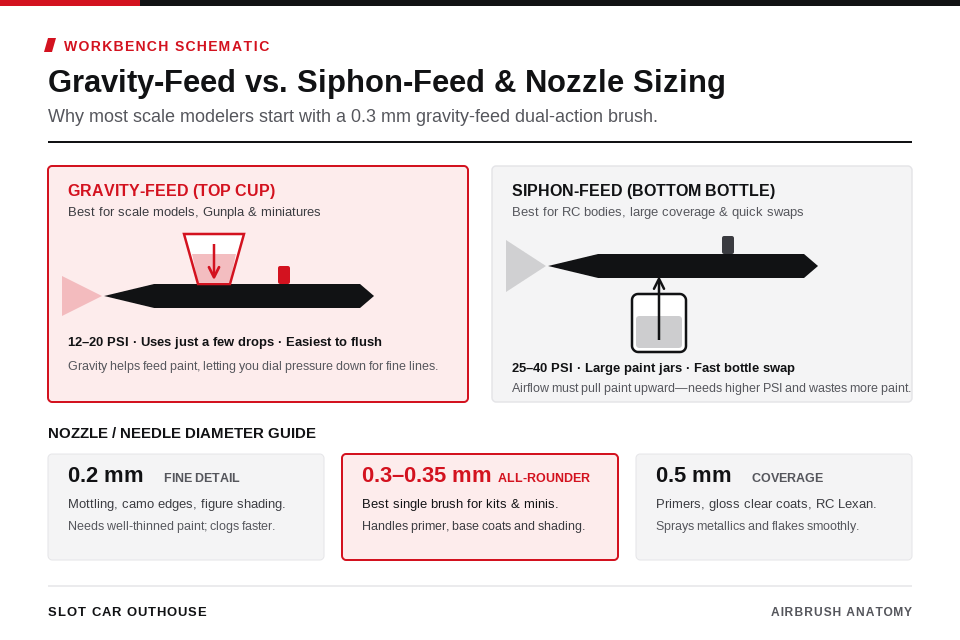
- Gravity-feed (top cup): Paint sits in a small cup above the body and drops naturally into the nozzle channel. Because gravity assists paint flow, you can spray at low pressures (12–20 PSI) for crisp detail with minimal overspray, waste almost no paint (a few drops suffice), and flush colors in seconds. This is the overwhelming favorite for Gunpla, aircraft, armor, and miniatures.
- Siphon-feed (bottom bottle): Airflow creates vacuum suction to pull paint upward from a jar suspended below. It demands higher pressure (25–40+ PSI), wastes more paint in the pickup tube, and makes close-up detail harder—but lets you swap large 1–2 oz color jars instantaneously. Best suited for T-shirt work, muralists, or painting multiple large RC truck bodies in one sitting.
- Side-feed: A swappable cup mounts to the left or right side, giving an unobstructed sightline down the barrel and letting you tilt the brush steeply without spilling. Niche, but handy for intricate figure painting.
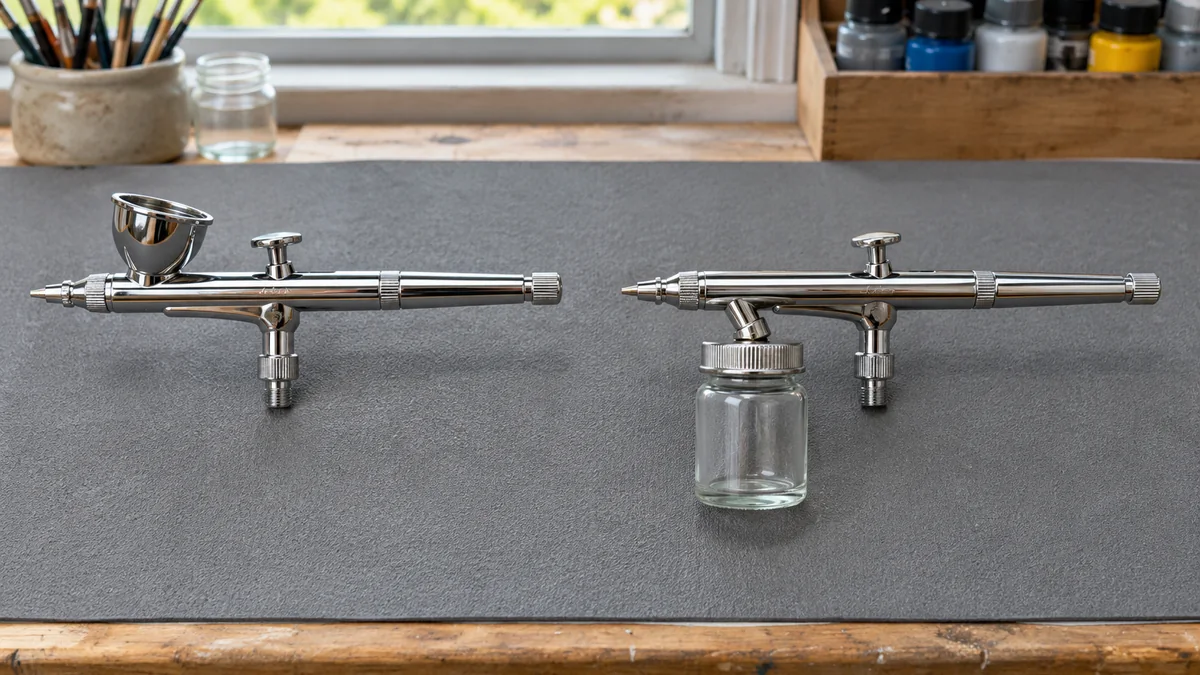
Nozzle sizes: 0.2 mm vs. 0.3–0.4 mm vs. 0.5 mm
Nozzle size determines the maximum paint viscosity and spray-pattern width the airbrush handles cleanly:
- 0.2 mm (Detail specialist): Delivers hair-thin camouflage mottling and panel pre-shading at low PSI, but it is unforgiving. Water-based acrylics contain relatively large pigment particles and dry fast right at the needle tip ("tip dry"). Push slightly under-thinned acrylic through a 0.2 mm orifice, and microscopic dried flecks immediately bridge the gap between needle and nozzle, choking airflow into sputtering bursts.
- 0.3 mm to 0.4 mm (The all-rounder): The ideal first—and often only—airbrush size. Properly thinned, a 0.35 mm or 0.4 mm nozzle lays down smooth primers, metallics, clears, and 2 mm shading lines alike.
- 0.5 mm (Heavy lifter): Effortlessly pushes high-build surfacer primers, metallic flakes, heavy pearl RC polycarbonate paints, and wet automotive clear coats across broad surfaces like 1:24 car bodies or 1:10 RC shells.
Floating (drop-in) nozzles vs. threaded nozzles
This single engineering detail saves beginners more money than any feature on the box. Traditional airbrushes use a microscopic threaded brass nozzle (barely 4 mm long) that screws into the body with a tiny wrench. Over-tighten it by a quarter turn after cleaning, and the hollow brass threads shear clean off inside the airbrush body.
Modern floating / self-centering nozzles—found on Harder & Steenbeck brushes and the Iwata Eclipse series—have no delicate threads at all. The flared cone simply drops into a machined seat and is held snugly in place by the large hand-tightened air cap. Zero tiny wrenches, faster deep cleaning, and virtually impossible to snap.
The best airbrush brands compared
| Brand | Standout Model(s) | Typical Price | Nozzle Style | Best Strength | Watch Out For |
|---|---|---|---|---|---|
| Iwata | Eclipse HP-CS (0.35 mm), Revolution HP-CR (0.5 mm), Custom Micron | $100–$480 | Compression-fit drop-in (Eclipse) / threaded (HP/Micron) | Benchmark trigger smoothness, global parts availability | Neo entry line is outsourced and less refined than Japan-made models |
| Harder & Steenbeck | Ultra 2024 (0.45 mm), Evolution 2024 CRplus (0.28/0.45 mm), Infinity | $110–$320 | Floating self-centering drop-in | Easiest teardown/cleaning, solvent-proof PTFE seals, Ultra beginner trigger lock | Soft brass needles bend easily if dropped; handle tips gently |
| GSI Creos (Mr. Hobby) | Procon Boy PS-289 (0.3 mm), PS-270 (0.2 mm), PS-290 (0.5 mm) | $85–$130 | Threaded (precision Japanese brass) | Exceptional Japanese precision (same OEM tier as Iwata) at half the price | Tiny threaded nozzles require a light touch; heavier body balance |
| Badger | Patriot 105 (0.5 mm), Sotar 20/20 (0.2 mm) | $85–$160 | Large drop-in / self-centering | Rugged US-made workhorses, affordable replacement needles | Clunkier finish and proprietary hose thread (needs adapter for 1/8" BSP) |
| Paasche | Talon TG, VL Siphon | $85–$140 | Threaded / heavy-duty multi-size | Tough, long-lived utility brushes, great for broad coats & siphon work | Proprietary hose fitting; less refined low-PSI micro-detail than Japanese/German rivals |
| Grex | Tritium TG3 (0.3 mm), Genesis XG | $175–$260 | Threaded / quick-fit options | Best-in-class pistol-grip ergonomics and fan-cap accessories | Higher price per feature than standard top-trigger brushes |
| Sparmax | Max-3 (0.3 mm), Max-4 (0.4 mm), SP-35 | $75–$115 | Threaded | Iwata-affiliated reliability and solid value compressors/brushes | Smaller US retail footprint than Iwata proper |
| Gaahleri | GHAD-39 (0.35/0.5 mm), Mobius (0.2/0.3 mm) | $40–$95 | Compression-fit / grooved nozzles | Strongest budget atomization and clean machining under $80 | Newer brand; long-term parts continuity still catching up to legacy makers |
Iwata — The industry benchmark
Built in Japan (except the budget Neo sub-brand), Iwata sets the standard against which every other airbrush is measured. The Iwata Eclipse HP-CS (0.35 mm) is arguably the single safest one-brush recommendation in scale modeling: its compression-fit drop-in nozzle cleans effortlessly, its trigger action feels buttery from day one, and it sprays everything from thinned acrylics to Gunpla lacquers and primers reliably. If you mostly prime or spray big 1:10 RC shells, the Revolution HP-CR (0.5 mm) delivers rugged workhorse coverage, while the hand-tuned Custom Micron sits at the apex for competition illustrators. Note that the Neo for Iwata is a budget OEM line—decent for a starter, though outclassed today by Harder & Steenbeck's Ultra 2024 and GSI Creos.
Harder & Steenbeck — The ergonomics and cleaning champion
Manufactured in Germany, Harder & Steenbeck (H&S) refreshed its lineup dramatically with the 2024 Ultra and Evolution 2024 CRplus. Every H&S brush uses large, finger-handled floating nozzles and solvent-resistant PTFE (Teflon) needle packing, meaning you can flush aggressive lacquer thinner through them without melting rubber O-rings and disassemble the front end completely without a single wrench.
The Ultra 2024 (0.45 mm) is uniquely clever for first-timers: its trigger mechanically prevents you from pulling back for paint until you have already pressed down for air, automatically building proper dual-action muscle memory, and a numbered collar lets you dial in preset pull limits for priming, basecoating, and highlighting. Step up to the Evolution 2024 CRplus (often sold as a 2-in-1 with 0.28 mm and 0.45 mm sets) if you want crisp trigger response that grows with you for a decade.
GSI Creos (Mr. Hobby) — Best value in precision machining
Known mostly for Mr. Color paints, GSI Creos sells its Procon Boy airbrushes—engineered and built in Japan by the same high-precision OEM manufacturing ecosystem famed for top-tier Iwata brushes, yet priced roughly $60–$90 lower. The PS-289 (0.3 mm) and PS-270 (0.2 mm) feature a built-in MAC (Micro Air Control) valve right beneath the cup so you can tweak air pressure at the brush with a fingertip, silky-smooth triggers, and immaculate atomization. The PS-290 (0.5 mm) pistol-grip brush with its optional fan air cap is a cult favorite among car modelers and Gunpla builders laying glass-smooth gloss clears. The only trade-off is a traditional tiny threaded nozzle—treat it gently during teardown.
Badger & Paasche — American workhorses
Badger's Patriot 105 (0.5 mm) has been a staple on miniature and armor benches for decades. It uses a chunky, durable drop-in nozzle that laughs off thick acrylic primers, and spare needles cost a fraction of Japanese parts. Its sibling, the Sotar 20/20 (0.2 mm), offers astonishing fine-line capability for the money, though its tiny paint cup favors detail passes over broad basecoats. Paasche (notably the Talon gravity-feed and VL siphon-feed) delivers similarly rugged metal construction built for years of abuse. Just remember that both Badger and Paasche use their own non-standard air-hose threads, so budget $8 for a 1/8-inch BSP adapter if connecting to a standard compressor hose.
Grex, Sparmax and Gaahleri — Specialists and budget standouts
- Grex excels in ergonomics. Its Tritium TG pistol-grip series feels immediately natural to anyone who has used spray guns or struggles with index-finger cramps during long painting sessions, and magnetic crown caps snap on and off cleanly.
- Sparmax (part of the Iwata Medea family) produces dependable midrange brushes (like the Max-3) and some of the quietest, cleanest-built hobby compressors on the market.
- Gaahleri disrupted the sub-$80 category with the GHAD-39 and Mobius series. Unlike anonymous $25 generic clones plagued by rough internal channels and spitting triggers, Gaahleri uses genuinely smooth CNC-machined drop-in nozzles with micro-grooves that aid atomization—making it a credible budget starting point if you want to test airbrushing before spending $150+.
Why your compressor matters just as much as the airbrush
A $300 airbrush hooked to a bad air source still sprays badly. Many newcomers buy palm-sized, battery-powered or tankless mini-box compressors because they look neat and quiet on a desk. Here is why they disappoint:
- Pulsing airflow: Without a buffer tank, every piston stroke sends a tiny pressure ripple down the hose, causing uneven stippling on smooth gloss coats.
- Moisture spitting: Compressing air heats it up; as warm air cools inside the hose, water condenses and suddenly blasts straight through your nozzle as a giant droplet that ruins a freshly painted hood or Gunpla chest plate.
- Overheating: Tankless diaphragm pumps run continuously whenever the trigger is pressed and quickly cook themselves during long sessions.
Look instead for a classic AS-186 style oil-less piston compressor with a 3-liter air tank, built-in pressure regulator (0–60 PSI gauge), and water moisture trap (sold under Timbertech, Fengda, Master, and Sparmax). Expect to spend $85–$120. The compressor fills the tank, shuts off silently while you spray pure pulseless air, and cycles on only briefly to top back up. Check our airbrushes and compressors lineup alongside our model paint brands guide so your paints, thinners, and compressor match cleanly from day one.
Practical buying rules for your first setup
- Total budget ~$180–$220: Pair an AS-186 tanked compressor (
$95) with a Harder & Steenbeck Ultra 2024 ($115), GSI Creos PS-289 ($95), or Badger Patriot 105 ($95). Add a quick-disconnect fitting ($10) and a glass cleaning pot ($15). - Total budget ~$280–$350 ("buy once, cry once"): Pair the tanked compressor with an Iwata Eclipse HP-CS or Harder & Steenbeck Evolution 2024 CRplus. Either brush will comfortably serve every stage of your modeling journey for ten-plus years.
- Mostly painting RC polycarbonate bodies or 1:24 car clears? Prioritize a 0.5 mm nozzle (Iwata Revolution HP-CR, Badger Patriot 105, or GSI Creos PS-290) so thick metallics and gloss clear coats lay down wet and level without orange peel.
- Don't forget ventilation: Water-based acrylics still atomize respirable particulate mist, and lacquers emit volatile organic vapors. Always spray inside a vented tabletop spray booth and wear a properly fitted respirator—especially when clearing or priming Gunpla kits from our Gunpla grades guide.
Sources
- Iwata-Medea — Airbrush Lineup, Nozzle Design & Care Guides
- Harder & Steenbeck — Ultra 2024, Evolution 2024 & Infinity Specifications
- GSI Creos / Mr. Hobby — Procon Boy Airbrush Technical Catalog
- Badger Air-Brush Co. — Patriot 105 & Sotar 20/20 Documentation
- Grex Airbrush — Pistol-Grip Tritium & Genesis Reference
Frequently Asked Questions
The Harder & Steenbeck Ultra 2024 (0.45 mm) is the easiest airbrush to learn on thanks to its beginner trigger lock (which enforces air-before-paint habits), drop-in self-centering nozzle, and tool-free cleaning. The Iwata Eclipse HP-CS (0.35 mm) is the classic runner-up if you want a slightly finer all-rounder that you will never outgrow.
Start with 0.3 mm to 0.45 mm. A 0.2 mm nozzle clogs easily unless your paint thinning and pressure tuning are dialed in, while a 0.5 mm nozzle excels at priming and big clear coats but struggles with fine shading on 1:144 Gunpla or 28 mm miniatures.
Acrylic paint dries rapidly as air rushes past the needle tip ("tip dry") and requires thinning to roughly the consistency of skim milk—usually 1:1 with dedicated acrylic thinner plus a drop or two of flow improver or retarder. Also confirm your air pressure sits around 15–20 PSI rather than too low to atomize the pigment cleanly.
Cordless handheld mini-compressors can handle quick basecoats or casual priming, but they lack adjustable pressure control, moisture traps, and consistent airflow, and their unbranded brushes have rough triggers and scarce replacement parts. Stepping up to a tanked AS-186 compressor and a budget name-brand brush like a Gaahleri GHAD-39 or H&S Ultra saves frustration and money in the long run.
Yes, provided the airbrush uses solvent-resistant PTFE (Teflon) needle packing seals—which Iwata, Harder & Steenbeck, GSI Creos, and Badger include on their main lines. Just flush the cup and nozzle thoroughly with the matching thinner before switching chemistries so incompatible paint residues never curdle inside the nozzle.