Best Soldering Iron Brands for RC, FPV and Slot Cars of 2026
Nothing exposes a weak soldering iron faster than an RC battery plug. An inexpensive 30-watt hardware-store wand might handle thin LED wires on a model train layout, yet the moment you touch it to a thick 10-gauge silicone wire and a brass XT60 cup, the solder turns into dull gray putty and freezes solid while the nylon plug melts into a crooked mess. For RC vehicles, FPV drones, and slot car braided leads, you want an iron with fast thermal recovery and a broad chisel tip—ideally a modern cartridge-tip iron from Pine64, Miniware, Sequre, Hakko, JBC, or Metcal, or a proven high-mass bench classic from Hakko or Weller.
The core trade-off in hobby soldering is desktop ruggedness versus cartridge responsiveness and field portability. Traditional passive bench stations like the Hakko FX-888DX last decades and cost pennies per replacement tip, whereas cartridge stations and USB-C PD smart pens heat up in ten seconds, dump serious wattage directly into massive copper heat sinks, and slip into a trackside pit bag powered straight from a 4S–6S LiPo battery.
Cartridge tips vs. passive tips (and why it matters for RC)
Understanding the mechanical difference between passive tips and active cartridge tips explains ninety percent of soldering frustration—and saves you from burning out expensive ESC boards or stripping battery connectors.
Passive (slug-style) tips
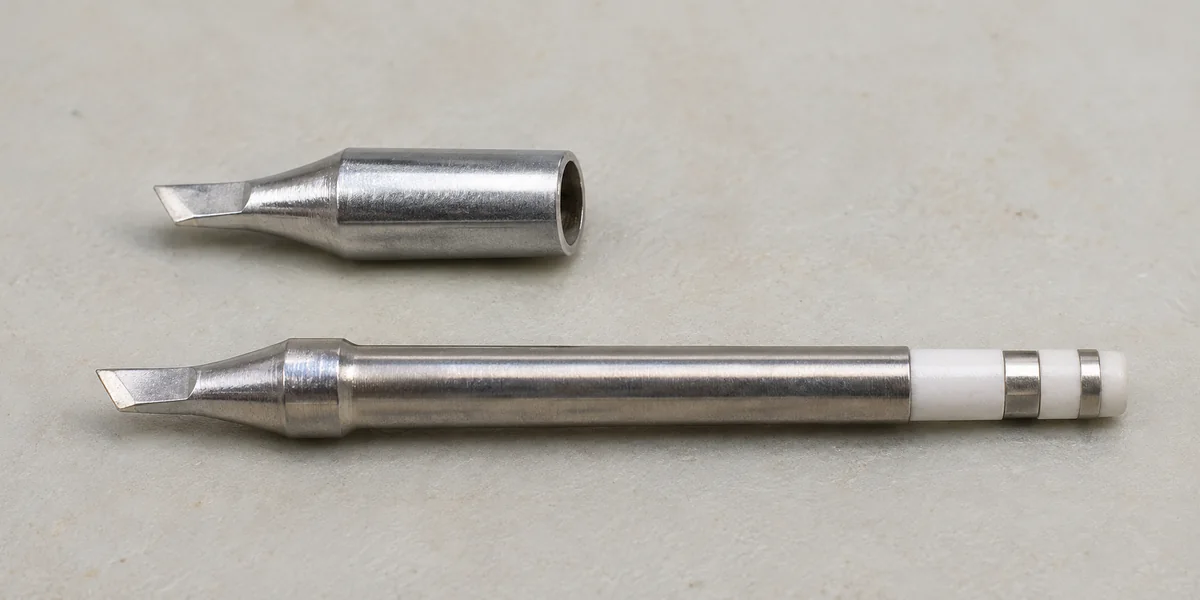
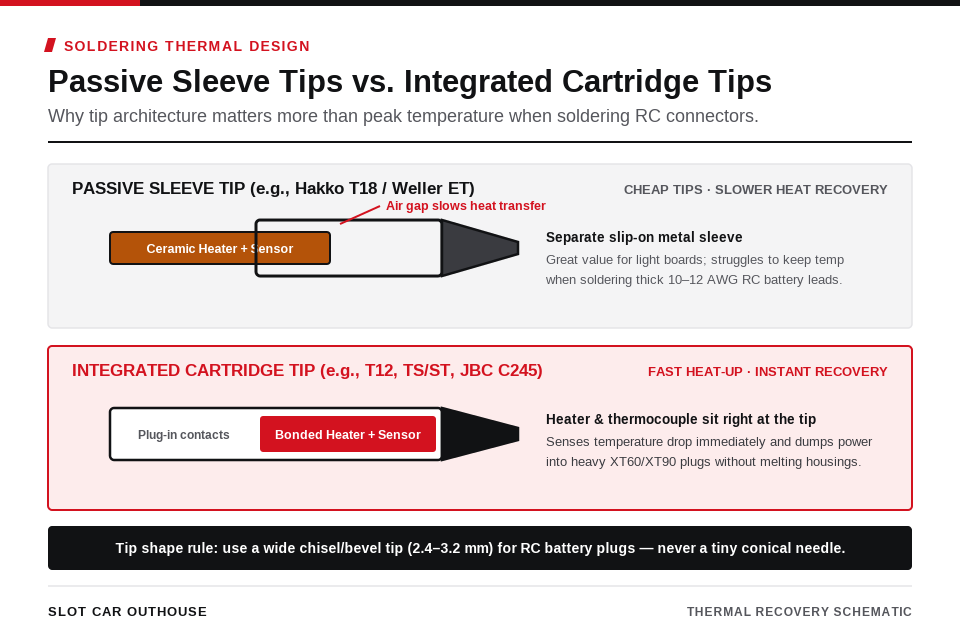
Classic bench stations like the Hakko FX-888D/DX and Weller WE1010NA separate the heater from the tip. A stationary ceramic heating element sits inside the handle, and a hollow metal tip slides over it like a thimble, locked down by a threaded collar.
The catch is physics: there is always a microscopic air gap between the heater core and the inside of the tip, and the temperature sensor sits back inside the heater rather than at the working end. When you touch that tip to a thick 10 AWG braided copper wire soldered to an XT90 plug, the copper acts like a massive radiator, sucking heat out of the tip faster than it can travel across the air gap. The tip temperature plunges, the solder stalls halfway through flowing, and you end up holding the iron on the connector for ten seconds—long enough to soften the nylon housing and misalign the gold bullet pins.
Active cartridge tips (T12, TS/ST, C245, SmartHeat)
Cartridge-tip irons seal the heating coil, thermocouple temperature sensor, and copper tip together inside one solid, swappable cartridge right behind the working edge. There is no air gap to cross and almost zero lag before the controller detects a temperature drop.
Touch a 65W–100W cartridge iron with a wide chisel tip to an XT60 cup, and the controller sees a 2°C dip within milliseconds, dumps full power straight into the tip face, and melts the entire joint cleanly in two to three seconds—before heat even has time to wick down the wire or deform the connector housing.
The golden RC rule: tip geometry beats brute temperature
Beginners almost always blame temperature when a thick wire refuses to melt, cranking a pointy conical "needle" tip up to 450°C (840°F). That makes everything worse: a pinpoint tip makes microscopic surface contact (like trying to warm a frying pan with a sewing needle), while 450°C instantly boils away flux, oxidizes the tip black, and scorches fiberglass ESC pads.
Instead, keep your iron at 350°C–380°C (660°F–715°F) for leaded solder (or 380°C–400°C for lead-free) and match tip width to the joint:
- Wide chisel / knife tip (2.4 mm to 3.2 mm, e.g., D24, D32, K, BC2/BC3): Mandatory for 10–14 AWG battery leads, XT60/XT90/EC5 plugs, motor tabs, and ESC battery pads. Flat faces maximize heat-transfer area.
- Fine chisel or bevel tip (1.2 mm to 1.6 mm): Ideal for slot car motor braids, receiver pins, FPV flight controller signal pads, and model train DCC decoders.
- Conical needle tips: Almost never the right tool—leave them in the box except for ultra-tiny surface-mount rework under a magnifier.
The best soldering iron brands compared
| Brand | Standout Model(s) | Tip System | Power & Heat-Up | Typical Price | Best Fit |
|---|---|---|---|---|---|
| Hakko | FX-888DX (passive), FX-951 / FX-971 (cartridge) | T18 passive / T15 & T39 cartridge | 70W–100W (~30s passive / ~10s cartridge) | $115–$360 | Bulletproof bench reliability; FX-971 for pro cartridge speed |
| Weller | WE1010NA (passive), WX / WT series (cartridge) | ET passive / RT cartridge | 70W–150W (~25s–30s on WE1010NA) | $110–$400+ | Classic US workshop staple with universal parts availability |
| Pine64 | Pinecil V2 | ST / TS short cartridge | Up to 88W via USB-C PD 3.1 or DC barrel (24V / 6S LiPo), ~6–10s | $26–$40 (iron only) | Best value portable & field RC/FPV iron; open-source IronOS |
| Miniware | TS101 | TS cartridge | Up to 90W USB-C PD / 65W DC (24V / 6S LiPo), ~8s | $70–$90 | Refined pocket cartridge iron with OLED screen & Boost mode |
| Sequre | S99, SI012 Pro | C245 cartridge (S99) / TS | Up to 130W–150W PD / DC (S99), ~5s | $55–$90 | Portable pen running genuine JBC C245 high-power tips |
| JBC | CD-2BQF (T245 handle) | C245 cartridge | 130W peak, ~2–3s heat-up | $500–$650 | Industry gold standard for instant recovery & ergonomics |
| Metcal | MX-5200, PS-900 | SmartHeat RF induction cartridges | Curie-point self-regulating, ~5s | $350–$850+ | Industrial production standard; zero calibration, fixed temp per tip |
| Aixun / Ksger | Aixun T3A / T420D, Ksger T12 | C245 / T12 cartridge clones | 72W–200W, ~3–6s | $55–$190 | High-wattage cartridge performance on a tight bench budget (check grounding!) |
Hakko — The undisputed hobby-bench benchmark
Japan's Hakko earned its reputation on sheer longevity. The FX-888D (and its updated rotary-knob successor, the FX-888DX) is a 70W passive bench station that runs quietly for ten to twenty years without complaint. Pair it with a fat T18-D32 (3.2 mm chisel) tip and it handles 12 AWG XT60 plugs cleanly, even if it recovers a bit slower than a cartridge iron on heavy 8–10 AWG monster-truck leads. If you want Hakko build quality with instant cartridge response, step up to the FX-951 (legacy T15 cartridges) or the newer FX-971 (100W T39 cartridges)—true buy-it-for-life bench gear. Watch out for counterfeit FX-888 units on marketplace listings; buy from authorized electronics distributors.
Weller — Classic bench dependability
Weller's WE1010NA (70W) sits right alongside the Hakko FX-888DX as a safe, UL-listed bench staple with an intuitive three-button temperature display, auto-standby sleep mode, and heat-resistant silicone cord. Like the FX-888DX, it uses passive ET-series tips—meaning it thrives on slot car leads, model train wiring, and everyday RC repairs when fitted with a broad chisel tip, though heavy high-current crawler/basher battery packs benefit from cartridge power. Weller's pro-tier WT and WX cartridge stations compete directly with Hakko and JBC at higher price points.
Pine64 Pinecil V2, Miniware TS101 & Sequre S99 — The RC & FPV field game-changers
Nothing revolutionized RC and FPV pit bags more than smart USB-C Power Delivery (PD) and DC-barrel cartridge irons. Weighing barely more than a Sharpie marker, they heat to 350°C in under ten seconds, auto-sleep when set down, and run either off a 65W–100W USB-C laptop charger at home or directly from a 4S–6S RC LiPo battery using a simple XT60-to-DC5525 adapter cord right on a tailgate at the track:
- Pine64 Pinecil V2: Unbeatable value around $30–$40 (plus a good silicone USB-C cable and 65W+ GaN brick). Its revised V2 heater drops resistance to 6.2 ohms so it pulls higher wattage safely, runs the beloved open-source IronOS firmware, and pairs best with a wide short chisel tip (ST-D24 or ST-BC2).
- Miniware TS101: The polished successor to the iconic TS100, featuring USB-C PD 3.1 up to 90W, a crisp OLED screen, a handy one-click Boost mode for stubborn battery lugs, and wide third-party TS-tip compatibility.
- Sequre S99: Raises the portable ceiling further by accepting C245-style high-power cartridges (including genuine JBC C245 tips), delivering desktop-grade thermal mass on hefty 10 AWG LiPo plugs in a pocketable handle.
JBC & Metcal — The no-compromise pro tier
If you solder daily—building custom race rigs, assembling wiring harnesses, or repairing high-end electronics—JBC and Metcal feel almost supernatural. A JBC CD-2BQF (running the T245 handle) reaches 350°C from cold in roughly two seconds, sleeps the instant you rest it in the stand (extending tip life dramatically), and slices through massive ground planes and 8 AWG lugs without flinching. Metcal takes a different physics route called SmartHeat: high-frequency RF energy heats a Curie-point alloy tip that physically locks at a precise temperature and automatically pours extra energy into thick copper without any menu settings or calibration. Overkill for an occasional slot car lead, unforgettable if you live at the bench.
Aixun & Ksger — Budget cartridge power (with eyes open)
Chinese cartridge stations like the Ksger T12 ($60) and Aixun T3A / T420D ($120–$190, running JBC-compatible C245 handles) brought blazing 72W–200W cartridge performance within reach of hobby budgets. On pure melting speed per dollar, an Aixun T3A with a genuine JBC C245 chisel tip runs circles around passive stations twice its price.
Two honest caveats apply before buying budget stations:
- Safety & grounding checks: Some early or unbranded T12/C245 clones exhibited poor chassis earth grounding or small leakage voltage at the tip when touching grounded PCBs (especially on single-transformer designs like the T3A; the isolated dual-channel T420D addresses this better). Always unplug live circuits before soldering and buy from reputable vendors rather than mystery clones.
- Buy genuine tips: Even if you run a budget Aixun handle, spending $30 on one genuine JBC C245-906 or C245-907 chisel tip delivers far better plating life and heat transfer than $8 generic cartridges.
Solder, flux and maintenance: the $25 upgrades that matter most
Even a $600 JBC station makes ugly joints with bad solder. Stock your bench from our soldering tools and hobby tools sections with four essentials:
- 63/37 eutectic leaded rosin-core solder (0.8 mm or 1.0 mm diameter): Unlike 60/40 solder (which goes through a slushy half-solid phase as it cools), 63/37 Sn/Pb snaps instantaneously from liquid to solid at 183°C—preventing fractured "cold" joints if a wire twitches slightly. Trusted brands include Kester 44, MG Chemicals, and TBS. If you must avoid lead for health or regulatory reasons, pick SAC305 lead-free rosin-core solder, raise tip temp ~30°C, and use generous external flux.
- Extra flux (no-clean gel syringe or rosin paste): Built-in rosin core burns off within two seconds on heavy RC plugs. A dab of fresh flux (like MG Chemicals 8341 or Chip Quik) dissolves copper oxidation so molten solder wicks deep into every braided strand instead of beading up on top.
- Brass wool tip cleaner—not a dripping wet sponge: Plunging a 370°C tip onto a cold wet cellulose sponge causes thermal shock that cracks the protective iron plating over time. Jabbing the tip gently into coiled brass shavings wipes away crust while keeping the tip hot.
- Always tin before turning off: Before powering down, melt a shiny bead of fresh solder across the tip face. That sacrificial coat seals the iron plating from oxygen while it cools—a dry, black tip is a ruined tip.
Practical buying rules for RC, FPV and slot cars
- Mostly RC bashers, crawlers, FPV quads, or field repairs ($60–$110 total): Grab a Pinecil V2 (or Miniware TS101 / Sequre S99), a flexible 100W silicone USB-C cable, a 65W–100W GaN USB-C charger, an XT60-to-DC field cord, and a wide chisel tip (D24 / BC2 / C245-907).
- Permanent indoor hobby desk for slot cars, model trains, and medium RC ($120–$150): A Hakko FX-888DX or Weller WE1010NA paired with one wide 3.2 mm chisel tip and one 1.6 mm chisel tip gives you UL-listed safety and twenty-year reliability.
- Heavy 6S–8S RC packs (8–10 AWG wire) or daily electronics bench ($180–$550): Go straight to high-wattage cartridge power—Hakko FX-971, Aixun T420D (with genuine C245 tips), or a JBC CD-2BQF.
- Bonus slot car tip: When soldering soft braided copper pickups or thin lead wires on slot cars, dial down to 330°C–350°C and work briskly so solder does not wick too far up the flexible wire and turn the swivel guide stiff.
Sources
- Hakko USA — FX-888DX, FX-971 & Soldering Tip Selection Guides
- Weller Tools — WE1010NA & Professional Soldering Station Specifications
- Pine64 Wiki — Pinecil V2 Hardware, Power Delivery & IronOS Documentation
- JBC Tools — C245 Cartridge Technology & Thermal Recovery Reference
- IPC — J-STD-001 Requirements for Soldered Electrical and Electronic Assemblies
Frequently Asked Questions
Aim for at least 65W to 100W with a cartridge tip—or a solid 70W bench station fitted with a wide 3.2 mm chisel tip. Wattage alone does not tell the whole story: a 65W cartridge iron (like a Pinecil V2 or TS101) melts an XT60 plug dramatically faster than an old 80W hardware-store wand because the heater sits right at the tip face.
Yes, provided you power it properly (a 65W–88W USB-C PD 3.1 brick or a 6S LiPo pack via DC barrel) and swap the stock pointy tip for a wide short chisel tip (ST-D24 or ST-BC2). On thick 8 AWG connectors, a higher-wattage C245 iron like a Sequre S99 or JBC handles the load with even more headroom.
For 63/37 leaded solder, set 340°C–360°C (645°F–680°F) for delicate receiver pins, LEDs, and flight controllers, and 370°C–385°C (700°F–725°F) for heavy battery connectors and motor tabs. For lead-free SAC305 solder, bump those numbers up by roughly 25°C–30°C.
Your tip is oxidized—usually from running too hot (above 400°C), leaving the iron idling dry, or wiping it on abrasive sandpaper (which destroys the thin iron plating permanently). Clean a mildly oxidized tip using tip tinner paste and brass wool, then coat it generously with fresh rosin-core solder; if the plating is pitted or worn through to raw copper, replace the tip.
For personal hobby use where local regulations allow it, 63/37 eutectic leaded rosin-core solder is far easier to work with: it melts at a lower temperature (safer for nylon RC plugs and plastic PCB pads), flows glossier, and resists brittle cold joints. Just wash your hands thoroughly after soldering and avoid eating at the workbench—soldering fumes come primarily from vaporized flux rosin, so use a small carbon fume extractor regardless of solder alloy.