Best Model Paint Brands of 2026
Walk past a hobby paint rack and you will see dozens of nearly identical bottles promising "ultra-smooth coverage" and "scale accuracy." Yet grabbing the wrong bottle for your tool is the fastest way to ruin a clean build—like trying to hand-brush Tamiya X/XF acrylics across a tank hull and watching the second coat tear up the first, or pouring thick brush acrylic straight into a fine airbrush nozzle and clogging it immediately.
The secret to picking the right paint brand is matching paint chemistry to your application method and ventilation setup. If you paint mostly by hand at a bedroom desk with zero fumes, water-based acrylics from Vallejo, Monument Hobbies Pro Acryl, AK Interactive 3rd Gen, Citadel, or Army Painter are the clear winners. If you own an airbrush and a vented spray booth and want factory-smooth Gunpla armor or mirror-like model car gloss, Mr. Hobby (Mr. Color), Tamiya LP, and MRP lacquers are in a league of their own.
Acrylic, lacquer and enamel: how the chemistries behave
Every hobby paint consists of two core parts: pigment (color particles) and a binder suspended in solvent (the liquid carrier that evaporates and glues pigment to plastic). How aggressive that solvent is determines odor, dry time, grip on bare plastic, and which paints can safely layer over each other.
| Paint Chemistry | Typical Solvent / Thinner | Odor & Ventilation Need | Hand-Brush Ease | Airbrush Ease | Durability / Grip on Plastic |
|---|---|---|---|---|---|
| Water-based Acrylic (Vallejo, Pro Acryl, Citadel, AK 3rd Gen) | Water, acrylic thinner, flow improver | Very low; dust mask when airbrushing | Excellent (smooth, forgiving, wet-palette friendly) | Good (needs careful thinning & tip-dry care) | Moderate (chips without primer; hardens over 24 hrs) |
| Alcohol-Solvent Acrylic (Tamiya X/XF, Mr. Hobby Aqueous) | Proprietary alcohol thinner (X-20A) or lacquer leveling thinner | Moderate alcohol odor; light ventilation | Fair to tricky (reactivates underlying layer without retarder) | Excellent (atomizes effortlessly, minimal tip-dry) | Good to very good |
| Lacquer (Mr. Color, Tamiya LP, AK Real Colors, MRP) | Lacquer thinner / Mr. Leveling Thinner (with retarder) | Strong fumes; vented spray booth + OV respirator mandatory | Poor (dries too fast, melts prior coats) | Gold Standard (microscopic atomization, self-leveling, zero tip-dry) | Best (lightly etches/bites into plastic; resists masking tape) |
| Enamel (Tamiya Panel Line, AK/Ammo Weathering, Testors) | Odorless mineral spirits / white spirits | Moderate petroleum odor; good room airflow | Good for small details, washes & blending | Fair (long cure times, strong cleanup solvents) | High once cured; slow dry time is ideal for weathering |
Why drying is not the same as curing
Touch a freshly airbrushed acrylic or lacquer panel after fifteen minutes and it feels dry. That only means the surface carrier has flashed off (touch-dry). Beneath the surface, polymer chains are still outgassing trapped solvents and cross-linking into a hard shell (curing). Slap masking tape onto paint that is dry but uncured, and the tape can peel clean sheets of pigment right back to bare primer. Give water-based acrylics and enamels a full 24 hours (and lacquers at least several hours to overnight for thick gloss coats) before heavy masking or aggressive weathering.
How to check which layers work together
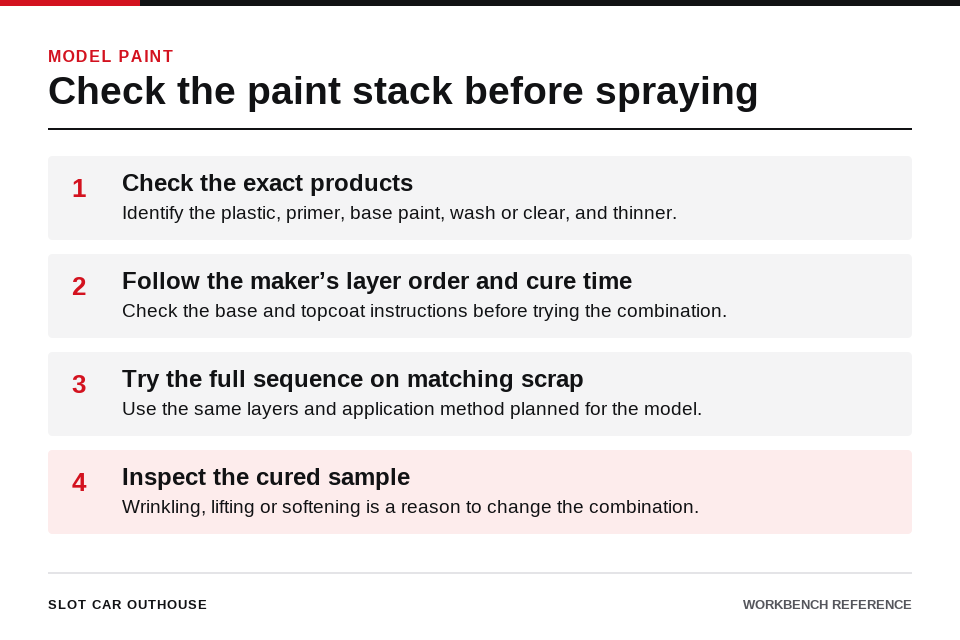
Start with the exact products, including the primer, basecoat, clear, wash, and thinner. Check the instructions for both coats and let the base cure for the specified time. For example, Tamiya’s coating guide advises against applying its lacquer over its acrylic or enamel paint.
For a panel wash, a compatible gloss coat can help the wash flow into recessed lines and make cleanup easier. Try the entire sequence on a piece of matching scrap, including the same thinner and cleanup method. Change the combination if the sample wrinkles, lifts, or softens. Bare plastic and stressed snap-fit joints deserve particular care when using solvent-based washes.
Ventilation and respirators for lacquers
Water-based acrylics let you paint comfortably with a wet palette in any living room (though airbrushing still produces fine respirable mist that calls for a particulate mask or booth). Lacquers and enamels release volatile organic compounds (VOCs) that standard N95 dust masks do not filter. If you airbrush Mr. Color, Tamiya LP, or MRP, invest in two non-negotiables: a tabletop spray booth vented outdoors through a window hose and a half-face respirator fitted with NIOSH-approved Organic Vapor + P100 cartridges (such as 3M 6001/2091 or 60921 combos).
The best model paint brands compared
Vallejo (Model Color, Model Air & Mecha Color)
Spanish manufacturer Acrylicos Vallejo is the universal workhorse of water-based modeling. Packed in spill-proof 17 ml / 18 ml dropper bottles that dispense exact drop ratios onto a wet palette without drying out, Vallejo splits into three key lines:
- Model Color: Thick, high-pigment matte acrylic formulated specifically for hand-brushing military kits, figures, and cockpit details. Thins cleanly with water or Vallejo thinner.
- Model Air: Pre-thinned with finer pigment grind for direct airbrushing at low PSI (a drop of flow improver still prevents tip-dry).
- Mecha Color: Formulated with a slightly tougher polyurethane-acrylic resin to resist handling wear on poseable Gunpla and robot kits.
Tamiya (Acrylic X/XF & LP Lacquers)
Every scale modeler knows Tamiya's iconic glass screw-top jars—and almost every beginner learns one surprise the hard way: Tamiya X (gloss) and XF (flat) acrylics are alcohol-solvent based, not pure water-based. Push Tamiya X/XF through an airbrush thinned 1:1 with Tamiya X-20A or Mr. Leveling Thinner, and it sprays like silk with almost zero clogging. Try hand-brushing a large wing without adding Tamiya Paint Retarder, however, and the alcohol in your second brush pass instantly softens the first coat and drags up rough ridges. For even faster drying, finer metallic flakes, and tougher adhesion, Tamiya's LP (Lacquer Paint) glass-jar line delivers full lacquer performance in classic Tamiya military and automotive shades.
Mr. Hobby / GSI Creos (Mr. Color & Aqueous)
Ask experienced Gunpla, aircraft, and car airbrushers for their single favorite paint system, and GSI Creos Mr. Color tops the list almost every time. These pure hobby lacquers spray razor-smooth, bite firmly into plastic, dry in minutes, and boast an unmatched Japanese catalog of Gundam-matched shades, authentic aircraft greens, and silky metallic finishes. Pair them with Mr. Leveling Thinner—a lacquer thinner blended with built-in retarder that keeps paint wet for just a few extra seconds on the surface so orange peel melts away into a glassy sheet. Prefer less odor? Mr. Hobby Aqueous (H-series) offers a milder alcohol-acrylic cousin that sprays nearly as cleanly.
Citadel / Games Workshop
Designed primarily for tabletop miniatures (Warhammer 40K, Age of Sigmar), Citadel makes getting vibrant tabletop results intuitive through its structured system: opaque Base paints, semi-translucent Layer paints, liquid Shades (like Nuln Oil and Agrax Earthshade) that pool naturally in recesses, and Contrast paints—one-coat translucent glazes that simultaneously basecoat, shade, and highlight over a light primer. The paint quality is genuinely strong; the universal complaint is Citadel's flip-top paint pots, which allow dried paint crust to build around the rim and spill easily if bumped. Many serious painters decant their favorite Citadel colors into empty dropper bottles.
AK Interactive (3rd Gen Acrylics, Real Colors & Enamel Weathering)
AK Interactive covers virtually every modeling discipline under one roof. Its 3rd Gen Acrylics rival Vallejo and Pro Acryl for smooth, opaque hand-brushing and reliable airbrushing, with an enormous palette of historical military shades. Its Real Colors lacquer line caters to armor and aircraft airbrushers wanting tight historical color accuracy, while its enamel washes, streaking grime, and pigment sets remain a cornerstone for realistic rust, mud, and oil effects.
Monument Hobbies Pro Acryl
A runaway favorite among miniature painters and figure builders, Pro Acryl packs extraordinarily dense, ultra-matte pigment into large 22 ml twist-cap dropper bottles (complete with a glass agitator ball inside). Even notoriously transparent hues like yellow, white, and bright red cover cleanly in one to two thin brush coats without chalky buildup. Because it already has a creamy, ready-to-brush flow, it requires minimal thinning on a wet palette and airbrushes surprisingly well with a touch of flow improver.
The Army Painter (Warpaints Fanatic & Speedpaint 2.0)
After an early reputation for inconsistent separation, Army Painter completely reformulated its lineup with Warpaints Fanatic—a thick, high-opacity water acrylic organized into intuitive Flexible Color Triads (six matched steps from deep shadow to bright highlight) that take the guesswork out of shading miniatures. Meanwhile, Speedpaint 2.0 competes directly with Citadel Contrast at a lower price per milliliter, delivering fast one-coat shading in dropper bottles without the reactivation quirk of the original v1 release.
MRP (Mr. Paint)
Made in Slovakia, MRP is a purist's airbrush dream: ultra-fine, pre-thinned pure lacquer packaged in 30 ml glass bottles ready to pour straight into your airbrush cup without measuring a single drop of thinner. Because its pigment grind is extraordinarily fine, you can build razor-thin translucent coats for realistic aircraft mottling, subtle panel fading, and metallic aircraft skins. It is strictly an airbrush paint—never attempt to hand-brush it—and demands proper lacquer ventilation.
Practical buying rules: building a smart starter rack
Avoid buying a giant 80-bottle mega-set on day one—half those shades will sit untouched for three years. Build your rack around how you actually paint, and check our hobby paints and finishes category alongside our best airbrush brands guide when matching tools to chemistry:
- Hand-brushing miniatures, figures, or cockpit details? Start with 10–15 core dropper bottles of Vallejo Model Color, Monument Pro Acryl, or AK 3rd Gen, plus a cheap homemade or store-bought wet palette so paint stays workable for hours.
- Airbrushing indoors with light ventilation (no outdoor vent hose)? Stick to Vallejo Model Air / Mecha Color or Tamiya X/XF thinned with X-20A, always over a solid primer coat, and wear a particulate mask.
- Airbrushing Gunpla, aircraft, or car bodies with a vented spray booth? Jump straight into Mr. Color or Tamiya LP paired with Mr. Leveling Thinner—you will spend zero time fighting tip-dry and achieve smoother coats immediately.
- Always prime first: Bare smooth polystyrene resists water-based acrylics. A thin coat of hobby primer (like Mr. Surfacer 1200/1500, Tamiya Fine Surface Primer, or Vallejo Surface Primer) locks paint down and reveals seam lines before color goes on—see our model glues and putty category if those seams need filling first.
- Buy matching brand thinners initially: Water works for brushing pure acrylics, but dedicated thinners contain flow enhancers and surfactants that make airbrushing dramatically smoother than tap water.
Sources
- Tamiya — Plastic modeling guide and paint compatibility
- Acrylicos Vallejo — Model Color, Model Air & Mecha Color Guides
- Tamiya USA — Acrylic (X/XF) & Lacquer (LP) Paint Reference
- GSI Creos / Mr. Hobby — Mr. Color & Aqueous Paint Technical Information
- Monument Hobbies — Pro Acryl Paint System Guides
- OSHA — Respiratory Protection & Organic Vapor Cartridge Guidance
Frequently Asked Questions
Vallejo Model Color, Monument Hobbies Pro Acryl, and AK Interactive 3rd Gen are the easiest paints for hand-brushing beginners. They come in clean dropper bottles, thin easily with plain water, have virtually no fumes, and self-level smoothly on a wet palette without tearing up prior coats.
You can for small details, though large flat surfaces are tricky because Tamiya X/XF uses an alcohol solvent that reactivates dried paint underneath. If you hand-brush Tamiya, mix in 10–20% Tamiya Paint Retarder (Acrylic), lay down thin strokes without repeatedly brushing over the same spot, and let each coat dry fully before adding another.
For airbrushing Gunpla, GSI Creos Mr. Color lacquers (thinned with Mr. Leveling Thinner) are the gold standard thanks to tough scratch resistance on articulated parts and official Gundam color sets. If you prefer low-odor water-based paints for brush or indoor airbrush work, Vallejo Mecha Color offers tougher abrasion resistance than standard hobby acrylics.
Check the instructions for the exact acrylic and clear coat. Tamiya, for example, advises against using its lacquer as a topcoat over its acrylic paint. If the combination is uncertain, use a clear coat the maker lists as compatible.
Aim for the consistency of skim milk—when you swirl thinned paint gently up the side of a mixing cup, it should slide back down cleanly while leaving a translucent colored film, not thick opaque streaks and not watery beads. Most hobby acrylics and lacquers land between a 1:1 and 1:1.5 (paint-to-thinner) starting ratio depending on pigment density and air pressure.