Best RC Crawler Brands of 2026
RC rock crawling flips standard RC priorities upside down. Instead of chasing 60 mph straight-line speed or 20-foot skatepark jumps, crawling is about reading a steep slab of granite, easing the throttle by a millimeter, and watching four soft rubber tires claw upward without slipping or rolling backward. Because speeds stay near a brisk walk, crawlers break far less often than bashers—and a single battery pack often delivers 45 to 90 minutes of trail time.
The market inside RC trucks and crawlers divides cleanly across three niches: 1:10 trail and scale crawlers for hiking paths and rock gardens, 1:10 competition (comp) crawlers engineered purely to clear vertical gates, and 1:18/1:24 micro crawlers for indoor courses and backyard rock beds. Axial and Traxxas anchor mainstream support, Vanquish Products and Element RC appeal to enthusiasts obsessed with drivetrains and geometry, FMS and RC4WD chase true-to-life scale looks, and Redcat delivers remarkable climbing capability per dollar.
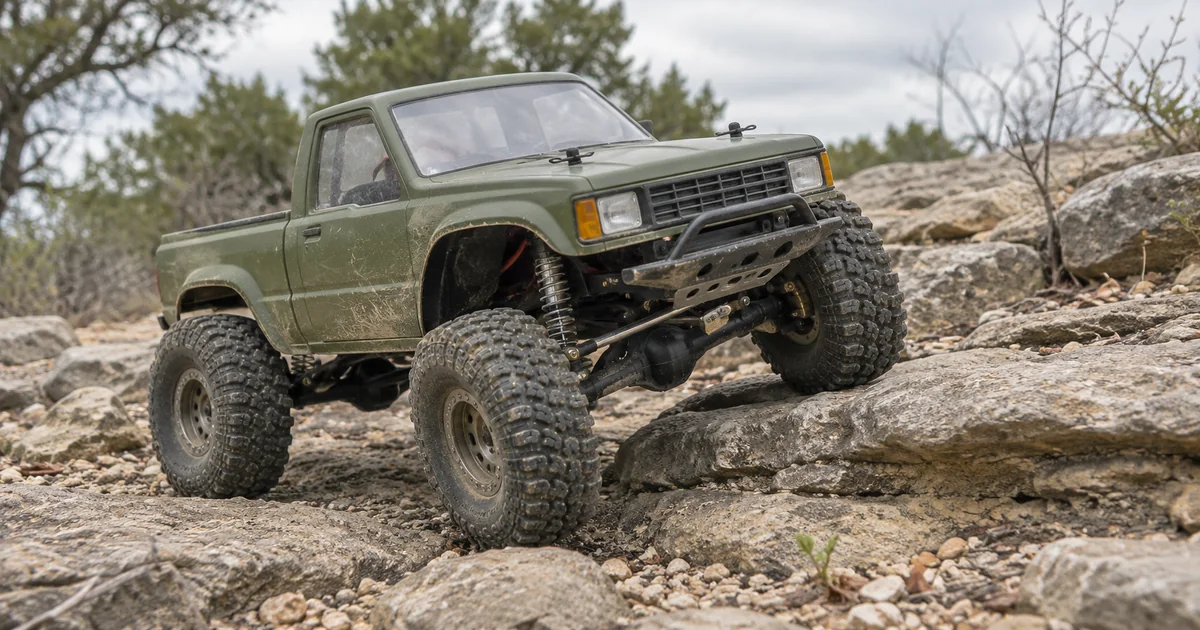
Quick comparison of the best RC crawler brands
| Brand | Signature Models | Core Scales | Axle Style | Aftermarket Depth | Best Fit For |
|---|---|---|---|---|---|
| Axial | SCX10 III, SCX10 Pro, Capra, SCX24 | 1:10, 1:24 | Portal & Straight | Deepest in crawling | Builders, upgraders, and trail drivers wanting limitless parts |
| Traxxas | TRX-4, TRX-4 Sport, TRX-4M | 1:10, 1:18 | Portal (1:10), Straight (1:18) | Huge (local + online) | Trail hikers wanting features (locking diffs, 2-speed) & local support |
| Vanquish Products | VS4-10 Phoenix, Fordyce, VRD Carbon | 1:10 | Portal & Straight | Strong (premium hop-ups) | Enthusiasts wanting tight tolerances, machined quality, and comp capability |
| Element RC | Enduro Ecto, Sendero, Knightrunner, Bushido | 1:10 | Straight (Stealth X) | Strong | Value-focused trail & comp drivers who want great stock geometry |
| FMS | FCX24, FCX18, FCX10 | 1:24, 1:18, 1:10 | Portal | Growing rapidly | Scale-realism fans wanting licensed hardbodies & working lights out of the box |
| Redcat Racing | Ascent, Ascent Fusion, Ascent-18 | 1:10, 1:18 | Portal | Good (growing) | Budget-conscious drivers wanting modern comp-inspired climbing |
| RC4WD | Trail Finder 2 (TF2), Gelande II | 1:10, 1:18 | Straight (often leaf-spring) | Specialty scale | Scale purists replicating real vintage 4x4s down to metal frames |
Portal axles, scale looks and comp rigs
Every serious crawler decision comes down to one engineering triangle: ground clearance, center of gravity (CG), and scale realism. Pulling harder toward one corner inevitably compromises the others—and nowhere is that clearer than in axle choice and body design.
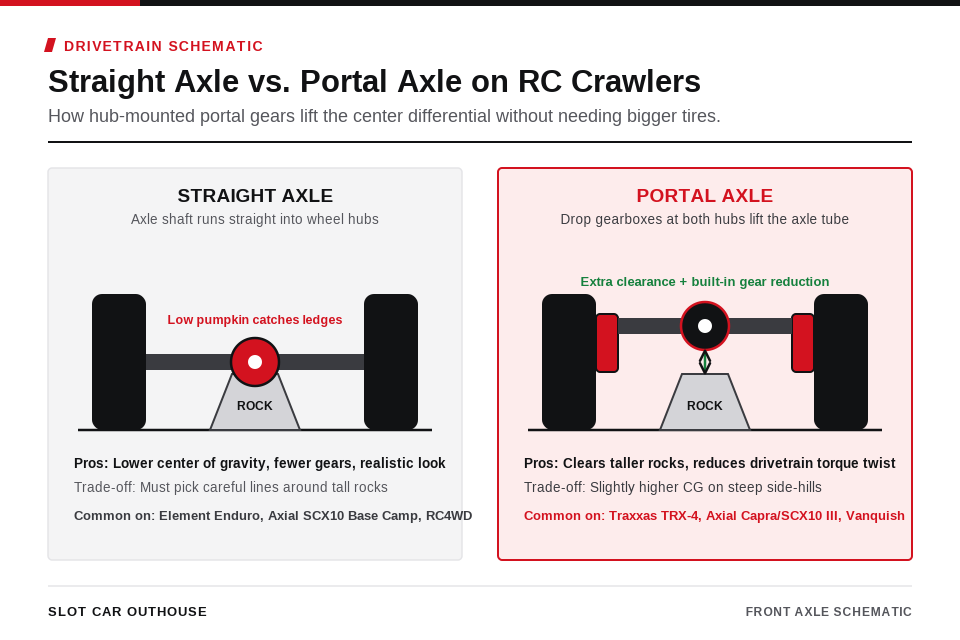
A straight axle puts the driveshaft and differential housing inline with the wheel hubs, just like a classic Jeep or Toyota pickup. That keeps the axle compact and low-slung, lowering the truck's center of gravity so it resists rolling sideways on steep off-camber slopes (side-hilling). A portal axle adds a small gear-reduction drop box right at each wheel hub, lifting the entire axle tube and central differential "pumpkin" higher off the ground. Because the gear reduction happens at the wheels, portals also reduce torque twist—the annoying habit of a crawler's body leaning heavily to one side whenever you squeeze the throttle. The tradeoff is extra rotating mass up high and a slightly raised CG, which is why portal rigs often add brass wheel weights down low to pull balance back toward the dirt.
Body and chassis design split the hobby into three camps:
- Scale trail rigs prioritize realistic bodies—hard ABS plastic trucks with opening hoods, full interiors, roof racks, and LED light kits. They look extraordinary on camera and feel rewarding on forest hikes, though heavy high-mounted bodies raise the CG and make vertical rock ledges harder to climb.
- Performance trail rigs use lightweight clear-painted polycarbonate bodies with pinched noses and dovetailed beds so the tires contact rock before the bumper does.
- Competition (comp) rigs strip away anything that does not help clear a rock gate: carbon-fiber or low-CG angled chassis rails, forward-mounted motors, overdrive (gearing the front axle to spin slightly faster than the rear so the front tires actively pull the truck over ledges and tighten turning radius), and dig (a mechanism that locks the rear wheels while the front tires pivot the truck sharply around tight turns).
Brand-by-brand breakdown
Axial: the platform that defined modern crawling
Owned by Horizon Hobby, Axial effectively wrote the blueprint for the modern 1:10 scale crawler with the original SCX10, and today's SCX10 III family remains one of the safest recommendations in RC. Axial builds across the entire crawling spectrum: the SCX10 III Base Camp (a clean, lightweight, affordable portal trail rig), full-featured scale Jeep/Bronco editions with dig transmissions, the Capra (a tube-cage unlimited trail buggy with wide portal axles built for brutal boulders), and the SCX10 Pro (a dedicated straight-axle competition kit).
At micro scale, the 1:24 Axial SCX24 spawned an entire cottage industry of aftermarket brass links, brushless outrunner motors, chassis kits, and miniature 3D-printed bodies. Stock SCX24 electronics and worm-gear axles are modest compared to newer rivals, yet no other micro crawler matches its sheer depth of bolt-on customization.
Traxxas: engineering polish and trail-ready features
The Traxxas TRX-4 reshaped 1:10 crawling by packing real full-size off-road hardware into a durable, waterproof RTR package. Full-featured TRX-4 models (Defender, Bronco, Blazer, K5) include portal axles, a 2-speed transmission (low gear for crawling torque, high gear for brisk trail pace between obstacles), and T-Lock remotely lockable differentials. Being able to unlock the differentials from the transmitter turns a stiff-turning crawler into a nimble trail truck that doesn't scrub tires on pavement—then lock front and rear with a flick of a switch when the trail turns vertical.
If you want fewer servos and lighter weight for pure climbing performance, the TRX-4 Sport strips away the shifting and locking mechanisms into a locked-diff, single-speed rig that climbs noticeably better out of the box and costs less. At 1:18 scale, the TRX-4M combines oil-filled shocks, crisp clipless ABS hardbodies, and strong local hobby-shop parts support into one of the most polished small crawlers available.
Vanquish Products: machined precision for discerning builders
For years, Vanquish Products made the high-end CNC-machined aluminum axles and wheels that hardcore Axial builders upgraded to. When Vanquish launched its own chassis—the VS4-10 line (Phoenix, Fordyce, Origin) and the competition-focused VRD Carbon and VRD Stance—it brought that same tight-tolerance engineering to full kits and select RTRs.
Vanquish's VFD Twin transmission is a standout piece of mechanical design: it places the motor low and far forward for climbing balance while giving you selectable overdrive ratios and a mechanical dig function in one compact unit. Vanquish rigs cost more upfront than entry-level RTRs, yet the plastic molding quality, gear mesh precision, and thoughtful assembly experience rival high-end race kits.
Element RC: the stealth-gearbox value champion
Created by Team Associated's engineering team, Element RC entered crawling with a clear mission: nail suspension geometry and drivetrain design first, without gimmicks. Its Enduro platform (found in the Sendero, Ecto, Knightrunner, and Gatekeeper) centers on the Stealth X gearbox, which lets you adjust front-to-rear overdrive right inside the stock transmission using included gears—no expensive aftermarket axle ring-and-pinion swaps required.
Because Element sticks primarily to clean straight axles (with portal conversions available), behind-the-axle (BTA) steering that tucks the tie rod safely out of rock strikes, and lightweight bodies on trucks like the Ecto, Element rigs frequently out-climb heavier, pricier trucks straight from the box.
FMS: hardbody scale realism at mainstream prices
FMS shook up the micro and scale markets by pairing licensed, injection-molded hardbodies (Land Rover, Toyota LC80, Chevy K5, Power Wagon) with genuinely capable chassis rather than display-only toys. Its 1:24 FCX24 and 1:18 FCX18 rigs arrive with portal axles, two-speed transmissions, oil-filled shocks, metal gears, and full working LED light systems for roughly the same price other brands charge for bare-bones Lexan micros. FMS has also expanded into 1:10 scale with the FCX10, bringing multi-feature trail rigs into direct competition with Traxxas and Axial. Aftermarket breadth still trails Axial and Traxxas slightly, though third-party brass and suspension support has grown fast.
Redcat Racing: budget comp geometry that punches up
Redcat used to be seen strictly as an inexpensive trail alternative (Gen7/Gen8), but its Ascent family changed the conversation. The 1:10 Redcat Ascent and brushless Ascent Fusion ship with flat-rail LCG (low-center-of-gravity) frames, portal axles, underdrive rear gearing, and pinched bodies—delivering competition-inspired rock performance for hundreds less than building a custom comp rig. Likewise, the 1:18 Ascent-18 became an instant standout in micro crawling by prioritizing low-slung climbing geometry, ball bearings, and metal portal gears out of the box at around $120.
RC4WD: ultra-scale nostalgia and metal realism
If your dream crawler is a weathered 1985 Toyota pickup bouncing over mud ruts on authentic leaf springs rather than modern coil-over links, RC4WD is the specialist brand. Platforms like the Trail Finder 2 (TF2) and Gelande II use CNC-machined billet ladder frames, scale cast metal axles, realistic hardbodies, and licensed off-road tires (BFGoodrich, Goodyear, Mickey Thompson). They do not climb extreme vertical ledges as effortlessly as a Vanquish VRD or Axial SCX10 Pro—and they reward builders who enjoy thread-locking metal fasteners and dialing in scale suspension—but nothing looks more convincing in slow-motion trail video.
1:10 scale vs. 1:18 / 1:24 micro crawlers
Choosing your scale affects how often you actually drive:
- 1:10 scale (~18–22 inches long): The core of the hobby. Big enough to conquer real river rocks, exposed tree roots, creek crossings, and hiking trails alongside friends. Parts are easy to wrench on with standard hex drivers, and electronics options (like ultra-smooth FOC brushless systems, which use Field-Oriented Control to maintain steady slow-crawl RPM up or down hills without surging) shine brightest here.
- 1:18 and 1:24 micro scale (~8–11 inches long): Affordable ($110–$200), backpack-friendly, and playable anywhere—a pile of firewood, backyard landscaping stones, or an indoor cardboard-and-foam obstacle course on rainy evenings. Micro screws are tiny (buy a quality 0.050" / 1.3 mm driver), and outdoor grass stops them cold, yet many seasoned 1:10 owners end up driving their micros more days per week simply because zero travel is required.
How to choose your crawler brand
- Best all-around first 1:10 trail crawler with local parts: Traxxas TRX-4 Sport (for simpler, better climbing) or standard TRX-4 (for 2-speed + locking-diff fun).
- Best 1:10 platform for endless upgrades and modding: Axial SCX10 III Base Camp or SCX10 III scale editions.
- Best pure rock-climbing value out of the box: Redcat Ascent Fusion (brushless comp-ready RTR) or Element RC Enduro Ecto.
- Best premium kit build experience: Vanquish Products VS4-10 Phoenix or VRD Carbon.
- Best 1:18 / 1:24 micro crawler: Redcat Ascent-18 for pure climbing capability, Traxxas TRX-4M for parts support and scale polish, FMS FCX18/FCX24 for hardbody detail + 2-speed gears, or Axial SCX24 for maximum custom aftermarket parts.
- Best ultra-scale realism: RC4WD Trail Finder 2 (if you love wrenching and leaf springs) or FMS FCX10.
Unlike high-speed bashers in our best RC truck brands guide, crawlers draw relatively gentle current—meaning smaller, lightweight 2S or 3S packs keep your center of gravity low while still running for an hour (see our best LiPo battery brands guide for compact shorty packs).
Sources
Frequently Asked Questions
Not to get started. A good brushed crawler motor (paired with a quality crawler ESC like a Hobbywing QuicRun 1080) already delivers smooth low-speed modulation for a fraction of the cost. However, modern sensored brushless FOC systems (like the Hobbywing Fusion) are a huge upgrade once you get hooked: they offer whisper-quiet operation, insane ultra-slow crawl precision, and automatic speed matching so the truck crawls down steep ledges at the exact speed you command.
Drag brake is an ESC setting that automatically locks or resists motor rotation the instant you release the throttle trigger to neutral. On a steep rock face, strong drag brake holds the crawler parked on a 50-degree slope instead of letting gravity roll it backward down the hill—letting you pause, plan your next steering input, and feather the throttle cleanly.
No. Portal axles excel on jagged, uneven trails where rocks constantly snag low differentials. Straight axles lower the truck's center of gravity and eliminate portal gear backlash, making them prized on steep, smooth granite slabs and side-hill off-camber obstacles where rolling over is the main threat.
Tires and low unsprung weight. Soft-compound aftermarket tires (from Pro-Line, JConcepts, or Pit Bull) paired with tuned foams transform grip more than any motor swap. Next, adding modest brass weight to the front steering knuckles or portal covers shifts weight forward and down (aiming near a 60/40 front-to-rear weight bias), keeping the front tires planted on steep climbs.
Most modern RTR crawlers from Traxxas, Axial, Element, and Redcat ship with water-resistant or waterproof electronics that handle shallow creek crossings cleanly. Water still attacks steel ball bearings, axle hardware, and open tire foams over time—so blow out excess moisture, dry the rig thoroughly, and re-lubricate exposed bearings after wet trail runs.