Best RC Car Brands of 2026
The best RC car brand is rarely the one advertising the highest box-art top speed. In hobby-grade radio control, the real dividing line is whether a manufacturer designs repairable drivetrains, keeps spare parts on hobby-shop pegs for years, and builds chassis around the surface you actually drive on. A 60 mph street missile turns into an expensive shelf ornament the moment a single shattered suspension arm takes three weeks to ship from overseas.
For most buyers, the shortlist breaks cleanly along driving style. Traxxas and Arrma anchor ready-to-run backyard bashing, Tamiya owns approachable build-it-yourself scale kits, Team Associated, Losi (and TLR), Kyosho, and Tekno lead club racing and heavy-duty kits, and value brands like Redcat, MJX, and WLtoys fill the sub-$200 starter tier. Understanding how those ecosystems differ saves far more money than chasing a marginal discount on day one.
Hobby-grade vs. toy-grade: the parts-support test
Before comparing badges, draw a hard line between toy-grade cars sold in big-box aisles and true hobby-grade platforms. Toy-grade cars usually combine the receiver, steering actuator, and speed control onto one disposable circuit board, use non-proportional steering that snaps only full left or full right, and offer zero replacement gears or suspension arms. When a front knuckle snaps against a curb, the whole car goes in the trash.
Hobby-grade RC cars work like scaled-down real vehicles. Every piece—control arms, spur gears, bearings, shock shafts, and electronics—unbolts with a hex driver and has a printed part number in an exploded-view manual. Steering and throttle are fully proportional, meaning a light squeeze of the trigger lets the car creep across a driveway at walking pace instead of lurching forward.
Before spending money on any brand, run the parts-support test: look up a front suspension arm and a spur gear for the exact model you want at two major U.S. online hobby shops or your closest brick-and-mortar shop. If those wear items are in stock and clearly cataloged, you are buying into a real ecosystem. If you can only find parts under cryptic third-party listings with multi-week shipping, treat the car as semi-disposable regardless of how good its spec sheet looks.
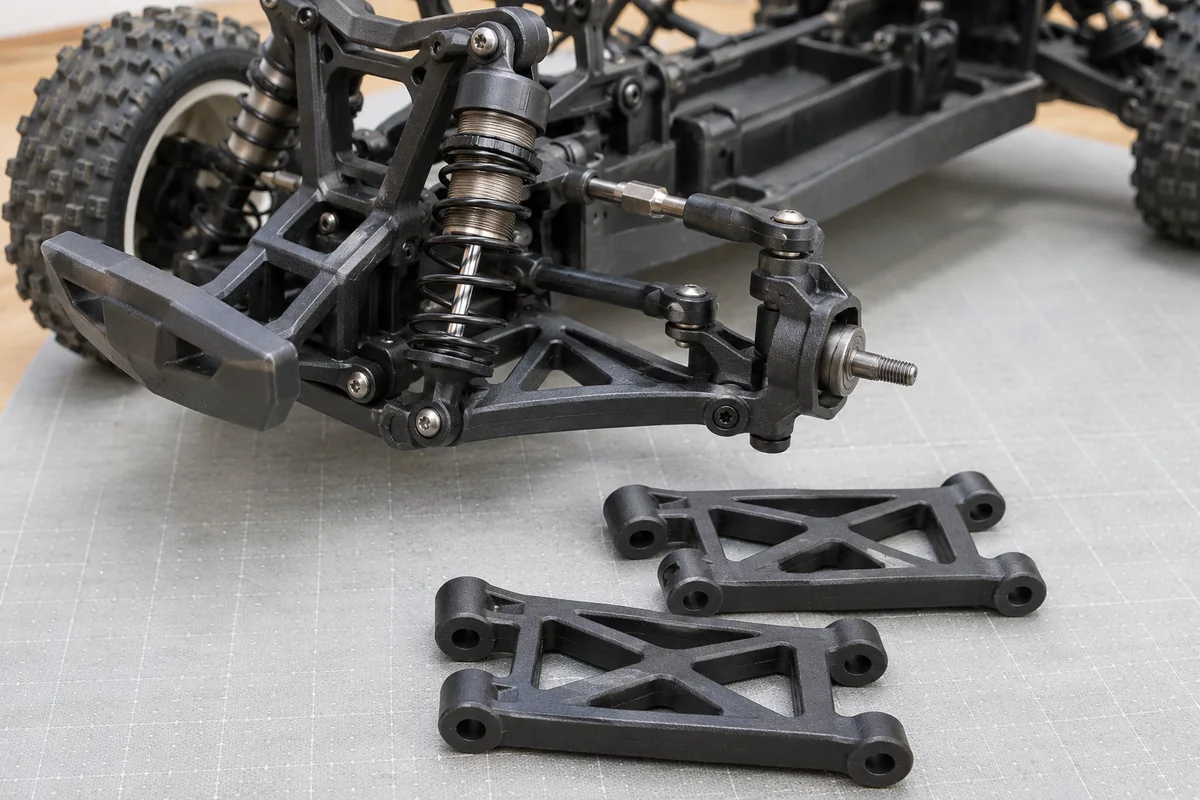
Quick comparison of the major RC car brands
| Brand | Core Specialty | Typical Format | Parts Availability (US) | Battery / Connector Ecosystem | Best Fit For |
|---|---|---|---|---|---|
| Traxxas | All-around bashing, street, short-course, crawlers | Mostly RTR | Industry-best (local + online) | Proprietary TRX-ID (adapters work) | First-time hobbyists who want walk-in parts support |
| Arrma | High-power 3S–8S bashing, street speed runs | Mostly RTR | Excellent (Horizon Hobby network) | Spektrum IC3/IC5 (EC3/EC5 compatible) | Drivers prioritizing brushless toughness per dollar |
| Tamiya | Scale on-road, classic 2WD buggies, rally | Unassembled Kits | Very strong (long-lived chassis) | Standard Tamiya plug (often upgraded) | Builders, nostalgia fans, casual club classes |
| Team Associated | 1:10 & 1:8 track racing, RTR bashers | Race Kits + RTR | Strong at tracks & online | Open (you pick ESC/plug on kits) | Carpet/clay racers and structured club driving |
| Losi / TLR | Scale desert trucks, race buggies, micro/mini | RTR (Losi) + Kits (TLR) | Strong (Horizon Hobby network) | Spektrum IC2/IC3/IC5 or open | Racers and scale-chassis enthusiasts |
| Kyosho | 1:28 Mini-Z indoor racing, 1:8 nitro/electric buggies | RTR + Race Kits | Good online, strong in Mini-Z shops | AAA (Mini-Z) / open (1:8 & 1:10) | Living-room racers and precision 1:8 competitors |
| Tekno RC | Tank-tough race buggies, truggies, basher kits | Unassembled Kits | Strong online & race shops | Open (kit only) | Builders wanting maximum mechanical durability |
| Redcat Racing | Budget bashers, lowriders, value crawlers | Mostly RTR | Good online, growing local | Deans / XT60 / Hexfly | Value-conscious buyers wanting U.S. support |
| MJX / WLtoys | Ultra-budget fast mini bashers (1:14–1:16) | RTR | Online only (slower shipping) | Deans / XT60 / proprietary packs | Tight budgets and secondary parking-lot beaters |
Brand-by-brand breakdown
Traxxas: the local hobby-shop benchmark
Traxxas built the modern ready-to-run (RTR) market, and its biggest advantage is still logistics rather than any single patent. Walk into almost any independent hobby shop in North America and an entire wall is stocked with Traxxas suspension arms, shock caps, body clips, and pinions. Platforms like the Slash, Rustler, Bandit, and 4-Tec have remained mechanically recognizable for years, which also means a massive aftermarket from RPM, Pro-Line, and Hot Racing.
The trade-off is Traxxas's closed-garden electronics ecosystem. Its proprietary TRX-ID connectors combine the main power leads and balance leads into one plug—genuinely convenient for families using Traxxas chargers, because the charger automatically detects the battery chemistry and cell count. However, it locks you into higher-priced branded packs unless you use adapters or solder on standard connectors later. You also sometimes pay a slight brand premium compared to an equivalent Arrma brushless rig, especially once you factor in upgrades like steel driveshafts on 3S power.
Arrma: brushless bashing value and modular toughness
Owned by Horizon Hobby, Arrma earned its reputation by engineering cars from the ground up for brushless LiPo abuse instead of adapting older brushed designs. An ESC (electronic speed controller—the digital throttle brain that meters battery power to the motor) paired with a high-torque brushless motor (an efficient, low-maintenance motor rated in kV, meaning revolutions per minute per volt applied) puts enormous shock loads through gears and drivetrains. Arrma addresses that with oversized drivelines, sturdy composite chassis tubs on its 3S BLX line (Typhon, Vorteks, Granite), and thick anodized aluminum chassis plates on its 6S EXB and street-bashing models (Infraction, Felony, Limitless).
Arrma's modular slide-out motor mounts and accessible center differentials (a gear unit that splits torque front-to-rear and absorbs landing shock, unlike a rigid solid shaft) make routine maintenance noticeably faster than tearing down older designs. Connectors are Horizon's Spektrum IC3 and IC5 plugs, which stay backward-compatible with universal EC3/EC5 plugs—a friendlier middle ground than a fully proprietary plug.
Tamiya: the gold standard for kit builders and scale charm
If half the appeal of RC is opening bags of hardware on a kitchen table, fitting ball bearings, painting a clear polycarbonate body from the inside, and understanding how every differential works, Tamiya sits in a category of one. Chassis like the TT-02 (an entry-level 4WD on-road/rally platform) and classic 2WD buggies such as the Grasshopper, Hornet, and DT-03 cost far less than modern racing kits and come with arguably the clearest step-by-step manuals in the hobby.
Keep expectations realistic about raw bashing speed. Most entry Tamiya kits ship with plastic bushings instead of metal ball bearings, friction dampers instead of oil-filled shocks, and modest brushed motors. Adding a $15 sealed bearing kit during initial assembly is mandatory, and Tamiya cars belong on smooth asphalt, rally gravel, or friendly club tracks—not launched 25 feet off skatepark ramps.
Team Associated and Losi (TLR): track-bred precision
When lap times on groomed clay, dirt, or high-grip indoor carpet matter, Team Associated and Team Losi Racing (TLR) are the names you see stacked on pit tables across the United States. Team Associated's RC10 lineage—evolving today into platforms like the B7 2WD buggy and B74 4WD buggy—and TLR's 22 and 8IGHT series prioritize low center of gravity, crisp weight transfer, and razor-sharp suspension tuning. Even their RTR offshoots (like Associated's Reflex 14B/14T or Losi's Mini-B, Micro-B, and scale desert platforms) inherit genuinely sorted handling rather than bouncy toy-like suspension.
Race kits are rolling chassis: they include no motor, ESC, servo, radio, battery, or paint. That sounds intimidating at first, yet it lets experienced drivers match electronics precisely to local track rules (such as 17.5T spec-class motors) without paying twice for throwaway RTR electronics.
Kyosho: Mini-Z indoor dominance and 1:8 championship pedigree
Kyosho is one of RC's oldest Japanese pioneers and shines at two opposite ends of the scale spectrum. At the tiny end, the 1:28 Kyosho Mini-Z line is the undisputed king of indoor racing and living-room tabletop driving. Mini-Z cars pair museum-grade hardbody scale shells with proportional hobby electronics and dedicated urethane race tracks at clubs worldwide. If you want small-scale sideways driving on hardwood floors, Kyosho's Mini-Z AWD also shows up frequently in our guide to the best RC drift car brands.
At the large end, Kyosho's Inferno 1:8 buggy platform holds more IFMAR World Championship titles than any other lineage in RC history. Kyosho parts are easy to source online and through specialty shops, though walk-in availability at small suburban hobby stores is typically narrower than Traxxas or Horizon brands.
Tekno RC: built like racing armor
Tekno RC does not chase mass-market impulse buyers. It sells high-grade unassembled kits—1:8 race buggies (EB48), truggies (ET48), 1:10 4WD racers (EB410), and legendary basher kits (MT410)—engineered with thick CNC-machined aluminum shock towers, oversized hinge pins, and beefy steel drivetrains. Think of Tekno like a purpose-built rally raid truck: slightly heavier than ultralight pure carpet racers, yet dramatically more resistant to bent shock shafts and stripped ring gears when a landing goes wrong.
Because Tekno kits require you to supply your own electronics, tires, and body, total upfront cost lands noticeably above an RTR. Over two or three seasons of hard driving, however, fewer broken parts and Tekno's generous 50% lifetime warranty replacement program narrow that cost gap significantly.
Redcat, MJX, and WLtoys: budget reality check
Budget brands have improved enormously over the last decade, especially in brushless power per dollar. Redcat Racing operates out of Arizona with U.S. parts warehousing, making models like the Valkyrie or its crawler lineup legitimate entry points rather than throwaway imports. Meanwhile, Chinese direct-to-consumer brands like MJX (Hyper Go) and WLtoys (such as the 144001 and 124017) pack metal gears and startling 3S brushless speed into compact 1:14–1:16 chassis for under $150.
The catch with MJX and WLtoys is consistency and logistics. Screws may arrive without thread-lock on metal-to-metal joints, radio latency can feel less crisp than Spektrum or Futaba gear, and replacement arms usually mean waiting on online warehouses rather than driving ten minutes to a hobby shop. They make fantastic low-risk entry cars or travel trunks—just buy a spare set of front arms and steering knuckles alongside the car.
RTR vs. kit: understanding the real cost
Beginners often compare a $350 RTR to a $350 kit and assume they cost the same. They do not. A kit's box price covers only the mechanical chassis; adding a quality brushless motor/ESC combo, metal-gear steering servo, transmitter/receiver, polycarbonate paint, tires, and a LiPo battery and charger routinely doubles the final bill.
- Choose RTR if you want to drive the same afternoon, prefer a warranty covering bundled electronics, or are buying a first car for yourself or a teenager. You can still upgrade individual weak points—like a stronger steering servo or aluminum shock caps—as they wear out.
- Choose a Kit if you enjoy mechanical assembly, plan to race at a local track where spec electronics are required, or already own a multi-model radio transmitter, tools, and chargers. Building a car bolt-by-bolt also makes every future repair faster because you already know how the drivetrain comes apart.
Drivetrain basics that separate brands
Two mechanical features quietly determine how long an RC car survives aggressive throttle:
- Slipper clutch vs. center differential: A slipper clutch uses friction pads squeezed against the main spur gear so the gear slips briefly on hard landings instead of shearing teeth off the transmission. It is simple, durable, and standard on 2WD cars and many 3S 4WD bashers. A center differential uses silicone fluid inside a sealed gear housing to bleed excess wheelspin smoothly between front and rear axles; thicker fluid makes wheelies easier, while thinner fluid improves cornering stability on rough tracks.
- 2WD vs. 4WD: A 2WD car has half the driveshafts, half the differentials, and simpler maintenance—making it a brilliant teacher of throttle control and a lower-cost starter. A 4WD car accelerates harder, tracks straighter across loose dirt and short grass, and forgives clumsy steering inputs, at the expense of slightly more wrenching when debris jams a front driveshaft.
Remember also that body style matters as much as brand. If your main playground is deep grass, BMX jumps, or rocky backyard trails rather than paved lots and dirt tracks, stepping up to taller tires in our best RC truck brands guide or exploring dedicated rock crawlers will deliver a better experience than forcing a low-slung buggy through thick turf.
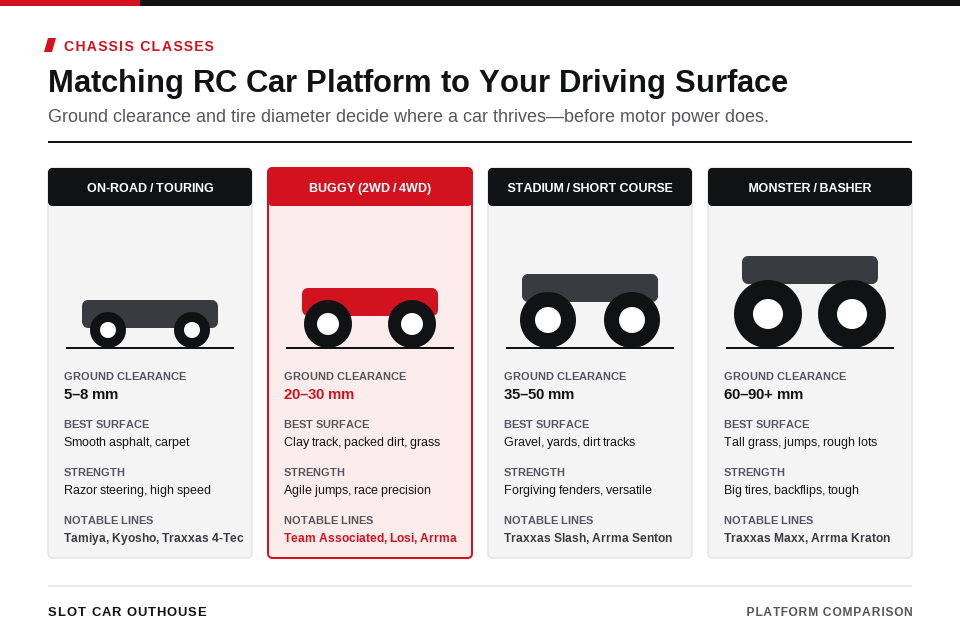
Which RC car brand fits your use case?
- Best first hobby-grade car for stress-free parts: Traxxas (Rustler 4X4, Slash, or 2WD BL-2s models) if a local hobby shop sits nearby and you want effortless replacements.
- Best high-speed bashing durability per dollar: Arrma (Typhon 3S BLX, Vorteks, or 6S EXB lineup) for stronger stock drivetrains and standard-friendly IC/EC plugs.
- Best father-and-kid or weekend build project: Tamiya (TT-02 on-road/rally or DT-03 buggy) paired with a sealed ball-bearing kit.
- Best indoor or apartment-friendly RC: Kyosho Mini-Z (1:28 scale) or Losi Micro-B (1:24 buggy) for genuine proportional handling in tight spaces.
- Best local dirt or carpet track racer: Team Associated or TLR—visit your local track first and buy whichever brand the fast locals and pit shop stock.
- Best "buy once, break less" custom kit: Tekno RC for drivers willing to wrench and spec their own electronics.
- Best under-$150 taste of brushless speed: MJX Hyper Go or Redcat—just order spare front suspension arms on day one.
And whatever brand you pick, invest early in quality hex drivers (not L-shaped Allen keys that strip soft screws) and reliable packs—our best LiPo battery brands guide breaks down safe charging, C-ratings, and connectors so you don't overpay for rebranded cells.
Sources
Frequently Asked Questions
For ready-to-run bashing straight out of the box, Arrma (especially its EXB-trimmed models) and Traxxas (especially its WideMaxx/Maxx and brushless 4X4 platforms) lead the pack in surviving awkward landings. Among unassembled kits, Tekno RC is widely regarded as the benchmark for mechanical toughness thanks to thick shock towers, oversized drivetrain hardware, and resilient plastics.
Traxxas is worth the premium if you value walk-in hobby-shop parts availability, simple plug-and-play battery charging via its TRX-ID ecosystem, and massive third-party upgrade support. If you shop mainly online, already own a hobby charger with universal connectors, and want maximum brushless speed and chassis strength per dollar, Arrma or Redcat often deliver stronger hardware value.
Choose 4WD if you plan to drive on loose dirt, gravel, or short backyard grass, because four driven wheels resist spinning out and pull cleanly over bumps. Choose 2WD if you want lower purchase cost, simpler mechanical repairs, and a car that teaches smooth throttle control on pavement or packed dirt.
Yes. You can either use a short, high-current connector adapter (such as XT60 or IC5 to TRX) for light-to-moderate 2S–3S use, or solder a universal connector directly onto the ESC. Note that modifying the factory ESC connector typically voids Traxxas's electronics warranty, and cheap loose adapters can add electrical resistance on high-amp 4S–6S setups.
Even most "Ready-to-Run" hobby cars exclude the main LiPo battery, a proper balance charger, and AA batteries for the transmitter. Beyond power, buy a set of machined metric hex drivers (1.5 mm, 2.0 mm, and 2.5 mm), blue medium-strength thread-locker for screws threading into metal, and a fire-resistant LiPo charging bag.