Best RC Drift Car Brands of 2026
Buying your first RC drift car is deceptively easy to get wrong, because two completely different styles of car are marketed under the same "RC drift" label. One is a dedicated rear-wheel-drive (RWD) chassis with extreme steering lock, rear-biased weight, and a steering gyro that holds graceful, full-scale tandem drifts on smooth club tracks. The other is a standard all-wheel-drive (AWD) touring car fitted with hard plastic tires that powerslides aggressively around driveways and parking lots.
Both are genuinely fun, yet they drive on opposite physics and almost never mix on the same track. Once you know which lane fits your floor and goals, the brand hierarchy becomes crystal clear: MST, Yokomo, and Reve D lead modern 1:10 RWD drifting, 3Racing covers budget RWD kits, Overdose anchors exotic CNC builds, and Kyosho and Tamiya own casual AWD sliding at micro and 1:10 scale.
Quick comparison of the best RC drift car brands
| Brand | Flagship / Entry Models | Drivetrain | Format | Tuning Difficulty | Best Fit For |
|---|---|---|---|---|---|
| MST (Max Speed Tech) | RMX 2.5, RRX 2.0, MRX GT | RWD | RTR & Kits | Beginner-friendly | Best ready-to-run entry into real 1:10 RWD drifting |
| Yokomo | RD2.0 (Rookie), SD2.0, MD2.0 | RWD | Kits (+ some RTR) | Moderate to deep | Long-term tuning ecosystem & universal track parts support |
| Reve D | RDX | RWD | Kit | Very beginner-friendly | Builders wanting pro-level geometry with zero guesswork |
| 3Racing | Sakura D5 MR / D5S / D6 | RWD | Budget Kit | Moderate (needs setup) | Tinkerers entering 1:10 RWD kits on the lowest chassis budget |
| Overdose | GALM (Ver.2 Anti+) | RWD | High-End Kit | Advanced | Enthusiasts chasing CNC artistry & exotic tuning freedom |
| Kyosho | Mini-Z AWD (MA-020) | AWD | RTR (1:28 micro) | Plug-and-play | Living-room hardwood, kitchen tile, and desktop drifting |
| Tamiya | TT-02D | AWD | Easy Kit (1:10) | Beginner-friendly | Casual driveway powersliding & classic JDM kit building |
RWD vs. AWD: the choice that changes everything
If you take one lesson from this guide, make it the mechanical gap between RWD and AWD drift cars—because almost every local RC drift track in North America, Japan, and Europe is RWD-only.
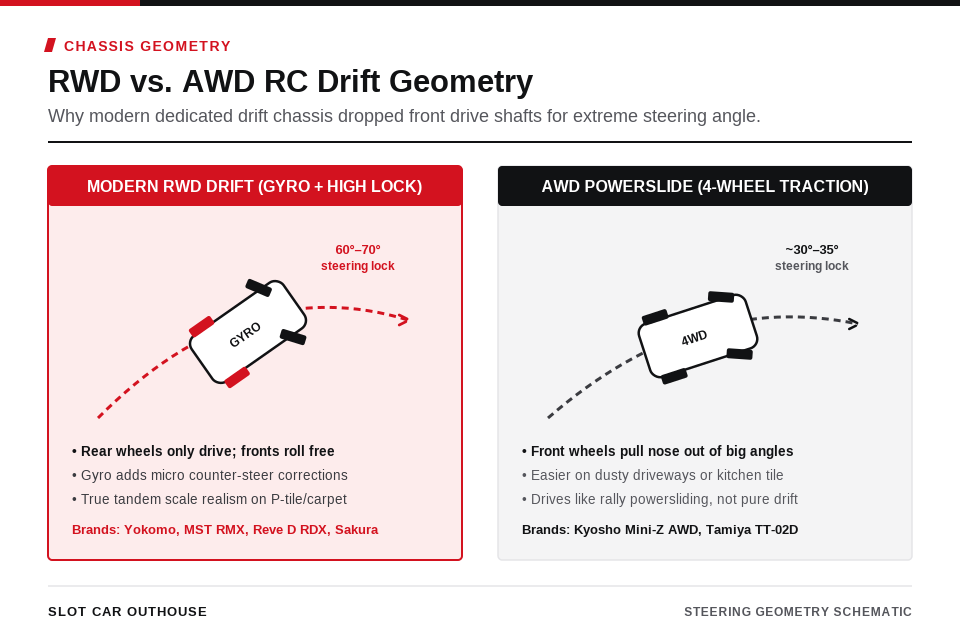
An AWD drift car drives all four wheels through hard plastic tires. You whip the car sideways, stay heavy on the throttle, and steer almost into the direction of the corner (or slightly straight) while the front wheels pull the nose around the apex. It feels intuitive within five minutes, works well on slightly gritty asphalt or living-room hardwood, and requires no steering gyro. However, AWD cars accelerate differently through corners than real drift cars, so they cannot safely run bumper-to-bumper tandems with RWD chassis—and their visual lines look more like rally powerslides than Formula Drift runs.
Modern RWD drift cars replicate real full-size drift physics:
- 60° to 70°+ of steering angle: Standard RC touring cars turn their front wheels about 30–35 degrees. An RWD drift chassis uses specialized wide-angle steering racks and slim lower arms so the front wheels crank nearly sideways without hitting the suspension—allowing deep drift angles without spinning out.
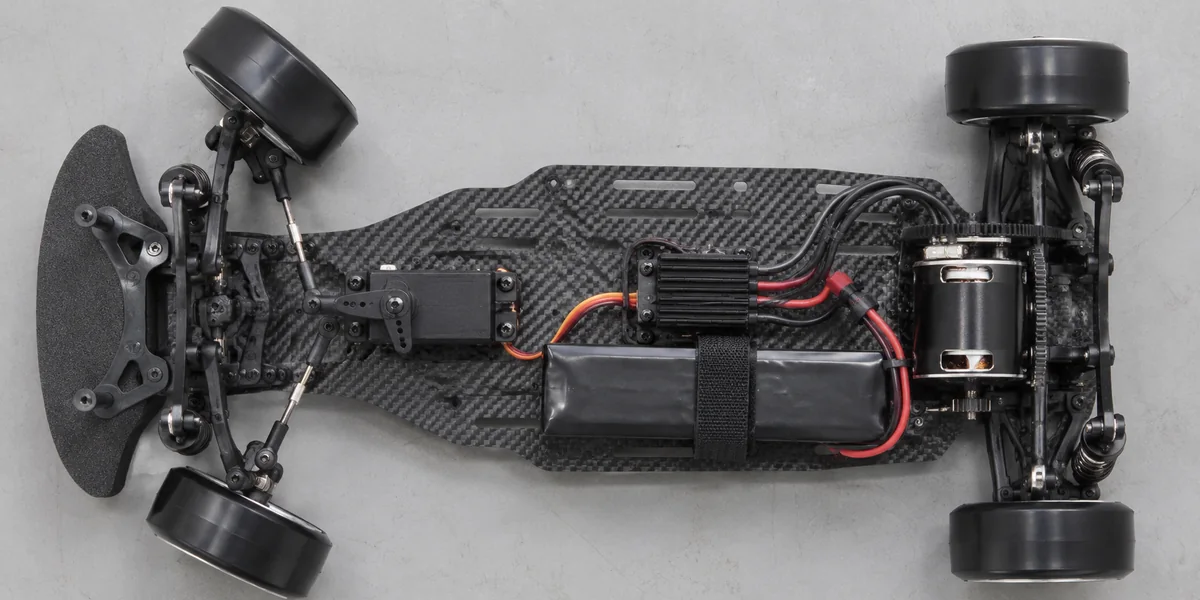
- Rear-biased weight distribution: Unlike racing buggies that chase balanced grip, RWD drift chassis place the motor and battery rearward (often 65–70% rear weight bias) so the light front end floats cleanly while the rear tires generate predictable forward bite.
- Gyro-assisted counter-steer: A drift gyro is a tiny solid-state sensor wired between your receiver and steering servo. Because a 1:10 car weighs under 4 pounds and snaps sideways ten times faster than a 3,000-pound Nissan Silvia, human thumbs cannot catch micro-slips cleanly on their own. The gyro senses the tail stepping out and automatically applies smooth counter-steer (turning the front wheels in the direction of the slide) while you modulate throttle and guide the car's line. It does not drive the car for you—poor throttle control still sends you straight into the wall—but it bridges the scale-physics gap so RWD drifting feels fluid and realistic.
The practical rule: If you plan to visit a local RC drift track, drive on polished garage concrete, or want authentic slow-motion counter-steer drifts, buy RWD from day one. If you only want to slide around a bumpy asphalt driveway or your living room floor without buying a gyro and specialty track tires, AWD is the right tool.
Brand-by-brand breakdown
MST (Max Speed Technology): the gold-standard RWD starter
For years, getting into 1:10 RWD drifting meant building a kit and sourcing seven separate electronic components—until MST nailed the ready-to-run formula with the RMX 2.0 and today's upgraded RMX 2.5 RTR. The RMX 2.5 arrives pre-assembled with a brushless motor/ESC (on brushless editions), a decent starter gyro, a painted licensed body, and sorted RWD suspension geometry straight out of the box.
Equally important, the RMX 2.5 is not a dead-end toy: it shares its mechanical backbone with MST's upgradeable kits, meaning you can swap in a faster digital steering servo, a higher-grade gyro (like a Yokomo V4 or Reve D Revox), and adjustable turnbuckles over time without throwing away the chassis. If you want to drive an authentic RWD drift car this weekend without assembling 400 tiny screws first, MST is the default recommendation.
Yokomo: the ecosystem benchmark (YD-2 legacy to RD2.0 & SD2.0)
Yokomo defined modern 1:10 RWD drifting with the legendary YD-2, a platform so dominant that most drift tracks stock Yokomo arms, spur gears, and knuckles as their baseline inventory. Yokomo recently streamlined that lineage into a clean three-tier ladder:
- RD2.0 (Rookie Drift): Composite-chassis successor to the YD-2Z, delivering modern steering geometry, revised gearbox positioning, and forgiving handling at an approachable kit price (~$200–$220 chassis).
- SD2.0 (Super Drift): Mid-tier performance kit featuring a carbon-fiber deck, aluminum shocks, and expanded tuning adjustments for serious club drivers.
- MD2.0 (Master Drift): Flagship competition chassis packed with CNC aluminum bulkheads and refined suspension geometry for top-level tandem events.
Yokomo's biggest moat is community knowledge and parts ubiquity. If your RD2.0 feels twitchy on local polished concrete, three people at any drift track will know the exact Ackermann shim or shock-oil change to calm it down.
Reve D: fixed-geometry brilliance with the RDX
Founded by former Yokomo engineering talent, Reve D solved the biggest headache facing new RWD kit builders: accidentally assembling a car with crooked toe, camber, and caster angles. Its RDX kit uses precision-molded fixed-length suspension links engineered to hit a competition-proven alignment the moment you finish bolting it together.
You do not need a $100 setup station or calipers to make an RDX drift like a tuned pro car—it drives remarkably well straight off the workbench, even against carbon-and-aluminum chassis costing three times as much. Once your skills advance, a massive aftermarket of Reve D and third-party aluminum upgrades lets you unlock full adjustability piece by piece. For anyone willing to assemble a kit and install their own electronics, the Reve D RDX is arguably the sharpest value in modern RC drifting.
3Racing Sakura: the budget RWD kit playground
Hong Kong-based 3Racing has long made budget touring and drift kits, and its Sakura D5 (mid-rear and sport versions) and newer Sakura D6 chassis bring RWD drifting down to roughly $110–$140 for the rolling kit. The D5's rear-motor layout gives strong forward traction on slick surfaces, and the low entry price appeals to tinkerers who already have spare electronics sitting in a toolbox.
The tradeoff is refinement. Instructions can be terse, molded plastics have slightly more slop than Yokomo or Reve D, and stock setups often need patient tweaking of steering endpoints and suspension droop to avoid mid-transition wobble. It is a fun project for experienced hobbyists on a budget, though total beginners usually spend less frustration starting on an MST RMX 2.5 or Reve D RDX.
Overdose: CNC art for hardcore drift builders
At the boutique ceiling sits Overdose (Weld Japan) and its iconic GALM chassis. Overdose builds drift cars the way bespoke bike makers build titanium frames: jewel-like anodized CNC aluminum components, innovative anti-squat / high-mount motor configurations designed to replicate realistic weight transfer and body roll, and virtually infinite setup depth. A fully optioned Overdose build easily crosses $1,000–$1,500+ with electronics. You do not need one to throw clean tandems—and an improperly tuned GALM is harder to drive than an RDX—but for seasoned drifters who prize mechanical craftsmanship and dramatic scale chassis roll, Overdose is aspirational perfection.
Kyosho Mini-Z AWD: the king of indoor living-room sliding
If you lack a nearby drift track and want to link smooth slides around coffee-table legs on hardwood or smooth kitchen tile, the 1:28 Kyosho Mini-Z AWD (MA-020) is in a league of its own. Unlike cheap toy-grade micro drift cars with on/off steering, Mini-Z delivers crisp proportional control, licensed auto-scale painted hardbodies (RX-7, Skyline GT-R, AE86, GR Supra) that look like diecast collectibles, and effortless AAA-battery convenience. It is AWD rather than pure RWD—micro RWD chassis exist from specialty brands like Drift Art and Atomic, though they demand surgical tuning—making the Mini-Z AWD the easiest way to enjoy scale drifting indoors.
Tamiya TT-02D: nostalgic AWD kit fun for driveways
Tamiya's TT-02D ("Drift Spec") takes the friendly, inexpensive TT-02 4WD touring chassis and bundles oil-filled shocks, ball bearings, a sport-tuned brushed motor, and hard plastic drift tires. It makes an awesome weekend build project—especially with Tamiya's iconic JDM polycarbonate bodies—and slides happily across smooth residential asphalt. Just go in with open eyes: converting a TT-02D into a competitive RWD gyro drifter costs more than buying a true RWD chassis outright, so keep it as a fun AWD parking-lot car (and see our best RC car brands guide if you also want to turn a TT-02 into a grip racer or rally car).
Tires, surfaces, and electronics: the three hidden make-or-breaks
Even the best RWD brand feels awful if three supporting choices are mismatched:
- Tires dictate everything: RC drift tires are not rubber—they are engineered hard plastics (HDPE, ABS, polycarbonate, or specialty LF-series compounds) matched to floor friction. Polished concrete and epoxy typically use hard HDPE tires (like Yokomo DRC or DS Racing LF-3/LF-4); P-tile (smooth vinyl club flooring) uses specific P-tile compounds (like Yokomo DRP or Reve D AS-01); carpet requires dedicated slick carpet drift tires so the car doesn't grip-roll. Always ask your local track which spec tire they run so your car matches everyone else's drift speed.
- Gyro + servo pairing matters more than motor power: Unlike bashing trucks, RC drifting rarely uses full throttle—a smooth 10.5T or 13.5T sensored brushless motor is plenty. Where you should not skimp is the steering servo and drift gyro. A slow, sloppy servo creates "gyro wobble" (the front wheels oscillating violently left and right on straights). Pair a dedicated drift gyro (Yokomo V4, Reve D Revox, Futaba GYD470) with a fast, low-jitter digital drift servo.
- Lightweight 2S shorty LiPos: Nearly all 1:10 RWD drift cars run 2S (7.4V) shorty LiPo batteries to save weight and let you shift battery position forward or backward to fine-tune chassis balance. Check our best LiPo battery brands guide for reliable 2S shorty packs, and our best soldering iron brands guide if you plan to wire your own competition ESC cleanly.
Which RC drift brand should you buy?
- Best ready-to-run 1:10 RWD starter: MST RMX 2.5 RTR (brushless version if budget allows)—unbox, charge a 2S pack, and learn real counter-steer drifting immediately.
- Best first 1:10 RWD kit build: Reve D RDX for stress-free, fixed-link competition geometry out of the box.
- Best long-term tuning platform: Yokomo RD2.0 (entry) or SD2.0 (intermediate) with unmatched parts and setup support.
- Best indoor apartment/living-room drift car: Kyosho Mini-Z AWD on hardwood, laminate, or smooth tile.
- Best nostalgic build for casual street slides: Tamiya TT-02D (AWD powersliding, not RWD club tracks).
- Best budget RWD kit for experienced tinkerers: 3Racing Sakura D5/D6.
Sources
Frequently Asked Questions
You can, especially on very smooth, freshly sealed asphalt or clean garage concrete, though rough parking-lot tarmac chews through hard plastic drift tires quickly and introduces unpredictable pebble snags. For rough outdoor asphalt, either use slightly softer drift tires or consider an AWD powerslider like a Tamiya TT-02D.
Yes, unless you enjoy extreme frustration. Because a 1:10 scale car has very little rotational inertia compared to a full-size car, its tail snaps around faster than human reflexes can cleanly counter-steer. Virtually every recreational and championship 1:10 RWD drifter worldwide runs a steering gyro—it is considered a core component of the discipline, not a "cheat."
Most dedicated RC drift tracks prohibit AWD cars on open RWD sessions because AWD cars carry different corner speeds, run tighter throttle-on arcs, and cannot safely door-to-door tandem with RWD cars. A cheap AWD touring car is fine for solo driveway sliding, but if community drifting is your goal, start with a purpose-built RWD chassis.
A 10.5T (turn) or 13.5T sensored brushless motor is the global sweet spot. Sensored motors eliminate low-speed cogging (stuttering at gentle throttle), giving you silky-smooth wheelspin control mid-corner, and pairing them with an ESC offering programmable boost and turbo lets you add crisp mid-drift wheel speed without harsh low-end punch.
An MST RMX 2.5 RTR typically lands around $350–$420 before battery and charger. Building a Reve D RDX or Yokomo RD2.0 kit (~$200–$260) plus a sensored brushless combo, drift servo, quality gyro, transmitter/receiver, painted body, wheels/tires, and 2S battery usually totals $600 to $850—costlier upfront, yet packed with far better electronics that won't need replacing six months later.