Best RC Boat Brands of 2026
If you want the safest first step into hobby-grade RC boating, Pro Boat is the brand to beat. Owned by Horizon Hobby, it pairs dependable self-righting hulls with the widest spare-parts availability in North America—critical because boats inevitably hit submerged sticks, chew up propellers, or burn through water-cooling tubing. If you already run Traxxas trucks and own their chargers, Traxxas slides neatly into your existing battery ecosystem, while Joysway owns the competitive RC sailboat space and UDI RC and VolantexRC deliver surprisingly capable pond runners on a tighter budget.
The biggest trap in RC boating is shopping by advertised top speed alone. A 50 mph hull is thrilling for thirty seconds, right up until it flips upside down two hundred feet from shore on a windy lake with no way to roll itself back over. Unlike an RC car that you simply walk over and flip back onto its wheels, a stranded boat stays stranded until the wind pushes it in or you bring out a rescue rig. Choosing the right brand means matching hull physics, self-righting design, parts support, and battery compatibility to the actual water near your house.
Why RC boats punish bad brand choices differently than RC cars
When an RC truck breaks a suspension arm at the park, it stops in the grass. You pick it up, order a ten-dollar part, and run again next weekend. When a poorly supported RC boat breaks a rudder servo, strips a flex shaft, or leaks through a warped canopy hatch, the failure happens out in open water—often with a high-current brushless motor and lithium polymer battery sealed inside a narrow hull.
Three realities separate hobby-grade boat brands from disposable toy-grade hulls:
- Waterproof electronics with real water cooling: Boat motors work constantly under heavy load. Pushing through water is like driving a car uphill in mud at full throttle; there is no coasting. Hobby-grade brands route lake water through a small pickup tube behind the propeller or rudder, circulate it through an aluminum jacket wrapped around the motor and electronic speed control (ESC), and spit it out a side port. If that cooling loop clogs or wasn't engineered properly, electronics cook fast.
- Serviceable drivelines: Most fast electric boats use a flex shaft—a braided steel cable spinning inside a brass stuffing tube that curves gently from the motor down through the hull to the propeller. Like a car's wheel bearings, a flex shaft needs marine grease to stay cool and rust-free. Good brands make removing and greasing that cable a two-minute hex-wrench job; cheap brands bury it behind glued parts.
- Parts longevity: Propellers nick on submerged branches, plastic rudders shear on docks, and drive dogs slip. Brands like Pro Boat and Traxxas stock exploded parts diagrams and individual replacement hardware for years. Generic marketplace brands often sell you a whole new hull when a five-dollar coupler breaks.
Hull types explained: matching the boat to your water
Before comparing logos, match the hull geometry to the body of water you will actually visit. A hull built for mirror-smooth morning ponds behaves wildly on an afternoon lake with wind chop.
Deep-V monohulls (the all-rounder)
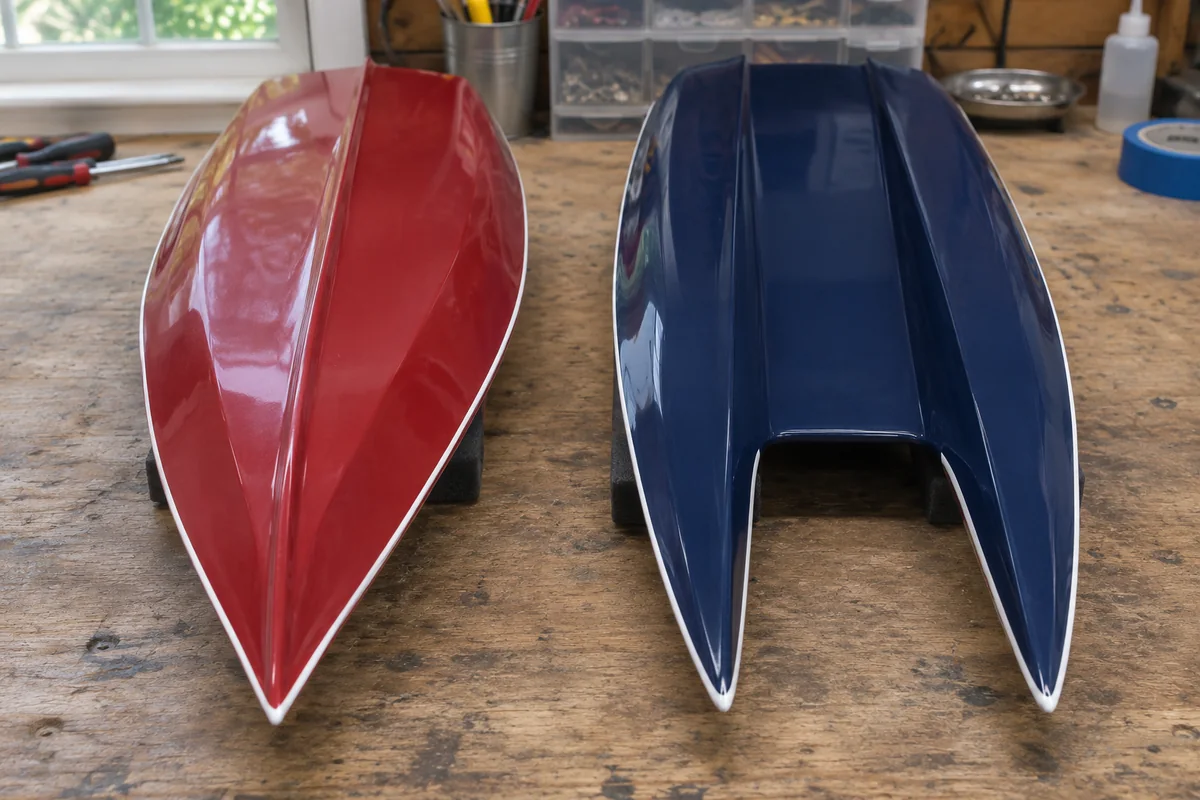
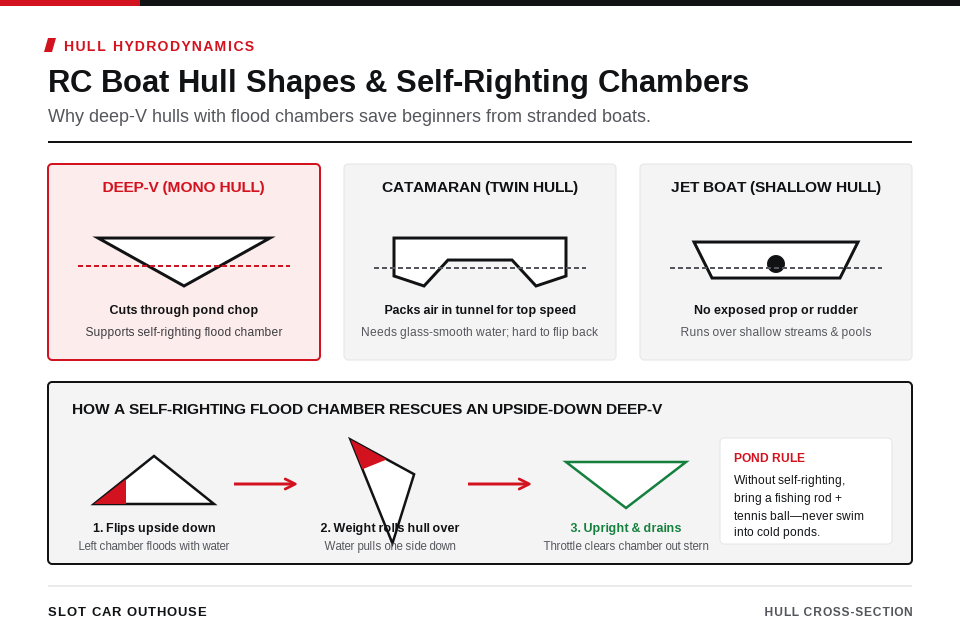
A deep-V hull has a sharp, V-shaped bottom that slices downward into waves rather than slapping across the top of them. Think of it as the sport-sedan suspension of RC boating. Deep-V boats corner predictably, tolerate breezy pond chop, and are the easiest hulls to engineer with reliable self-righting flood chambers—a sealed internal tunnel along one side of the hull that fills with water when the boat flips upside down, deliberately making one side heavy so the boat rolls upright on its own. Once you hit the throttle, the water drains out the back in two seconds.
Catamarans and hydroplanes (glass-water speed machines)
Catamarans ride on two parallel sponsons with an air tunnel down the center. At speed, air packs into that tunnel and lifts most of the hull out of the water, slashing drag so the boat skims on tiny contact patches. Hydroplanes push this concept further with wide front sponsons and a three-point stance. On calm, glassy water, cats and hydros look glued to rails and post huge speeds. On choppy water, however, a gust under the nose can blow them over backward—and because twin-hull designs resist rolling over, most catamarans cannot use a passive flood chamber.
Jet boats (shallow water and rocky creeks)
Instead of an exposed spinning propeller and deep rudder hanging below the hull, a jet boat sucks water through a bottom intake grate and blasts it out a steerable rear nozzle—just like a personal watercraft. Because nothing protrudes beneath the keel, jet boats can skim over inches of water, hop small waves, run in swimming pools without slicing liners, and navigate rocky creeks that would instantly destroy a conventional prop. The trade-off is lower top speed and shorter run times per battery pack because jet pumps are less hydrodynamically efficient than surface-piercing props.
RC sailboats (quiet, long-session precision)
Sailboats replace high-amp brushless motors with two simple servos: one steers the rudder, and a winch servo pulls in or eases out the sail lines (sheets). A modest four-cell AA pack or small receiver battery can power an entire afternoon on the water. You learn real sailing physics—tacking upwind, reading wind shifts, and trimming sails—at a fraction of the battery cost of fast electrics.
Best RC boat brands compared
| Brand | Best Known For | Price Tier | Typical Speed / Type | Self-Righting Tech | Parts Availability | Best Fit |
|---|---|---|---|---|---|---|
| Pro Boat | All-around hobby-grade fleet (Sonicwake, Recoil 2, Blackjack, Jet Jam) | Mid to High ($150–$700+) | 20–50+ mph electric & jet | Flood chamber & flip-recover (model-dependent) | Excellent (Horizon Hobby & local shops) | Most first-time & intermediate hobbyists |
| Traxxas | High-speed RTRs & ecosystem simplicity (Spartan SR, Blast) | Mid to High ($180–$550+) | 20–50+ mph deep-V | Flood chamber (Spartan SR) | Excellent (nationwide hobby shops) | Existing Traxxas owners & speed fans |
| UDI RC | Affordable pond-sized brushless runners (UDI005 Arrow, UDI022) | Budget ($70–$180) | 25–35 mph deep-V | Throttle/rudder flip-recover | Moderate (online spare packs) | Budget buyers wanting real brushless pep |
| VolantexRC | Value brushless hulls & ABS monohulls (Vector SR48, SR80) | Budget to Mid ($110–$260) | 30–40+ mph deep-V | Reverse-throttle flip-recover | Moderate (online retailers) | Value hunters stepping up from pool toys |
| Joysway | One-design RC sailboats & compact powerboats (DF65, DF95) | Budget to Mid ($120–$400) | Sailboats & 20–35 mph electrics | Weighted bulb keel (sailboats) | Very good (specialist & hobby shops) | Sailboat racing & relaxed lake afternoons |
| Oxidean Marine | High-performance carbon/fiberglass brushless hulls | Premium ($450–$1,200+) | 55–80+ mph deep-V & cats | Flood chamber on select deep-Vs | Direct specialist support | Experienced boaters chasing serious speed |
| Cheerwing / Force1 | Backyard pool & calm-pond starter boats | Entry ($30–$70) | 12–20 mph brushed | Capsize recovery flick | Limited (mostly whole-unit replacement) | Kids, backyard pools & casual gifts |
Deep dive into the top RC boat brands
Pro Boat: the benchmark for hobby-grade RC boating
Pro Boat sets the standard because it designs boats for how real people actually use them, not just for flat-water promo videos. Its lineup spans nearly every category cleanly:
- Jet Jam (12-inch): A brushed, pool-safe jet boat with a foam bumper and self-righting hull—one of the few hobby-grade boats genuinely suited for a backyard pool or small creek.
- Recoil 2 (18-inch and 26-inch): Self-righting brushless deep-V hulls that use torque-assisted flip recovery and come ready-to-run with Spektrum electronics, making them ideal pond-sized everyday runners.
- Sonicwake 36-inch V2: Widely regarded as the sweet-spot large lake boat. Its passive flood chamber rolls the 36-inch hull upright automatically on 4S or 6S LiPo power without draining battery capacity, and its breakaway rudder folds back if you clip a submerged branch instead of ripping the transom apart.
- Blackjack 42-inch: A massive brushless catamaran for wide, calm lakes and dramatic roostertails.
Pro Boat's primary strength is longevity. Because Horizon Hobby backs the line, you can walk into most hobby shops or order online and find exact flex shafts, silicone water jackets, propellers, and canopies years after a model launches. Most RTR kits also integrate Spektrum Smart telemetry if you already use that ecosystem, though you can run standard batteries with an adapter.
Traxxas: familiar hardware, serious straight-line punch
Traxxas has a much smaller marine catalog than Pro Boat, anchored by two very different hulls: the entry-level Blast (a 24-inch brushed deep-V for calmer ponds) and the flagship Spartan SR (a 36-inch 6S brushless deep-V capable of over 50 mph).
Historically, the original Traxxas Spartan was blisteringly fast but lacked self-righting—meaning one bad wave flip required a kayak. The Spartan SR fixed that omission by adding a dedicated self-righting flood chamber, instantly transforming it into a direct rival to the Pro Boat Sonicwake. Traxxas also uses a clean modular electronics tray that unbolts from the hull for easy bench service, and its parts network is second to none.
The catch is the Traxxas iD battery ecosystem. If you already own Traxxas 3S LiPos and a Traxxas EZ-Peak charger from running RC trucks or crawlers, the Spartan SR is effortless plug-and-play. If you run standard XT60 or IC5 packs from other brands, expect to budget for adapters or Traxxas-specific batteries—something we unpack in our guide to the best LiPo battery brands.
UDI RC: the budget brushless gateway
For shoppers who want real 30 mph speed on a neighborhood pond without spending $350+, UDI RC has carved out a strong niche. Models like the UDI005 Arrow and UDI022 Tylosaurus deliver water-cooled brushless power, low-battery alarms on the transmitter, and throttle-assisted capsize recovery for a fraction of big-brand pricing.
Where does the lower price show up? Hull plastics are thinner ABS rather than heavy fiberglass or thick injection-molded composite, factory flex-shaft grease is often sparse out of the box, and transmitters feel lighter in the hand. You also rely on online marketplaces for spare props and drive shafts rather than local hobby counters. Still, for a first brushless pond boat that won't break the bank, UDI RC offers remarkable speed per dollar.
VolantexRC: value-focused pond and lake hulls
VolantexRC sits right alongside UDI RC in the budget-to-midrange tier, best known for the Vector SR48 (compact pond runner) and Vector SR80 (a 31-inch deep-V that punches well above its price class). Volantex hulls generally use sturdy, unibody ABS molding that resists cracking in light dock bumps, and their metal hardware—turn fins, trim tabs, and rudder assemblies—gives you real tuning adjustments to dial out porpoising (bouncing nose-up on flat water). Like UDI RC, plan on inspecting every screw with blue threadlocker and greasing the flex shaft before the maiden run.
Joysway: the undisputed king of accessible RC sailboats
If fast electrics feel too frantic—or your local pond bans noisy motorboats—Joysway is the brand to know. In partnership with world-champion model yacht designers, Joysway created the DragonForce 65 (DF65) and DragonFlite 95 (DF95). Both are strict "one-design" racing classes: every skipper runs the same hull, keel, and sail geometry, so races are won by reading wind gusts and trimming sails rather than outspending your neighbors.
Because the weighted bulb keel hangs deep beneath the hull, a sailboat is naturally self-righting; even a fierce gust that knocks the mast flat to the water simply makes the boat pop back upright once you ease the sails. Joysway also makes solid budget powerboats (such as the Bullet and Mad Flow lines), though its international sailing classes are where it truly dominates.
Oxidean Marine: boutique performance for speed chasers
Once a 45 mph RTR boat starts feeling slow, hobbyists graduate from plastic ABS hulls to composite fiberglass and carbon-fiber layups that stay rigid under extreme power. Oxidean Marine specializes in ready-to-run and almost-ready-to-run (ARTR) composite boats like the Animal Twin catamaran and Dominator deep-V. These hulls use upgraded CNC aluminum struts, balanced metal propellers, and higher-amp ESCs capable of 60 to 80+ mph runs. They demand respect—both in battery safety and water space—and are best reserved for boaters who already understand prop balancing, center-of-gravity tuning, and rescue logistics.
Cheerwing and Force1: honest backyard pool toys
Brands like Cheerwing (UDIRC-derived micro hulls) and Force1 (Velocity series) serve a specific, valid purpose: inexpensive, low-risk fun in a backyard swimming pool or calm park basin with kids. They run small brushed motors at 15–20 mph, include simple capsize recovery, and cost little enough that hitting the pool wall doesn't cause heartburn. Just recognize them for what they are—entry toys with limited upgrade paths—rather than platforms you will rebuild over several seasons.
Self-righting tech: flood chambers vs. throttle flip-recover
"Self-righting" appears on almost every RC boat box today, but brands achieve it in two mechanically different ways:
- Passive flood chamber (deep-V hobby hulls): A hollow tunnel along the port side fills with water through transom holes whenever the hull sits upside down. Gravity rolls the boat upright automatically in three to eight seconds, even if your battery is nearly dead. When you apply throttle, forward momentum pushes the water straight back out the rear openings. You lose a tiny bit of straight-line efficiency, but gain huge peace of mind on big lakes.
- Active flip-recover (smaller brushless & brushed boats): Instead of a flood chamber, you rock the throttle sharply between reverse and forward. The motor's rotational torque kicks the lightweight hull back over onto its bottom. This works reliably on smooth, compact hulls under 28 inches, provided the battery still has punch left—and provided the water isn't so choppy that waves keep pushing the hull back over.
Practical buying rules before your maiden launch
Before picking a boat from our RC boats guide and reviews, run through four practical checks that prevent most beginner disasters:
- Match hull length to water size: Under 16 inches fits swimming pools and tiny retention ponds. Boats from 18 to 26 inches shine on neighborhood ponds the size of a football field. Once you step up to 30–36 inches (like a Sonicwake or Spartan SR), you need a real lake—at 45 mph, a 36-inch boat covers a football field in under five seconds.
- Check battery chemistry and run time: Most hobby-grade boats require 2S to 6S LiPo packs sold separately. High-draw brushless hulls typically deliver 6 to 10 minutes per charge, so plan on two matched packs and a dedicated balance charger from our RC batteries and chargers hub.
- Always bring a rescue plan: Even self-righting boats can strip a prop, snarl fishing line around the shaft, or suffer a dead battery far from shore. Never swim into cold, deep, or weed-choked water after a toy. Pack a cheap collapsible fishing rod with a tennis ball tied to the line—cast over the boat, reel gently until the line catches the hull or rudder, and pull it home dry.
- Build a five-minute post-run ritual: Pull the canopy off immediately after running so trapped moisture dries out. Wipe down the interior with a towel, unplug the batteries, and slide the flex shaft out every few sessions to wipe away milky water-emulsified grease and recoat it with waterproof marine grease.
Sources
Frequently Asked Questions
Pro Boat is the easiest recommendation for most beginners because its models balance durable hulls, straightforward self-righting systems, and widely stocked spare parts. Start with the Jet Jam for pools and tight creeks, or the 18-inch Recoil 2 for a neighborhood pond. If you want a lower upfront price to test your interest first, the UDI RC UDI005 Arrow is a capable budget alternative.
You can, but saltwater accelerates corrosion aggressively on steel flex shafts, bearings, motor screws, and brass fittings. Unless a boat is specifically prepped for marine use, flush the cooling tubes with clean tap water immediately after every saltwater session, remove and dry the flex shaft completely, re-grease it, and spray exposed metal hardware with a moisture-displacing corrosion inhibitor.
Water creates vastly more continuous drag than air or pavement. A brushless boat motor draws heavy amperage almost nonstop just to keep the hull up on plane, whereas an RC car coasts between throttle inputs. Running larger-capacity mAh packs extends runtime somewhat, though adding too much battery weight makes the hull sit deeper in the water and draw even more current.
Anything over 30–35 mph feels cramped on a small suburban pond. At 50 mph, a boat travels roughly 73 feet every second—leaving you barely two seconds of straightaway before you have to brake and carve a wide turn to avoid the opposite bank. Match speed to the shoreline buffer you actually have.
Yes. A flex shaft spins at 20,000 to 35,000 RPM inside a tight brass tube. Without marine grease, friction overheats the cable, water wicks up into the hull, and the steel strands rust and snap under load. Removing the shaft, wiping it clean, and applying fresh waterproof marine grease every three to five runs is the single best way to extend a boat's life.