Digital vs Analog Slot Cars: How They Work, Compatibility, and Which to Buy
The short answer comes down to whether you want pure lap-time racing with open car compatibility, or wheel-to-wheel traffic with overtaking and pit strategy. Analog slot cars assign one car to each lane and vary the voltage on that lane's metal rails to control speed—simple, affordable, and nearly universal across brands. Digital slot cars keep constant full voltage on every rail and use a tiny circuit board inside each car to read coded throttle signals, letting four to six (or more) drivers share a two-lane track, switch lanes at speed, and manage fuel in the pits.
Neither system is objectively "better," and plenty of longtime racers keep one of each. Analog rewards clean throttle control, easy tuning, and collecting cars from dozens of makers without buying brand-specific chips. Digital transforms a compact two-lane footprint into a lively race with blocking, drafting, pace cars, and pit-lane drama—at a noticeably higher cost per car and with tighter brand lock-in.
How analog and digital tracks actually work
The easiest way to understand the split is to compare a dimmer switch on a lamp with a smart bulb on a live household circuit.
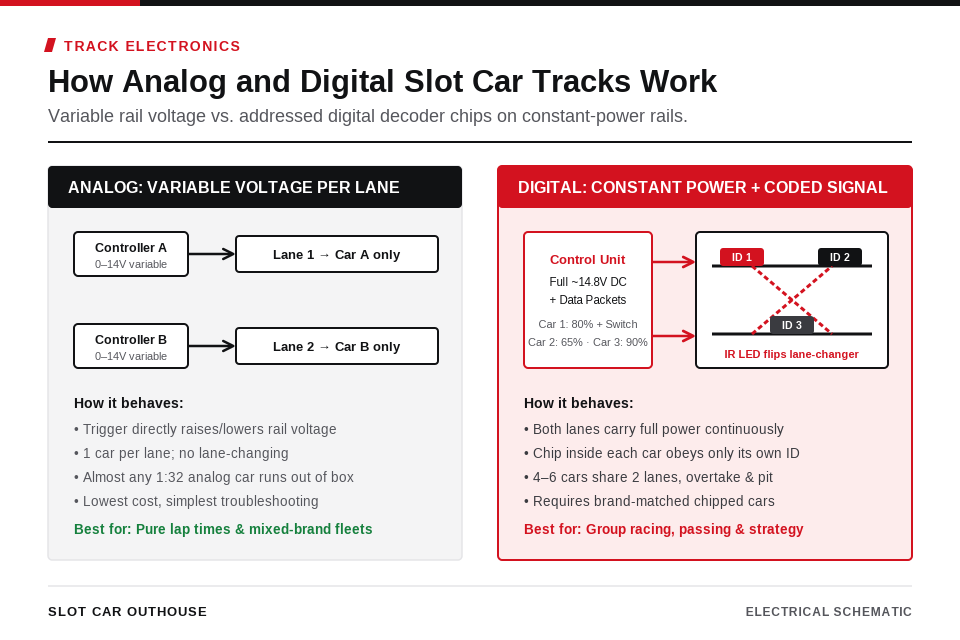
In an analog system, each lane is its own independent DC electrical circuit. Your handheld controller sits in series between the power supply (typically 12V to 15V DC for 1:32 home sets) and that single lane's pair of steel rails. When you squeeze the trigger, the controller's resistor or PWM (pulse-width modulation) circuit sends somewhere between 0V and ~14V down the rails. The car's copper braid pickups feed that voltage straight to the motor. More voltage means more RPM. Because the rail voltage is the throttle signal, two cars in the same lane would both receive the exact same voltage and speed up or slow down together—which is why analog is strictly one car per lane.
In a digital system, the rails stay energized at a constant full voltage the entire time the powerbase is turned on—roughly 14.8V on Carrera Digital 132, 18V on Carrera Digital 124, and about 15V on Scalextric ARC PRO. Riding on top of that constant DC power is a high-frequency stream of digital data packets (similar in spirit to DCC in model railroading). Every few milliseconds, the powerbase broadcasts a coded message for every active controller: "Car #1: 70% throttle, lane-change button off. Car #2: 40% throttle, lane-change button pressed."
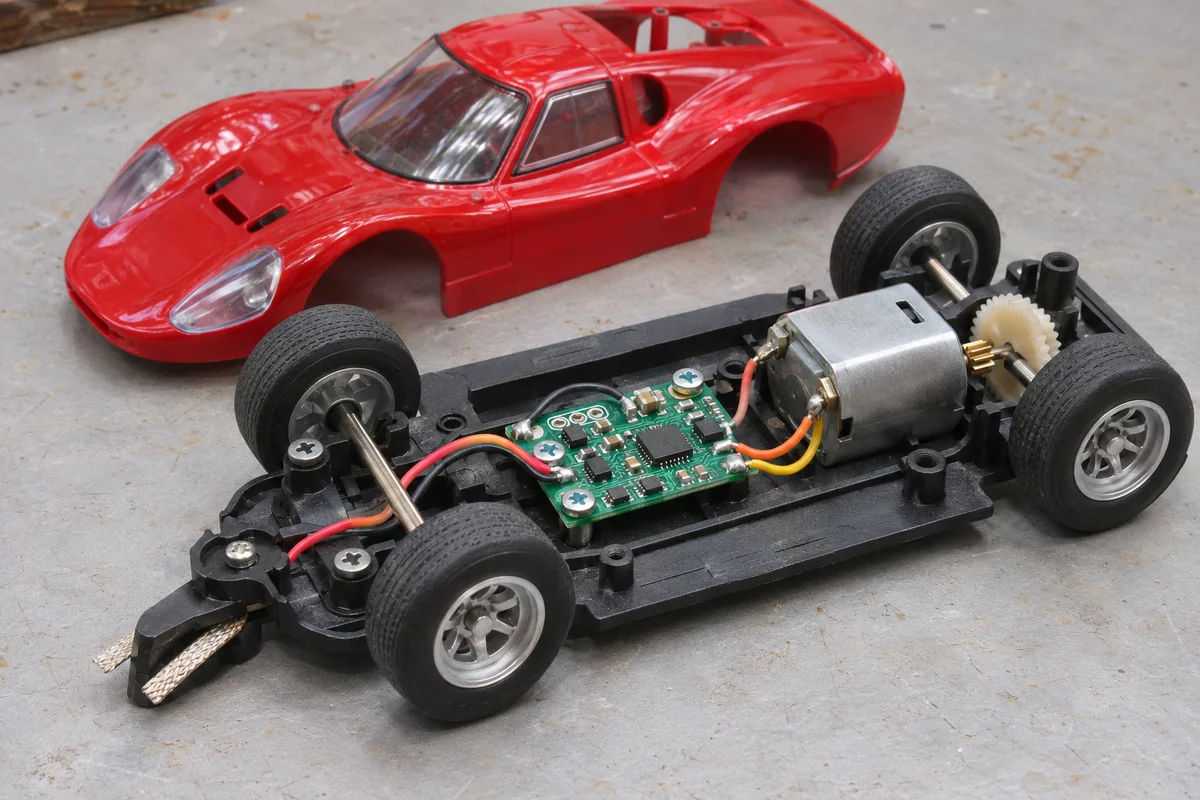
Inside every digital car sits a decoder chip wired between the guide braids and the motor. When you pair a car to Controller #2, that chip ignores every other car's data packets and only obeys commands addressed to ID #2. To vary motor speed, the chip switches the constant rail power on and off thousands of times per second (PWM) to match your trigger position.
Lane changing works through an optical handshake built into the track:
- When you hold the lane-change button on your controller, the decoder chip illuminates a tiny infrared (IR) LED recessed under the car's chassis.
- Just before a lane-changer track piece, an IR photodetector embedded in the slot sees that light beam as the car passes over it.
- A small electromagnetic solenoid beneath the track immediately flips a mechanical guide blade (flipper), steering the car's guide flag smoothly into the adjacent lane.
- Once the car clears the junction, the blade resets (or is mechanically pushed straight by the next car) so trailing cars stay in their own lane unless their IR LED is also lit.
Because the powerbase tracks every car's ID as it crosses start/finish and pit-lane sensors, digital systems can also run ghost cars (automated pace cars cruising at a set speed), fuel-burn simulation (where cars slow down or stop counting laps if you skip a pit stop), and individual speed or brake limits—a huge perk when adults race alongside younger kids on the same track.
Head-to-head comparison: analog vs digital
| Feature | Analog Slot Cars | Digital Slot Cars |
|---|---|---|
| Electrical principle | Variable 0–14V DC per lane | Constant rail voltage + coded data packets + in-car chip |
| Cars per 2-lane track | 2 (one per slot) | Typically 4–6 (up to 20 on wireless club systems like oXigen) |
| Lane changing & overtaking | No (fixed lane) | Yes, via IR LED + motorized lane-changer track pieces |
| Cross-brand car compatibility | Very high (nearly any 2-wire DC car fits) | Locked to the system's chip protocol unless you swap chips |
| Pit stops & fuel simulation | Only with aftermarket PC lap timers | Native on major digital systems (Carrera, ARC PRO, oXigen) |
| Ghost / pace cars | No | Yes (great for solo racing against traffic) |
| Entry starter set cost | Lower ($100–$250 typical) | Higher ($280–$550+ typical) |
| Cost per extra car | $45–$80 typical (1:32) | $65–$110+ (or analog car + $25–$50 chip install) |
| Best suited for | Collectors, tuning purists, tight budgets, club lap racing | Families, group race nights, solo racers wanting traffic |
Major digital ecosystems compared
Once you step into digital, you are no longer just buying plastic track—you are choosing a communications protocol. Digital chips from one brand do not speak the language of another brand's powerbase. Here is how the four main systems differ.
Carrera Digital 132 and Digital 124
Carrera is the heavyweight of home digital racing. Its track is molded at 1:24 scale width, which means wide lane spacing (about 99 mm between slots) and generous room for 1:32 cars to drift without door-banging—and the exact same physical track runs giant 1:24 cars if you upgrade the power supply and use wider outer borders. Carrera Digital 132 supports up to 6 active drivers plus 2 ghost/pace cars, individual speed and brake adjustments right from the Control Unit, and a deep catalog of pit lanes, wireless controllers, and app connectivity. Its biggest downside is physical footprint: wide track pieces require more floor or table space. For a deeper brand-level breakdown of track geometry and starter kits, see our Carrera vs Scalextric guide.
Scalextric ARC PRO
Scalextric's ARC PRO powerbase sits on standard Scalextric Sport 1:32 track, which is narrower than Carrera track and much easier to fit onto a 4×8-foot table or bedroom floor. ARC PRO supports up to 6 cars simultaneously, connects via Bluetooth to the free ARC mobile app for race modes (Grand Prix, Endurance, Pit Stops, weather events, KERS boost), and includes a physical Analog/Digital switch right on the powerbase. That toggle lets you run your classic analog collection in 2-lane mode one evening and flip to 6-car digital racing the next. Scalextric's DPR (Digital Plug Ready) hatch on most modern cars lets you install a chip with a single screwdriver in two minutes—no soldering required.
Slot.it oXigen
Built for serious hobbyists and slot-car clubs, Slot.it oXigen takes a different engineering path. Instead of sending data through the track rails, oXigen sends throttle signals over 2.4 GHz radio directly from a wireless controller to a tiny radio receiver chip inside the car. The track rails only supply constant DC power. Because track brand no longer dictates data transmission, oXigen works on Carrera, Scalextric, Ninco, Policar, and even custom-routed wooden tracks (using magnets embedded in the wood for lap counting and lane changes). It supports up to 20 cars simultaneously, though the entry cost and technical setup are geared toward experienced builders rather than casual living-room racers.
Scorpius Wireless
Like oXigen, Scorpius is an Australian-engineered 2.4 GHz wireless digital system designed for both plastic track conversions and routed wood tracks. It offers ultra-low latency, smooth wireless controllers, anti-collision logic on lane changers, and full PC race-management integration. It is a niche, enthusiast-tier platform with a smaller retail footprint than Carrera or Scalextric, prized by builders constructing permanent club-grade home tracks.
Car and track compatibility: what actually works together
Compatibility misunderstandings cause more wasted money in slot cars than anything else. Keep these four rules straight before ordering extra slot cars or track packs:
- Analog cars cannot run directly on a digital track. Because a digital track feeds constant full voltage to the rails, setting an unchipped analog car onto a live digital lane will send it rocketing off at 100% throttle the instant its braids touch metal—ignoring every controller—until it launches into a wall or trips the powerbase overload protection. To run an analog car on a digital track, you must install a compatible decoder chip (via a plug-in DPR hatch on modern Scalextric cars, or by soldering a chip onto the motor and braid leads).
- Many digital cars can run on analog tracks. Most Carrera Digital 132/124 cars include a tiny recessed polarity/mode switch on the underside of the chassis (or auto-switch via the guide) that lets them run cleanly on any 1:32 analog track. Modern Scalextric digital chips also auto-detect analog DC voltage and pass it through to the motor. The only minor quirk is that an in-car chip needs roughly 3V to 4V just to wake up its logic circuit, so a chipped car on an analog track can feel slightly less smooth at creeping low speeds than a pure analog car.
- Digital chips are not cross-brand compatible. A Carrera Digital 132 car will not respond to a Scalextric ARC PRO powerbase, and a Scalextric DPR car will not respond to a Carrera Control Unit. Their IR frequencies and rail data encoding are completely different. You can run a Scalextric car on a Carrera digital track—or vice versa—only if you remove its native chip and wire in the host track's chip (and verify the guide blade depth fits the slot).
- Track brands do not snap together natively. Analog or digital, Carrera, Scalextric, Ninco, and Policar each use different locking tabs and slot spacing. Adapter tracks exist for mixing analog brands, but mixing digital track brands is rarely worth the electrical headache because lane-changer wiring and IR sensor placement are proprietary.
Real-world cost of ownership
Starter-set price tags only tell half the story. The real cost gap between analog and digital shows up over your first year of expanding a layout.
- Starter set: A solid 1:32 analog set from Scalextric or Carrera Evolution typically runs $130 to $250 with two cars, two controllers, and a basic oval or figure-8. A comparable digital starter set (Carrera Digital 132 or Scalextric ARC PRO) usually lands between $300 and $550, though it often includes a lane changer and sometimes three cars.
- Expanding the grid: With analog, adding a fresh car costs $45 to $75 from brands like Scalextric, Carrera, Slot.it, NSR, Scaleauto, or RevoSlot—plug it in and drive. With digital, factory-chipped cars run $65 to $100+, and converting a third-party analog car adds $25 to $50 for the decoder chip plus soldering time.
- Track upgrades: Plain analog straights and curves are interchangeable with digital straights and curves inside the same brand (Carrera Evolution track is Carrera Digital 132 track; Scalextric Sport track is ARC PRO track). Where digital adds cost is the specialty hardware: each double lane changer costs roughly $65 to $95, a digital pit lane adds $100 to $160, and extra wireless controllers run $55 to $90 each.
- The upgrade path: If you want to start modestly without locking yourself out of digital later, buy an analog Carrera Evolution or Scalextric Sport (ARC ONE / ARC AIR) set. Every straight and curve piece carries straight over if you later swap in a digital powerbase, digital controllers, and lane changers. Before buying expansion boxes, map your table footprint with slot car track layout software so you know exactly how many curves and lane changers fit.
Practical decision rules: which system should you buy?
Use these straightforward rules to pick the right lane the first time:
- Buy Analog if you love collecting diverse cars. If half the fun is lining up a Slot.it Group C prototype against an NSR GT3 car and a classic Fly Porsche without picking up a soldering iron, analog is effortless.
- Buy Analog if you are on a tight budget or want pure lap-time focus. Two equal-length lanes, a good aftermarket controller, and a simple optical lap timer deliver razor-sharp driving feel for half the price of digital.
- Buy Digital if 3 to 6 people will race together. On a two-lane layout, analog forces extra friends to sit and watch. Digital lets four to six people race simultaneously on the exact same table footprint.
- Buy Digital if you mostly race solo. Ghost and pace cars give solo drivers moving traffic to time overtakes around—far more engaging than running endless hot laps alone.
- Buy Scalextric ARC PRO if you want both worlds on a compact table. Its physical Analog/Digital powerbase toggle and compact 1:32 track geometry make it the most flexible dual-mode setup for spare bedrooms and 4×8 tables.
- Buy Carrera Digital 132 if you have space and want the richest digital ecosystem. Wide track, rock-solid lane changers, smooth wireless controllers, and easy pit-lane expansion make it the gold standard for dedicated basement or garage builds. Browse current slot car sets once you know which ecosystem fits your room.
Sources
Frequently Asked Questions
Yes, if you choose a brand whose track pieces are shared across both lines. Carrera Evolution (analog) uses the exact same plastic track as Carrera Digital 132, and Scalextric Sport analog track is identical to Scalextric ARC PRO track. You keep all your straights and curves and simply replace the powerbase and controllers, add digital lane changers, and chip (or replace) your cars.
Yes, digital cars use the same chassis, tires, gears, and traction magnets as their analog siblings. The decoder chip adds only a few grams of weight, so handling is virtually identical. One advantage on digital is adjustable electronic braking and top-speed scaling per car, which makes non-magnet (wood-style) drifting easier to tame for beginners.
Practically speaking, HO scale (1:64 to 1:87) remains almost exclusively analog. Miniature HO chassis leave almost no internal room for a decoder chip, IR LED, and heat dissipation. If you want digital overtaking and pit stops, step up to 1:32 scale (or 1:43 with Carrera Digital 143, though Carrera has largely shifted focus toward 1:32).
Missed lane changes almost always come down to timing, dirt, or speed. You must press the lane-change button before the car's IR LED crosses the track sensor—pressing it mid-junction is too late. Dust on the IR sensor lens, a crooked guide flag, or taking a lane changer at extreme full throttle can also cause the sensor to miss the pulse.
Slightly, yes. Because digital systems rely on clean high-frequency data pulses traveling along the rails, corroded rails, loose track joints, or dirty pickup braids can cause brief hesitation or missed lane-change commands. Keeping rails wiped clean, using track clips, and adding power-tap jumper wires on layouts longer than 45 to 50 feet keeps digital voltage rock-solid.