Best Epoxy Putty of 2026

Most people go looking for epoxy putty when something is dripping, cracked or stripped: a joint under the sink lets go on a Sunday night, a screw hole crumbles, a tile chips, a resin figure loses a corner. Putty needs no clamp. Knead the two parts until they turn one color, press it into the gap or shape it around the break, and it cures hard enough to drill and sand.

Format changes how a putty behaves. Sticks are stiffer and easier to jam into a joint, two-part clays are tackier and hold fine detail, and steel-reinforced versions feel gritty but take a screw thread better. Working time is not cure time, and a five-minute putty leaves little room to change your mind, so wear gloves and have the repair planned before you start kneading.

Our Top Picks

The Best Epoxy Putty

1.

Milliput Standard Grain Epoxy Putty Best Overall
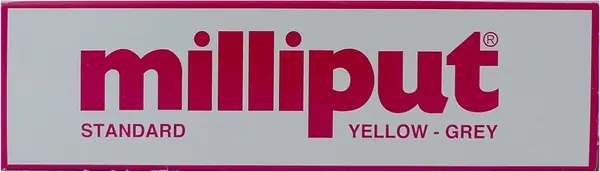
Milliput Standard Grain two-part epoxy putty in a yellow-grey four-ounce box

Model building

Track Score 95/100
Package Size
4 oz
Cure Time
5 hours, faster with heat
Cured Finish
Sawn, drilled, filed, sanded and painted
Rollable Thickness
Down to 1/64 inch
View on Amazon

Rolled to 1:64 inch, Milliput presses into a seam on a slot car body thin enough to disappear under paint, and that number is the reason it lives in a modeler's drawer rather than a toolbox. You slice equal amounts from the two bars, knead until the color runs uniform, and shape it with a tool or a fingertip before it starts to firm up.

What sold us is how it behaves after it sets. This is the cleanest-sanding putty in this group, filing to a feather edge without crumbling, and a wet fingertip smooths a fillet before the cure, so most of the shaping happens before sandpaper comes out. Nothing else here does both of those things as well.

The trade-off is the clock. Milliput stays workable for hours and wants about five hours to cure, which suits a bench session and rules out anything urgent, so a dripping pipe is not this product's job. Until it sets it is tacky enough to grab bare fingers, which is where the water comes in: keep a cup beside you and wet your hands instead of fighting it dry.

A 4-oz box outlasts the size on the label, because a pea-sized piece fills a chip and a whole seam takes very little. It also keeps: ours has sat between projects without going crumbly at the edges, which matters when you buy a putty for one small job and come back to it months later.

Worth Noting

  • Costs more per ounce than the bulk clays
Our Verdict

Our choice for models and detail repairs: it shapes and sands cleaner than anything else here, as long as a few hours of cure fits the job.

Check Latest Price
2.

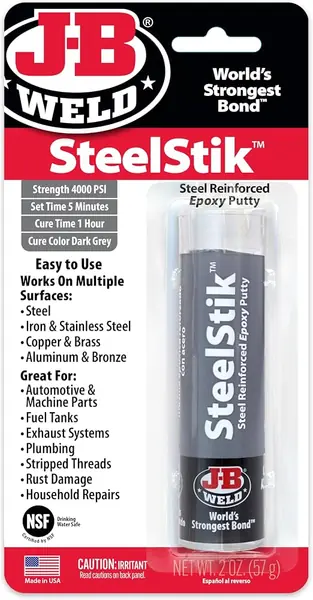
J-B Weld SteelStik Epoxy Putty Stick Best for Metal Repair

J-B Weld SteelStik two-part steel-reinforced epoxy putty stick, two ounces, curing dark grey

Metal repairs

Track Score 93/100
Package Size
2 oz stick
Full Cure
1 hour
Set Time
3 to 5 minutes
Lap Shear Strength
900 psi
View on Amazon

Five minutes is the working life of a SteelStik once the kneading stops, and that clock is why we keep it for metal. It goes on dark gray, sets hard enough to handle almost immediately, and after an hour you can drill it, tap it, and run a bolt into a repaired bracket. For a joint that has to hold today, the slower clays here are no help at all.

The putty comes as a two-part stick with the hardener running down the middle, and the steel filler gives the mixed putty a dense, gritty feel that stays where you press it, even on a vertical face. The 900 psi lap shear rating is the number to trust over the packaging language; this is a structural patch, not a cosmetic one.

Prep decides the result. A greasy or glossy surface lets it slide before it bites, so roughen the area with sandpaper and wipe it clean first. We choose it over Milliput when the part is load-bearing, and choose Milliput when the repair is going to be studied up close under paint.

Worth Noting

  • Dark gray only, so it shows on light parts
  • Two-ounce stick covers only small rebuilds
Our Verdict

Our pick for metal that has to stop moving now: a five-minute set and an hour to a drillable, paintable repair.

Check Latest Price
3.

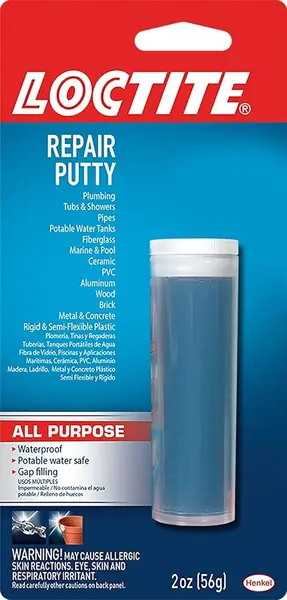
Loctite Multi Purpose Repair Putty Best for Plumbing and Wet Surfaces

Loctite Multi Purpose Repair Putty stick with blue outer putty and a white hardener core

Leaks and plumbing

Track Score 90/100
Package Size
2 oz stick
Full Cure
60 minutes
Water Rating
Waterproof, potable-water safe, cures underwater
Working Time
About 5 minutes
View on Amazon

Metal, masonry, brick, wood, glass, ceramic, rubber, fiberglass, china, stone, marble, and rigid plastics: the Loctite stick covers the widest material list in this group, with polyethylene, polypropylene, and non-stick coatings named as the exceptions. That breadth is unusual for a two-ounce stick, and it is the first thing we check when the damaged part is not obviously metal or wood.

The underwater cure is what we care about most. A repair under a dripping joint or inside a pool fitting is where a lot of putty fails before it ever sets, and this one is built to go on damp and set while wet, and it is rated safe for contact with drinking water. It does not shrink as it cures, and once hard it sands, drills, and paints like the rest.

Two ounces goes quickly if the repair is bigger than a crack, so size up the job before you commit the whole stick to it. Working time runs about five minutes, which is plenty for one small patch if the part is already clamped and not enough for a two-handed reassembly, so set yourself up before you knead.

Worth Noting

  • Small two-ounce stick goes fast on big fills
Our Verdict

The leak-and-wet-surface specialist: it cures underwater, stays potable-water safe, and grips materials the other sticks here ignore.

Check Latest Price
4.

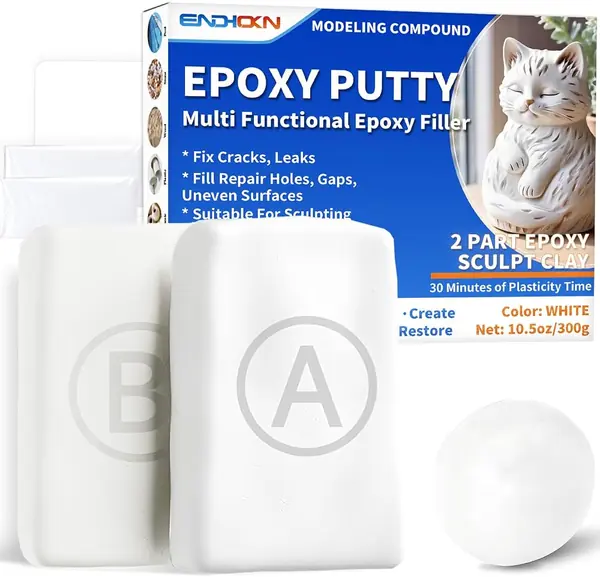
Endhokn White Epoxy Putty Best for Sculpting and Large Repairs

Endhokn white epoxy putty kit with two 150-gram tubs, gloves, scraper and instructions

Sculpting and leaks

Track Score 89/100
Package Size
10.5 oz (150 g Part A + 150 g Part B)
Full Cure
24 hours
Water Use
Above or below water
Molding Time
30 minutes
View on Amazon

Two 150-gram tubs, two pairs of gloves, a scraper, and a printed sheet: the Endhokn kit is the most complete package here, and at 10.5 ounces it is also the most putty you get in a tub short of the sculpting clays.

What we noticed first is the clock. About 30 minutes of molding time before it firms up is long enough to build a shape, step back, and fix it, which is the opposite of a five-minute stick and the reason this one suits sculpting, filling a deep void, or rebuilding a corner in stages.

It is rated for above and below water, so a pool fitting or a tank seam is fair game, and the white cures hard enough to sand and paint. The two parts sit in separate tubs and take a 1:1 mix, so cutting an equal slice with the scraper is easy to get right.

For a project that needs volume and working time, this is our pick; for a quick repair on a metal bracket, the SteelStik is the better tool. It is a tub, not a toolbox item, so buy it when the job is already on the bench rather than for the drawer.

Worth Noting

  • Can stay tacky well past a full day
  • Sanding needed for a smooth finish
Our Verdict

Best for jobs that need putty by the handful and time to shape it, from a rebuilt corner to a joint that has to set underwater.

Check Latest Price
5.

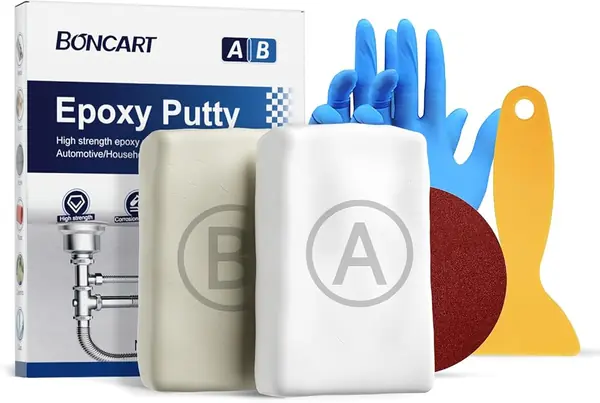
Boncart AB Epoxy Putty Best Value

Boncart white AB epoxy putty 200-gram box with gloves, sandpaper and a scraper

All-purpose repairs

Track Score 88/100
Package Size
200 g (7.1 oz)
Full Cure
24 hours
Color
White
Mix Ratio
1:1
View on Amazon

The Boncart box arrives with gloves, sandpaper, and a scraper alongside 200 grams of white putty, which is more material than any stick here and all the tooling for the job in one purchase. For someone fixing a few things around the house with no supplies on the shelf, that is a sensible place to start.

The two parts are cut in a 1:1 ratio with the spatula and kneaded until the color is uniform, then pressed into place. It cures hard enough to sand and takes paint, and the label rates it waterproof for indoor or outdoor work, which covers the camper-panel and heat-shield sort of repair people buy it for.

Where it earns its place next to the pricier tubs is quantity for the money: 200 grams covers a lot of patch work, and the white is a sensible base for paint. We also liked the scraper, which cuts a clean 1:1 slice instead of leaving you guessing at the ratio with a fingertip.

Worth Noting

  • Full cure takes a full day
  • Dries off-white rather than bright white
Our Verdict

A generous white all-purpose putty with the tools in the box, and the easiest way to start if you have several small repairs ahead.

Check Latest Price
6.

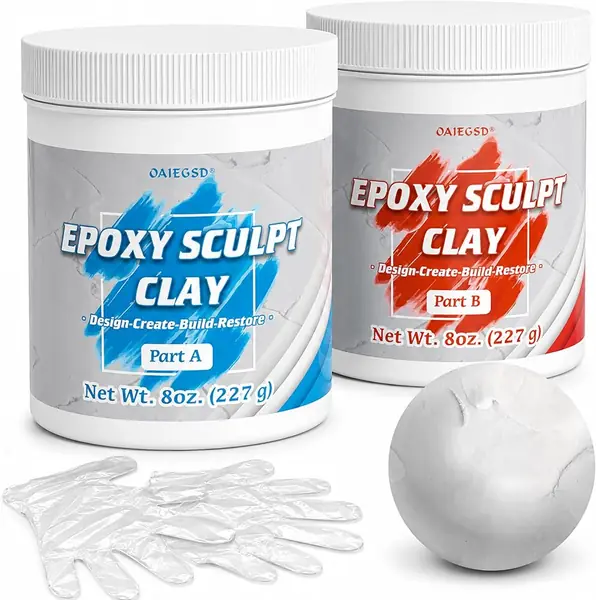
OAIEGSD Epoxy Sculpt Clay Best for Bulk Sculpting

OAIEGSD white epoxy sculpt clay in a one-pound tub for modeling and repair

Bulk sculpting

Track Score 87/100
Package Size
1 lb (16 oz)
Mix Ratio
1:1
Finish
Sandable and paintable
Shrinkage
Low shrinkage
View on Amazon

A pound of clay in a tub is a different purchase from a stick, and this one is built for volume: building up a missing corner on a statue or a prop, packing a large void, or adding material back in handfuls rather than carving a crisp edge into a thin seam.

It mixes 1:1, cures with low shrinkage, and sands and paints once hard, which is exactly what you want when the job is adding material rather than joining two pieces. It moves like a stiff clay and holds the shape you press it into instead of slumping.

Our read is that this is a build-up putty, not a detail putty; the fine work belongs to Milliput, which rolls thinner and smooths with water. Buy the OAIEGSD tub when the job is measured in handfuls and the finish will be painted, and it does the work at the lowest cost per ounce in this group.

Worth Noting

  • Sticky clay grabs tools and fingers
  • Firm block is awkward to measure out
Our Verdict

A pound of low-shrink sculpting clay for rebuilding volume, best when the repair will be painted over rather than admired up close.

Check Latest Price
7.

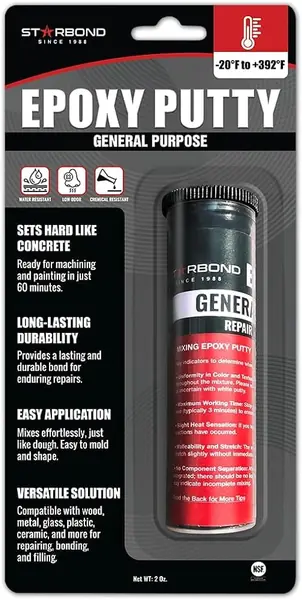
Starbond Black Epoxy Putty Stick Best for Black Trim Repairs

Starbond black epoxy putty stick, two ounces, for dark trim and plastic repairs

Black trim repairs

Track Score 86/100
Package Size
2 oz stick
Full Cure
60 minutes
Color
Black
Compressive Strength
Up to 8,000 psi
View on Amazon

Black putty solves a problem the gray sticks create: a repair on dark trim, black plastic, or a shadowed joint that would otherwise show as a pale patch. Starbond sells this stick in a spread of tones, and the black version is the one for automotive trim, dark furniture, and anything that will not be painted afterward.

It is rated up to 8,000 psi compressive strength, cures in about an hour, and can be sanded and painted once hard, which puts its cured performance in the same conversation as the steel stick here. Knead it, press it into the gap, and shape it before it firms.

Our take: buy it for the color, not as the all-rounder. On a black plastic panel that will never see paint, it saves a topcoat, and that is a genuine convenience. For structural work on metal the SteelStik is the safer choice, and for anything studied up close under paint the Milliput still finishes better.

Worth Noting

  • Color can cure lighter than the label implies
  • Stiff stick takes effort to press in
Our Verdict

A firm-curing black stick for dark trim and plastic, where hiding the repair matters as much as making it.

Check Latest Price

How We Tested Epoxy Putty

We started with a list of 60-odd putties sold in the U.S. — sticks, ribbons, and tubs of two-part clay — and narrowed it by format, stated working and cure times, substrate claims, mix ratio, and price per ounce. Each package went on a kitchen scale so we knew how much of what we paid for was actually usable, and we noted the shelf-life date stamped on every one. We bought 14 at retail and tested them for four months.

Testing happened where the repairs actually happen: a garage bench, a kitchen sink, a rental bathroom, and a model desk. With gloves on, we timed working time from the moment the two parts touched, kneading until the color went uniform, and noted whether the mix stayed tacky or firmed up and whether it sagged out of an overhead joint. We packed it into stripped screw holes in pine and oak, drove a screw once cured, and pried at metal lap joints with a chisel. A cracked drain fitting and a pinhole in copper got patched and run under water; spare plugs sat in a bucket for a week, and another set went into hot water to see what heat did to them.

At the label's full-cure time and again the next day, we scratched and filed each cured sample to judge hardness, then sanded flat pieces outdoors with a dust mask on and painted them to see how the finish took color. For the sculpting putties, we pressed the mix into silicone molds, watched how long it held detail before slumping, and measured shrinkage with calipers. Every repair got a second look at one week and a third at one month — the ones that failed, failed there.

How to Choose an Epoxy Putty

Stick or Clay Comes First

A putty stick is a pre-measured cylinder with the hardener running through the middle. Cut a slice, knead it, press it, and it is hard within the hour. That speed is the whole point and also the constraint, because once a stick starts to set you get one attempt at the shape.

A two-part clay sold as tubs or bars gives you 30 minutes to several hours of working time, which is what you want when the repair has to be smoothed into a seam or sanded to a finish. Treat them as different tools rather than competitors: the stick for a joint that has to hold now, the clay for anything a person will look at.

Working Time Is Not Cure Time

Every putty here has two clocks. Working time is how long it stays moldable; full cure is when you can sand it, drill it, or put a load on it. A stick may set in five minutes and still want an hour before you file it, and a tub clay may be shapeable for half an hour and soft overnight.

Plan the repair around the second number. Clamp or tape the part so it can sit undisturbed, and resist flexing it early to see whether it worked. Full cure runs from about an hour on the fast sticks to a full day on the tub clays, so the putty that felt convenient at the mixing stage may be the one that keeps you waiting.

What It Will Actually Stick To

Almost every package lists metal, wood, ceramic, and plastic, and the list is usually honest, with two exceptions worth memorizing. Polyethylene and polypropylene, the waxy plastics in flexible jugs and some trim, resist epoxy, and so do non-stick coatings. A putty that grips everything else will peel off those.

Prep does the rest. Roughen the surface, remove grease, and do not run a repair across a smooth painted edge where you cannot key the material. If you are not sure about a plastic, press a small amount on and leave it overnight before you commit the whole repair.

Judging a Putty for Detail Work

For slot car bodies, models, and figures, three properties matter more than strength. Thinness: a putty you can roll to a fraction of an inch feathers into a seam without a ridge. Sandability: cured putty should file to an edge rather than crumble. Shrinkage: a clay that pulls back as it cures leaves a hollow under the paint.

Milliput's 1:64-inch rolling and its water smoothing are why we keep it for this kind of work, and the tub clays here are better for building volume than for crisp edges. If the finished surface will be painted and photographed, buy for the sanding, not for the strength rating.

Buy the Amount You Will Use

Epoxy putty rewards small purchases unless you are building. A two-ounce stick handles a handful of small repairs and keeps for years in a drawer; a 200-gram or 1-pound tub is cheaper per ounce and better for sculpting or filling a large void, but a tub left open for a year dries at the edges.

Our rule is to buy the smallest format that covers the job in front of you, and to buy the big one only when the project is already on the bench. The one exception is a repair you know will need a second pass, since matching a fresh batch to a cured one is easier with the same product.

Frequently Asked Questions

Final Verdict

Milliput is the one we hand to someone working on a slot car body, a figure, or any repair that has to disappear under paint. It rolls thin, smooths with water, and sands to an edge none of the sticks here can match, and that is why it takes the top spot despite its slower cure.

Keep a J-B Weld SteelStik beside it for metal that has to stop moving today, five minutes of working time and an hour to a drillable surface. If the job is a leak on a wet or submerged fitting, the Loctite stick is the one to use, with the Endhokn kit as the better choice when you need a handful of putty and half an hour to shape it.