Best Thin CA Glues for Model Building of 2026

Water-thin CA glue does one thing thicker adhesives can't: it wicks. A drop at the edge of a hairline seam gets pulled inside the joint instead of pooling on top. That is the appeal, and also why a bad bottle can fog a clear canopy, race across a painted fuselage or weld your fingertips before the cap is on.

"Thin" is a marketing word, not a measurement. A glue rated 2 to 5 CPS flows nothing like one that only claims low viscosity, and the eight picks span that range. Over three months at a working bench with 15 bottles, on plastic kits, 3D-printed parts, balsa and a loose chair spindle, we judged how each wicked, how fast it grabbed, how well the applicator placed it and how much glue we threw away.

Our Top Picks

The Best Thin CA Glues for Model Building

1.

Starbond Super Fast Thin CA Glue Best Overall
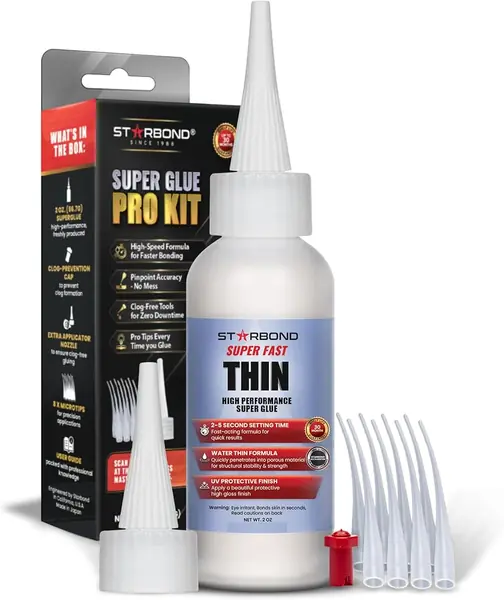
Starbond Super Fast Thin CA glue bottle with microtips and pin cap

Tight mixed-material seams

Track Score 95/100
Viscosity
Low
Bottle Size
2 oz
Set Time
2-3 seconds
Applicator Kit
8 microtips, 2 nozzles, pin cap
View on Amazon

A water-thin CA is only as useful as the tip you use to place it, and this Starbond kit arrives ready for detail work: two applicator nozzles, eight microtips, and a pin cap. We like having a fresh tip for a clean seam instead of reaching for a toothpick, especially when several joints need attention in one sitting.

At two to three seconds of set time and a listed five-second full cure, this is one of the fastest thin CAs in this group. We treat it as the default for tight model joints: the low-viscosity liquid pulls into the seam, and a small drop travels farther than you expect. On plastic, resin, and metal photo-etch it leaves almost no time to reposition, so dry-fit first and keep the parts aligned.

What won us over is the combination of speed and control. The two-ounce bottle has enough glue for a long run of small repairs, and the kit's spare nozzle and pin cap make it easier to return to after a week away from the bench. The formula is also listed for wood, rubber, ceramic, and common 3D-print filaments, which makes it a strong one-bottle answer for a mixed-material model shelf.

It is not a gap filler, and a loose joint that needs bridging is the wrong job for it; thin CA wants contact. For tight seams, laminations, and small parts that must not shift, the fast set is the advantage. A fresh two-ounce bottle is also easier to keep usable than a huge container that sits open all season.

Worth Noting

  • Can wick beyond the joint in open-grain wood
  • Cap can clog between sessions
Our Verdict

For most model builders, this is the thin CA we recommend: fast, genuinely water-thin, and packaged with the microtips that keep small joints clean.

Check Latest Price
2.

Bob Smith 103 Insta-Cure Super Thin Best Classic Water-Thin

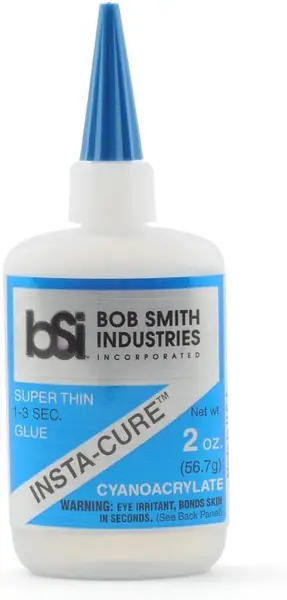
Bob Smith Industries Insta-Cure Super Thin CA glue bottle

Classic capillary joints

Track Score 94/100
Viscosity
Water-thin
Bottle Size
2 oz
Full Cure
2 hours
View on Amazon

A close-fitting joint is the test. Bob Smith's Insta-Cure is water-thin enough to pull itself into a seam by capillary action, so you can touch a drop at the edge and let the joint draw it in rather than smearing glue across the surface. That is exactly the behavior we want for fine model work, and it is why this plain bottle stays useful beside more elaborate kits.

The two-ounce bottle is simple and workmanlike, with none of the microtip hardware that comes with our top pick. For structural seams and laminations where a fine needle matters less, that simplicity is fine; the liquid does the work. The low viscosity is the real feature here, and it makes the glue easy to pull into a joint that already fits.

It sets quickly at the surface, but the full cure is listed at two hours, so we still give a loaded joint time before stressing it. The long cure is not a problem on a static model; it is a reminder that a fast initial grab is not the same as a finished bond. The two-hour cure is the number we plan around, not the initial grab.

Worth Noting

  • Can run on vertical joints
Our Verdict

We keep this as the straightforward capillary pick: a plain water-thin glue that rewards a steady hand and a well-fitted joint.

Check Latest Price
3.

KRAFTPROTZ 3D Printing CA Glue Liquid Best for 3D-Printed Parts

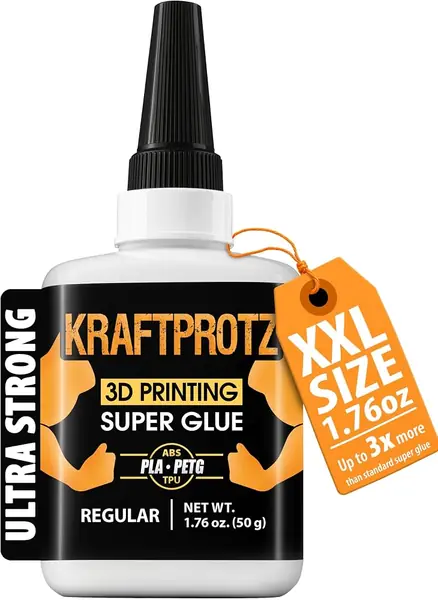
KRAFTPROTZ liquid 3D printing CA glue bottle with precision needle tip

3D-printed assemblies

Track Score 93/100
Viscosity
Low
Bottle Size
1.76 oz
Full Cure
15 seconds
3D-print Materials
PLA, ABS, PETG, TPU, ASA, nylon
View on Amazon

The list of filaments is the tell: PLA, ABS, PETG, TPU, ASA, and nylon. This is a thin CA aimed at printed assemblies rather than a general craft shelf, and the needle tip supports that job. The compatibility list covers the filaments most home printers run, and the low-viscosity formula is meant to follow layer lines rather than sit on top.

On printed parts, a small amount can reach inside a joint without building a visible ridge, and the 1.76-ounce bottle is a sensible size to keep at the printer. The listed 15-second full cure gives you a brief window to align a part before it takes hold. That is quick enough for assembly work but still more forgiving than the fastest water-thin bottles.

Our verdict is that it is a strong specialist for 3D-printed model parts, not the universal first bottle for every seam. The anti-clog needle is a real convenience for repeated assembly, and the larger fill means fewer interruptions during a print-heavy build. For a mixed bench of brass, resin, and balsa, the Starbond kit is the more flexible choice.

Worth Noting

  • Can stay tacky beyond the listed set
Our Verdict

If your bench is full of 3D-printed parts, we think this is the easiest thin CA to live with, especially for PLA and PETG assemblies.

Check Latest Price
4.

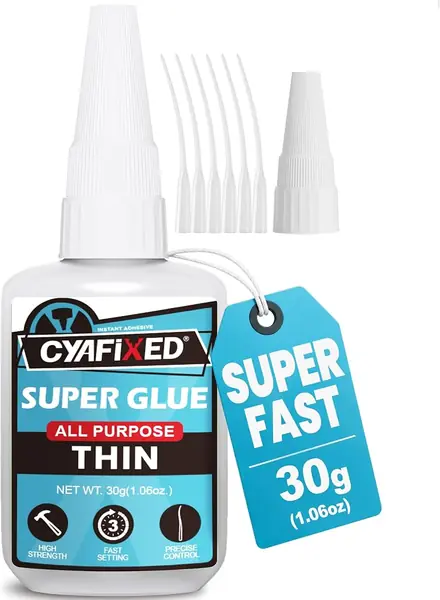
CYAFIXED Super Fast Thin CA Glue Best Budget

CYAFIXED Super Fast Thin CA glue bottle with anti-clog cap and microtips

Budget detail work

Track Score 92/100
Viscosity
5 CPS
Bottle Size
1 oz
Set Time
3-5 seconds
Tensile Strength
3,580 psi
View on Amazon

Five CPS is the number that matters here: this is a genuinely watery CA, not a glue labeled thin that lands halfway to medium. At the tip it spreads and wicks quickly, so a tiny drop at the edge of a seam is usually enough. For a model builder, that is the difference between filling a joint and flooding the surface.

We like it as the budget bottle in this group. It sets in three to five seconds, lists a high tensile strength, and comes with anti-clog caps and microtips, so the lower price does not leave you without application control. For miniatures, small repairs, and tight plastic joints, it covers the basics without asking you to buy a kit.

The trade-off is the one-ounce fill: it disappears quickly if you use thin CA for larger assemblies. We keep this one for detail work and switch to the larger CYAFIXED bottle for wood or balsa. The cap and microtips are what make it feel less disposable than the price suggests.

Worth Noting

  • Watery formula runs on vertical joints
Our Verdict

Our budget pick is this 5 CPS bottle for modelers who want a genuine water-thin glue and do not mind a careful, sparing hand.

Check Latest Price
5.

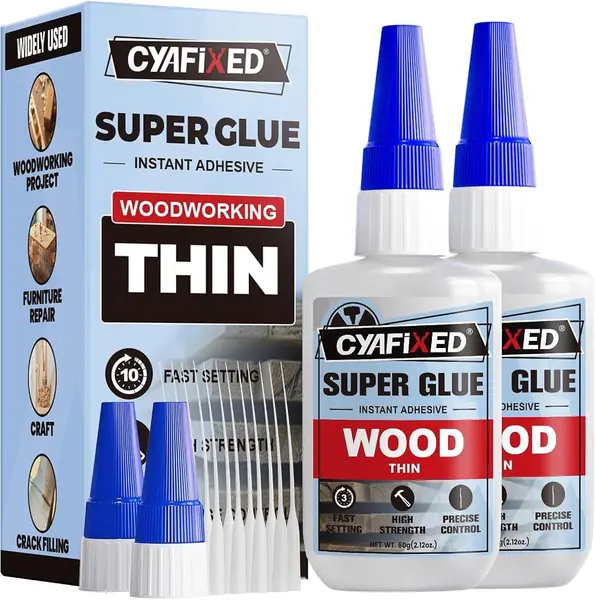
CYAFIXED Thin Viscosity CA Glue 4 oz Best Large Bottle for Wood

CYAFIXED Thin Viscosity CA glue two-bottle pack with microtips and caps

Wood and balsa

Track Score 91/100
Viscosity
2 CPS
Set Time
3-30 seconds
Applicator Kit
12 microtips and 2 caps
Pack Size
Two 2-oz bottles
View on Amazon

The two-bottle format tells you who this is for: someone who goes through thin CA in ounces, not drops. This is the CYAFIXED bottle we keep for balsa, hardwood, and larger model assemblies, where a single tiny container would run out before the frame is done. You get two 2-ounce bottles of 2 CPS liquid, plus 12 microtips and two caps.

At 2 CPS it is extremely thin, almost like water, and the listed 3-to-30-second set range gives you some room depending on the joint and how much you apply. On tight fits it pulls in cleanly. On open grain, use less than you think; this is a glue for contact, not for filling a visible gap.

The maker's own recommendations lean toward wood, and that is how we treat it. For plastic, resin, or photo-etch, one of the smaller all-purpose picks is easier to justify. For a wooden ship model, balsa framing, or a run of pen blanks, the two-bottle pack is a practical way to keep thin CA on the bench without constant reordering.

Worth Noting

  • Very runny on vertical assemblies
Our Verdict

We like this two-bottle pack for balsa, wood, and larger builds where you will use thin CA by the ounce, not the drop.

Check Latest Price
6.

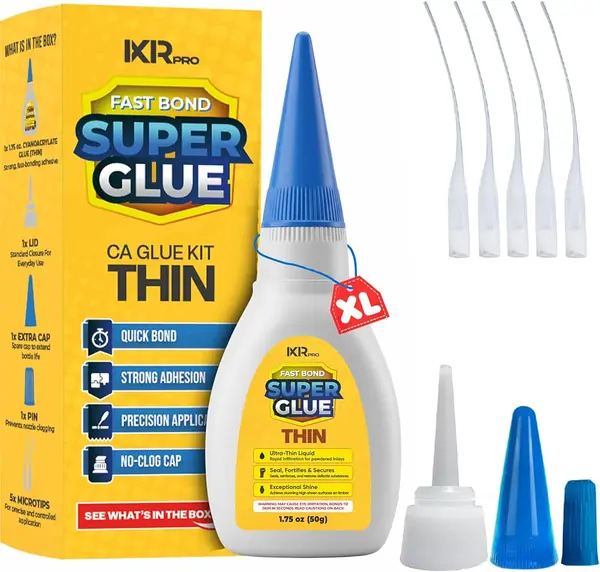
ixirpro Thin CA Glue Best Starter Kit for Fine Work

ixirpro Thin CA glue tube with microtips, pin, and lid

Fine detail repairs

Track Score 90/100
Viscosity
2-5 CPS
Bottle Size
1.75 oz
Set Time
5-10 seconds with activator
Applicator Kit
5 microtips, pin, lid
View on Amazon

The cure time is the first thing to understand. ixirpro lists five to ten seconds with an activator spray and a longer full cure without it. That makes this less of a one-drop-and-done bottle than the fastest glues here, and more of a kit you use with a plan.

The kit itself is well thought out for fine work: a 1.75-ounce tube, five microtips, a pin, and a lid. The 2-5 CPS adhesive is watery enough to reach hairline seams and small model joints, and the microtips keep the drops where you aim them.

We like the small-tube format for detail sessions because it is easy to keep close to the work. The activator-dependent cure is a trade-off: it adds a step, but it also gives you a way to speed a joint when you need to keep a build moving. Without accelerator, plan for a slower full cure rather than an instant structural bond.

Our judgment is that this suits a builder who wants a compact precision kit and does not mind reaching for accelerator on fussy joints. It is not our first choice for a bottle that will sit for months; buy it when you have a run of detail work, not as a once-a-year emergency tube. The five microtips are generous enough to make the kit feel complete.

Worth Noting

  • Can cloud clear inlay work
Our Verdict

We suggest this kit for detail work where microtips matter more than a huge bottle, and where you can give the joint a little setup time.

Check Latest Price
7.

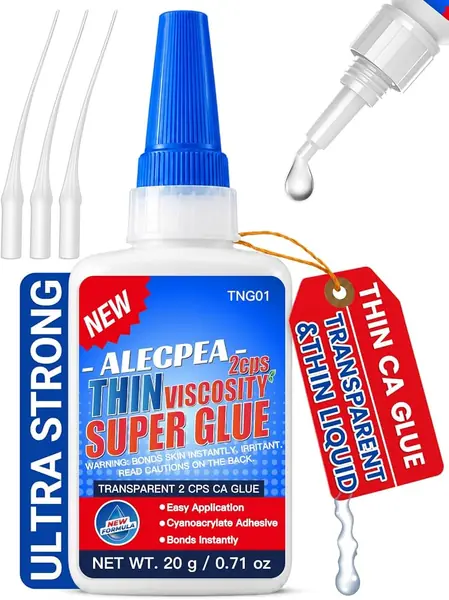
ALECPEA Thin CA Glue 20g Best for Tiny Miniature Repairs

ALECPEA Thin CA glue bottle with three precision droppers

Tiny miniature repairs

Track Score 89/100
Viscosity
Low
Bottle Size
0.71 oz
Set Time
10-45 seconds
Included
3 precision droppers
View on Amazon

A 20-gram bottle and three droppers make this a small-repair kit rather than a workshop refill. The point is control: you can place a drop at a hairline seam without dragging the bottle across the model. For miniatures and tiny parts, that matters more than a large fill.

The formula is low viscosity and meant for close-fitting joints, and the 10-to-45-second set gives you more adjustment time than the fastest thin CAs. We like that for delicate parts that shift when you look at them; it lets you nudge a piece before the bond grabs. The three droppers are a practical addition rather than a gimmick.

Our call is that it earns a place as a small-bottle option for delicate repairs, not as the all-purpose bottle. The slower set rewards patience but can punish a joint you expected to hold instantly, and the formula is not intended for polyethylene or polypropylene. For a miniature, a jewelry repair, or a tight detail that needs a careful drop, it is easy to justify. A 20-gram bottle is a sensible way to try a thin CA without committing to a workshop-size container.

Worth Noting

  • Small 0.71-oz bottle runs out fast
Our Verdict

We see this as a small-bottle option for miniature repairs and delicate parts, provided you give its slower set time room in your workflow.

Check Latest Price
8.

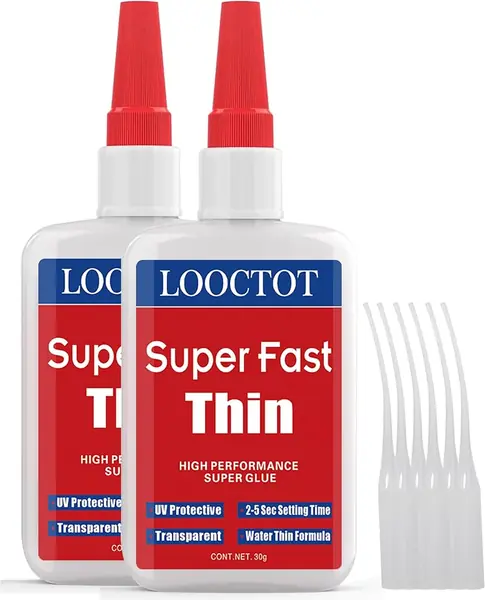
LOOCTOT Thin CA Glue 60g

LOOCTOT water-thin CA glue bottle with anti-clogging cap

High-volume woodwork

Track Score 86/100
Viscosity
Water-thin
Bottle Size
2.12 oz
Set Time
2-5 seconds
Tensile Strength
3,500 psi
View on Amazon

A 60-gram bottle is a commitment. This is the thin CA for a woodturner or a builder who goes through glue on large surfaces, not for someone who needs a single delicate seam once a month. The size is the feature, and it changes how you shop.

The formula is water-thin and lists a two-to-five-second set, so it behaves like a fast wicking glue rather than a gap filler. We like the anti-clogging cap and the 3,500 psi tensile figure for shop work, and the large fill means fewer mid-project reorders. The clear, waterproof finish is also useful on wood pieces that will be handled.

On a model bench, its best use is bigger wooden assemblies and balsa framing where you can work flat and control the run. It is not the bottle for a photo-etch joint that needs a measured microdrop. The listed full cure runs to 24 hours, so leave a stressed joint alone longer than the fast surface set suggests.

Our judgment is that it is a bulk-buy bottle for high-volume woodwork, not the precision pick for fine miniatures. The two-to-five-second set and water-thin flow are useful when you can apply a thin line and keep the work level; on vertical detail, the same glue can escape before it cures. A bottle this large is best bought when you have a project list ready.

Worth Noting

  • Bottle is easy to tip over
Our Verdict

For woodturners and large balsa frames, we value the big fill: it makes water-thin CA practical at a scale where tiny bottles disappear.

Check Latest Price

How We Tested Thin CA Glue at the Bench

We built the shortlist from spec sheets, comparing stated viscosity in CPS, set times, applicator hardware, bottle size, and cost per ounce. Fifteen bottles went to the bench for three months.

Every bottle was used the way a modeler uses one: wicked into the seam of a two-piece fuselage, run along 3D-printed PLA and PETG brackets, laid into balsa and hardwood joints, worked into inlay and a pen blank, and pressed into service on a loose chair spindle and a cracked mug. We timed set with a stopwatch from the moment parts were pressed together, watched whether a drop traveled along a hairline seam or beaded on top of it, and laid drops on vertical and end-grain faces to see which ones ran, which soaked in and starved the joint, and which stayed put.

Once joints had cured, we twisted and flexed them until something gave and noted whether the wood or the bond failed first, then left the finished pieces on a shelf and checked them again weeks later for creep, clouding, or bloom on clear parts. Applicators got the same scrutiny: we counted how many microtips a bottle burned through, whether the cap came off clean after a week of sitting, and how much glue we lost to crusted tips. Weighing each bottle before and after gave us a real cost per usable ounce.

Safety shaped the whole process. We wore eye protection at the bench, kept glue off skin, worked with a fan pulling fumes away from our faces, never leaned in over an open bottle, and capped each one as soon as we were done. Accelerator stayed a sparing, ventilated tool, and everything went back into a drawer out of reach of kids and pets.

How to Choose a Thin CA Glue for Model Building

Start With Viscosity, Not the Label

Thin is a marketing word until you see the number. For hairline model seams, we look for a water-thin super glue in the roughly 2-to-50 CPS range; the lower end wicks fastest, while a 40-to-50 CPS glue gives slightly more working control. A 100 CPS bottle is a medium CA despite a thin label, and a gel is the wrong tool for capillary flow. Check the viscosity on the exact bottle you are buying, not just the headline. If a bottle calls a glue thin but lists 100 CPS, treat it as a general-purpose adhesive rather than a seam wicker.

Match the Glue to the Material

On balsa and open-grain wood, water-thin CA can travel past the joint, so use a small drop and keep the bottle moving. Resin, photo-etch, and 3D-printed parts usually want the same low viscosity but a tighter, cleaner fit. PLA and PETG bond well with the specialty formulas here; polyethylene and polypropylene generally do not, no matter how the bottle is labeled. For a mixed-material bench, choose a glue that names the materials you actually use, and test on scrap before you commit a finished part.

Application Control Is Half the Job

Microtips, droppers, and anti-clog caps are not accessories; they are what keep a water-thin glue out of places you did not intend. A needle tip lets you touch a drop to a seam and let capillary action do the rest, while a plain bottle is better suited to horizontal work where you can control the bead. We prefer a kit with spare tips for detail work and a simple bottle for large wood assemblies. If the cap clogs, clean it before you squeeze harder; pressure is how a thin CA floods a joint.

Set Time, Shelf Life, and Safety

Fast set is useful only if you can align the part first. Two to five seconds is unforgiving on complex assemblies; ten to forty-five seconds gives more adjustment room. Accelerator shortens the wait but can make the bond brittle or cloudy, so test it. Thin CA also bonds skin in seconds, so wear eye protection, ventilate the area, and keep bottles away from children and pets. Buy a bottle size you will finish in a season; an open bottle can thicken or clog before the next project.

Frequently Asked Questions

Final Verdict

For most model builders, we put the Starbond Super Fast Thin kit first because it combines a genuinely water-thin glue with the tips and pin cap that make small-joint work controllable.

If you prefer a plain bottle and already have your own applicator, the Bob Smith 103 is the capillary classic to choose. Choose KRAFTPROTZ for 3D-printed assemblies, the 5 CPS CYAFIXED for a tight budget, or the two-bottle CYAFIXED pack when wood and balsa dominate your bench.