Best Glue for Gunpla of 2026

A snap-fit Gunpla kit holds together without glue, which is exactly why the glue matters: you aren't assembling the model so much as erasing the evidence that it's a model. Solvent cement melts two polystyrene edges into one and disappears under sandpaper. CA grabs in seconds and handles resin and printed parts, but it doesn't care whether it lands on the part or your fingertip, and thin CA can frost a painted shoulder piece.

Thin isn't stronger. It wicks, pulling into a seam you can't see until you sand. Set time and cure time are separate events, too, so a joint that feels locked in ten seconds can still shift a day later. Across 14 thin, medium, gel and solvent bottles used on real builds, the seven picks cover seam welding, snapped pegs, resin conversions and printed parts.

Our Top Picks

The Best Glue for Gunpla

1.

Tamiya Extra Thin Cement 87038 Best Overall
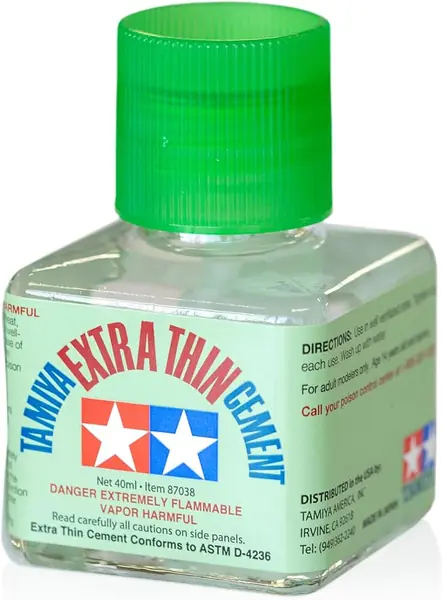
Tamiya Extra Thin Cement bottle with fine applicator and clear 40 ml liquid

Polystyrene seam welding

Track Score 96/100
Type
Extra-thin solvent cement
Volume
40 ml
Applicator
Fine tip
Compatible Material
Plastic
View on Amazon

For bare polystyrene seams, we start with Tamiya Extra Thin. The 40 ml bottle and fine applicator let you touch cement to a fitted joint and let capillary action pull it into the seam; that's the difference between welding two parts into one surface and leaving a ridge to sand. We recommend it as the default for anyone building unpainted Gunpla.

The low-viscosity liquid is the point. It flows into the gap between parts that already fit closely, so you can assemble dry, touch the seam, and squeeze gently to spread the bond. That also means it rewards a clean joint: flash, paint, or a loose fit will keep it from doing its best work. We keep a dedicated bottle for seam work.

The 24-hour full cure is worth respecting. Parts may hold in minutes, but we leave stressed joints alone overnight before sanding or posing. The smell is strong enough that we keep a window open and cap the bottle between seams. What earns it the top spot is control: a little cement goes a long way, and the fine tip puts it at the seam instead of on surrounding detail. For the polystyrene work that makes up most of a Gunpla build, that's the tool we want in hand.

Worth Noting

  • Not for ABS resin or gap filling
Our Verdict

We recommend Tamiya Extra Thin as the default for bare polystyrene Gunpla because the low-viscosity cement and fine applicator weld seams cleanly and stay where you put them.

Check Latest Price
2.

Starbond Super Fast Thin CA Best for Fast Repairs

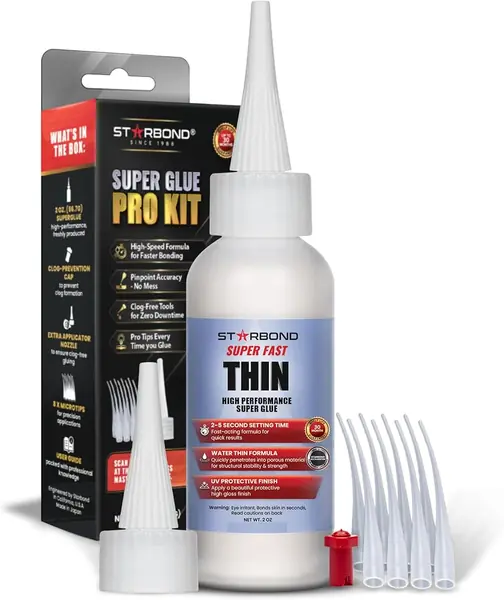
Starbond Super Fast Thin CA glue bottle with microtips and applicator nozzles

Fast ABS repairs

Track Score 95/100
Type
Thin CA glue
Volume
2 oz
Set Time
2-3 seconds
Included
2 nozzles and 8 microtips
View on Amazon

Thin CA is a repair tool, not a seam welder. Starbond Super Fast Thin is for a tight break in ABS or resin that has to hold now: the 2-3 second set is fast enough that you need to have the parts aligned before the drop lands, and the eight microtips let you put it exactly at the crack instead of beside it.

What we like is the speed for small, clean breaks. A little glue goes a long way, and the thin liquid wicks into a hairline gap before it sets. We apply it from the tip, not the bottle, and keep a paper towel under the part. The spare nozzles help keep it usable, and the two-ounce bottle gives you more working life than the tiny tubes. The microtips are thin enough to reach a crack without flooding the surrounding detail.

It is not the CA we choose for filling a gap or building up a missing chunk; that's a job for a medium or gel. But for a cracked peg or a small conversion part that needs an instant bond, this is the one we keep within reach.

Worth Noting

  • Thin liquid can run before setting
Our Verdict

We reach for this thin CA when a tight ABS or resin break needs speed; the 2-3 second set and microtips make it a repair tool, not a seam welder.

Check Latest Price
3.

Starbond Medium CA Pro Kit Best All-Around CA

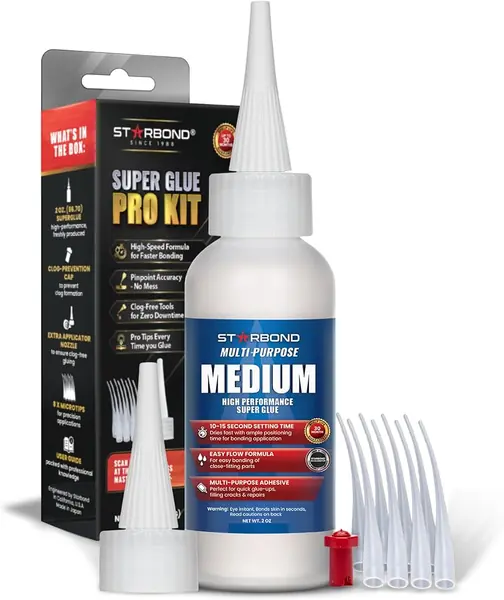
Starbond Medium CA glue pro kit bottle with microtips and spare nozzles

Mixed-material assembly

Track Score 94/100
Type
CA glue
Volume
2 oz
Set Time
10-15 seconds
Included
2 nozzles, 8 microtips, pin cap
View on Amazon

Ten to 15 seconds is enough time to slide a part into place without holding it forever. That working window is what separates Starbond's Medium CA from the two- to three-second thin grades, and the pro kit adds two nozzles and eight microtips for small joints.

We use it for ABS inner-frame repairs, resin accessories, and places where a thin CA would set before we're ready. A little goes far, and the two-ounce bottle gives you room to practice. The included pin cap helps keep the nozzle clear between sessions.

What we like most is the balance: it gives us a moment to line up a mixed-material joint without making us hold it for a minute. For a cleanly snapped peg or a small conversion part, this is the CA we use most often.

Worth Noting

  • Not for large gap filling
Our Verdict

We like this CA for mixed-material assembly because its 10-15 second set gives us a little positioning time before the bond grabs.

Check Latest Price
4.

Loctite Ultra Gel Control Best Gel for Broken Pegs

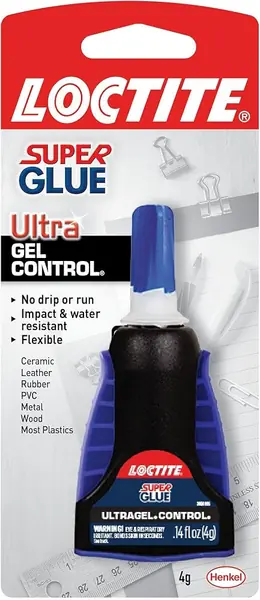
Loctite Ultra Gel Control clear super glue in a small side-squeeze bottle

Broken peg repairs

Track Score 93/100
Type
Rubber-toughened gel CA
Volume
0.14 fl oz
Dispensing
Side-squeeze bottle
Water Resistance
Water resistant
View on Amazon

A side-squeeze gel bottle is a different kind of control. Loctite Ultra Gel Control puts a no-drip bead exactly where you squeeze, so it is the one we grab for a broken peg on a vertical inner frame or a repair where a runny CA can travel into a joint you don't want glued.

We keep it for repairs, not seam work. The gel stays put, sets clear, and the rubber-toughened formula is meant to resist impact and vibration; that makes it a sensible choice for a load-bearing peg or a part that gets handled. We use it in dots, not lines.

For a small, high-control repair on an assembled kit, the control is worth it. The clear set keeps repairs discreet on dark plastic. If you need to weld a polystyrene seam, this is the wrong bottle; keep it for the broken bits.

Worth Noting

  • Tiny 0.14 fl oz bottle runs out fast
  • Gel can take longer to set
Our Verdict

We keep this gel for broken pegs and vertical repairs where a runny CA can travel; the side-squeeze bottle puts a controlled bead exactly where we want it.

Check Latest Price
5.

KRAFTPROTZ 3D Printing Super Glue Best for Resin and Printed Parts

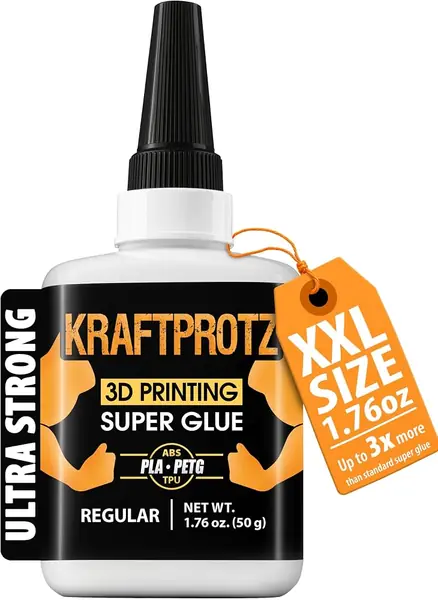
KRAFTPROTZ 3D Printing Super Glue liquid bottle with precision needle tip

Resin and prints

Track Score 92/100
Type
Liquid CA for 3D prints
Volume
1.76 fl oz
Applicator
Precision needle tip
Compatible Materials
PLA, ABS, PETG, TPU, ASA, nylon
View on Amazon

Resin conversion parts and 3D-printed add-ons are where this bottle makes sense. KRAFTPROTZ's 3D Printing Super Glue is a liquid CA with a precision needle tip and stated compatibility with PLA, ABS, PETG, TPU, ASA, and nylon; we recommend it for printed parts and resin details that need a capillary bond without a thick gel line.

The 1.76 oz bottle is generous for a thin CA, and the needle tip is the detail that matters on small parts: you can touch a drop to a join and let it wick rather than squeeze a blob onto the surface. We also like that the formula is described as heat and water resistant, which is useful for parts that get handled or displayed near a window. The bottle is more than enough for a conversion project.

It does not replace Tamiya for polystyrene seam welding. This is a CA, so it sits on the surface rather than melting the plastic together, and the material list doesn't include polystyrene. Use it for printed or resin pieces, or for repairs where a thin bond line matters. For a mixed build, that makes it a useful second bottle rather than the only one on the bench.

Worth Noting

  • Thin liquid can run on vertical parts
Our Verdict

For resin and 3D-printed conversion parts, this needle-tip liquid CA is our pick; its stated ABS/PETG compatibility and fine applicator suit small joins better than a seam cement.

Check Latest Price
6.

Gorilla Micro Precise Super Glue Best for Tiny Detail Parts

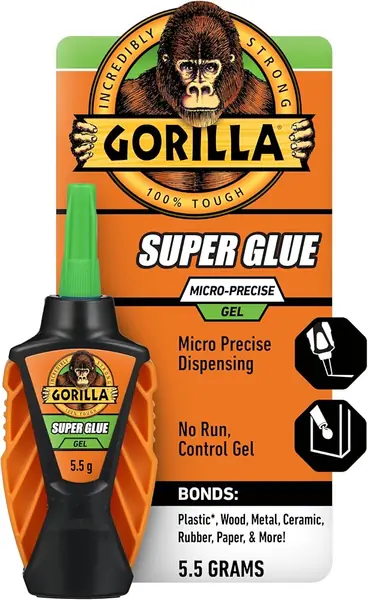
Gorilla Micro Precise Super Glue gel tube with controlled dispensing tip

Tiny detail parts

Track Score 91/100
Type
Gel CA
Volume
0.19 oz
Set Time
10-45 seconds
Dispensing
Controlled squeeze dispenser
View on Amazon

The Gorilla Micro Precise is built around its dispenser. The controlled squeeze puts a small gel drop where you want it, not a blob that has to be cleaned up, and that is the feature that matters on detail parts, sensors, or a tiny repair on an assembled kit.

The gel stays put on vertical surfaces, and the 10-45 second set gives you a moment to adjust before it grabs. It is thicker than a thin CA, so it won't wick into a hairline seam; this is a surface bond for small parts, not a seam welder. The clear gel dries without a colored line, which matters on light plastic.

We use it for spots where a full-size CA bottle would be clumsy. The precision is worth it when one careful drop is the whole repair. We keep it for the tiny jobs and switch to a larger CA when the work spreads out.

Worth Noting

  • Small 5.5 g tube empties quickly
Our Verdict

We find detail parts are where this tiny gel earns its keep: the controlled squeeze places a drop where a full-size CA would flood the joint.

Check Latest Price
7.

Gorilla Super Glue Brush & Nozzle

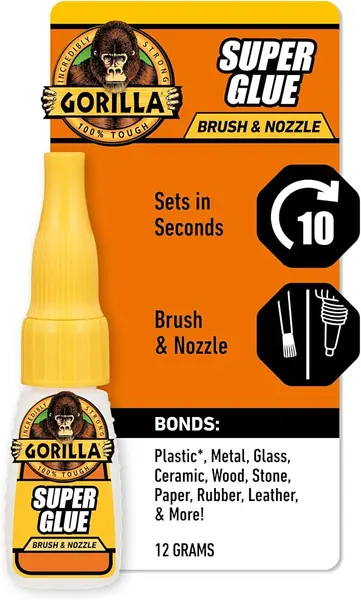
Gorilla Super Glue brush and nozzle bottle with clear 12 g adhesive

Larger joint coverage

Track Score 90/100
Type
Medium-viscosity CA
Volume
0.42 oz
Set Time
10-45 seconds
Applicators
Brush and precision nozzle
View on Amazon

Two applicators in one bottle is the reason to pick up Gorilla Super Glue Brush & Nozzle. The brush lets you paint a thin line of medium-viscosity CA along a larger joint, while the precision nozzle gives you a drop for a spot repair. For Gunpla, that makes it a useful bridge between a gel and a thin CA.

The medium body resists running better than a watery CA, so it stays where you brush it on a vertical or overhead surface. The 10-45 second set gives you time to position a part, and the 12-gram bottle is a manageable size for a bench drawer.

We use the brush for edge-to-edge joins and the nozzle for tight spots. The brush is the part that makes it feel controlled; you can load a small amount and work it along the joint instead of squeezing a blob. The clear adhesive is easy to hide on light or dark plastic.

For a larger repair or a mixed-material join where we want controlled coverage, this is the bottle to use. The brush is the part we appreciate most: it turns a repair into a deliberate application instead of a squeeze-and-hope.

Worth Noting

  • Not for capillary seam welding
Our Verdict

Brush-and-nozzle control is why we pick this bottle for larger joints, especially when we want a thin line of CA rather than a drop.

Check Latest Price

How We Tested Glue for Gunpla Models

We started by sorting the category by chemistry rather than by brand: solvent cements, thin CA, medium CA, gel CA, and formulas pitched at printed parts. From there we filtered on material compatibility with polystyrene, ABS, and resin, then on applicator type, bottle size, clog resistance, and price, and bought 14 bottles to use over five months.

Every bottle got the same jobs. We touched a tip to a seam line and watched whether the cement ran along the joint on its own or pooled where it landed; after it cured we sanded the seam and looked for a ghost line. For CA, we timed how long a part needed steady pressure before it stopped sliding, then left the assembly alone for a full day before handling it, because a joint that feels set is often still curing. We filled widened peg sockets on a kit that had been dropped, checked whether the repair held under normal posing, and glued resin conversion parts and printed pieces to see which formulas actually bit.

Applicators got their own accounting. Bottles sat capped for a week or more between sessions, and we counted how many needed a pin or a wipe before they dispensed cleanly again. We tracked how many kits a bottle lasted, worked on scrap runners first, kept CA off skin entirely, and noted which formulas required an open window and which we could use at a shared table without clearing the room.

How to Choose Glue for Gunpla

Start With the Plastic

Gunpla sprues are usually labeled PS or ABS, and that label decides the adhesive. Polystyrene is the plastic that solvent cement is made for: the cement softens the surfaces so they fuse into one piece, which is why it can make a seam disappear. ABS inner frames, resin conversion parts, and painted pieces need a CA instead, because the solvent won't weld them the same way. Check the runner before opening a bottle; if you can't tell, test on a hidden sprue first.

Match Viscosity to the Joint

Extra-thin cement is for tight-fitting polystyrene seams; it moves by capillary action and leaves almost no material to sand. Thin CA is for hairline cracks and small repairs, where you want the glue to wick in fast. Medium CA and gel are for gaps, vertical surfaces, and broken pegs, where you need the glue to stay put long enough to position the part. A gel won't wick into a seam, and an extra-thin cement won't bridge a gap, so pick by the joint, not by the strongest claim on the label.

Separate Set Time From Cure Time

Set time is how long you hold the part; full cure is when you can sand, pose, or stress it. A thin CA may grab in a few seconds, a medium CA gives you 10-15 seconds, and a gel can take longer, but many CA labels still call for a 24-hour full cure. Tamiya's cement lists a 24-hour full cure too. We leave newly glued joints alone overnight before sanding or attaching them to a moving frame, even when they feel solid.

Applicators and Bottle Life

On small parts, the applicator matters as much as the adhesive. A fine tip or microtip lets you place a drop without flooding the joint; a brush is useful for larger areas but can load more glue than a seam needs. Anti-clog caps and spare nozzles help, but no bottle lasts forever if you leave the tip dirty. We wipe the tip, cap it upright, and keep a small bottle for detail work and a larger one for repairs. Tiny bottles are convenient but run out fast on bigger jobs.

Ventilation and Skin Contact

Solvent cement has strong fumes, and CA glue bonds skin almost instantly. We work near an open window, keep caps on between passes, and avoid leaning over the bottle. A small fan moving air across the bench helps, but don't blow dust onto a wet joint. Keep CA off your fingers, and don't use your mouth to clear a clogged tip. If you get CA on skin, don't pull; use warm soapy water or a debonder. These are small habits that make a long build more pleasant.

Frequently Asked Questions

Final Verdict

Tamiya Extra Thin Cement is the bottle we start with for most Gunpla builds. It welds bare polystyrene seams with capillary action, so there is less raised glue to sand, and the fine applicator keeps the cement on the joint. For ABS inner frames, resin parts, and broken pegs, keep a CA beside it: Starbond Super Fast Thin for a tight, fast repair or Loctite Ultra Gel Control when you need a no-drip bead. The right second bottle depends on whether your next job is a crack or a vertical peg.