Best Warbird RC Planes of 2026

Warbirds are the fun part of this hobby and the quickest way to learn how good you are at foam repairs. A Mustang or a Corsair looks fantastic at eye level, but narrow wings and a short nose make it twitchier than a boxy trainer, and a late correction a trainer shrugs off puts a warbird in the grass. A first warbird flight can be over in forty seconds.

Two things surprise first-time buyers. Three-channel planes steer mostly with rudder while four-channel planes add ailerons, and the gyro switch is what lets you fly in a breeze you would otherwise sit out. Each of the six picks gives you a safety net on the first flight and gets out of the way afterward. We flew 12 planes from a grass field on early mornings; none is a competition aerobat, so choose by the size of your field and your nerve.

Our Top Picks

The Best Warbird RC Planes

1.

VolantexRC P51D Mustang 4CH Best Overall
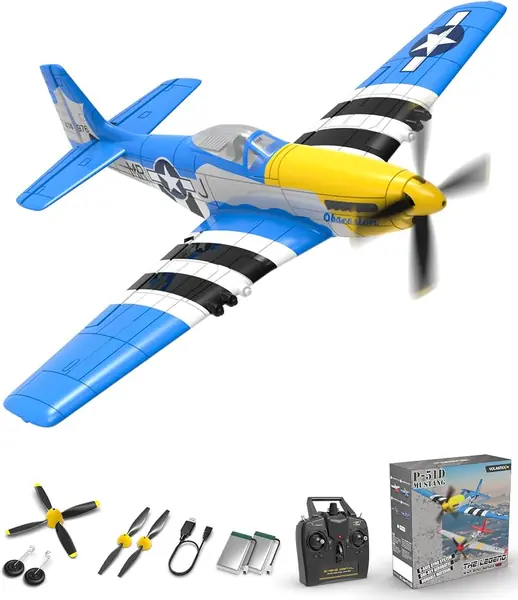
Blue VolantexRC P51D Mustang four-channel RC warbird airplane with propeller and landing gear

First warbird

Track Score 83/100
Channels
4-channel
Assist Modes
3 levels (beginner, intermediate, expert)
Control Range
656 ft (2.4GHz)
Claimed Flight Time
About 20 minutes
View on Amazon

Set it beside the other four-channel Mustangs here and the spec lines look almost identical: the same 656-foot radio link, the same three assist levels, the same molded foam airframe. What separates the VolantexRC is what happens in the first thirty seconds of a flight. Beginner mode is close to hands-off, with the gyro holding the wings level while you learn which stick does what, and the step up to intermediate is small enough to take in the same afternoon rather than the same season.

That progression is why it sits at the top of this list. Plenty of beginner planes are training wheels you outgrow by the second weekend; this one hands over authority in stages, so a single airframe carries a new pilot from a nervous first hand launch to a one-key barrel roll. It also arrives bound and trimmed, which meant we were flying minutes after opening the box rather than hunting through sub-trims, and two battery packs come included.

The parts that give up first are the ones hanging off the nose and the belly. The propeller is designed to pop off in a bump instead of snapping a shaft, which we appreciated on the landings that turned into arrivals, and the landing gear takes the rest of the punishment. Keep a couple of spares in the bag and this plane keeps flying.

Where it surprised us was wind. The gyro does not just make it docile in still air; a steady breeze that pushes a lighter foamy around is something this Mustang leans into, and it stays pointed where you left it. That is the difference between a plane you fly twice and one that lives in the car.

Worth Noting

  • Wheels and props take the damage on hard arrivals
Our Verdict

We recommend the VolantexRC P51D for most people buying a first warbird: four channels, three assist levels, and the steadiest flight manners of the four-channel planes here.

Check Latest Price
2.

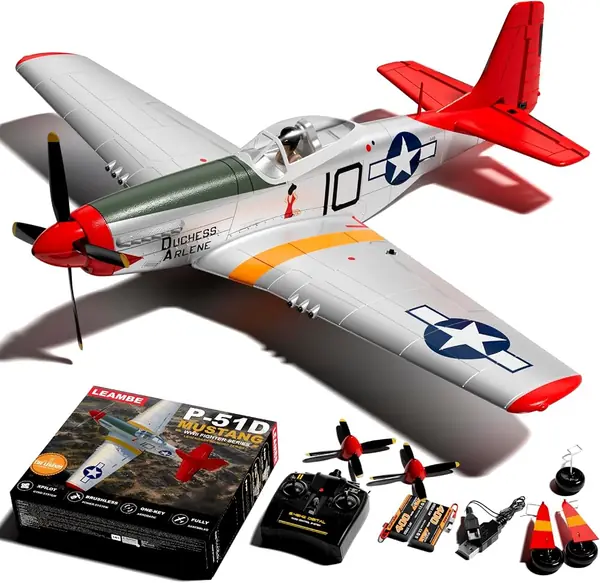
LEAMBE Brushless P51 Mustang Best Brushless Power

White LEAMBE brushless P51 Mustang RC airplane with extra-large foam airframe and propeller

Big windy fields

Track Score 82/100
Channels
4-channel, 3 assist levels
Control Range
656 ft
Motor
Brushless
Dimensions
19.7 x 6.69 x 15.75 inches
View on Amazon

The brushless motor is why this Mustang costs the most here, and after a few packs we stopped thinking of it as a line on the box. It holds its RPM under load, so the extra-large LEAMBE keeps climbing when a geared plane has already run out of pull, and it does it quietly, with no motor whine giving your position away across the park.

Extra large is not marketing. At 19.7 x 6.69 x 15.75 inches this is the biggest airframe we are recommending, and the size pays off in the air: easier to see at the far side of a field, less shoved around when the wind picks up, and far easier to read which way the nose is pointed when it is coming toward you.

It arrives pre-assembled, and field setup is the work of a minute: wing on, battery in, go. We also like the radio, good for 656 feet with anti-interference circuitry, enough to fly alongside two friends who brought planes instead of alone in a corner of the park.

Give it room on the landing approach, because an airframe this size covers ground quickly on final. It is the pick for a big field and a breezy afternoon, and it is wasted on a small yard where the turns come up faster than the plane does.

Worth Noting

  • Prop and wheels let go in hard landings
Our Verdict

For a big field and a steady breeze: a brushless motor and an extra-large airframe give it the thrust and presence the geared planes here cannot match.

Check Latest Price
3.

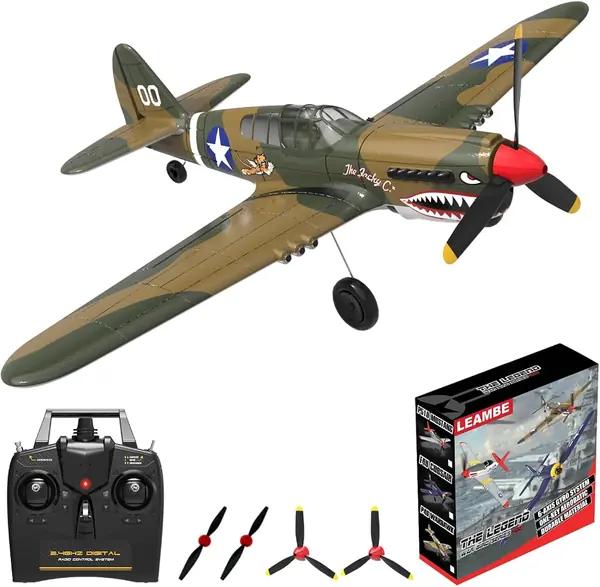
LEAMBE P-40 Warhawk Best Looking

Green LEAMBE P-40 Warhawk four-channel RC airplane with propeller and landing gear

Scale looks

Track Score 81/100
Channels
4-channel, 3 assist levels
Wingspan
15 inches
Spare Propellers
4 included
Claimed Flight Time
Up to 15 minutes
View on Amazon

The P-40 is the one people walk over to look at. Olive-green finish, the big nose, the tail squared off instead of rounded: LEAMBE got the shapes right, and the model reads as a warbird from across a field rather than a foam toy with a sticker set. If the reason you want one of these is the way a WWII fighter looks sitting on a workbench, this is the one to buy.

It happens to fly well too. Four channels, three assist levels, and a claimed fifteen minutes a pack; beginner mode is docile enough for a first-timer, and the middle setting is where the P-40 is at its best, responsive without being twitchy.

Expert mode is a different animal. A fourteen-inch fuselage with full manual control is a lot of airplane for a small airframe, and it will punish a heavy thumb, which is exactly why the assist switch matters on this model. The 15-inch wingspan puts it in the same park-flyer class as everything else here: a ball field, a calm evening, and no ambitions about flying it between the trees.

Between this and the brushless Mustang above, we take the P-40 for looks and the Mustang for an easier time in expert mode. Neither is a wrong answer, and the P-40 is the one you will want to leave out on the shelf between flying days.

Worth Noting

  • Prop savers wear out and stop gripping
Our Verdict

The P-40 is for the pilot who wants a warbird that looks right on the bench as well as in the air; it is the best-looking model here, and it still flies on a beginner setting.

Check Latest Price
4.

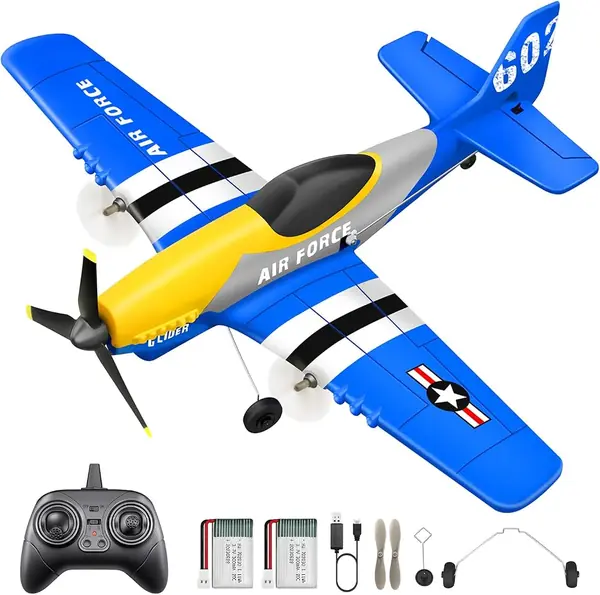
HAWK'S WORK P-51D 3-Channel Best Budget

Blue HAWK'S WORK P-51D three-channel RC airplane with propeller and landing wheels

Young beginners

Track Score 80/100
Channels
3-channel
Batteries
2 rechargeable included
Warranty
1 year airframe, 3 months battery
Takeoff Modes
Hand launch or taxiing takeoff
View on Amazon

If the goal is a first flight rather than a first warbird, this is where we start people. Three channels means throttle, elevator and rudder, with no ailerons, so the plane turns on the rudder and the six-axis gyro keeps it from rolling into a spiral while a new pilot works out which way is away.

We like that it teaches the two things that actually matter early: throttle management and orientation. It has two takeoff modes, a hand launch or a taxi run of five to ten meters on its wheels, and switching between them is a switch rather than a rebuild. Two brushed motors and a high-low speed setting mean it is not fast, and at this stage that is a feature.

The coverage is the real story. HAWK'S WORK backs the airframe for a year and the battery for three months, the longest warranty in this guide, and on a first plane that counts for more than any figure on the box.

Its ceiling is the ailerons it does not have: no rolls, no inverted flight, none of the aerobatics the four-channel planes are for. That is exactly right for the eight-to-twelve-year-old this model is meant for, and when the pilot outgrows it, the same brand sells a four-channel P-51D and a BF-109 in the same size.

Worth Noting

  • Wheels work loose after hard arrivals
Our Verdict

The plane we hand a kid or a total beginner: three channels, two batteries, and a one-year airframe warranty for the least money in this group.

Check Latest Price
5.

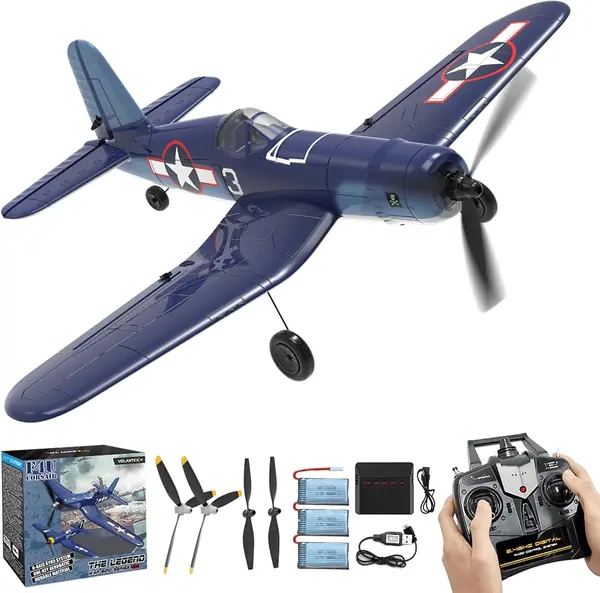
RCkuler F4U Corsair 400mm Best for Corsair Fans

Blue RCkuler F4U Corsair 400mm RC warbird with three batteries and five propellers

Corsair fans

Track Score 79/100
Channels
4-channel, 3 flight modes
Wingspan
400mm
Batteries
3 included
Spare Propellers
5 included
View on Amazon

Open the box and there is a plane, three batteries, a five-port charger and five propellers. That is the most complete kit in this guide, and it changes an afternoon: three packs is three flights without a charging break, and five props is a lot of bad landings before you have to order anything.

The airframe is a 400mm Corsair in EPP foam with the gull wing, a clear canopy instead of a painted blob, and a blue scheme that stays visible against a gray sky. There are two takeoff options, hand launch or a gliding takeoff off the ground, plus one-key aerobatics for the days you feel brave.

The one-key search function sounds like a gimmick until you fly a fifteen-inch plane over grass. Press it and the model beeps so you can find it, and that is the feature we ended up valuing most, because every park has a patch of long grass with a plane in it.

It is a newer arrival than the Mustangs, so the long-term picture is thinner than the rest of this list, and we are comfortable saying so. It is still the Corsair we point people to, because nothing else here arrives this well equipped.

Worth Noting

  • Wants open space and still air
Our Verdict

If a Corsair is the shape you want, this is the version to get: three batteries, five props, and a one-key finder that pays for itself in tall grass.

Check Latest Price
6.

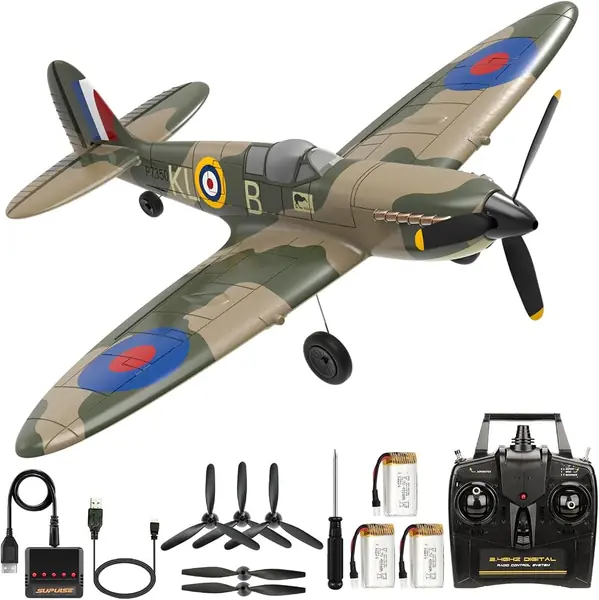
ANTSIR Spitfire 4-Channel Best for Spitfire Lovers

ANTSIR Supermarine Spitfire four-channel RC warbird airplane with painted fighter livery and spare propeller

Spitfire lovers

Track Score 78/100
Channels
4-channel
Assist Modes
3 levels (beginner, intermediate, expert)
Gyro
6-axis XPILOT stabilization
Special Functions
One-key aerobatic and U-turn
View on Amazon

Plenty of Mustangs on this list and exactly one Spitfire, which makes the choice easy for anyone who wants the Battle of Britain fighter rather than another P-51. The elliptical wing and the camouflage are done properly, and ANTSIR leans into the history rather than pretending it is just a toy.

On the sticks it is a real four-channel warbird: ailerons, elevator and rudder, a six-axis gyro, and three assist levels that step from fully stabilized to manual. We rate the one-key U-turn above the one-key roll, because on a small plane that gets small fast, a button that brings it back is worth more than a button that makes it spin.

There are low-battery and out-of-range alerts too, the two alarms that actually save an airframe, and a spare propeller in the box for the day the field wins.

What you pay for here is the shape, not the flight envelope. It costs about what the top pick does and flies like the rest of the 400mm class, so if the Spitfire is the one you want on the shelf between flying days, that is a fair reason to choose it.

Worth Noting

  • Nose and paint scuff in ordinary crashes
Our Verdict

Somebody on this list had to be the Spitfire, and this is it: four channels, three assist levels, and a U-turn button that turns a disappearing plane around.

Check Latest Price

How We Chose and Flew a Dozen Warbirds

We started by rounding up every ready-to-fly warbird we could find in the sizes that actually suit a park, then filtered on channel count, stabilization, wingspan, what came in the box, and price. Twelve planes came out the other side, and we flew all of them.

Testing ran eight months, mostly on weekend mornings at a local grass field and on empty school fields after work, plus one deliberately gusty afternoon to see what the assist modes were worth. We flew each plane on every assist setting, rolled and looped each one at altitude to see what the stabilization would let through, timed each pack with a stopwatch instead of trusting the box, and handed the transmitter to a friend who had never flown a plane in his life.

Then we tried to break them, gently. Every plane took a few landings it didn't plan, and we checked afterward for cracked foam, bent shafts, and props that needed swapping on the spot. We also counted the spare props and packs that shipped in each box, and timed both the run from car trunk to airborne and the repair after a hard arrival.

Battery handling got its own routine: every pack went on the supplied charger, on a concrete floor, with someone in the room, and we logged real flight time per pack against how many came in the box. Each plane stayed within sight and well clear of people, roads, and airports the whole time, and younger pilots only flew with an adult standing alongside. The six that made the list were still flying well on their tenth session, not just their first.

How to Choose a Warbird RC Plane

Three Channels or Four?

Three-channel planes control throttle, elevator and rudder. Four-channel adds ailerons, which is what lets a warbird roll, hold a banked turn without skidding, and fly inverted. For a kid or a total beginner, a three-channel trainer like the HAWK'S WORK is the gentler way in and still teaches throttle and orientation.

For anyone who wants the warbird experience, rolls, loops, a one-button barrel roll, go four channels. The trap is buying four channels and flicking to expert on day one: every four-channel plane here will out-turn its pilot for the first few packs, and the assist switch is the whole reason that does not end badly.

What the Assist Modes Actually Do

A six-axis gyro senses roll, pitch and yaw and corrects faster than a thumb can, and the three-position switch sets how much of that correction is applied. Beginner mode keeps the wings level and limits how far the plane can bank; intermediate loosens the leash; expert gets out of the way.

All six planes here offer three levels, and that switchable middle ground is what makes one airframe last past the first month. What the gyro cannot do is choose where the plane goes. It levels the model; it does not fly the circuit for you.

Match the Wingspan to Your Field

Everything in this guide is a park flyer, which means a ball field, not a backyard. The 400mm class, roughly 15 inches of wingspan, wants a football field of open grass, a clear line of sight and no spectators downwind. The extra-large LEAMBE is bigger again, easier to see and steadier in a breeze, but it covers ground quickly and needs more room to turn and land.

Smaller planes survive impacts better and fit in the car; bigger ones handle wind better. Buy for the field you actually have rather than the one you plan to find.

Power, Props and Repairs

Brushless motors deliver more thrust per ounce and have no brushes to wear out, at a price. Geared coreless motors are lighter and cheap enough to keep a plane small. For a first model, either is fine. What matters more is what is in the box: a prop saver that lets the blade pop off instead of snapping a shaft, spare props, and EPP foam that flexes rather than cracks.

Every plane here will lose a propeller eventually. The ones that ship with four or five spares are simply less annoying about it, and that is worth more than a slightly higher claimed top speed.

Frequently Asked Questions

Final Verdict

The VolantexRC P51D is the warbird we point most people to first. Four channels, three assist levels and a claimed twenty minutes a pack are the numbers, but the reason is simpler: it is the plane here that a beginner can fly on Saturday and still enjoy in six months, and it asks the least of your field and your thumbs.

If your field is big and the wind rarely settles, the brushless LEAMBE P-51 is the better buy. If the pilot is a kid, start with the three-channel HAWK'S WORK and save the ailerons for later. And if a particular airframe is the whole point, a P-40, a Corsair, a Spitfire, this list has one of each, which is exactly why we kept them.