Best STOL RC Planes of 2026

STOL sounds technical until you watch a good one land: nose high, flaps hanging, tailwheel kissing the grass a few feet past the fence post. That short-field habit is the reason to own one. You can fly off a mowed pasture or a dirt lot instead of driving an hour to a paved runway, and still have enough airplane for a loop on the way down.

The trade is real. All that wing and drag gives gorgeous slow flight and an airplane that gets shoved around in wind, and bind-and-fly saves money only if you already own a compatible transmitter. Over nine months on a grass strip, a club runway and a calm-morning park, the planes that won us over landed short without a fight. Choose by your field: a first airplane with switchable assist modes suits a calm park, and a big-winged model shrugs off a windy afternoon.

Our Top Picks

The Best STOL RC Planes

1.

E-flite Turbo Timber Evolution 1.5m Best Overall
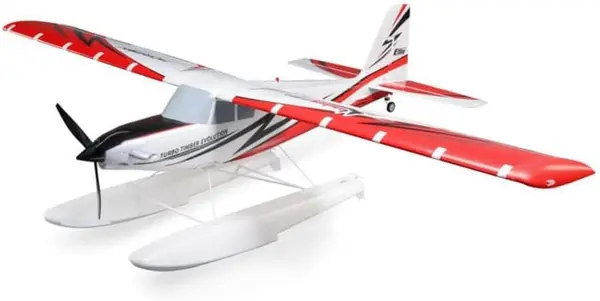
E-flite Turbo Timber Evolution 1.5m RC airplane with large wheels and optional floats

Rough-field STOL flying

Track Score 83/100
Wingspan
1.5 meters
Radio
Spektrum AR637TA with AS3X and SAFE Select, transmitter not included
In The Box
Floats and optional leading-edge slats
Power System
3S and 4S compatible outrunner, 3-blade prop
View on Amazon

The tires tell you what this airplane is for. Oversized rubber on shock-absorbing gear with heavier springs means a mown strip, a cut hayfield or a dirt road all count as a runway, and that is the whole point of the STOL breed. In the air it runs up to whatever speed you ask for, then slows right down for the landing without going twitchy, which is the combination we look for first in a bush plane. Of the four here, this is the one we hand to most pilots.

E-flite also puts the float set and a pair of leading-edge slats in the box, and the floats are what sold us on this version: bolt them on and a pond becomes a second flying site. The 70-amp Avian Smart ESC is the detail we appreciate most. It reports pack voltage and motor RPM through the AR637TA receiver to a telemetry-capable transmitter, and it reverses the motor, so you can cut a landing rollout short and back away from the water's edge instead of wading in after the plane.

Metal-geared servos and reinforced mounts address the parts that give up first on a foam bush plane, and ours has taken ordinary hangar rash without loosening up. The wing stays honest at low speed with the slats fitted, which is what lets you fly it into a short field rather than arrive there.

SAFE Select will level the wings when you lose orientation and the telemetry will call out a sagging pack, but neither teaches you to fly. We call this a second airplane — a generous one, because the slow-flight manners shorten the learning curve for anyone who has already turned a trainer around.

Worth Noting

  • No transmitter, battery, or charger included
Our Verdict

We recommend the Turbo Timber Evolution as the default STOL plane: it lands on mown grass or water, slows down when asked, and needs only a Spektrum radio and packs you may already own.

Check Latest Price
2.

HobbyZone Carbon Cub S 2 1.3m Best for Beginners

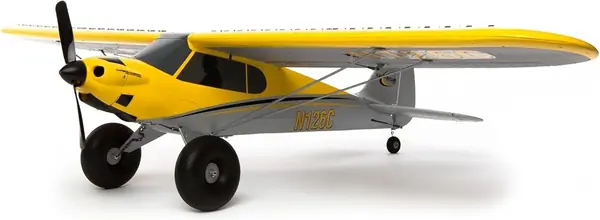
HobbyZone Carbon Cub S 2 1.3m RC trainer airplane in white with propeller and landing gear

First-time pilots

Track Score 82/100
Wingspan
1.3 meters
Radio
Spektrum DXS transmitter included
Flight Modes
Beginner, intermediate, and experienced
Flying Weight
4.4 lb
View on Amazon

If you do not own a transmitter yet, this is the only airplane here that solves the problem for you: the Spektrum DXS is in the box. Everything else about the Carbon Cub S 2 is aimed at the same buyer — a 1.3m foam Cub with SAFE on board and three flight modes you can switch between in the air, from a beginner setting that limits bank and pitch to an experienced mode that lets the airframe do Cub things.

That combination is why we point first-time pilots here. A 4.4-pound trainer with this much wing is stable enough to fly itself in a straight line for a few seconds while you think, and the mode switch means the same airplane is still interesting after three months. We also like that it is modeled on the CubCrafters Carbon Cub rather than a generic trainer, so it reads as a Cub both on the grass and overhead.

Two things sit outside the standard box. Flaps are an add-on rather than standard, and on a STOL airplane that is the upgrade we budget for first, because flaps are what let you bring it in slow over a fence line; the servo is a one-evening job. The foam also dents, so keep foam-safe glue and packing tape on the bench — a repaired trainer still flies straight.

One habit worth forming: run every control surface on the bench before the maiden. A servo or receiver can arrive dead, and five minutes of wiggling the sticks at home is cheaper than a cartwheel on the first takeoff. It is a calm-morning airplane; the heavier Super Timber is the one for days when the trees start moving.

Worth Noting

  • Battery and charger sold separately
Our Verdict

Our pick for anyone who has never flown: the Carbon Cub S 2 puts a transmitter in the box and SAFE modes on a switch, and it still flies like a proper Cub.

Check Latest Price
3.

E-flite Super Timber 1.7m Best for Windy Days

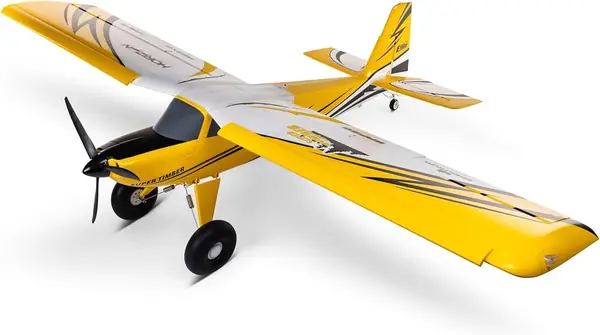
E-flite Super Timber 1.7m yellow RC bush plane with inflatable tires and long wing

Windy large-field flying

Track Score 80/100
Wingspan
1.7 meters
ESC
85-amp Spektrum Avian Smart Lite
Landing Gear
Inflatable rubber tires with beadlock wheels
Battery Class
4S to 6S LiPo
View on Amazon

At 1.7 meters and 5.8 pounds, this is the biggest airplane here and the only one built around 4S-to-6S power. The weight is the feature: on a gusty afternoon when the 1.3m Cub stays in the car, the Super Timber punches through the chop and keeps tracking the line you asked for. Nothing else in this group carries that much momentum or looks that settled in the air.

The bush hardware is where the money went. Inflatable rubber tires on beadlock wheels and articulated, shock-absorbing gear soak up a rough strip in a way foam wheels never do, and with slats and flaps down it will cruise at walking pace and float over the threshold. The 85-amp Smart ESC reports pack voltage and current, so you know what the battery is doing before it sags.

We like it best as a second or third airplane, and that is a statement about the pilot rather than the foam: it rewards smooth inputs and punishes lazy ones. Setup is mostly landing gear and moves along quickly, though the instructions are thinner than the hardware deserves. The color scheme and the big tires also make it the easiest of these to keep in sight against a gray sky.

Two things we check on the bench before the maiden: the tail-wheel assembly and prop tracking. Neither is a reason to skip this airplane — it is the one we want in wind — but both are far easier to sort on a table than at the field.

Worth Noting

  • Needs a large field and hauling space
  • Lands faster than a lightweight foam trainer
Our Verdict

Choose the Super Timber if your field is big and the wind is up; it is the heaviest, most planted airplane here and it wants an experienced hand on the sticks.

Check Latest Price
4.

RCSHOBBY Sport Cub 500 S2 Best for Calm-Day Park Flying

RCSHOBBY Sport Cub 500 S2 blue micro RC plane with propeller and small wheels

Calm-day park flying

Track Score 79/100
Flight Modes
Beginner, intermediate, and expert assist
Size
500mm x 350mm x 90mm
Control Range
2.4GHz, 656 ft
Included Batteries
Two 3.7V 400mAh LiPos and USB charger
View on Amazon

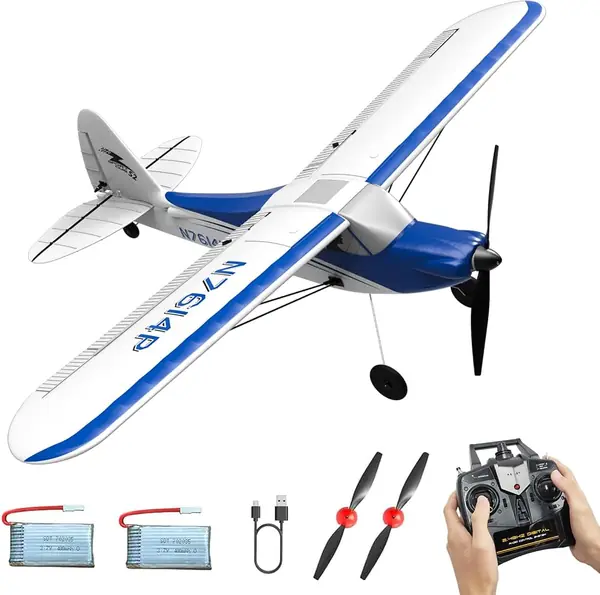
At 500mm the Sport Cub 500 S2 is small enough to fly from a driveway, and it arrives complete: a 2.4GHz transmitter, two 400mAh packs, a USB charging cable and two spare propellers. Three assist levels take you from full stabilization down to manual control, and a one-key aerobatic button plus a U-turn button handle the drama while you build confidence.

For a first flight on a still evening in a park, we have not flown anything easier. Beginner mode holds the wings level, the two included packs let you land, swap and go again without a field charger, and the 2.4GHz link is rated to 656 feet — farther than we can reliably see an airplane this size.

What it is not is a bush plane. The wheels are small, so pavement and packed dirt work and grass does not, and a 500mm span is not what you fly out of a rough strip. Think of it as a park flyer and a cheap way to build stick time before a bigger airframe.

The one check we insist on is the radio link. Range-test it on the ground, keep the first few packs close, and rule out a throttle that stops answering before you send it out over anything you cannot wade into.

Worth Noting

  • Light enough that wind sets the schedule
Our Verdict

It is the least expensive way to start flying, and we like it for paved parks on calm evenings rather than rough fields.

Check Latest Price

How We Tested the Best STOL RC Planes

We started with club-forum threads and spec sheets, then narrowed to airplanes claiming genuine short-field habits — flaps, slats, or oversized wheels — and kept a mix of bind-and-fly and ready-to-fly kits so the list served pilots who already own a transmitter and pilots who don't. Wingspans in the group ran from a 500mm park flyer to a 1.7-meter airframe.

Nine airplanes flew with us over nine months, mostly at a mowed grass strip with a rough patch we aimed for on purpose, plus a paved club runway on windy afternoons and a schoolyard on still mornings. Assembly was timed on a picnic table, and every flight day started the same way: a range check and a full sweep of every control surface before the first takeoff.

In the air we flew the same box pattern with each plane — a slow pass with flaps down to see how much it wanted to tip, a touch-and-go off the rough patch to judge the wheels, and a climb into whatever wind was blowing to see whether it penetrated or got carried. We watched stall behavior, takeoff roll, how each airframe carried the packs it was rated for, and whether the assist modes actually helped or just fought the sticks.

Foam airframes live in truck beds and hatchbacks, so we tracked hangar rash: dents from transport, cracks from a hard arrival, and how cleanly each one glued or taped back together. We logged the small failures that decide whether a plane stays in rotation — a servo that arrived off-center, a speed control that ran hot, a receiver that needed rebinding — kept packs at storage voltage between sessions, and added up what each plane cost to keep flying.

How to Choose a STOL RC Plane

Start With the Radio You Already Own

Bind-and-fly RC airplanes arrive with the receiver and servos installed but no transmitter, no battery and no charger; both E-flite Timbers are sold that way. A ready-to-fly package includes a transmitter — the Carbon Cub S 2 and the Sport Cub 500 both do — though you still check whether packs are in the box, because often they are not.

Our rule: total up the radio, three packs and a charger before you compare airframes. A cheaper bind-and-fly can cost more than the ready-to-fly option on day one, and it only wins if you already fly Spektrum DSMX gear and have packs on the shelf.

Wingspan, Wind, and Where You Will Fly

Wingspan sets both the space you need and the breeze you can handle. A 500mm micro flies from a paved park on a still evening; a 1.3m or 1.5m bush plane wants a club field or a big open lot; a 1.7m model wants real room and a vehicle that swallows a box around four feet long.

Weight is the other half of that. Heavier airplanes punch through wind and land with more energy; light ones get bounced around. If your only flying window is a windy Saturday, buy the weight. If it is a calm evening after work, buy the light one and fly more often.

What Actually Makes an Airframe STOL

The badge on the wing does not do it. Short-field performance comes from light wing loading, flaps that add lift and drag, and landing gear that survives grass rather than tripping on it. Slats help the wing keep flying at very low speed, and oversize or inflatable tires are what turn a rough strip into a runway.

Watch for add-ons sold as upgrades. Flaps are optional on the Carbon Cub S 2, and on any STOL airplane that is the first money we spend. If your field is grass, prioritize wheels and gear over extra power every time.

Batteries, Chargers, and the Cost After Purchase

A 3S or 4S airplane runs on packs a modest charger can fill; a 4S-to-6S model like the Super Timber needs bigger packs, a bigger charger and more respect at the field. Telemetry-equipped ESCs report pack voltage in the air, which is the best defense against running a LiPo flat.

Plan on three or four packs for a session and a charger that can refill them in under an hour. Charge and store each pack as the manufacturer instructs, never unattended, and leave them at storage voltage between weekends.

Frequently Asked Questions

Final Verdict

For most people shopping for a STOL RC plane, the E-flite Turbo Timber Evolution 1.5m is the one to buy: the floats and slats in the box make it a two-surface airplane, the gear handles a mown strip, and it slows down for landing without turning mean.

If you have no radio gear yet, start with the Carbon Cub S 2 — the transmitter is included and its flight modes do real work while you learn. The Super Timber earns its place only if you fly from a big field and want weight for windy days.