Best Park Flyer RC Planes of 2026

A park flyer lives or dies on the wind, and the prettiest foam airframe on the shelf still loses when the breeze moves the treetops. A good one buys you repetition: it survives clumsy landings, doesn't cost a fortune every time a prop breaks and is still flying by the time you've learned to fly it.

Four channels is the practical floor for anything past a first toy, and how the radio maps the fourth channel, rudder or flight-mode switch, changes the whole feel of the plane. The planes worth keeping had honest low-speed manners and a gyro that does what the manual claims, flown at a school field before work, in a gym on rainy Saturdays and at a club field on calm evenings.

Our Top Picks

The Best Park Flyer RC Planes

1.

RCSHOBBY Sport Cub 500 S2 Best Overall
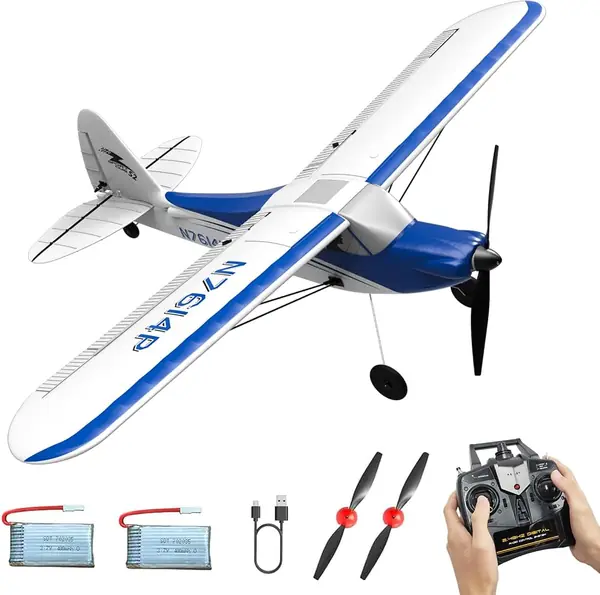
RCSHOBBY Sport Cub 500 S2 blue foam RC airplane with landing gear and propeller

First-time park pilots

Track Score 86/100
Channels
4
Batteries Included
2
Control Range
656 ft
Flight Time
About 20 minutes
View on Amazon

A high wing, a deep fuselage, and a 500 mm span give the Sport Cub 500 the look of a plane with nothing to prove, and that is exactly why we recommend it as a first park flyer. The wing wants to level itself and the gyro's beginner mode finishes the job, so a first flight is mostly a matter of pointing the nose at open sky and letting go of the sticks when you get nervous. We hand this one to people who have never flown anything.

What we did not expect at this size is how much of the package is aimed at the flight after the first one. Two 400 mAh packs and two spare propellers ship in the box, the link is good out to 656 feet, and the roughly 20-minute figure per pack is realistic for a plane this light on a calm evening. Three assist levels mean the same airframe goes from full help to manual, so the plane you learn on is still a plane you want in month two.

The foam earns its keep the first time you arrive nose-first. A dab of hot glue at a wing tip or a cracked cowl is the entire repair, and the plane flies the same afterward, which is what you want from a trainer. Keep the first few packs over open grass and inside comfortable range — if the link ever drops, a light foam plane glides down, and you want that glide to end somewhere soft. Then step up a mode when the turns start to feel boring.

Worth Noting

  • Small wheels make grass takeoffs impractical
Our Verdict

We recommend the Sport Cub 500 S2 to anyone flying a first season in a park: the high wing, the self-leveling assist, and two batteries in the box make the first dozen flights feel manageable.

Check Latest Price
2.

volantexrc Ranger600 Stunt Best Glider for Small Fields

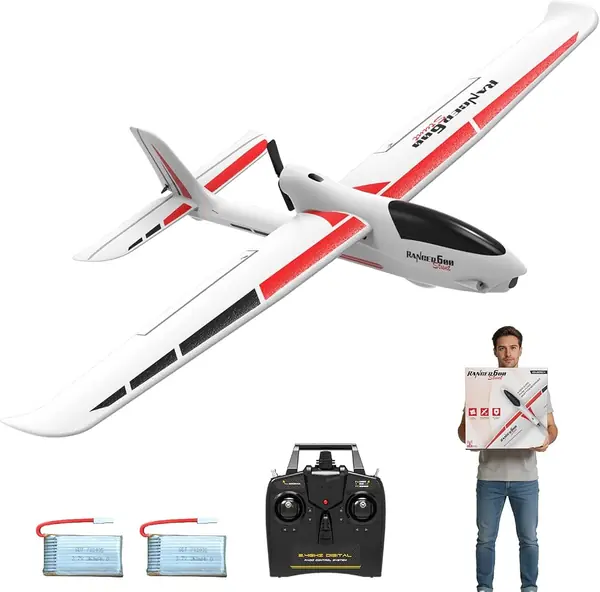
volantexrc Ranger600 Stunt white foam RC glider with pusher propeller and wide wing

Small-field soaring

Track Score 85/100
Channels
4
Batteries Included
2
Control Range
656 ft
Size
Length: 18.11 Inches, Width: 23.62 Inches
View on Amazon

Cut the throttle on the Ranger600 and it keeps going. Point the nose down a touch, let the motor rest, and a 600 mm foam sailplane tracks across the field on the height it already had — that is the whole appeal of a glider this size, and it is why a pack goes noticeably further here than it does on a warbird.

The layout is what sells it to us. The motor and propeller sit behind the wing, so a bad arrival meets foam instead of a spinning blade, and three assist levels plus a 656-foot link make it as easy to start on as anything here. The one thing the box does not cover is four AA cells for the transmitter, so bring those — nothing ends a first trip faster than a dead radio.

In the air it flies on the wing rather than on the motor, which makes a ham-fisted turn recoverable if you give it a second to sort itself out. It will not snap around like a P51, and that is the point: this is a plane for reading the air and stretching a calm evening, not for showing off over the car park.

Worth Noting

  • Motor can overheat during repeated full-power aerobatics
Our Verdict

For a small field and a patient pilot, the Ranger600 is the glider: the prop stays out of trouble and the glide means you spend more of each battery actually flying.

Check Latest Price
3.

volantexrc P51D Mustang Best Step-Up Warbird

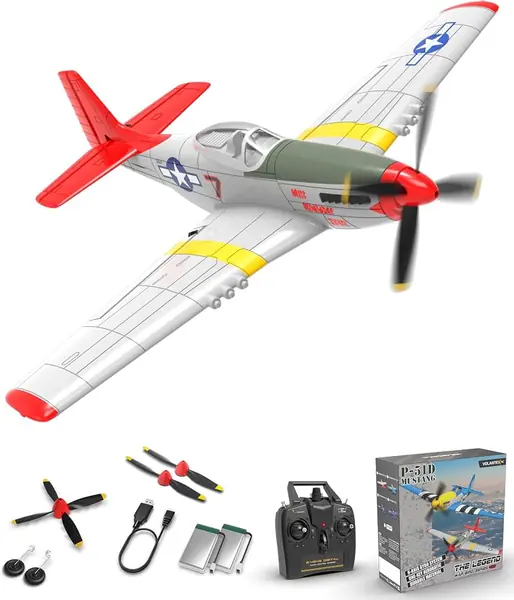
volantexrc P51D Mustang red foam RC warbird with propeller and landing gear

Pilots stepping up

Track Score 84/100
Channels
4
Batteries Included
2
Flight Modes
3
Dimensions
13 x 13 x 5 inches
View on Amazon

Press a button, hold the left stick, throw, and the P51D climbs out to hover overhead while you decide what happens next. That launch-and-hover sequence is why we reach for this one with newer pilots. A first flight usually goes wrong in the first ten seconds, while the plane is already moving and the pilot is still catching up; here the aircraft waits for you at altitude instead.

From there it behaves like a conventional four-channel warbird with three levels of assist — full help, partial help, and nothing but your thumbs. The one-key barrel roll is a crowd-pleaser, the airframe is maneuverable at low and mid speeds rather than only flat out, and two packs in the box mean a session does not end after one battery.

A warbird shape does not float the way a high-wing trainer does, so this is a plane for a second season rather than a first afternoon. Do one thing for us: fly the first two packs straight and level at altitude before you trust the electronics. A gyro that misbehaves tends to do it a few minutes in, and finding out over grass is better than finding out over the trees.

Worth Noting

  • Prop hub is the part that breaks
Our Verdict

For a pilot who has outgrown a two-channel glider, the P51D is the step-up we recommend: throw it, let it hover, and take your first turn on your own terms.

Check Latest Price
4.

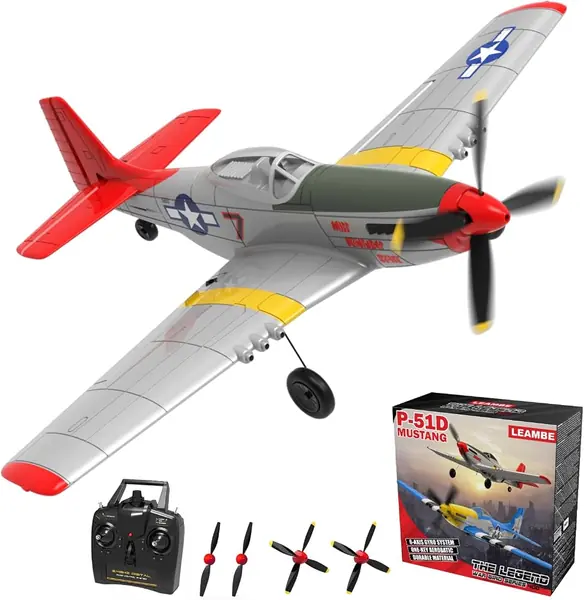
LEAMBE P51 Mustang Best for Rough Landings

LEAMBE P51 Mustang white foam RC warbird with propeller and radio transmitter

Rough-landing beginners

Track Score 83/100
Channels
4
Control Range
656 ft
Flight Modes
3
Wingspan
15.75 inches
View on Amazon

The propeller on this P51 is built to pop off instead of snapping, and once you have replaced a couple of shattered blades on another plane you understand what that design decision is worth. A nose-over on landing becomes a short walk to retrieve a propeller rather than the end of the session. The trade is that the hub lets go now and then when it should not, and you spend a second wondering where it landed.

It also copes with a bit of moving air, which in a real park — trees, a fence line, a game on the next field — counts for more than any top-speed number. Three assist modes take it from full help to manual, the radio reaches 656 feet, and the airframe is light enough to correct itself when you get a turn wrong.

What it is not is precise. This is a foam warbird that needs a little speed to stay happy, so the landing is where a beginner gets reminded that a small wing and a heavy nose do not float. Give yourself a long final approach and the arrival stops being an event.

Where it lands for us is the forgiving end of the warbird shelf: the one we point at a field that is not a billiard table, with grass, a few bumps, and landings that arrive faster than anyone planned.

Worth Noting

  • Wheels can detach in a rough arrival
Our Verdict

For landings that are still a work in progress, this P51 forgives: the prop pops off instead of snapping, so a nose-over costs a walk rather than an afternoon.

Check Latest Price
5.

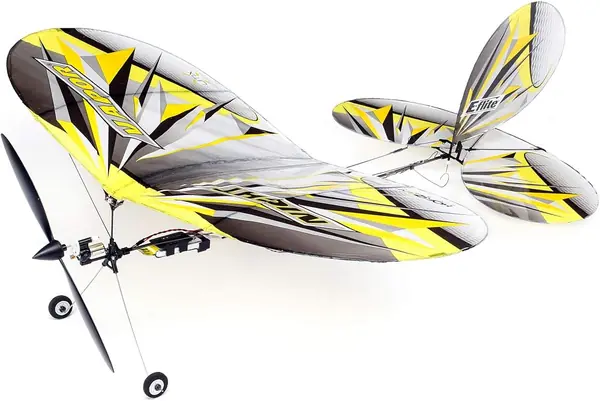
E-flite UMX Night Vapor Best for Calm-Air Flying

E-flite UMX Night Vapor yellow slow flyer with LED lights and propeller

Calm-air flying

Track Score 82/100
Lighting
Factory-installed LEDs, multiple colors
Flying Space
Indoors or calm-air outdoors
Battery Included
150mAh 1S LiPo
View on Amazon

The lights are the reason to own this one. Cycle through the color options, wait for the streetlights to come on, and a small yard or a quiet corner of a park turns into something worth standing in — the Night Vapor flies slowly enough to stay inside the fence and carries enough light to show you which way it is pointed.

Slow is the other half of the pitch, and it is what makes the price look reasonable. This is a 1S, 150 mAh airplane that will fly at walking pace, hang on its propeller at a steep angle, and let you switch the stabilization off when you want to feel the wing. In a gym or a large garage it is a different hobby from the park-flyer routine: no launch, no runway, just laps of the hall.

What it cannot do is wind. A leaf has more penetration, and a single gust over the fence line ends the session, so treat this as a calm-evening and indoor airplane and the rest of the package makes sense. Judged as a park flyer for a breezy Saturday it is the wrong purchase; judged as a slow flyer for the still hour, it is the nicest thing here.

Worth Noting

  • Prop shaft and motor mount break in nose-ins
Our Verdict

Buy the Night Vapor if your flying happens at dusk in a yard or a gym; it is the slowest, most forgiving thing here and the lights make the last hour of the day worth waiting for.

Check Latest Price
6.

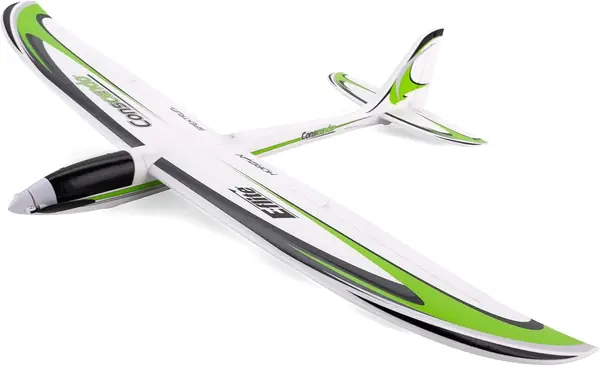
E-flite UMX Conscendo Best for Experienced Glider Pilots

E-flite UMX Conscendo BNF multicolored motor glider with folding propeller and removable wing

Experienced glider pilots

Track Score 81/100
Wing
Removable with quarter-turn thumbscrew
Flaps
Optional flaperons and spoilerons
Radio
Not included (BNF Basic)
Power System
2S and 3S compatible brushless
View on Amazon

There is no transmitter in the box, and that one fact tells you who this is for. Bind-n-fly means the airframe, motor, receiver, and servos arrive assembled and you supply the radio — a fair trade for anyone already flying compatible gear, and a dead end for anyone who is not.

What you get for the trouble is the quickest airframe in this group. The wing comes off with a quarter turn of a thumbscrew for the ride home, the brushless system runs on 2S for mild or 3S for wild, and the folding propeller and optional flaperons let it stretch a glide the warbirds cannot match. It loops from level flight and climbs without a run-up.

That combination makes it a second or third airplane, and we recommend it that way. On 3S it is quick enough that a small field leaves no room for a late decision, and the reflex you need is one you only get from hours on something slower. Own the radio, fly low rates for the first few packs, and it rewards you.

Our Verdict

The Conscendo is for pilots who already own a compatible radio and want a small glider that soars and still goes vertical on demand; it is the quickest airframe here and the least suited to a first-timer.

Check Latest Price
7.

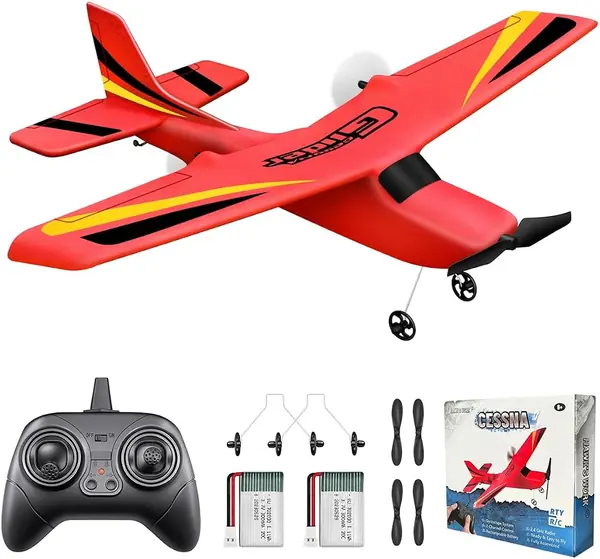
HAWK'S WORK 2CH RC Glider Best for Young First-Timers

HAWK'S WORK red two-channel foam RC glider with propeller and landing gear

Young first-timers

Track Score 80/100
Channels
2
Batteries Included
2
Size
35cm x 30cm x 9cm
Warranty
1 year airframe, 3 months battery
View on Amazon

Two channels is not a stripped-down four-channel plane; it is a different way to fly. There are no ailerons and no separate elevator surface to strip or replace, so the airframe shrugs off arrivals that would ground something more complicated, and the whole skill becomes throttle and timing rather than coordination.

The rest of the package suits the same buyer: two 300 mAh packs, two spare propellers, a USB charger, a one-year warranty on the airframe, and an eight-and-up age rating. It will taxi off a short runway or launch from your hand, and it is small enough to carry in one hand with the transmitter in the other.

It works as a first taste, not a first love. It needs still air and a field big enough for a wide, slow turn to have somewhere to go, and its authority is limited enough that flying it well becomes its own small skill. For a kid on a calm evening in a big empty field, that is exactly the right amount of airplane.

Worth Noting

  • Wide slow turns need planning ahead
  • Wheels can fall off in a crash
Our Verdict

It suits a kid's first taste of flying in a big empty field on a still evening — two channels are genuinely easy, and finding out whether the hobby sticks costs very little.

Check Latest Price

How We Picked and Tested the Best Park Flyers

We started at the beginner-friendly end of the market and read spec sheets and owner threads until dozens of candidates came down to 12 planes we could actually fly. Two filters did most of the work: whether replacement props and batteries were easy to buy, and whether the assist modes and channel layout were described plainly enough to trust.

Testing ran eight months and followed a new pilot's routine — hand launches over an empty school field before the morning wind arrived, grass landings at a club field, one rainy Saturday in a gym with the lightest model, and a lot of calm evenings. Before the first flight we weighed every plane on a kitchen scale and checked it against the FAA's registration threshold, and LiPo packs were charged on a concrete floor, never left alone.

Every flight got the same notes: did the gyro level the plane when we let go of the sticks; how many assist modes changed the handling rather than the label; what the fourth channel actually did in the air; how much grass a landing ate; whether it stayed predictable at a crawl and how it felt at full throttle. We also let each plane cartwheel across the grass at least once — a nose-in landing tells you far more about prop protection and airframe resilience than the box does — then priced a spare prop and a second battery to see what ownership costs after the sale.

Link checks came before every takeoff and again at the far edge of the field, watching for the delay or dropout that turns into an early landing. Wind was a hard limit, not a challenge: an anemometer, a hard stop when the treetops moved, and a note on which airframes needed more air than the day had.

How to Choose a Park Flyer RC Plane

Start With the Wing, Not the Paint Job

The oldest trainer shape in the world is a wing sitting on top of the fuselage, and it is still the right first answer. A high wing gives you a plane that wants to level itself and flies slowly enough that you can think between inputs. A low-wing warbird looks better and rolls faster, but it needs more speed to stay honest, and a pusher RC glider trades speed for glide. For a first season we point people at the high wing; the warbirds and the gliders are second airplanes, and they reward patience more than reflexes.

What Beginner Mode Really Does

Almost every plane here advertises a six-axis gyro, and that label on its own tells you very little. The question that matters is whether the assist levels the wings when you release the sticks, and whether you can switch it down. A three-position switch — the volantexrc, RCSHOBBY, and LEAMBE models all have one — lets the same airframe go from full help to manual, so you learn to fly rather than learn to hold the sticks still. Buy the switch, not the sensor count.

Wind Is the Real Ceiling

These are light foam airframes, and wind ends more sessions than crashes do. A slow flyer like the Night Vapor is a calm-air airplane, full stop; the larger four-channel models will take a light breeze and complain about anything more. A practical test beats any number on a box: if the tops of the trees are moving, leave the plane in the car. The calm hour after sunrise and the last hour before dark are worth planning around, and a field with a windbreak of trees or buildings is worth the extra walk.

Match Takeoff and Landing to Your Field

Wheels look right on a warbird and they are close to useless on a lawn. The Sport Cub's gear is small enough that pavement or a closely mowed strip is the practical runway, and a hand launch covers the rest. A pusher glider like the Ranger600 solves the same problem from the other end by keeping the propeller out of the arrival path. Walk your field before you order and decide which of the three you have: a hard surface, short grass, or hand-launch only.

Batteries, Props, and the Cost After the Sale

Read the box for what is actually included. Two packs turn a ten-minute outing into a forty-minute one, and spare propellers matter because the prop is the part you will break. USB chargers at this size are slow, so a second charger earns its place in the bag. Before you commit, check that propellers and batteries for that model are sold on their own — a plane you cannot re-prop, or cannot buy a pack for, turns into a shelf ornament faster than any crash will.

Frequently Asked Questions

Final Verdict

We recommend the RCSHOBBY Sport Cub 500 S2 as the default first park flyer. The high wing and self-leveling assist do most of the work while you learn, two packs and two spare props keep a session going, and 500 mm is small enough for the field you actually have rather than the one you wish you had.

If your landings arrive faster than planned, the LEAMBE P51 and its pop-off prop is the friendlier second airplane; if you want to soar instead of sprint, the Ranger600 does it in the same small space.