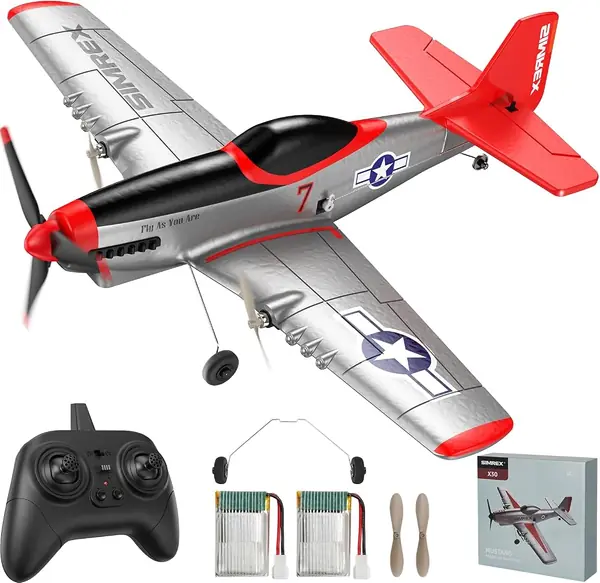
Best RC Plane Kits of 2026

The first flight is where most RC planes either prove themselves or end up as a bag of foam crumbs. A good first plane offers enough stabilization to recover from a wobble, controls that make sense without the manual and foam that survives a nose-in on grass.

Channel count is not a score. A plane with fewer channels can be more fun if its stabilization and control throws are sorted, and a four-channel plane can be a handful if the gyro fights you. Over six months in parks and open fields, in calm air and the kind of breeze that makes you second-guess a launch, we tried every assist mode and one-key stunt on 12 planes, from tiny two-channel gliders to four-channel warbirds and a build-it-yourself kit. The eight here make the first several flights feel like flying rather than troubleshooting.

Our Top Picks

The Best RC Plane Kits

1.

RCSHOBBY Sport Cub 500 S2 Best Overall
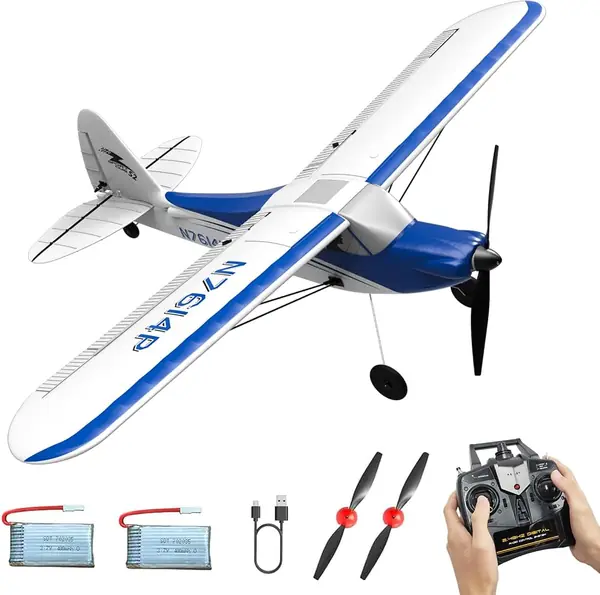
RCSHOBBY Sport Cub 500 S2 blue foam RC plane with propellers and transmitter

First-time pilots

Track Score 86/100
Size
500 mm x 350 mm x 90 mm
Flight Modes
Three (beginner, intermediate, expert)
Claimed Flight Time
About 20 minutes
Flight Batteries
Two 3.7V 400mAh LiPo
View on Amazon

The switch on the shoulder of the transmitter is the reason we made this our top pick. In beginner mode the Xpilot gyro takes over the corrections and keeps the wings level; flip to intermediate and it hands back some authority; expert gives you the raw four-channel airframe. That progression means a nervous first flight and a satisfying tenth one can happen on the same afternoon with the same plane.

Flight time is where it separates from the cheaper planes. RCSHOBBY rates the geared motor at about 20 minutes a pack, and the box includes two 400mAh packs plus two spare propellers, so a session doesn't end after one battery. We also like the one-key U-turn: when the plane gets small and you lose track of which way it's pointed, it turns itself around and comes back toward you.

Two things are worth doing before the first flight. Check every control surface on the bench, because some arrive with a servo that won't center or a transmitter that needs re-binding, and that is far easier to sort out in the driveway than in the field. Then launch at about a third throttle and let it climb out rather than trying to yank it into the air. Minor foam damage takes a dab of hot glue, and the EPP springs back from most cartwheeled landings.

Worth Noting

  • Small wheels bog down in thick grass
Our Verdict

Our default first four-channel plane: three assist levels keep the learning curve gentle, and it takes the landings beginners make better than the warbirds here.

Check Latest Price
2.

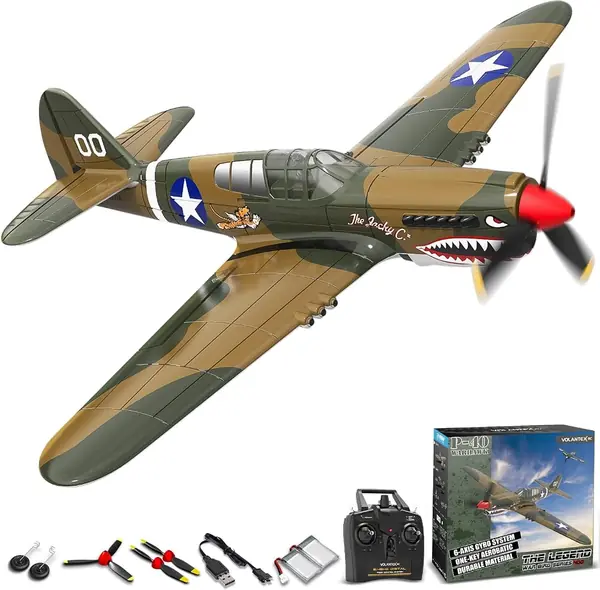
VolantexRC P-40 Warhawk Best Warbird

VolantexRC P-40 Warhawk bronze foam RC warbird with propeller and transmitter

Warbird fans

Track Score 85/100
Flight Modes
Three assist levels
Stabilization
Six-axis Xpilot gyro
Radio Range
Up to 656 ft
Wingspan
400 mm
View on Amazon

The P-40 answers a question our top pick can't: what if you want a fighter and not a trainer? It's a low-wing warbird rather than a high-wing ship, which you notice the moment you turn, because it tracks more precisely and looks better doing it. We rate it the more rewarding of the two to fly once you've stopped crashing, and the less forgiving one while you still are.

Everything that makes it manageable sits on the transmitter: three assist levels, a six-axis Xpilot gyro doing the steadying, and a one-key button for rolls when you want them. The 400 mm wing keeps the whole thing inside a small field, and the 2.4 GHz link is rated to 656 feet, which is plenty when the plane is already a dot at 200. In beginner mode it stays composed in a light breeze, which is more than we can say for the two-channel planes here.

What we watched most closely was the radio link. Range is generous, but a lost signal is the one failure that ends a flight permanently, so keep the plane inside comfortable visual range and bring it in when your eyes start to strain. Otherwise the mode switch handles more than you'd expect, and a 400 mm airframe means you can fly it in a park that would swallow the bigger Ranger600.

Worth Noting

  • Propellers snap on nose-in landings
Our Verdict

The warbird we point improving beginners to: sharper handling than a trainer, with the same three-mode safety net underneath it.

Check Latest Price
3.

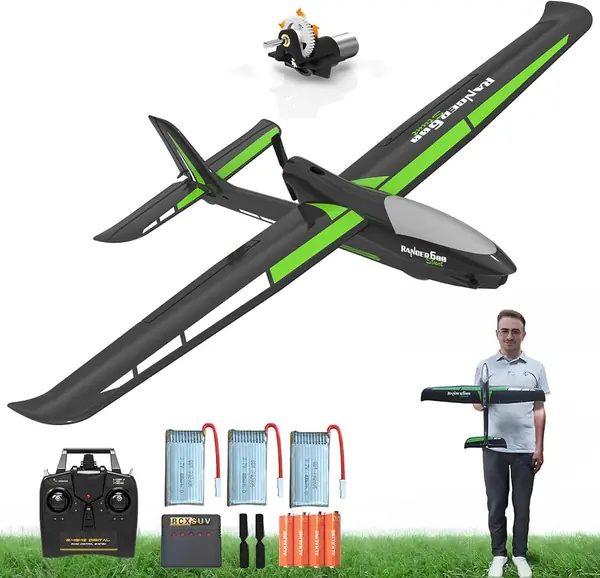
VolantexRC Ranger600 Best for Large Fields

VolantexRC Ranger600 black foam RC glider plane with transmitter and spare propellers

Open fields

Track Score 84/100
Size
23.6 x 18.1 x 3.5 inches
Flight Modes
Three assist levels
Flight Batteries
Three LiPo packs
Spare Propellers
Three (one pre-installed)
View on Amazon

At 23.6 by 18.1 inches, the Ranger600 is the largest airframe in this guide by a wide margin, roughly half again the span of the 400 mm warbirds and twice the foam of the little two-channel trainers. That size buys visibility: at 400 feet it still reads as an airplane rather than a speck, and it shrugs off the light chop that tosses the smaller planes around.

The bundle is the real argument. Three flight packs, four AA batteries for the transmitter, three propellers with one already fitted, and a multi-port charger come in the box, so you can fly through the afternoon without hunting for a wall socket. The prop sits behind the wing as a pusher, which keeps it out of the way on a nose-in, and the streamlined fuselage is shaped to cut drag rather than to look scale.

What sold us is how little else you need to buy. Add the three assist levels and the one-key stunt button and this is a complete kit in the way the phrase is supposed to mean: nothing to add except a field. That field is the catch, because 23 inches of wingspan needs real room and a backyard will feel like flying in a closet. Give it a ballfield and it's the most relaxed plane here to spend an afternoon with.

Worth Noting

  • Needs a ballfield-sized space to fly
Our Verdict

The most complete kit here: three packs, three props and a big airframe, provided you have a ballfield to fly it in.

Check Latest Price
4.

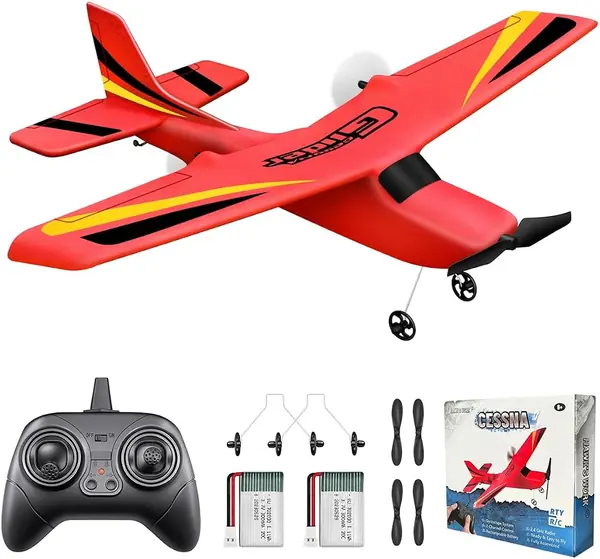
HAWK'S WORK 2CH RC Plane Best Budget Starter

HAWK'S WORK red foam two-channel RC glider with controller and spare propellers

Kids' first flights

Track Score 83/100
Size
11.81 x 13.78 x 3.54 inches
Included Batteries
Two 3.7V 300mAh LiPo
Channels
Two
Warranty
1 year aircraft, 3 months battery
View on Amazon

Two channels, two batteries, two spare propellers, and a transmitter that runs on ordinary AA cells: the HAWK'S WORK kit is the shortest path from box to air in this guide. Takeoffs are a five-to-ten-meter taxi run on pavement, or a hand throw once you're confident, and the built-in self-stabilization keeps the wings level while you work out which stick does what. The 11.8 by 13.8-inch airframe survives the light crashes that come with a first weekend.

We hand this one to the family buying a first plane for a kid, because at this price losing a plane is annoying rather than painful, and because the one-year airframe warranty and three-month battery cover mean a dead motor is a message to support rather than a write-off. The catch is the control scheme. With no ailerons, a gust lifts a wing and you have no elegant way to put it back down, so plan around still air and a big open space. Fly it on a calm evening and it's a genuinely good time; take it out in a gust and you'll spend the whole flight chasing it.

Worth Noting

  • Two channels struggle once the wind picks up
Our Verdict

For a kid's first plane or a low-stakes gift, this is the one we hand over: two channels, two packs, and a year of airframe warranty.

Check Latest Price
5.

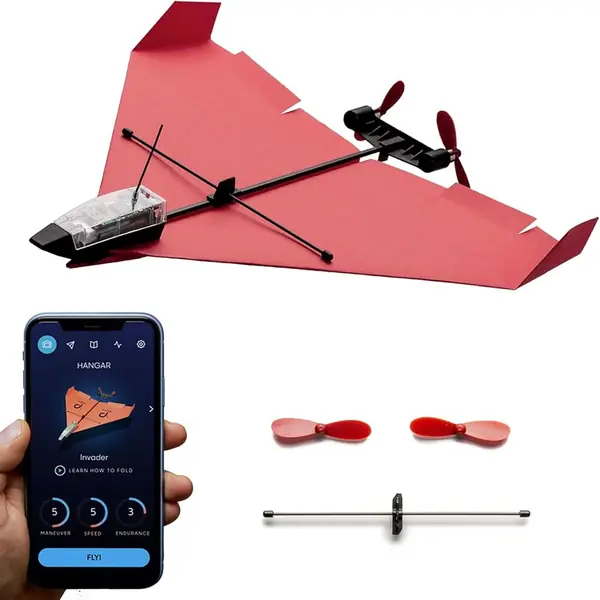
POWERUP 4.0 Paper Airplane Kit Best Build-It-Yourself Kit

POWERUP 4.0 white paper airplane conversion module with spare propellers and charging cable

Tinkerers and STEM

Track Score 82/100
Weight
0.67 oz
Top Speed
20 mph
Flight Time
10 minutes per 30-minute charge
Control Range
Up to 230 ft
View on Amazon

The POWERUP 4.0 isn't a plane you unbox and fly. It's a module you clip to a paper airplane you fold yourself, and that is exactly why we like it. The box has a set of templates, the app has a hangar of approved designs, and you fold, trim and adjust until the thing glides before you add power. It's the only product here where the airframe is something you made, which turns a bad flight into a design problem instead of a broken toy.

The module is 0.67 ounces with a gyro, an autopilot mode and a top speed around 20 mph. The app pairs to it, logs your flights and keeps a leaderboard if you want to chase flight times against other pilots. Range runs to 230 feet, and a 30-minute charge gives about 10 minutes in the air, which is three or four good throws rather than an afternoon.

Paper is the trade-off. Airframes crease and lose their trim after a hard arrival, so you'll fold more often than you expect, and something this light is at the mercy of any breeze at all. On a still evening in a park it's a small delight: quiet, cheap to keep flying, and simple enough to hand to a kid who wants to understand why a wing works. Set expectations to science project that flies rather than trainer, and it delivers.

Worth Noting

  • Paper airframes crease and need refolding
  • About 10 minutes of flight per charge
Our Verdict

We like it as a build project rather than a trainer: you fold the airframe, the app supplies the brains, and the reward is a plane you made.

Check Latest Price
6.

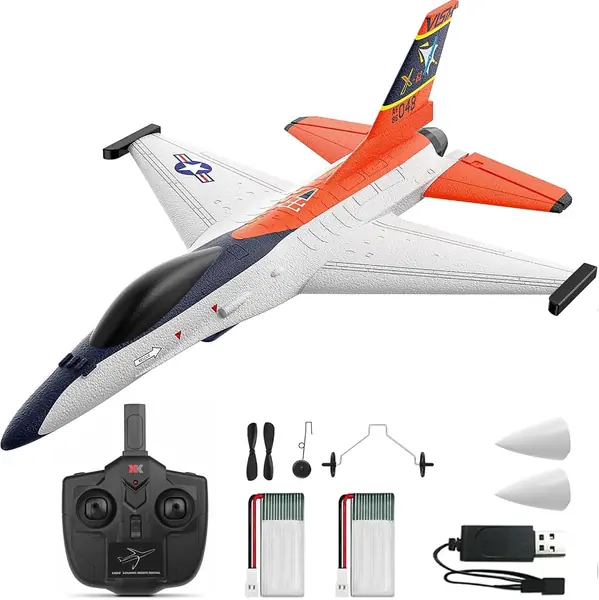
DEERC F-16 X-62A Vista Best for Speed Seekers

DEERC F-16 style orange foam RC jet with gyro stabilizer and landing gear

Speed seekers

Track Score 81/100
Stabilization
Six-axis gyro
Included Batteries
Two 400mAh LiPo
Claimed Flight Time
20+ minutes total
Motor
4400KV coreless
View on Amazon

Scale paint, a fighter silhouette and a 17.8-inch airframe: the DEERC is the plane here that looks most like the thing it's modeled on. The foam is EPP with a soft rubber nose bonded to the front, which is the right combination for this shape, because it's built to be flown aggressively and to arrive hard.

Under the shell it's a 4400KV coreless motor in a four-channel airframe with a six-axis gyro, and it launches either from the ground or by hand. Two 400mAh packs give a claimed 20-plus minutes between them. The motor is the headline: this is the quickest-climbing plane in the group, and we found the speed is genuinely what you're buying.

Speed cuts both ways. It covers ground fast, so a small park becomes small very quickly, and slow turns are where it gets untidy, so keep some throttle on through a turn rather than coasting into it. The gyro helps, but it can't make a fast jet behave like a trainer, and the first few flights are about learning to stay ahead of it.

Our take is that it's the most exciting flight per dollar in this group, and the one to pick once you're past the keep-it-level stage. Budget for the nose: EPP forgives a lot, but the fuselage is the part that cracks when a fast plane meets a hard surface, and a rubber nose only protects so much.

Worth Noting

  • Fuselage can crack in a hard nose-in
Our Verdict

Pick it once you can keep a plane level: the quickest climb here, a fighter look and two packs, with a nose that needs respect.

Check Latest Price
7.

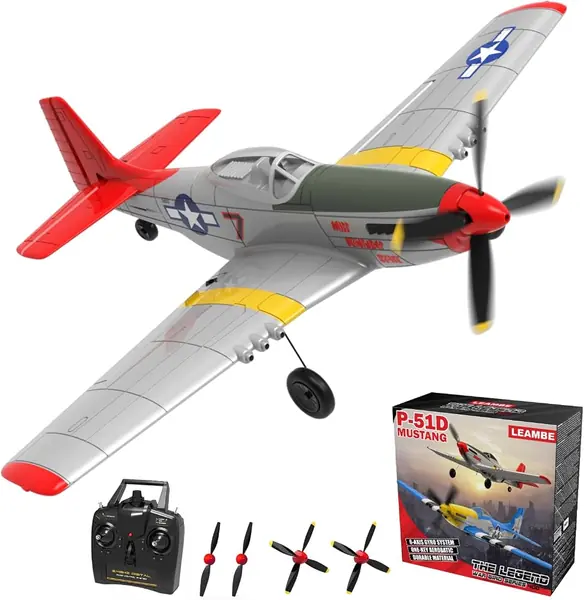
LEAMBE P51 Mustang Best for Small Parks

LEAMBE P51 Mustang white foam RC warbird with propeller and remote control

Small parks

Track Score 80/100
Size
12.1 x 15.75 x 3.94 inches
Flight Modes
Three assist levels
Weight
1.76 oz
Radio Range
Within 656 ft
View on Amazon

Twelve inches long on a 15.75-inch span and 1.76 ounces in the air, the LEAMBE P51 is one of the smallest four-channel planes here, which is either the reason to buy it or the reason to skip it. It fits in a trunk, launches by hand and will fly in a neighborhood park that the Ranger600 would turn into a traffic pattern.

The hardware is familiar: Xpilot stabilization with beginner, intermediate and expert modes, a 2.4 GHz link rated to 656 feet, and a propeller saver designed to let the prop pop off rather than tear the nose apart on impact. In intermediate mode it's a lot of fun. The roll rate is there and it flies bigger than its size in calm air.

Longevity is the problem. Props and wheels come off in crashes, and while the airframe comes back for more, you'll spend part of a session hunting for a wheel. Worse, some of these stop working after a few flights, with a motor that quits or a plane that swerves left and won't trim. That's the failure that ends a beginner's season, because it happens when the pilot has finally started to enjoy themselves.

Our call: at the same money as the Sport Cub, the LEAMBE is smaller, harder to keep running and no more capable, so we rank it below that plane for a first four-channel. Buy it if the P51 shape is what gets you out to the field, and buy it from a seller with a generous return window. The airframe is fine; it's the parts around it that decide whether you get a season out of it.

Worth Noting

  • Props and landing gear detach easily
Our Verdict

A compact, genuinely fun P51 that we rank below our top pick because the electrics and the landing gear don't always hold up.

Check Latest Price
8.

SIMREX P51 Best for Park Flying

SIMREX red P51 foam three-channel RC glider with transmitter and two batteries

Park flying

Track Score 79/100
Stabilization
Six-axis gyro
Included Batteries
Two rechargeable packs
Claimed Flight Time
40+ minutes total
Channels
Three
View on Amazon

Two rechargeable packs, two speed modes, two launch modes and a claimed 40-plus minutes of total flight time: the SIMREX is sold as a bundle, and the bundle is the point. A second pack is what turns one flight into an afternoon, and it isn't always included at this end of the market.

The rest of the spec sheet makes sense for park flying: a three-channel layout with a six-axis gyro, flexible EPP foam, a 2.4 GHz radio and a 13.6-inch frame. Three channels is a step up from the two-channel trainers here and a step below the four-channel warbirds, which means gentle climbs and wide circuits on a calm evening rather than rolls and loops.

The design choices are the right ones for the money: EPP over the brittle stuff, a gyro in a plane this light, and two packs instead of one. Electronics are the usual weak point at this end of the market, so spend the first few flights close in and in calm air, checking that the motor holds its power and the surfaces center cleanly before you let it climb out. If yours is sound, it's a lot of flying for the outlay.

Worth Noting

  • Three channels rule out aileron aerobatics
Our Verdict

A sensible park flyer on paper, with two packs, two speeds and a six-axis gyro, for a pilot willing to shake it down first.

Check Latest Price

How We Tested RC Planes

We started by researching the category, then narrowed the field by channel count, wingspan, included batteries and spare parts, and whether each plane was genuinely ready to fly or needed extra gear. We also weighed price against what came in the box, because a cheap plane with no spare prop or battery can cost more by the second weekend. From that shortlist, we tested 12 planes over six months.

Testing happened where these planes actually get used: local parks, school fields, and open grass areas away from roads, people, and airports. We assembled each plane at the field, matched it to a space with enough room for its wingspan, and timed how long it took from opening the box to the first launch. We counted every spare prop, battery, and connector included. We charged lithium packs on a nonflammable surface and never left them unattended, and we kept every flight within visual line of sight. We stuck to the manufacturer's age rating and supervised younger pilots for their first several flights.

In the air, we switched through every assist mode and noted whether the gyro made the plane easier to control or fought the sticks. We mapped what each channel actually moved, tried the one-key aerobatic and stunt functions, and flew in calm air and a steady breeze to see how much correction each plane needed. We practiced landings on grass, noted how the foam and prop mounts held up after nose-ins, and timed each battery pack from launch to low-voltage cutoff. We also walked the radio range in open fields and watched for glitches when other pilots were nearby. At the end, less experienced testers flew each plane, because a model that only an expert can keep in the air isn't a good first plane.

How to Choose an RC Plane Kit

Channels Decide What the Plane Can Do

Two channels give you throttle and steering and nothing else: the plane climbs when you add power and turns when you steer. It's the cheapest way into the air and the least intimidating for a young kid, but it has no answer to a gust. Three channels add pitch, so climbs and descents become deliberate rather than a side effect of throttle. Four channels add ailerons, which is what actually rolls a plane and what you want if you plan to still be flying next summer. Every warbird in this guide is four-channel, and the assist modes make that fourth channel far less scary than it sounds.

Read the Stabilization, Not the Slogan

Every box says easy to fly; what matters is what the gyro actually does. Beginner mode on these planes takes over the corrections and limits how far the plane can bank, intermediate hands back some authority, and expert leaves the airframe entirely to you. Spend a full session in beginner mode instead of graduating on the manual's schedule, and move up when you're bored rather than when the calendar says so. We weight assist modes heavily because they let one plane serve two pilots: a kid on Saturday in beginner mode, an adult on Sunday in expert.

Budget for the Crashes

You will crash, so the question is whether the crash ends the day. Three things decide it: foam that flexes instead of cracking, a prop saver that lets the propeller pop off rather than tear the nose apart, and spare parts in the box. A plane that ships two or three extra props keeps you flying after a nose-in; one that ships none sends you home. Put a tube of foam-safe glue in the flight bag and treat the first scuff as maintenance rather than damage.

Match the Wingspan to Your Field

Bigger planes are easier to see and steadier in moving air, and they need more sky. A 12-inch micro plane will fly a small park on a still evening; a 23-inch airframe wants a ballfield with room for wide turns and room to walk after the landing. Any remote control airplane also needs calm air, so check the wind before you charge a battery, because a steady breeze turns a gentle flight into a fight. If your only space is a postage-stamp yard, buy the smallest four-channel plane you can rather than the biggest one you can afford.

Batteries Decide How Long You Actually Fly

Expect somewhere between eight and twenty minutes a pack depending on the plane and how hard you fly it, and don't trust the number printed on the box. What matters more is how many packs come in the kit and how fast they recharge. Two packs turn a ten-minute flight into a half-hour session, and a multi-port charger means nobody is queuing at the wall socket. Buy an extra pack or two of the same connector while you're at it, and never leave a lithium battery charging unattended.

Frequently Asked Questions

Final Verdict

Start with the RCSHOBBY Sport Cub 500 S2. The three assist levels mean you can learn without buying a second plane, two packs and two spare props keep a session going, and it takes a bad landing better than the warbirds here.

If you have already flown and want a fighter look, the VolantexRC P-40 is the more rewarding plane in the air. If your local field is large and your afternoons are long, the Ranger600's three-pack bundle earns its premium.