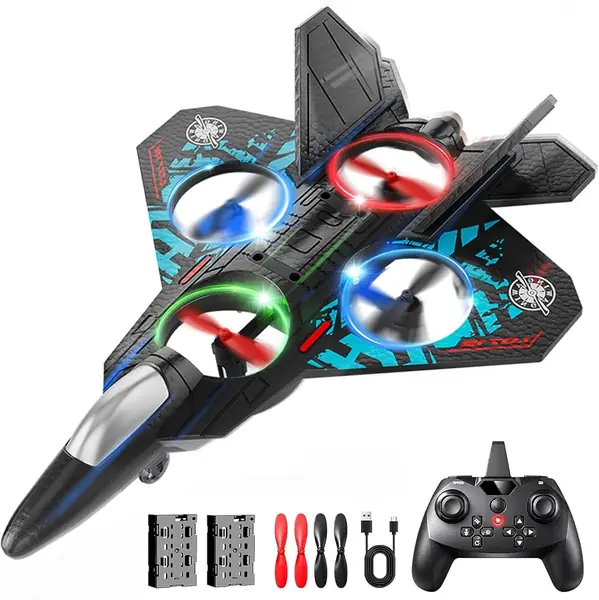
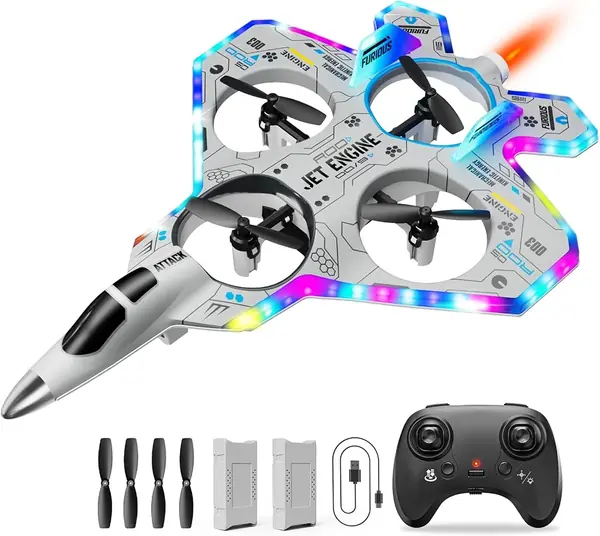
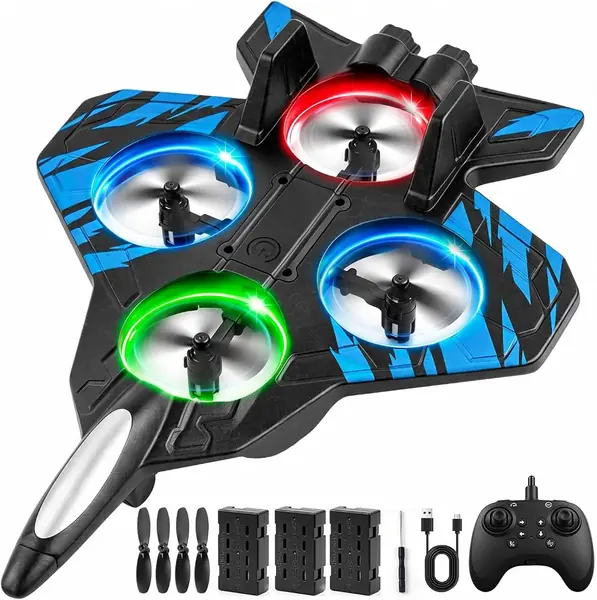
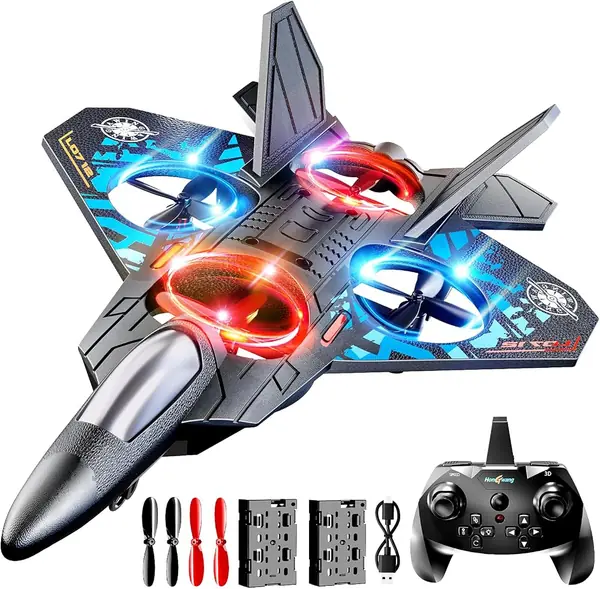
Best RC Planes for Kids of 2026

The first flight is where most kids' RC planes quietly die. The plane climbs, a gust takes it, and thirty seconds after launch it's in a hedge, then the box goes on a shelf. A plane that survives the learning curve does much of the flying itself, with gyro stabilization, altitude hold and one-key takeoff and landing.

Foam type, guarded props and spare parts decide whether a kid keeps going after bouncing a plane off a fence twice in one morning. Battery count matters more than claimed flight time, since one pack means a long wait between flights, and a plane that needs a full airfield won't get flown from a small yard. We flew 12 planes in backyards, at a park field and indoors on rainy days, and the seven picks all fly in a yard, a park or a gym.

Our Top Picks

The Best RC Planes for Kids

1.

SYMA X550 RC Plane Best Overall
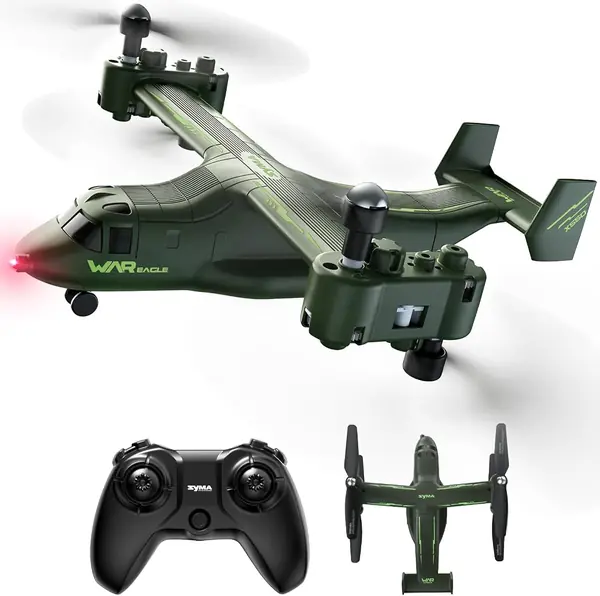
SYMA X550 military-style green remote control plane with matching controller

First-time pilots

Track Score 88/100
Channels
4-channel
Launch
One-key takeoff and landing
Stunt Moves
6 with 360° flips, spins, circles and jumps
Speed Settings
2
View on Amazon

Two speed settings and a one-key takeoff do the teaching here. Press the button and the X550 climbs and waits in the air while a new pilot finds the sticks; low speed keeps it inside a yard, and high speed is there for the field at the end of the street a few weeks later.

The six stunt moves — 360-degree flips, spins, climbing spins, circles and jumps — are what a kid works toward after that, and they're the reason this plane holds attention past the first afternoon. The military-inspired airframe helps too: it looks like a display model and flies like a toy, which is a better combination than it sounds.

Two things to plan for. It costs more than anything else in this guide, and there's a single rechargeable battery in the box with no published flight time, so a spare pack is the first accessory to buy. Calm air matters as well; foam this light gets pushed around by anything more than a breeze.

We made it our top pick because the progression is built in rather than bolted on. A nervous first-timer can spend a whole battery at low speed, and the stunts are waiting when they're ready, which is the difference between a toy that gets abandoned in a week and one that goes to the park every time.

Worth Noting

  • Costs more than the other kid-friendly planes here
  • Ships with only one battery
Our Verdict

We start every beginner on the X550: the low speed setting is genuinely forgiving, and the stunts give a kid somewhere to go once hovering stops being enough.

Check Latest Price
2.

DEERC AU4-SQN RC Glider Best Battery Bundle

DEERC yellow foam RC glider plane with landing gear and 2.4GHz remote

Backyard flying

Track Score 87/100
Size
10.7 x 4.1 x 11 inches
Control Range
164 feet
Stabilization
6-axis gyro
Batteries Included
3 lithium polymer
View on Amazon

Three batteries come in the box, and on a Saturday afternoon that's the feature that counts. Each pack gives a short flight rather than a long one, swapping takes seconds, and a kid gets several takeoffs instead of one and a long wait at the charger.

The rest of the DEERC is a proper little glider: a 6-axis gyro that levels the plane when a beginner overcorrects, 2-channel control that maps to up, down, left and right, and 164 feet of range. That's a short leash, so keep it upwind and in sight. At 10.7 inches long it turns inside a small yard, which is where most kids actually fly.

We hand this one over without hovering over a shoulder. It isn't the toughest plane here — the wheels are the first thing to go missing, and a roll of tape is part of the hobby — and it wants a calm day. But a self-leveling foam glider with spare batteries in your pocket is hard to beat for the money.

Worth Noting

  • Wheels work loose and come off
  • Needs calm air to stay controllable
Our Verdict

Three batteries and a self-leveling airframe make this the plane we're most relaxed about handing over on a Saturday morning.

Check Latest Price
3.

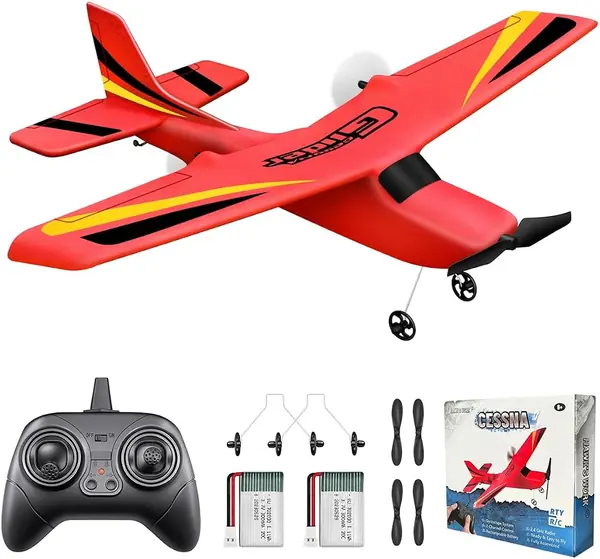
HAWK'S WORK Cessna RC Glider Best Trainer

HAWK'S WORK Cessna red foam RC glider with propeller and 2.4GHz controller

Learning real flight

Track Score 86/100
Size
35cm x 30cm x 9cm
Batteries
2 x 3.7V 300mAh (included)
Channels
2-channel, four directions
Takeoff
Taxiing 5 to 10 meters or hand throw
View on Amazon

Several planes in this guide are quad-prop toys that hover and call it flying. The Hawk's Work Cessna glides. It's a 2-channel fixed-wing remote control airplane that takes off from a 5-to-10-meter taxi run or a firm hand throw, and that's exactly why we point the airplane-obsessed kid at it — a wide turn and a real landing teach more than a button that flips it.

The realism has a price. It wants a calm day and an open space, a soccer field rather than a driveway, and the turns stay wide because there's no aileron control to tighten them. The landing gear pops off in a hard arrival; the airframe keeps flying without it.

The package is generous for the money: self-stabilization, two 300mAh batteries, a spare propeller, three AA batteries for the controller and a one-year airframe warranty with three months on the battery. For a first plane that is going to be thrown, that support matters as much as the foam.

Worth Noting

  • Needs calm air and a large field
  • Landing gear pops off in hard arrivals
Our Verdict

We steer the airplane-obsessed kid here: it flies a real circuit instead of hovering, provided you have a field and a calm morning.

Check Latest Price
4.

BEZGAR RC Fighter Jet Best for Younger Kids

BEZGAR blue foam RC fighter jet with LED lights and two batteries

Youngest pilots

Track Score 85/100
Size
14 x 3 x 8 inches
Batteries
2 lithium-ion (included)
Flight Time
Over 14 minutes with the dual-battery setup
Alert
Low-battery warning
View on Amazon

The BEZGAR is foam and plastic, 14 inches long, and light enough that a bad landing is mostly a walk across the field to pick it up. Nothing about this plane is intimidating to a small kid, including what happens when it meets a fence.

We like the low-battery warning most. It tells a kid — and the adult pretending not to hover — that the plane is about to run out of power, which is exactly when beginners lose them. Altitude hold keeps it parked at height while they practice steering, and one-key takeoff means nobody has to learn to launch before they learn to fly.

Two packs are rated for over 14 minutes of flying between them, enough for a park visit if you charge both the night before and keep a power bank in the car. The controls are forgiving enough that a five-year-old can manage them with a hand nearby, which is not something we can say for every plane in this guide.

Worth Noting

  • Best in dead calm air
Our Verdict

The first plane we're most comfortable handing to a small kid: light foam, altitude hold, and a warning before the battery gives out.

Check Latest Price
5.

LIFECHOIC F8 RC Plane Best for Evening Flights

LIFECHOIC F8 white foam RC plane with RGB light strip and controller

Evening flights

Track Score 84/100
Size
6.7 x 9.5 x 1.7 inches
Control Range
196 feet
Flight Time
16 minutes
Charge Time
70-90 minutes
View on Amazon

On paper the F8 is the most capable plane in the group: 16 minutes of flight, 196 feet of range, three speeds, toss-to-fly launching, headless mode and 13 light modes in a 9.5-inch airframe. The armor-grade shell is the part we're watching, since it's the reason a plastic body should survive the drops that crack plain foam. We like it best after dusk, when the light show makes it the easiest of these to keep in sight.

The catch is what happens between flights. One battery comes in the box, so a second pack is close to essential for anything longer than a single outing. We also haven't put enough hours on this one to vouch for the shell across a season — the specifications are the strongest here, and the history behind them is the shortest.

Worth Noting

  • Refueling takes 70 to 90 minutes
Our Verdict

The strongest specifications here for flight time and range, wrapped in a body we haven't flown long enough to vouch for.

Check Latest Price
6.

MIRUMAN FLY001 Foam RC Jet

MIRUMAN blue foam fighter-jet RC plane with USB-C cable and remote

Gift-ready first jet

Track Score 83/100
Batteries
2 rechargeable (included)
Colors
Blue or red
Charging
USB-C cable
Speed Modes
3
View on Amazon

The MIRUMAN arrives looking like a fighter jet rather than a toy, in blue or red, with a foam body and two rechargeable batteries in the box. For a birthday, that combination does a lot of work before the plane ever leaves the ground.

In the air it behaves like the other hover-style jets here: one-key takeoff and landing, altitude hold to park it at height, three speeds and 360-degree flips from a 2.4GHz controller. The second battery is the practical part — one pack charges over USB-C while the other flies.

What we like most is the progression: the same plane that scares nobody on low speed will flip on high a month later. We haven't had it long enough to speak to how the foam holds up over a full season, and there's no wall adapter in the box — any phone charger covers it.

Worth Noting

  • No wall adapter in the box
Our Verdict

We like it as the gift pick: fighter-jet looks, two batteries, three speeds, and a price that leaves room for the inevitable second plane.

Check Latest Price
7.

NIPLOOOW Foam RC Plane Best for Small Spaces

NIPLOOOW blue foam RC plane with enclosed propellers and LED lights

Small spaces

Track Score 81/100
Size
10 x 8 x 4 inches
Lighting
LED lights
Propellers
Four enclosed propellers
Recommended Age
6 to 9 years
View on Amazon

On the NIPLOOOW, four propellers sit behind a molded guard instead of out in the open, which is the detail that matters when a six-year-old is holding the controller. The foam body hovers on a cushion of air rather than flying a circuit, so it works in a garage, a basement or a small fenced yard.

We like that the safety comes from the design instead of from an adult saying not so close. Gravity sensing, stunt rolls and 360-degree circling are the fun part, but the hovering is the real argument: this is the plane here a kid can fly in a garage or a postage-stamp yard without an adult jogging alongside.

Worth Noting

  • Too light for breezy afternoons
Our Verdict

For tight spaces and little hands, the guarded propellers make this the one we're least worried about handing to a six-year-old.

Check Latest Price

How We Tested These RC Planes

We started by pulling out the things that change a first flight: channel count, stabilization, altitude hold, how many batteries come in the box, charge time, and whether the plane is built for a yard or a field. That narrowed the field to 12 planes, which we flew for six months.

Testing happened where these planes actually live: a fenced backyard, a park field with room for wide turns, a rec room on windy and rainy days, and a few evening sessions to see how the LED lights read against a dark sky. We logged every crash and noted what gave — nose, wing, propeller, landing gear — and whether a spare prop in the box got the plane back up. Each pack was timed from launch to the moment the plane stopped climbing, then a second timer ran on the recharge, with every battery charged on a concrete garage floor and someone in the room the whole time.

We handed the transmitter to kids from 6 to 11 with an adult standing beside them, and to grown-ups who had never flown, noting who could take off without help, whether altitude hold kept the plane level hands-off, and what the speed modes changed. To test range, we walked the controller back across open grass until the link cut and watched whether the plane circled, cut the motor, or flew on. We also weighed each plane and carried it to the park in a bag, since a plane that's a hassle to transport doesn't get flown.

How to Choose an RC Plane for Kids

Decide How Much the Plane Should Fly Itself

Nearly every plane here has a gyro that levels it and a button that launches it, but the amount of help varies a lot. Hover-style jets hold their own altitude, so a six-year-old can steer without managing height. A 2-channel glider like the Hawk's Work Cessna flies a real circuit and needs constant input, which suits a nine- or ten-year-old who wants to learn.

For a first remote control airplane, buy the one that flies itself. Save the glider for the second plane, when the crashing has mostly stopped and the appetite for a challenge has started.

Match the Plane to the Airspace You Have

A 164-to-196-foot control range sounds generous until you watch a plane cross a soccer field in a few seconds. Small foam planes turn tightly and forgive grass landings, but they have almost nothing to push against a breeze, so a sheltered yard beats an exposed field on a windy day.

The trap is the word compact: it describes how a plane packs, not where it flies. Only a hovering design with guarded propellers is genuinely indoor-friendly. Everything else needs a calm outdoor space, and a taxi takeoff needs several smooth yards of ground before the plane even leaves the grass.

What Actually Breaks

Foam fails in predictable places. Landing gear snaps off first, often in the first week; propellers chip on pavement; a motor glued into the airframe can pop loose in a hard nose-in. Flexible EPP foam bends and dents where a rigid plastic shell cracks, and neither is indestructible.

Buy the plane with a spare propeller in the box and propellers that are guarded or enclosed, keep tape and foam-safe glue in the car, and check that the landing gear snaps in rather than relying on friction. Repairs are part of the hobby, not a sign you chose badly.

Batteries Decide How Long the Fun Lasts

Flight time is only half the number that matters; charge time is the other half. One plane here flies 16 minutes on a 70-to-90-minute charge, while several ship with two or three smaller packs that swap in seconds. For a kid, three short batteries beat one long one every time, because the waiting is what ends the session.

Check what comes in the box, buy a spare before the first flight rather than after the first disappointment, and charge from a USB power bank in the car so the second pack is ready before the drive home.

Channels, Speed Modes, and the Learning Curve

Two-channel control gives you up, down, left and right. Four-channel adds independent steering and tighter turns. Neither is better by itself: a 2-channel glider is a fine trainer in open space, and a 4-channel plane with a low gear is easier in a small yard.

What we look for is that low gear. A plane you can dial down lets a beginner fly the same airframe that a more confident kid will stunt with a month later, which is a much better use of the money than buying twice.

Frequently Asked Questions

Final Verdict

Buy the SYMA X550 first. It is the plane we hand to a kid who has never touched a transmitter: low speed and one-key takeoff make the first flight short and survivable, and the six stunts are still there a month later when the nerves are gone. That built-in progression is worth paying a little more for.

If your kid wants to fly an airplane rather than hover a jet, get the Hawk's Work Cessna and give them a field and a calm morning. And if three batteries and a soft foam airframe matter more than tricks, the DEERC glider is the way in.