Best Plastic Cements for Models and Acrylic of 2026

Plastic cement isn't quite glue. It softens the plastic along the joint so two pieces fuse into one, which is why the wrong bottle leaves a seam that never closes or a white haze creeping across a surface you spent an hour fitting. The right one gives you a seam you can sand and forget.

Thin cements do the work for you, wicking into a closed seam by capillary action, while thicker ones bridge gaps and give you time to nudge a part. A bottle that's perfect for a tight fuselage seam is frustrating on a gap. Over four months on model seams, broken-toy repairs and the edges of an acrylic display case, we judged 14 cements on thickness, working time and whether the applicator lands where you aim. Keep a window open; the vapors are strong and several of these are flammable.

Our Top Picks

The Best Plastic Cements for Models and Acrylic

1.

Tamiya Extra Thin Cement 87038 Best Overall
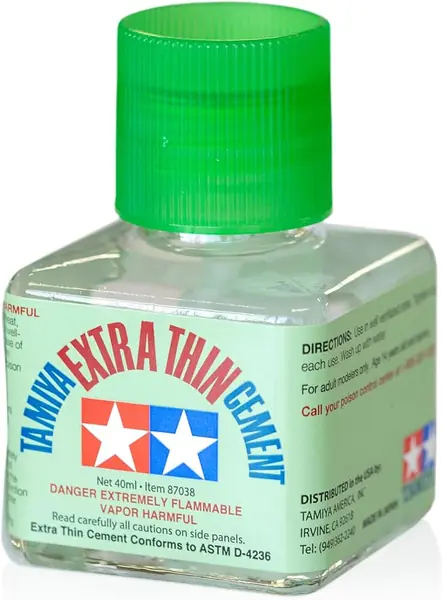
Tamiya Extra Thin Cement bottle with fine applicator tip and 40 ml label

Tight polystyrene seams

Track Score 95/100
Volume
40 ml
Viscosity
Extra thin
Full Cure
24 hours
Applicator
Fine tip
View on Amazon

The narrow applicator tip is why this bottle comes first. Hold two polystyrene parts together, touch the tip to the seam, and the extra-thin cement wicks into the joint by capillary action. That keeps the solvent on the mating surfaces instead of on surrounding detail, and it gives a clean weld with very little material.

The 40 ml bottle goes a long way because each joint takes only a touch. We found the fine tip especially useful around small assemblies and seam lines, where a brush can flood the area before you get the parts aligned. The formula is unforgiving on loose joints, though: it needs close-fitting surfaces and can flash off before a gap fills. Use a thicker cement there.

A 24-hour full cure is the other number to keep in mind. The joint may set quickly enough to hold, but we leave major handling and sanding until the cure is complete. That patience pays off on a visible seam.

Worth Noting

  • Strong solvent odor while working
Our Verdict

We recommend the extra-thin Tamiya for tight polystyrene seams, where its fine tip and capillary flow do the neatest work.

Check Latest Price
2.

Tamiya Plastic Cement 87012 Best General-Purpose

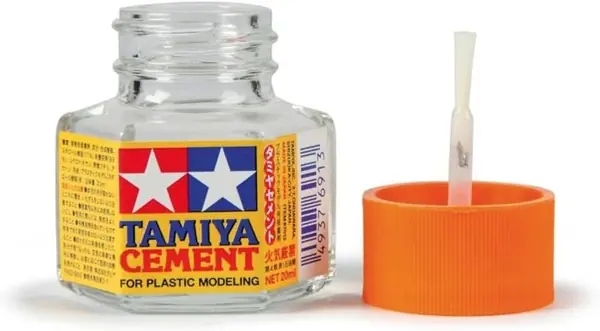
Tamiya Plastic Cement 20 ml bottle with brush applicator cap

General model assembly

Track Score 94/100
Volume
20 ml
Viscosity
Medium to high
Full Cure
24 hours
Applicator
Brush
View on Amazon

If the extra-thin Tamiya feels too watery for the job in front of you, this is the bottle to set beside it. The medium-to-high viscosity formula stays where the brush puts it, so you can run a small bead along an edge and seat the part without the cement racing into every nearby seam.

We prefer it for general assembly and for joints with a slight gap. It has enough body to fill a small void, and the 20 ml bottle is easy to control in one hand. The trade-off is less capillary action than the extra-thin version, so hairline seams need a different bottle. We treat this as the all-purpose brush cement rather than the finest detail tool.

The 24-hour full cure is the same as the extra-thin Tamiya, so plan on leaving structural joints alone overnight. A little goes a long way at the brush, and the bottle remains easy to handle during a long build session.

Worth Noting

  • Only a small 20 ml bottle
Our Verdict

For general model assembly, this thicker Tamiya gives us a controlled brush line and a little time to align parts before the joint grabs.

Check Latest Price
3.

Testors Plastic Cement Value Pack Best Value

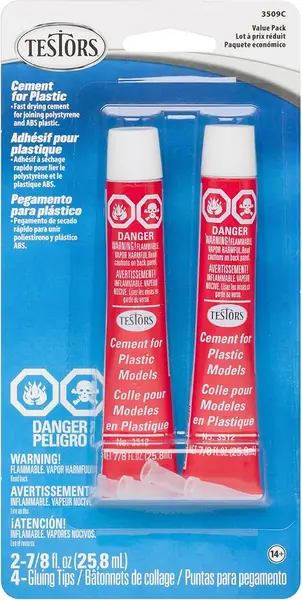
Testors plastic cement value pack with two tubes and four precision tips

Beginners and gaps

Track Score 93/100
Volume
51.6 ml
Viscosity
High
Pack Count
2
Precision Tips
4
View on Amazon

The two-tube pack with four snap-on precision tips is the least fussy way to start. The high-viscosity gel stays where you put it, so it can bridge a small gap or fill a seam that a water-thin cement runs straight through. For a first model, that forgiveness matters more than razor-fine capillary action.

The tube suits a visible bead you can control by hand. Squeeze a small amount, touch the tip to the part, and lift before you stop squeezing to avoid a string. The four tips are genuinely useful: keep one on the tube, one in the package, and you are less likely to be stuck with a clogged applicator.

The clear dry helps on visible joints, and the four tips make it easy to keep a clean applicator on the tube. What we appreciate most is the margin for error: a slightly uneven bead still fills the join instead of evaporating away.

Worth Noting

  • Too thick for hairline seams
Our Verdict

We suggest the Testors value pack for beginners and larger joints, where two tubes and four tips make a forgiving clear-drying bond.

Check Latest Price
4.

GSI Creos Mr. Cement S Best Fast-Setting

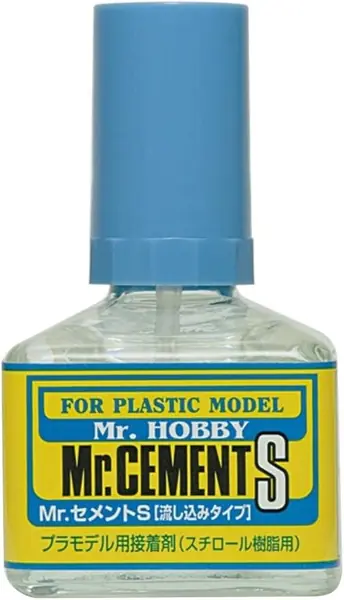
GSI Creos Mr. Cement S 40 ml bottle of low-viscosity plastic cement

Fast tight-joint work

Track Score 89/100
Volume
40 ml
Viscosity
Low
Full Cure
2 hours
Application
Capillary action
View on Amazon

A two-hour full cure is the number that sets Mr. Cement S apart from the 24-hour bottles here. It is a low-viscosity cement that runs into tight seams by capillary action, and the faster cure means a small subassembly can move on to sanding sooner. We like it for that quicker rhythm.

It suits detail work where the parts already fit closely. The 40 ml bottle gives you enough to work through a kit, and the thin formula leaves little excess to clean up. A small bead at the seam is all it takes.

The working window is shorter than some other Mr. Cement grades, so dry-fit before you touch the brush to the seam. We treat it as a precision cement, not an all-purpose one.

Worth Noting

  • Not a gap filler
Our Verdict

Mr. Cement S is our fast-curing pick for tight seams you want to sand sooner, with a two-hour full cure and strong capillary flow.

Check Latest Price
5.

Berkland Acrylic Bonding Cement Best for Acrylic

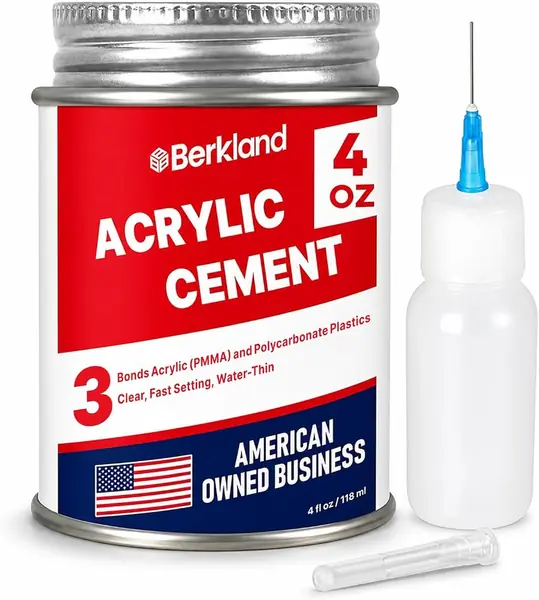
Berkland acrylic bonding cement bottle with needle applicator and clear liquid

Acrylic sheet projects

Track Score 88/100
Volume
4 fluid ounces
Viscosity
Water-thin
Full Cure
1 day
Applicator
Needle bottle
View on Amazon

Acrylic sheet is a different bond from a polystyrene kit, and the Berkland bottle is built for it. The water-thin cement flows into a tight seam by capillary action, so the joint stays clear instead of showing a thick glue line. A four-ounce bottle also gives you enough for a real acrylic project, not just a repair.

The needle applicator is the part we appreciate most. It lets you lay a thin line along an edge and keep the cement away from a finished face. The formula sets in minutes and reaches full cure in a day, so you can handle a small assembly and still leave it overnight before stressing the joint.

Control is everything with a water-thin solvent. Keep the bottle upright, apply a little at a time, and test on scrap acrylic before you work on a visible panel. We think this is the right choice for display cases, signs, and clean acrylic repairs; it is not the bottle for a loose polystyrene kit.

Our Verdict

For acrylic sheets and display cases, Berkland's water-thin cement and needle bottle give us clean seams without a thick glue line.

Check Latest Price
6.

Plastruct Plastic Weld

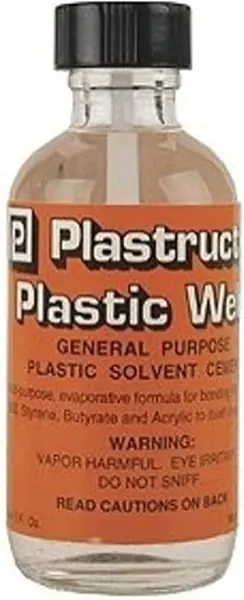
Plastruct Plastic Weld two-ounce bottle with brush applicator in cap

Mixed-plastic fabrication

Track Score 87/100
Volume
2 fluid ounces
Viscosity
Low
Applicator
Brush
Compatible Plastics
ABS, butyrate, styrene, acrylic
View on Amazon

Most bottles here are aimed at one family of plastic. Plastruct Plastic Weld is the general-purpose solvent for joining dissimilar plastics: ABS to butyrate, ABS to styrene, ABS to acrylic, and more. It dissolves a thin film on each surface, then bonds as a weld rather than a layer of glue.

It suits a project that mixes materials or a joint that needs a little liquid filling. The brush in the cap lays down a wet line, and the two-ounce bottle gives you room to work. The fast tack is the trade-off: dry-fit and support the parts before applying, because it grabs as soon as the surfaces meet.

We treat it as a fabrication cement for mixed-plastic assemblies, not as a replacement for a fine capillary cement on a polystyrene kit. The brush makes it easy to place a controlled line along an edge or into a corner.

Worth Noting

  • Not formulated for PLA
Our Verdict

Plastruct is the solvent weld we choose for mixed plastics, with a brush and fast tack for ABS, butyrate, styrene, and acrylic fabrication.

Check Latest Price
7.

Testors Liquid Plastic Cement Best for Small Polystyrene Jobs

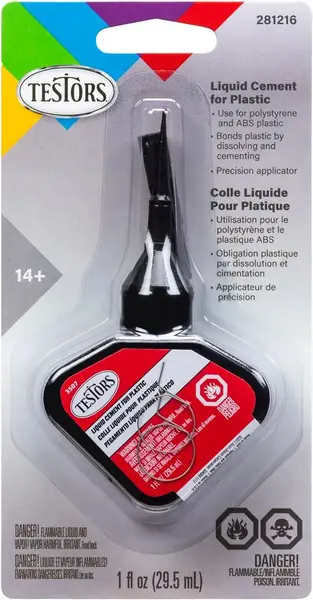
Testors liquid plastic cement one-ounce bottle with precision applicator

Small polystyrene jobs

Track Score 86/100
Volume
1 fluid ounce
Viscosity
Low
Full Cure
4 hours
Compatible Plastics
Polystyrene, ABS
View on Amazon

A one-ounce bottle of low-viscosity cement with a precision applicator is a simple tool, and that is the appeal here. The liquid is aimed at polystyrene and ABS, and it sets up fast enough that small parts do not need a long clamp.

We use it when we want a finer line than a tube can give but do not need the extra-thin capillary action of our top pick. The applicator puts a small drop where you touch it, and the one-ounce bottle is easy to store.

The four-hour full cure is shorter than the 24-hour Tamiya bottles, which helps on a detail assembly you want to handle sooner. It still needs a close-fitting joint; this is not a gap filler.

What we like most is the simplicity: one bottle, one applicator, no extra tips to keep track of. It is a sensible spare for a toolbox or a smaller bottle for a builder who does not want a large container open on the bench.

Our Verdict

We keep Testors Liquid for small polystyrene and ABS jobs where a one-ounce bottle and precision applicator are enough.

Check Latest Price
8.

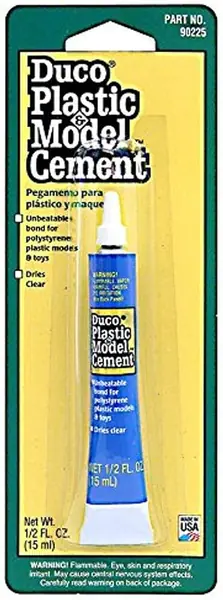
Devcon Plastic and Model Cement Best for Polystyrene Toy Repairs

Devcon plastic and model cement tube with clear-drying high-viscosity formula

Polystyrene toy repairs

Track Score 85/100
Volume
0.5 fluid ounces
Viscosity
High
Handling Time
10 minutes
Tensile Strength
300 psi
View on Amazon

The high-viscosity tube is the old-school end of plastic cement: a thick bead you place by hand, a clear dry, and a listed tensile strength of 300 psi. It is aimed at polystyrene models and toys, and it gives you more working time than a water-thin solvent.

It helps when the joint is not perfect or a repair needs a little material in the gap. The 10-minute handling time lets you position a part, and the two-hour set means you can move on without waiting all day. The full cure is 24 hours.

The tube can string when you lift it, so stop squeezing before you pull away and keep a scrap of paper nearby for the tip.

What we like most is the way a thicker bead stays put on a repair where the two surfaces do not meet perfectly. It is a useful tube to have beside a bottle of thin cement, not a replacement for one.

Worth Noting

  • Too thick for fine seams
Our Verdict

Devcon's clear-drying tube is a practical choice for polystyrene models and toys that need a thicker, gap-filling cement.

Check Latest Price

How We Tested Plastic Cement

We built the shortlist by sorting the market by solvent type and viscosity first, then filtering for applicator style, bottle volume, and cost per use. That left 14 cements worth putting on a bench, and we spent four months with them.

Most of the testing happened at a model bench, but not all of it. We ran extra-thin cement along the inside of closed polystyrene fuselage seams and watched whether it wicked the length of the joint on its own or pooled where the tip touched. Medium and thick cements went into gapped repairs — a snapped landing gear, a cracked toy body — where we checked whether the cement filled the void or shrank back as it set. Water-thin acrylic cement went onto display-case edges from a needle bottle, and we noted whether it stayed where it was put instead of wandering. Throughout, we timed how long a part stayed repositionable and how long it took before we could sand.

After full cure, we flexed joints, dropped finished assemblies, and sanded seams flush to see whether any ghosted back. We rated odor at arm's length, capped and uncapped bottles to see how quickly tips clogged, and did the arithmetic on cost per use from each bottle's stated volume.

How to Choose Plastic Cement

Match the Solvent to the Plastic

Solvent cement works by softening the plastic surfaces so they fuse; it is not a gap-filling adhesive in the usual sense. For a polystyrene model kit, a styrene cement such as Tamiya Extra Thin is the default. ABS and acrylic need a cement listed for them, and mixed-material work calls for a broader solvent like Plastruct Plastic Weld. A bottle labeled plastic glue is not automatically the right product; check that the label names your plastic and describes a solvent cement rather than cyanoacrylate. When in doubt, test on a hidden sprue or scrap.

Choose Viscosity by Joint Fit

Thin, water-like cement is for seams that already fit tightly. Capillary action pulls it into the joint, so you apply it after dry-fitting and keep it off the surrounding surface. A medium or high-viscosity cement stays where you put it and can bridge a small gap or fill a seam; a tube gel is the most forgiving but the least precise. If you can see daylight through the joint, reach for the thicker product, not more of the thin one.

Decide How Much Working Time You Need

Set time and full cure are different. A fast tack helps a small assembly stay put, but it leaves little chance to slide a part into alignment. A cement with a longer working window suits complex dry fits. Full cure is when you can sand or stress the joint: some bottles list two hours, others four or twenty-four. We dry-fit first and apply cement only after the parts are aligned, especially with fast capillary products.

Plan for Applicator, Ventilation, and Volume

Fine tips and needle bottles put cement exactly at a seam; brushes suit controlled beads; tubes are best for gap filling and repairs. Solvent vapors are strong and many plastic cements are flammable, so work with ventilation and away from flames, and cap the bottle between passes. Volume matters as much as price: a large acrylic project can use four ounces, while a fine-detail builder may prefer a small bottle that stays fresh. Buy for the work you do most.

Frequently Asked Questions

Final Verdict

For most model builders, we recommend Tamiya Extra Thin Cement first. Its fine tip and capillary flow put the solvent exactly at a tight polystyrene seam, and the 40 ml bottle covers plenty of small joints.

If you are building acrylic display cases, choose Berkland's water-thin acrylic cement instead; for a beginner or a gap-prone repair, the Testors value pack is the more forgiving tube. For mixed-plastic fabrication, Plastruct Plastic Weld is the right bottle.