Tamiya Extra Thin Cement Best Overall
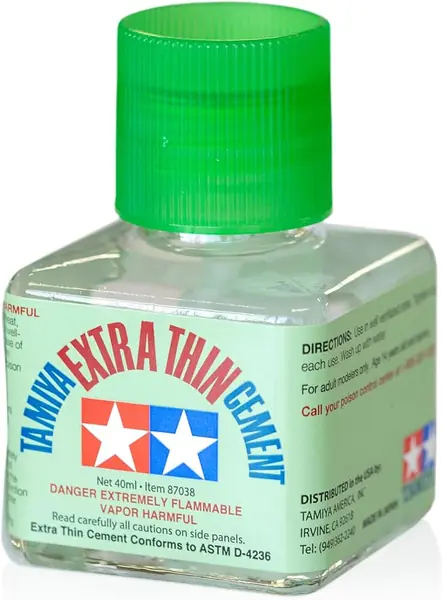
- Type
- Solvent cement
- Volume
- 40 ml
- Viscosity
- Extra thin
- Applicator
- Fine pointed tip
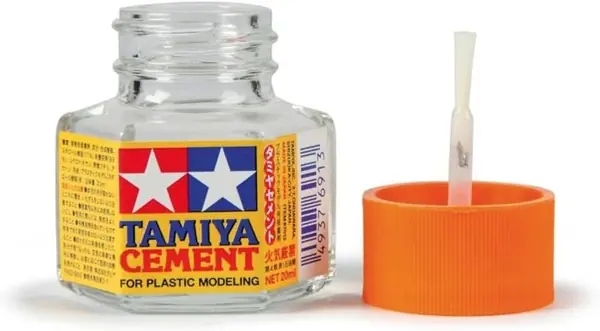
A drop touched to a closed seam disappears into the joint, and a moment later the two polystyrene parts are welded along the length of the join. That capillary action is why it comes first on bare styrene kits. You dry-fit the parts, touch the fine tip to the seam, and let the cement travel; there's no need to coat both faces or work a brush into a tight gap.
The fine applicator is the other half of the appeal. It lets us place cement at a locating pin or a narrow trim edge without flooding the surrounding detail. The 40 ml bottle is also generous for a thin cement, so a little goes further than the bottle suggests. It does reward close-fitting joints; on a loose seam or a visible gap, this thin formula has nothing to fill, and a thicker cement or a gap-filling CA is the better tool.
Working time is short at the joint but not frantic. The parts grab quickly, then continue to cure; we leave seams alone for the full cure before sanding or handling a fragile assembly. For a model with many small subassemblies, that rhythm is easy to learn.
Set it beside Tamiya's thicker cement and the division is clear: this one is for clean, tight joins and invisible seam lines, while the thicker bottle handles gaps and adjustment. A bottle this size covers several small kits before it needs replacing, especially when you apply it a seam at a time.
What We Like
- Capillary action pulls cement into tight seams
- Fine tip keeps cement off surrounding detail
- Generous 40 ml bottle covers multiple builds
Worth Noting
- Strong solvent fumes need ventilation
We recommend Tamiya Extra Thin as the default for bare polystyrene kits because its capillary action gives clean, strong seams with very little cement.
Check Latest Price