Best Plastic Cement for Warhammer Miniatures of 2026

Switching from super glue to a real solvent cement is usually when miniatures stop falling apart. A thin solvent wicks into the seam and welds the two polystyrene faces into one piece, so the joint ends up as strong as the plastic around it. The bottles all look alike and behave nothing alike.

Two things sort them faster than any label claim: how quickly the solvent flashes off, and whether the applicator puts cement on the joint or everywhere around it. A watery cement that vanishes in seconds suits a tight shoulder socket and fails on a gap, while a needle tube reaches into a closed sub-assembly a brush can't. We also opened and closed each of 16 bottles dozens of times over four months, because a cement that welds its own lid shut gets thrown away half full.

Our Top Picks

The Best Plastic Cement for Warhammer Miniatures

1.

Tamiya Extra Thin Cement 87038 Best Overall
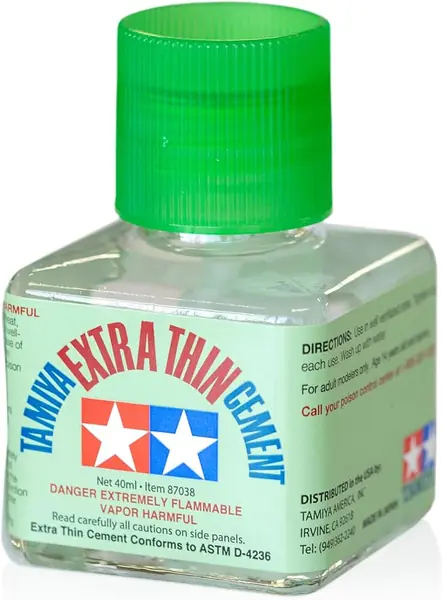
Tamiya Extra Thin Cement 40 ml bottle with a fine applicator brush

Miniature assembly

Track Score 94/100
Viscosity
Extra thin (low)
Volume
40 ml
Applicator
Fine brush
Full Cure
24 hours
View on Amazon

The moment this cement earns its place is when the parts already touch: press a shoulder to a torso dry, touch the loaded brush to the seam, and the liquid runs in by capillary action. Nothing gets painted onto the outside of the model, so there is nothing to sand off afterward. That single behavior is why we point new Warhammer builders at this bottle before any other.

At 40 ml it is the best value in this group as well. The brush holds a couple of drops at most, so you are touching a seam rather than painting a joint, and a bottle goes a long way. Full cure is listed at 24 hours, though the parts hold steady well before that, which is what lets you keep building while a leg sub-assembly sits overnight.

Thin cuts both ways. Two parts have to meet flush — flat, square, in contact — because this cement fills nothing, and a visible gap stays a weak one. It also welds styrene-family plastic only; soft, rubbery vinyl does not respond to it at all. For crisp modern kits and clean conversions, that is a small price for seams that disappear under primer.

Worth Noting

  • Gaps stay gaps; parts must fit flush
  • Won't weld rubbery vinyl or soft plastics
Our Verdict

We recommend Tamiya Extra Thin as the default: capillary action welds clean seams with almost no cleanup, and the brush puts cement only where you aim it.

Check Latest Price
2.

Tamiya Plastic Cement 87012 Best for Filling Gaps

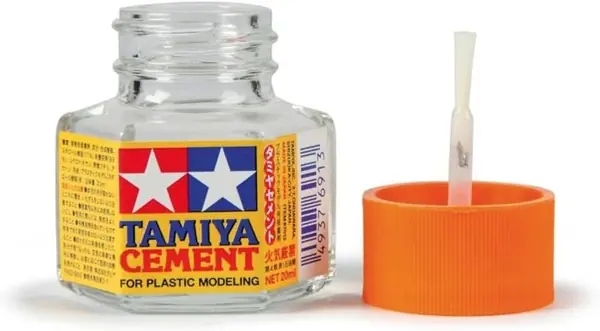
Tamiya Plastic Cement 20 ml bottle with brush applicator

Filling small gaps

Track Score 93/100
Viscosity
Medium to high
Volume
20 ml
Applicator
Brush
Full Cure
24 hours
View on Amazon

If the extra thin is water, this is syrup. Same brand, same brush format, but the 20 ml bottle holds a medium-to-high viscosity cement that stays where you put it instead of running down the seam. Apply it to one face, press, and you get a thin bead of squeeze-out rather than nothing at all.

That makes it the bottle for a joint that refuses to close: a warped plate, a gap along the edge of a cloak, the kind of fit that older or secondhand kits hand you. It is also the friendlier of the two Tamiya cements for a beginner, because parts stay where they are placed while you bring the next one in, and the longer working time buys a second to slide a shoulder pad into line.

It will not wick into a closed seam the way the extra thin does, so for hidden, well-fitted joins the thinner cement is still the better tool. Keep it away from fine detail too: it does melt plastic, and a heavy bead softens the surrounding edges along with the joint. Twenty milliliters also disappears faster than you expect once you are laying beads instead of touching seams.

Worth Noting

  • Needs sparing use near fine detail
  • Small 20 ml bottle empties quickly
Our Verdict

Our pick when a joint won't close: the thicker formula bridges small gaps and gives you a moment to line parts up before they grab.

Check Latest Price
3.

Revell Contacta Professional Best Needle Applicator

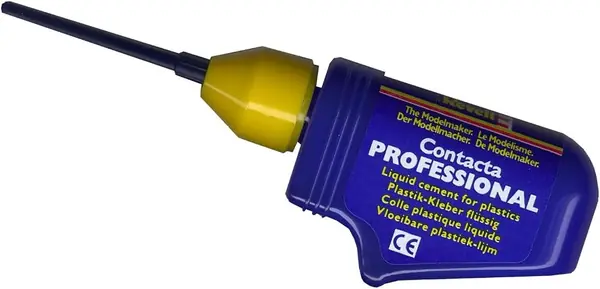
Revell Contacta liquid glue 25 ml bottle with long metal needle applicator

Hard-to-reach joints

Track Score 92/100
Viscosity
Low
Volume
25 ml
Applicator
Metal needle tube
Full Cure
24 hours
View on Amazon

A brush is only as precise as the hand holding it; a needle is precise on its own. Revell runs a long, narrow metal tube out of a 25 ml bottle, and the tip lets you lay a bead inside a torso, under a raised arm, or along a joint that is already half assembled without flooding the detail around it. That reach is the whole reason it has a place on our desk.

The formula is low viscosity, so it flows into the joint and cures over the listed 24 hours. Where it separates from the thin brush cements is speed: it does not grab as quickly, and on a large flat join you will be holding or taping parts while it tacks up. On small, awkward joins that trade goes your way, because the joint is already the hard part and a slow cement gives you time to get it right.

One habit matters. A metal tube left dirty or uncapped between sessions will clog, and a clogged tube is useless. Cap it after every joint and wipe the tip before the cement sets, and it keeps flowing project after project. If you are assembling a whole squad in one sitting a brush bottle is quicker; for reaching into a finished sub-assembly, this is the one.

Worth Noting

  • Slow to tack on large flat joins
Our Verdict

Revell is the answer when a joint is hard to reach: the metal needle places a bead exactly where you aim it, with none of a brush's slop.

Check Latest Price
4.

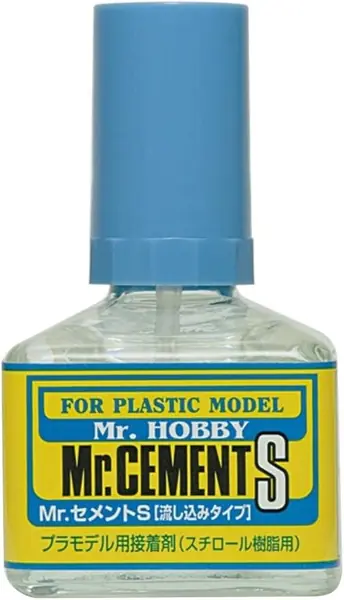
GSI Creos Mr. Cement S Best Fast Cure

GSI Creos Mr. Cement S 40 ml bottle of low-viscosity liquid cement

Batch assembly

Track Score 91/100
Viscosity
Low
Volume
40 ml
Full Cure
2 hours
View on Amazon

Twenty-four hours is the usual full-cure figure in this category; Mr. Cement S lists two. That number changes how you work: a squad assembled in the evening can be sanded and primed the next morning rather than the following night.

Everything else is familiar ground. It is a 40 ml bottle of low-viscosity cement that moves into a tight joint by capillary action, so the technique matches any thin cement — dry-fit, touch the seam, let the liquid run in. The bottle is big enough to see you through a project, which is more than the smaller bottles here can claim.

What you give up is time to think. The working window is shorter than its stablemates', and we noticed it: once two parts touch with cement between them you get roughly one chance at alignment. Dry-fit every sub-assembly first, decide the orientation, then commit. For a builder working in batches that is a fair trade; for someone still learning where the arms go, it is a good second bottle rather than a first.

Worth Noting

  • Short window to realign parts
Our Verdict

Our choice for batch building: Mr. Cement S welds like the others but cures in about two hours, so a squad can be sanded and primed the same day.

Check Latest Price
5.

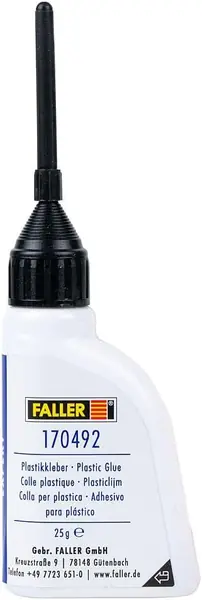
Faller Expert Plastic Adhesive Best for Tiny Parts

Faller Expert plastic adhesive 25 g tube with fine cannula and protective cap

Tiny parts

Track Score 90/100
Viscosity
Low
Applicator
Fine cannula
Container
Tube with protective cap
View on Amazon

Faller comes out of model railways, and this 25 g tube ends in a cannula fine enough to leave a dot of cement on a single boot strap. A protective cap covers the tip, which matters more than it sounds: a needle left open between sessions is a needle that stops working. The cement itself is low viscosity and tacks quickly on small styrene parts.

We like it best for the sub-assemblies you build a handful at a time — a hand, a weapon head, the edge of a cloak — where a brush carries more cement than the join can use, and the tube lets you squeeze out a controlled amount rather than dipping. Set time is the variable to know about: some joins grab fast, others need holding, and a larger flat face takes noticeably longer than a thin capillary cement would. If that unevenness gets under your skin, our top pick is the more predictable tool for the same money.

Worth Noting

  • Set time uneven on larger joins
Our Verdict

We like Faller for the tiniest parts: the fine cannula places a pinpoint dot, though set time is less predictable than our top pick's.

Check Latest Price
6.

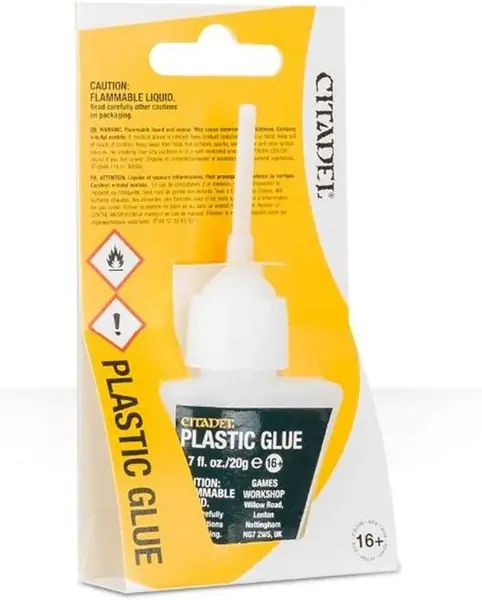
Games Workshop Adhesive for Plastic Best for Citadel Miniatures

Games Workshop plastic adhesive bottle with a fine applicator cannula

Citadel miniatures

Track Score 89/100
Viscosity
Low
Applicator
Fine cannula
Intended Use
Plastic miniatures
View on Amazon

Games Workshop sells its own cement in a bottle with a fine cannula, and the formula is a low-viscosity liquid aimed at the same polystyrene every Citadel miniature is molded in. Nothing about it is exotic: you put a small bead on the joint, it flows into the gap, and the parts weld. The cannula is fine enough to reach under a shoulder pad without taking the arm off again, which is the test that separates a real applicator from a nozzle.

Where it stands apart is price. It is the most expensive cement here, and nothing about it suggests it does something the others cannot — same low viscosity, same fine applicator, same polystyrene. What it does offer is zero guesswork: it is the cement sold next to the models, made by the people who designed them.

We rate it as a convenience purchase rather than a better one. If you are ordering miniatures and supplies from the same place and want one less decision to make, it is decent cement with a good applicator, and the tube does exactly what it should. If you are building an army on a budget, one of the less expensive bottles here will do the same job and leave money for more models.

Worth Noting

  • Most expensive cement in this group
Our Verdict

We think of this as the convenience pick: the maker's own cement with a fine cannula, at a price that buys the name as much as the bottle.

Check Latest Price
7.

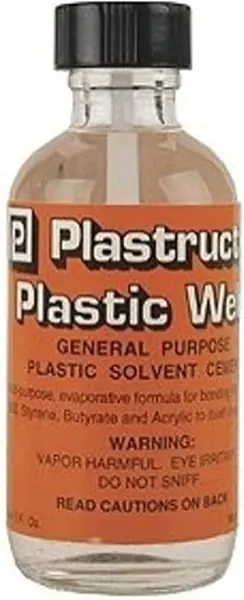
Plastruct Plastic Weld Best for Terrain Building

Plastruct Plastic Weld 2 fl oz bottle with applicator brush in the cap

Terrain building

Track Score 88/100
Viscosity
Low
Volume
2 fl oz
Bonds
Styrene, ABS, butyrate and acrylic
Set Time
Minutes
View on Amazon

Plastruct's Plastic Weld is a different animal from the miniature cements: a 2 fl oz bottle of aggressive solvent with an applicator brush in the cap, sold for bonding dissimilar plastics. It works by dissolving a thin film of both surfaces so they fuse, and it is formulated to bond ABS to butyrate, styrene and acrylic.

For Warhammer that makes it a terrain and conversion tool. Plasticard walls, styrene rod and tube, sheet stock, a plastic base married to an ABS core — the mixed-material joins that a cement formulated for one plastic will not touch. It also runs into a seam by capillary action and works as a liquid filler along a joint line.

It moves fast. Immediately tacky, set in minutes, and that matches how it behaves in the hand: put two pieces together and they stay. There is no sliding a wall back into square after contact, so dry-fit and mark your corners before the brush comes out of the bottle.

We keep it for scenery, not for a Space Marine's shoulder. The brush is broader than a needle, the solvent bites into detail quickly, and the fast grab leaves no room for adjustment. On a table of ruins and crates none of that matters, and the big bottle earns its shelf space.

Worth Noting

  • Grabs too fast to reposition parts
Our Verdict

We keep Plastruct for terrain and mixed-plastic joints: it welds styrene to ABS and acrylic, but the fast set leaves little time to adjust.

Check Latest Price
8.

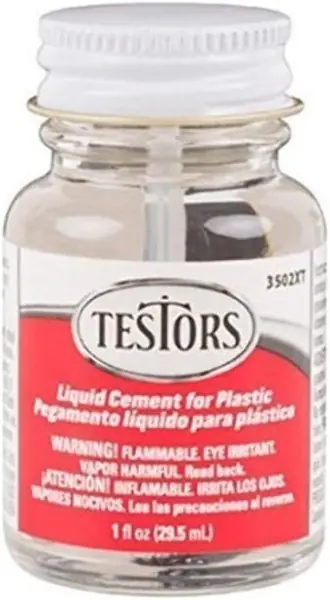
Testors Plastic Cement Liquid 3502XT

Testors liquid plastic cement 1 oz glass bottle with brush applicator

Brush-on assembly

Track Score 87/100
Viscosity
Low
Volume
1 fl oz (29.5 ml)
Applicator
Brush
Container
Glass bottle
View on Amazon

This is the old format: a 1 fl oz glass bottle with a brush fixed into the cap and a low-viscosity liquid that dissolves the surface of the plastic to make the bond. If you built models before thin cement bottles took over the shelf, you know exactly what is inside.

The formula covers more ground than polystyrene — it is rated for ABS, acetate and plexiglass as well. Full cure is 24 hours, in line with the other brush cements here, so plan on leaving a finished sub-assembly alone overnight before you sand it.

The brush is the part to understand. It is a fat brush next to the fine applicators on our top picks, and it carries a lot of cement. On a flat join — a vehicle hull, a wall section — that is efficient. On a shoulder pad or a hand it is a puddle, and you end up wicking the excess away with the corner of a paper towel before it softens detail.

We treat it as the dependable generalist: it welds the plastics it claims to weld, and the brush makes short work of big flat faces. What it will not do is pinpoint work, so keep a fine brush or a needle beside it for faces, hands and anything with a molded edge you want to keep.

Worth Noting

  • Adhesion varies with the plastic type
Our Verdict

We recommend Testors to anyone who wants a familiar brush-on bottle for big plastic joins rather than the finest detail work.

Check Latest Price

How We Tested Plastic Cement for Miniatures

We built the shortlist from the chemistry up. Anything that turned out to be a cyanoacrylate or a general-purpose craft glue was cut immediately; bottles that named a polystyrene solvent and shipped with a brush, needle, or cannula applicator went into the running, across a spread of prices and volumes.

Sixteen bottles spent four months on the bench, used the way these cements actually get used: assembling miniatures under a desk lamp, batch-building troops where speed matters, filling seams that were later sanded and primed, and laminating styrene sheet into terrain. For each one we counted how many joints a single dip or squeeze covered, watched whether the brush splayed or the needle clogged, and noted where the cement landed on a shoulder joint — on the mating faces or on the surrounding detail. We test-fit joints and counted the seconds until they stopped shifting, then left them alone and sanded a seam a couple of hours in and again the next day to see when it was ready for primer.

Bottle handling got its own notes. We capped each one between joints, kept it upright, weighed it at the start and end of each month to catch evaporation, and checked the threads for solvent crust. We worked with a window open and logged how sharp the fumes were at arm's length, since that's what decides whether you can keep going through a long session. Value came down to usable volume: how much cement we actually dispensed before a cap refused to seal or a nozzle jammed, not what the label promised.

How to Choose a Plastic Cement for Warhammer Miniatures

Solvent Cement, Not Super Glue

Polystyrene, which is what every Citadel sprue is molded in, softens on contact with the solvents in these bottles. Press two bare surfaces together, let the solvent flash off, and the plastic re-forms as one piece. Cyanoacrylate, the super glue many packages call plastic glue, sits on top of the surface instead. That is why a CA joint is brittle on a miniature that gets handled, and why it turns chalky white under stress.

The practical consequence: buy a solvent cement for anything that comes on a polystyrene sprue. It is the only thing that gives you a seam you can sand flush.

Brush or Needle Applicator

A brush in the cap rewards a light touch — dip shallow, touch the seam, let capillary action take the cement in. It is the fastest way through a squad of infantry, and it is what our top pick uses.

A needle or cannula is slower per joint but reaches where a brush cannot: inside a torso, under a raised arm, along a join that is already half built. Needles clog when they sit open, so cap them between joints. Keep both on the desk if you build a lot — brush for the rank and file, needle for the sub-assemblies.

Viscosity and Joint Fit

Thin cements flow into a joint you can close by hand, and they fill nothing: if you can see a gap, the cement cannot bridge it. Medium and thick cements stay where they are placed, bridge small gaps, and buy you a few seconds to slide a part into line, at the cost of a bead of squeeze-out to sand once it cures.

Choose thin for well-engineered modern kits where parts meet cleanly, and thicker for older kits, conversions, and any join that does not quite touch.

Working Time and Full Cure

Two clocks matter. Working time is how long you have to adjust a part before it grabs — short on the fastest capillary cements, longer on thick ones. Full cure is when you can sand, prime and handle the model without shifting a joint; most of these list 24 hours, and one lists two.

If you build in batches and want to prime the same weekend, shop by the cure figure. If you build one character at a time, it barely matters.

Ventilation and Bottle Care

These are solvents, and they smell like it. Work near an open window or under a fan, keep the cap on between joints, and do not lean over the model while the cement flashes off.

Solvent also evaporates out of an open bottle, so a bottle left uncapped thickens and a needle left dirty clogs. Both are cheap to prevent and irritating to fix: cap it, wipe the tip, and store the bottle upright.

Frequently Asked Questions

Final Verdict

Start with Tamiya Extra Thin. The fine brush and capillary action give you a seam you can sand flush with almost no cleanup, the 40 ml bottle is the best value here, and it teaches the technique every other cement on this page assumes. Add the thicker Tamiya 87012 when your joints stop closing on their own.

If most of your work happens inside sub-assemblies — arms, weapon heads, anything already half built — buy the Revell Contacta Professional instead. The metal needle reaches places a brush cannot, and the slower tack is a fair trade for that reach.