Best Paints for Model Trains of 2026

Model railroading is judged at three feet: close enough to see whether a boxcar's red reads as faded oxide or fresh plastic, far enough that a lumpy coat shows in every photo. The right paint covers a colored shell in a coat or two and survives the handling that comes with running trains.

Acrylic versus enamel drives everything downstream. Acrylics thin and clean up with water and dry fast enough to recoat the same evening; enamels lay a harder, glossier film but want ventilation, solvent cleanup and a 14-and-up label. Buy more thinner than you think you'll need. We brushed and sprayed 14 sets on plastic rolling stock, resin details and white-metal castings, and the seven picks cover both chemistries and enough range to mix honest railroad liveries.

Our Top Picks

The Best Paints for Model Trains

1.

Nicpro 18-Color Model Paint Set Best Overall
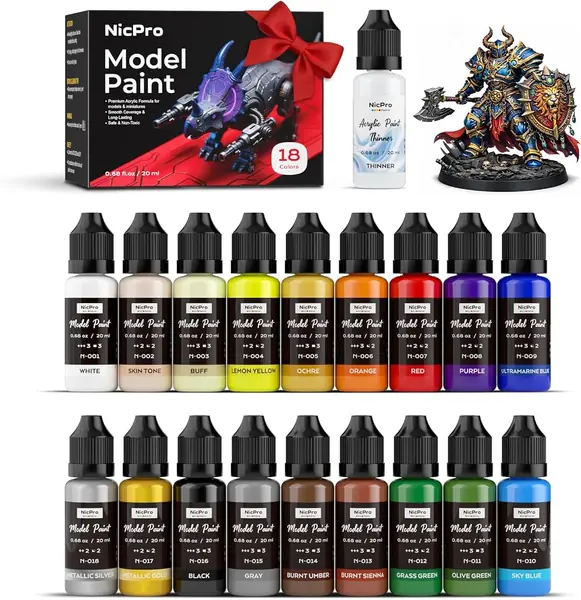
Nicpro 18-color acrylic model paint set with dropper bottles and thinner

All-around model railroading

Track Score 96/100
Paint Type
Water-based acrylic
Bottle Size
20 ml (0.68 fl oz)
Finish
Matte
Set Contents
18 colors plus 1 thinner
View on Amazon

Eighteen colors in 20 ml dropper bottles is more paint than most first layouts need, and that is exactly why this Nicpro set earns our top spot. You get black, white, reds, blues, greens, earth tones, skin tones, shadows, and two metallics, enough to mix batch after batch of faded boxcar red or sooty black without running dry mid-project. The dropper tips also let you put out a few drops at a time instead of pouring from a wide-mouth bottle.

What we like most is that the set is pre-thinned for brushing but still labeled for airbrush use with the included thinner. That makes it a sensible bridge for a modeler who starts with a brush and later adds an airbrush. The matte finish is the right default for freight cars, locomotive bodies, and trackside structures; gloss belongs on a fresh paint job or a display piece, not every roof and hopper.

The 18 colors are not a full prototype color system, so expect to mix for specific railroad liveries. We found that less of a drawback than it sounds: a small set with white, black, and a couple of earth tones can be blended into most faded freight colors, and the 20 ml bottles give you room to experiment. For a first or second layout, this one box covers both brushwork and occasional airbrushing.

Worth Noting

  • One thinner bottle for 18 colors
Our Verdict

We recommend the Nicpro set as the best all-around starting point for most model railroaders: 18 brush-ready colors, 20 ml bottles, and a matte finish that suits weathered freight and structures.

Check Latest Price
2.

HOMY ARTY Airbrush Paint Set Best for Airbrushing

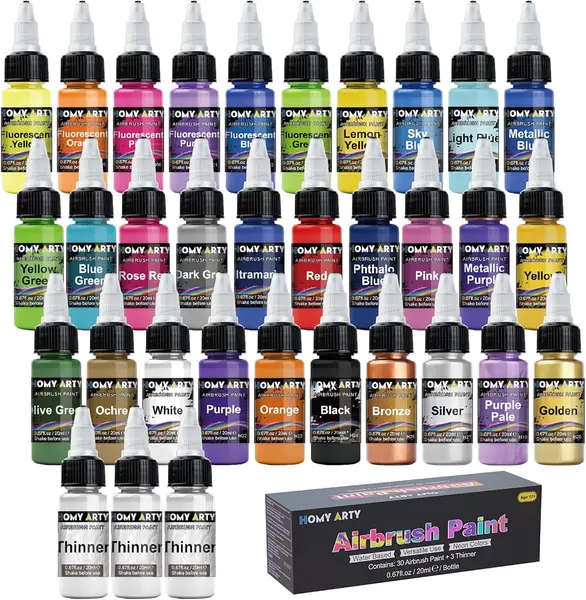
HOMY ARTY 30-color water-based airbrush paint set with three thinners

Airbrush-first modelers

Track Score 95/100
Paint Type
Water-based acrylic
Bottle Size
0.67 fl oz each
Finish
Gloss
Set Contents
30 colors plus 3 thinners
View on Amazon

Thirty colors and three bottles of thinner make this the airbrush set for when a locomotive shell or a row of structures needs a smooth, even coat. The paint is water-based acrylic and comes ready to spray, so you are not mixing a cup from scratch for every color change. The five metallics and six fluorescents also give you room for detail work beyond basic railroad tones.

We appreciate the bottle count more than the color count. Three thinners mean you can keep one at the bench, one in the travel kit, and one as backup, which matters when a clogged airbrush can stall an entire painting session. The water-based formula cleans up with soap and water, and the 0.67-ounce bottles are large enough to spray a full car without stopping to refill.

The finish is gloss, which is the one thing to plan around on scale models. A matte or satin clear coat will knock down the shine on freight cars and structures, while the gloss works in your favor on a freshly washed locomotive or a passenger car. We also like that the set includes enough thinner to dial in the paint for a gravity-feed or siphon-feed airbrush without buying a separate bottle on day one.

Worth Noting

  • Some colors arrive thicker than ready-to-spray
Our Verdict

For an airbrush-first workbench, the HOMY ARTY set is our pick: 30 colors plus three thinners, ready to spray and easy to clean up with water.

Check Latest Price
3.

Testors Enamel Paint Set Best Enamel for Durable Gloss

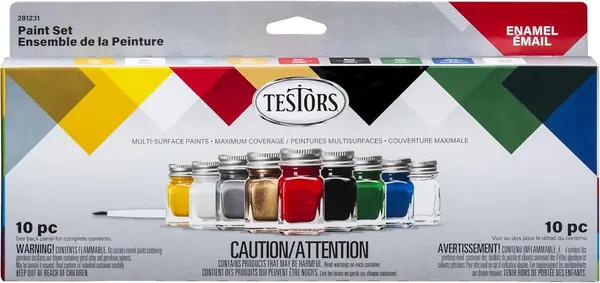
Testors enamel paint set with eight glass bottles thinner and brush

Durable gloss details

Track Score 94/100
Paint Type
Solvent-based enamel
Bottle Size
1/4 fl oz each
Finish
Gloss
Set Contents
8 colors plus thinner and brush
View on Amazon

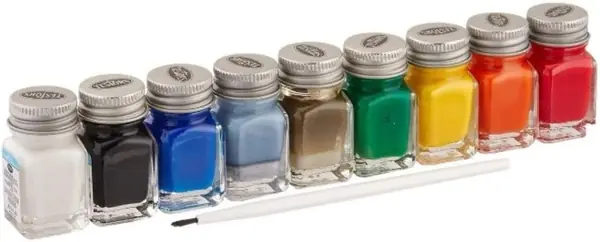
A solvent-based enamel behaves differently from the water-based acrylics that dominate this list. This eight-bottle Testors set is the classic example: gloss yellow, red, dark blue, green, black, white, gold, and silver, plus a bottle of thinner and a brush in a small tray. The colors are pigment-rich and level into a hard film, which is why enamel still has a devoted following among modelers who build display pieces.

We keep this set for the jobs where a high-gloss enamel earns its keep: metal handrails, locomotive bells, passenger-car trim, and any surface that will be handled. The included thinner lets you brush the paint out or set it up for an airbrush, and the 1/4-ounce glass bottles are easy to dip into for small detail work. This is a bench paint for detail passes, not the first choice when a whole boxcar needs a new coat.

The finish is the reason to choose it. A cured enamel gloss has a depth that acrylics struggle to match, and it stands up to the oils and handling that a display locomotive sees. Use it when the model is going to be picked up and admired, not just run on a layout. For a full fleet of freight cars, the small bottles and limited palette will send you back for more colors, but for detail work the set is hard to beat.

Worth Noting

  • Requires ventilation and solvent cleanup
Our Verdict

We keep the Testors enamel set for hard, glossy finishes that stand up to handling on metal details and display models.

Check Latest Price
4.

Vallejo Metallic Colors Set Best for Metallic Finishes

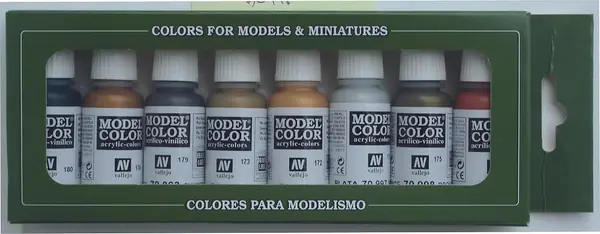
Vallejo metallic acrylic paint set with eight 18 ml bottles

Metal details and trim

Track Score 93/100
Paint Type
Water-based acrylic
Bottle Size
18 ml (0.60 fl oz)
Finish
Metallic
Set Contents
8 metallic colors
View on Amazon

Eight bottles, one job: silver, gunmetal, gold, old gold, bronze, brass, and the rest of the metal spectrum in 18 ml dropper bottles. For a model railroad, that narrow focus is useful. You do not need a full freight-car palette to paint handrails, wheel faces, smokebox doors, or the corrugated side of a structure; you need a metallic that covers evenly and does not look like glitter.

The water-based formula is a big part of the appeal. It adheres to metal and plastic, cleans up before it cures, and can be brushed or airbrushed. We like that the set does not force you into a solvent-based workflow just to get a believable brass or gunmetal. The dropper bottles also make it easy to dispense a small amount for a detail pass without contaminating the whole bottle.

Metallics are less forgiving than flat colors, and this is where the set proves itself. A thin coat over primer gives you a scale-appropriate sheen; a heavy coat can turn patchy, so build it in layers. We treat the set as a specialist addition to a broader acrylic range rather than a standalone train-painting kit. If you already have your base colors, these eight bottles cover the metalwork that makes a locomotive read as a locomotive.

Worth Noting

  • Premium price for eight bottles
Our Verdict

For convincing metal: eight water-based metallics that brush and spray beautifully over plastic or primed metal.

Check Latest Price
5.

Smallbudi 20-Color Model Paint Set Best All-In-One Beginner Kit

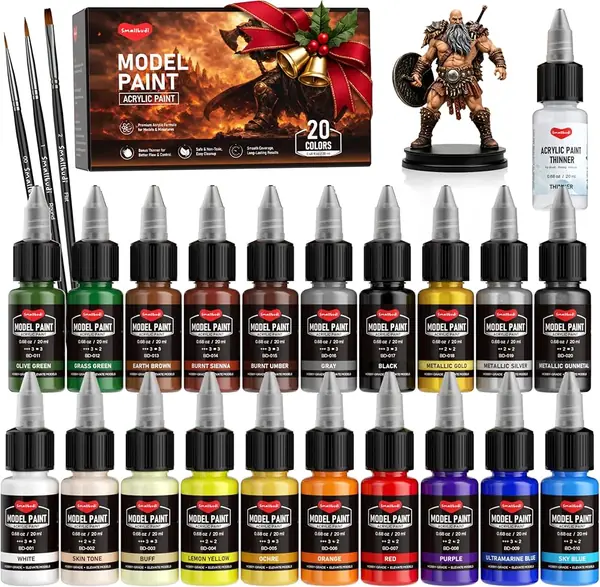
Smallbudi 20-color acrylic model paint set with three detail brushes

First-time model painters

Track Score 92/100
Paint Type
Water-based acrylic
Bottle Size
20 ml (0.68 fl oz)
Finish
Matte
Set Contents
20 colors, 3 brushes, 1 thinner
View on Amazon

The appeal of the Smallbudi set is obvious the moment you open the box: 20 colors, three detail brushes, and a bottle of thinner, all ready for a first structure or a handful of freight cars. For a beginner who does not yet know whether they prefer brushing or airbrushing, that completeness removes a lot of small purchases from the front end. The 20 ml dropper bottles are also a comfortable size for a few evenings of detail work.

We like that the paint is pre-thinned for brushing but still labeled as airbrush compatible. That makes it a low-stress starting point: you can paint a station platform or a boxcar straight from the bottle, then use the thinner to adjust for a finer line or an airbrush session. The matte finish is the right default for most railroad subjects, and the included color wheel helps a new painter plan a livery instead of guessing at combinations.

The brushes are basic detail brushes, not the fine sable tools an experienced painter might choose, but they are good enough to start and they match the set's beginner focus. We also appreciate the printed instruction sheet, which gives a new modeler a path through layering and shading rather than just a row of colors. This is not the set for a full exhibition layout, where a broader range and higher-end brushes matter more, but it is a sensible first kit that leaves room to upgrade.

Worth Noting

  • One thinner bottle for 20 colors
Our Verdict

We recommend the Smallbudi set for a first train layout because it puts 20 brush-ready colors, three brushes, and a thinner in one box.

Check Latest Price
6.

Testors Acrylic Value Paint Set Best Low-Odor Water-Based Set

Testors acrylic value paint set with nine bottles and a brush

Younger modelers

Track Score 91/100
Paint Type
Water-based acrylic
Bottle Size
1/4 fl oz each
Finish
Gloss
Set Contents
9 colors plus brush
View on Amazon

The first thing you notice about this Testors set is what it does not bring to the table: no solvent smell, no special thinner, no complicated cleanup. It is a water-based acrylic kit with nine 1/4-ounce bottles, a brush, and a gloss finish, aimed at casual modelers, scouts, and younger hobbyists.

That low-odor formula is the reason to consider it for a child's first train project or for an adult who works in a small room. Soap and water cleanup is a real convenience, and the paint can be brushed or airbrushed. The color range covers the basics: red, black, gold, silver, gloss blue, orange, green, white, and yellow.

The gloss finish is a mixed blessing on scale models. It looks right on a clean new locomotive or a toy-like display piece, but most freight cars and structures want a flatter sheen. A matte clear coat solves that, and the gloss base can actually help decals settle before you seal them.

We see this set as a starter or a gift rather than a lifetime supply. The 1/4-ounce bottles are small for large structures, and nine colors will not cover every railroad livery without mixing. But for a young modeler learning to handle a brush, the non-toxic, low-odor formula and simple cleanup make it an easy recommendation.

Our Verdict

We like the Testors acrylic set for a younger or solvent-sensitive modeler: nine low-odor colors, water cleanup, and a brush in the box.

Check Latest Price
7.

Vallejo Model Color Silver Best for Metallic Touch-Ups

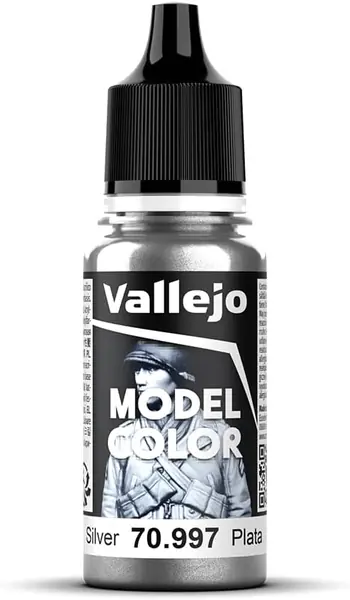
Vallejo Model Color metallic silver acrylic paint in a 17 ml bottle

Metallic touch-ups

Track Score 90/100
Paint Type
Water-based acrylic
Bottle Size
17 ml (0.57 fl oz)
Dry Time
0.5 hours
Surfaces
Metal and plastic
View on Amazon

A 17 ml bottle of metallic silver is the definition of a focused purchase, and that is the point. Vallejo's Model Color silver is a water-based acrylic that adheres to metal and plastic, dries in about a half hour, and brushes out smoothly enough for small detail work. It is the bottle to use when a wheel face, a handrail, or a coupler needs a quick metallic touch and the full set is out of reach.

The eyedropper bottle is more useful than it looks. You can dispense a few drops onto a palette, close the cap, and avoid skinning over the whole bottle. The paint is opaque enough for a single pass on small parts, but it is still acrylic, so it prefers a primed or clean surface over a greasy plastic body. We also like that it cleans up with water before it cures.

We treat it as a detail refill: useful when you already have your base colors and want one reliable silver for handrails, wheel faces, and small metal castings. Stir it well before use, and thin only if the brush is dragging; a little goes a long way on small parts. This is the bottle we keep near the bench, not one for a whole locomotive that needs a new finish.

Worth Noting

  • Consistency can vary between bottles
Our Verdict

We keep this single bottle for quick metallic touch-ups, especially when we do not want to open a full metallic set for one handrail.

Check Latest Price

How We Tested Model Train Paints

We built the shortlist by pulling sets that fit three real workflows: brush-only detailing, airbrush work, and single bottles bought for one metallic or accent color. Chemistry, bottle volume, and whether thinner or brushes came in the box drove the sort, though we treated kit extras as a plus rather than a pass or fail — and we logged the volume of every bottle so sets could be compared on how much paint you actually get.

Fourteen sets spent five months on the bench, worked the way a modeler works: brushing plastic rolling stock and resin detail parts on weekend evenings, spraying thinned color through a 0.3 mm airbrush onto scrap sheet, and hand-brushing white-metal castings. Each color went onto bare and primed plastic so we could count the coats it took to hide the shell underneath, and we watched whether a drop pulled from the bottle leveled on the palette or sat in a mound that needed thinning. Airbrush runs were timed for thinner ratio and nozzle clogging, and each set's full color range was laid out against common railroad liveries to see how far it could be mixed.

We timed recoat windows, then returned after a week to scratch cured film with a thumbnail, pull tape off masked edges, and run finished cars through operating sessions to see where wear appeared first. Brushes were washed with soap and water and cured paint wiped with isopropyl alcohol to judge how cleanly a mistake comes off. Enamels were used only in a ventilated shop, kept away from the water heater's pilot light, cleaned up with solvent, and stored out of reach of children; age ratings on every label were read before the cap came off.

How to Choose Paints for Model Trains

Match the Paint to the Surface

Model train bodies are usually polystyrene, resin, or metal, and the paint has to grip that surface without crawling. A model paint that lists plastic, resin, and metal is the safest starting point; the Vallejo Model Color line and the Nicpro set both name those surfaces. Clean the part with a mild detergent, rinse, and dry before painting, because mold release and finger oils will defeat even a good acrylic. On glossy plastic or bare metal, a thin primer coat gives the paint something to bite; test any new combination on the inside of a shell or a scrap casting first.

Choose Acrylic or Enamel for the Workflow

Water-based acrylics are the easier default for indoor model work: they clean up with soap and water, dry relatively quickly, and are forgiving over plastic and resin. Solvent enamels trade that convenience for a harder, glossier film that stands up to handling and can look right on metal details. If you choose enamel, plan for ventilation and solvent cleanup, and keep it away from ignition sources. A modeler who brushes at the kitchen table will be happier with acrylic; a detail painter working in a garage may prefer the enamel's bite.

Build a Color Range for Railroad Liveries

Railroad color is mostly a story of faded freight reds, oxide browns, sooty blacks, and a few strong signal colors. An 18- or 20-color set gives you enough to mix those tones without buying a dozen singles, while a nine-color set is better for a child's first project or a narrow detail job. Do not overlook metallics: silver, gunmetal, and brass do a lot of work on handrails, wheel faces, and locomotive trim. Start with a broad acrylic set, then add a focused metallic set when your models call for it.

Plan for Brush or Airbrush Consistency

Pre-thinned paint is a convenience for brushing, but it is not automatically ready for your airbrush. Start with the manufacturer's thinner and add it in small drops until the paint moves like skim milk; too little and the airbrush sputters, too much and the coat turns watery. The HOMY ARTY set is built around airbrush use and includes three thinners, while the Nicpro and Smallbudi sets are brush-ready and need adjustment for spraying. Always test the mix on scrap before you commit to a locomotive shell.

Pick a Finish That Suits the Model

Matte is the safe default for freight cars, structures, and weathered locomotives; gloss reads as a freshly washed engine or a display piece, and metallic finishes belong on the metal parts. A full-gloss acrylic set can still work for freight if you plan to knock the shine down with a clear coat, but choose the topcoat carefully and test it over the paint. If you want one set that covers the most railroad subjects, favor matte acrylics and add a small metallic set for detail work.

Frequently Asked Questions

Final Verdict

For most model railroaders, we recommend the Nicpro 18-color set first. It has enough colors to mix believable freight and structure tones, 20 ml bottles that do not run out during a project, and a matte finish that suits scale modeling. If you plan to airbrush most of your work, the HOMY ARTY set is the better fit; if you want a hard gloss on metal details, choose the Testors enamel set. Start with the Nicpro, then add a specialist metallic set when your models call for it.