Best Paints for Model Airplanes of 2026

Paint usually decides whether a model airplane looks like a museum piece or a toy. Lay it on too thick and the panel lines vanish under sludge; thin it too far and you're on a fourth pass waiting for the third to dry.

The biggest set on the shelf is rarely the right one. Thirty bottles are dead weight if six are the same olive drab and none match the underside gray the instructions call for. What matters is whether the range suits the aircraft you build, whether a bottle lasts one build before it skins over and how much thinning each paint needs, which four months of brushed interiors and airbrushed 1/48 fuselages made plain. The seven picks cover acrylics that clean up with soap and water and solvent enamels that hold a dead-flat camouflage.

Our Top Picks

The Best Paints for Model Airplanes

1.

Testors Aircraft Acrylic Earth Tone Paint Set Best Overall
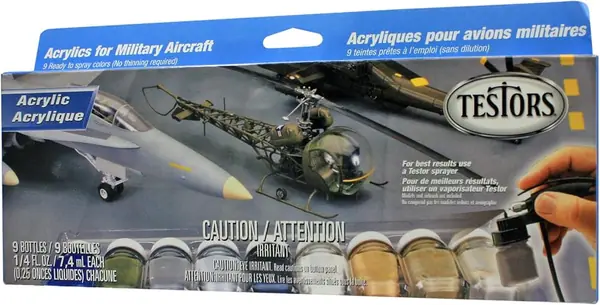
Testors Aircraft Acrylic Earth Tone paint set with nine small military-color bottles

Military aircraft models

Track Score 95/100
Paint Type
Acrylic
Application
Brush and airbrush
Bottle Size
0.25 fl oz each
Colors Included
9
View on Amazon

The first thing we check in an aircraft paint set is whether it can finish a warplane without a trip to the hobby shop for another bottle. This Testors set covers the core military shades: Light Ghost Gray, Dark Ghost Gray, Neutral Gray, Gunship Gray, Gloss Dark Blue, Olive Drab, Dark Green, and Dark Tan. That is a useful spread for modern jets and WWII subjects, and the colors are already tuned for military camouflage rather than a general craft palette. The acrylic formula is water-washup and non-toxic, which matters when you are brushing in a small room.

We think this is the best first set here for a military aircraft builder because it keeps the decision simple: one box, the colors you are most likely to need, and a satin finish that sits between toy-gloss and dead-flat. The 0.25 fl oz bottles are the trade-off. They are enough for a 1/48 fighter and touch-up work, but a large bomber or a batch of models will push you into a second set. For a single kit, that is a fair trade.

Testors calls it ready to spray, but this is still a jar acrylic: we thin it before it goes in the cup and test the mix on scrap styrene. Brushed on, it handles detail and small camouflage patches neatly. Soap-and-water cleanup makes this the set for the kitchen table, and it is the one we hand to a first-time aircraft painter who wants a credible result without a chemistry lesson.

Worth Noting

  • Military-only palette limits civilian aircraft schemes
Our Verdict

We recommend this set first for military aircraft because it pairs airplane-specific grays, greens, and tan with acrylic cleanup and both brush and airbrush use.

Check Latest Price
2.

Vallejo WWII Allied Model Air Paint Set Best for WWII Allied Aircraft

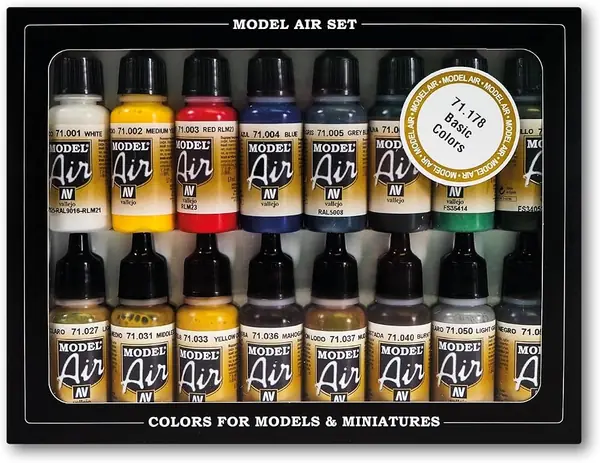
Vallejo WWII Allied Model Air paint set with sixteen 17 ml dropper bottles

WWII Allied aircraft

Track Score 94/100
Paint Type
Acrylic
Application
Airbrush-ready
Bottle Size
17 ml each
Colors Included
16
View on Amazon

This is the set for a WWII Allied airframe when the airbrush is already on the bench. The 16 bottles are Model Air colors, pre-thinned for spraying and ground fine enough to go through a detail nozzle without clogging. The palette is specific: Olive Drab, Dark Green, US Light Gray, Medium Sea Gray, Dark Earth, Sand Yellow, Hull Red, and the other Allied shades Vallejo lists. That narrow focus is the point. It is not a starter set for a modern jet or an Axis fighter, and we do not treat it as one.

The 17 ml dropper bottles are the practical detail we appreciate most. You can load a few drops into the cup, cap the bottle, and not lose the rest to a dried rim. The paint also brushes well enough for touch-ups when you do not want to fire up the compressor. We paid close attention to the labels, because the set is built around named Allied shades rather than a generic rainbow.

Coverage is even and the finish dries matte, which is what we want under decals and weathering. The set is at its best on a 1/48 or 1/72 WWII fighter where the scheme calls for several of these colors; on a single-color build, you will use only a few bottles. That is the honest boundary of this pick, and it is why we keep a broader set nearby for everything else. For an airbrushing Allied project, the narrow palette stops being a limitation and becomes the reason the set works.

Worth Noting

  • Product color images may not match bottles
Our Verdict

If you spray WWII Allied aircraft, we think this is the set to load first: sixteen pre-thinned shades in 17 ml dropper bottles.

Check Latest Price
3.

Testors Camo Flat Enamel Paint Set Best Enamel for Camouflage

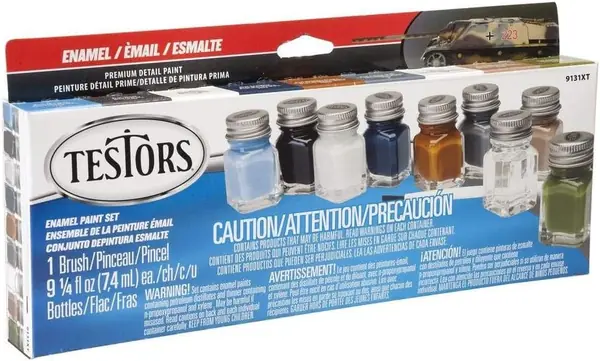
Testors Camo Flat Enamel paint set with military shades and thinner bottle

Flat military camouflage

Track Score 93/100
Paint Type
Enamel
Application
Brush and airbrush
Finish
Flat
Included
Paint thinner
View on Amazon

Enamel still has a clear advantage on a model airplane that will be handled: a flat coat that feels hard and stays flat. This Testors set is built around military camouflage, with a range of flat shades and one bottle of thinner. The colors are the sort that cover winter, desert, and European schemes, and the finish is dead flat rather than satin or gloss. If you have only used acrylics, the first thing you notice is how little the paint moves after it sets.

The included thinner is the difference between brushing and airbrushing: without it, the paint is too heavy for a cup; with it, the set sprays like a conventional enamel. The 1/4 oz glass bottles are the classic Testors format. The set is small enough to store in a drawer and complete enough for a single military build. We also like that the thinner is matched to the paint rather than left as a guess.

We like this set best for a modeler who already works in enamel and wants a durable camouflage finish without hunting for each color. The flat finish is the reason to choose it over acrylic here: it hides minor surface texture and looks right on a weathered warbird. The trade-off is solvent cleanup and ventilation, which is why we keep this set for a dedicated painting session rather than a quick touch-up at the kitchen table. For a handled warbird, that extra step buys a finish that feels tough.

Worth Noting

  • Small 1/4 oz glass bottles
Our Verdict

We keep this enamel set for modelers who want durable flat camouflage and do not mind solvent cleanup.

Check Latest Price
4.

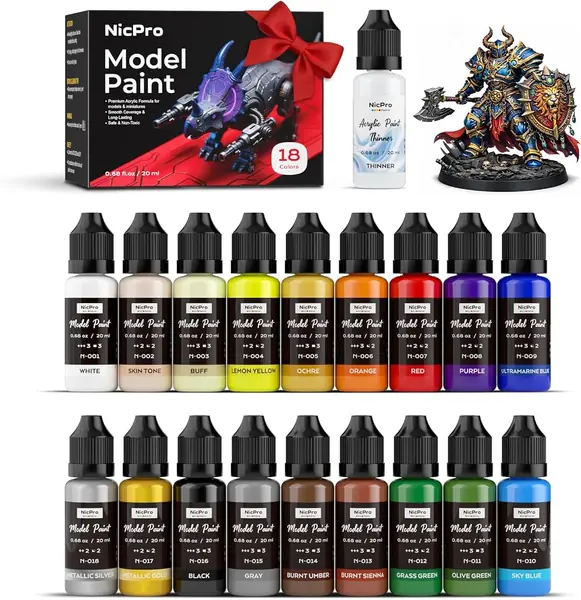
Nicpro 18 Colors Model Paint Set Best Starter Set

Nicpro 18-color acrylic model paint set with dropper bottles and thinner

Beginner brush painters

Track Score 92/100
Paint Type
Acrylic
Application
Brush and airbrush
Bottle Size
20 ml each
Colors Included
18
View on Amazon

The 20 ml bottles are larger than the little 0.25-ounce jars many aircraft sets use, and that changes how freely you can mix. Nicpro gives you 18 colors, a bottle of thinner, a color wheel, and a printed guide in one box. The paint is pre-thinned for brushing straight from the bottle, and the dropper tips let you put out a few drops without wasting a capful. We think this is the best starter set here for a brush painter who wants room to experiment.

The palette is broad rather than aircraft-specific: base colors, skin tones, shadows, and two metallics. On an airplane, that means you will mix your own olive drab, ghost gray, or trainer yellow instead of opening an exact match. We did not mind that for a first kit because the color wheel makes those mixes less guessy, but it is what separates a general model set from a dedicated aircraft set.

The finish dries matte and the pigments are described as UV-resistant, which is what we want for a model that will sit on a shelf rather than in a box. For airbrush use, the included thinner gives you a place to start; we still test the mix on scrap before committing a full cup. The bottles are generous enough that a single fighter will not exhaust a color, and the set leaves you with paint for the next one. That makes it a better long-term starter than a tiny six-jar kit.

Our Verdict

Our pick for a first full palette: Nicpro's 18 pre-thinned acrylics work by brush and, with the included thinner, through an airbrush.

Check Latest Price
5.

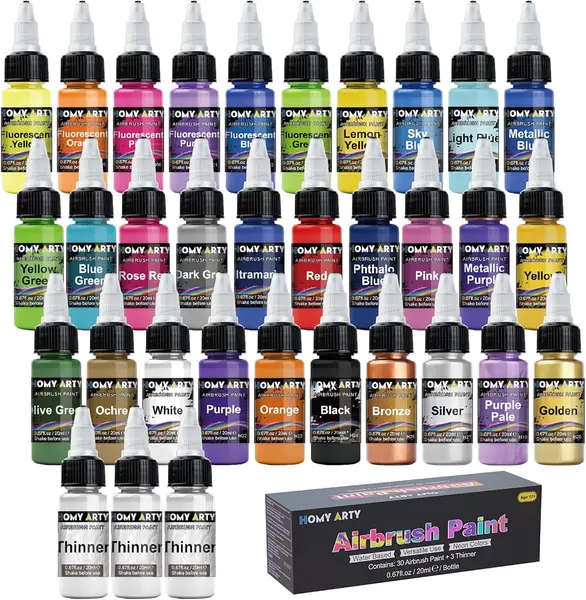
HOMY ARTY 30 Colors Airbrush Paint Set Best Budget Airbrush Set

HOMY ARTY 30-color water-based airbrush paint set with three thinner bottles

Budget airbrushing

Track Score 91/100
Paint Type
Water-based acrylic
Application
Airbrush-ready
Colors Included
30 plus 3 thinners
Finish
Gloss
View on Amazon

Thirty colors and three thinners in one box looks like a shortcut around buying model paint one bottle at a time. HOMY ARTY divides the 33 bottles into 19 common colors, 6 fluorescents, and 5 metallics, then adds the thinner. The paint is water-based, ready to spray, and easy to clean with soap and water. On plastic models, that combination is appealing: fewer clogs, less waste, and a color for almost any detail.

We think this is the best budget airbrush set here for sheer range, but we treat bare plastic carefully. A primer is the sensible first step on a slick styrene surface; without it, water-based airbrush paint can rub or lift at the edges. The gloss finish is the other thing to plan around: a flat clear coat brings it back to military sheen. Neither issue is a dealbreaker for a crafter who wants a big palette, but they are the reason this is not our first pick for a competition aircraft.

The bottles are 0.67 fl oz each, so you get real volume rather than a few drops. The three thinners are useful when a color sits or when you want a finer line, and the metallic and fluorescent shades extend the set beyond military subjects. For a first airbrush setup, we like having that many colors to learn on; for a precise scale build, a model-specific line is still the better choice. That split is exactly how we use it.

Worth Noting

  • Some colors need extra thinner
Our Verdict

We suggest this set when you want many airbrush-ready colors on a budget and will prime bare plastic first.

Check Latest Price
6.

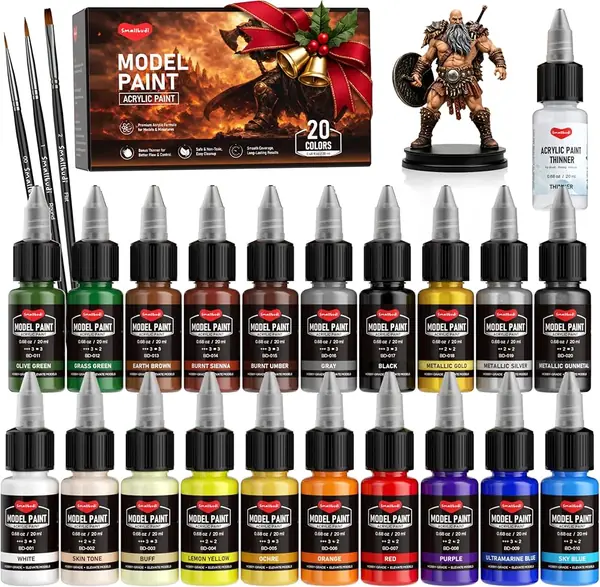
Smallbudi 20 Colors Model Paint Set

Smallbudi 20-color acrylic model paint set with three brushes and thinner

All-in-one starter kit

Track Score 90/100
Paint Type
Acrylic
Bottle Size
20 ml each
Colors Included
20
Included
3 brushes and 1 thinner
View on Amazon

A first airplane kit often needs paint, brushes, and thinner in the same box; this set is built around that shopping trip. Smallbudi includes 20 acrylic colors in 20 ml bottles, three detail brushes, one thinner, a printed instruction sheet, and a color wheel. The paint is pre-thinned for brushing and can be adjusted for airbrush use. Nothing in the box is an expert tool, but everything is ready for a first model.

The palette is broad, not aircraft-specific, so you will mix your own military grays and greens for a fighter. The matte finish is a good default for scale models, and the dropper bottles make it easy to dispense a small amount. The color wheel is more useful than it sounds when you are trying to shift a green toward olive without opening five bottles. For a beginner, that is a helpful guardrail rather than a gimmick.

The included brushes are a convenience rather than a replacement for a good detail brush; we used them for blocking in color and reached for a finer brush for cockpit work. For a beginner, that is the right role for starter tools. The 20 ml bottles give you enough paint to make mistakes and repaint a wing without rationing. The paint layers without turning cakey, so you can build color slowly instead of covering detail in one heavy pass.

We think this is the best all-in-one starter kit here for someone who does not want to assemble a paint collection before the first model. It is not the set we choose for exact aircraft color matches, but it shortens the distance between opening the box and putting paint on plastic. That is worth a lot when the goal is to finish a first model and learn what you like. It is also the set we point to when someone wants one purchase instead of five.

Our Verdict

We like this as a gift or first kit because the brushes, thinner, and twenty matte colors arrive ready to use.

Check Latest Price
7.

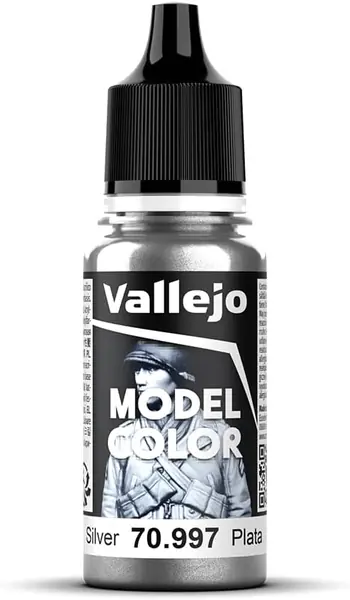
Vallejo Model Color Silver Best for Bare-Metal Details

Vallejo Model Color metallic silver acrylic paint in a 17 ml dropper bottle

Bare-metal details

Track Score 89/100
Paint Type
Water-based acrylic
Application
Brush-on
Bottle Size
17 ml
Color
Metallic Silver
View on Amazon

A bare-metal finish is usually a small area of a model, and that is exactly where a single bottle makes sense. Vallejo's Model Color silver is a water-based acrylic in a 17 ml dropper bottle, with permanent pigment and a smooth film that does not show brushstrokes. It is opaque enough to cover a panel in a coat or two, and it stays lightfast on a shelf. The color reads as metal rather than gray paint, which is the whole point.

It handles landing gear, antenna posts, chipped edges, and the occasional natural-metal panel. The dropper is the part we appreciate most: a few drops go on the palette and the rest stays sealed. The paint flows off the brush without dragging, and the film levels smoothly enough that brush marks do not build up. We stir it well before use and keep a little water nearby for the last passes.

This is not a set, and one bottle will not paint a whole silver aircraft. It is a detail and accent purchase, and that is how we use it. If you need an entire bare-metal scheme, buy two bottles or a dedicated metallic set; if you need a convincing silver for small parts, this is the one we keep in reach. For a natural-metal finish, a single bottle that behaves this well earns its drawer space.

Worth Noting

  • Consistency can vary between bottles
Our Verdict

For bare-metal finishes and small details, this single silver is the choice because it brushes smoothly and stays lightfast.

Check Latest Price

How We Tested Model Airplane Paints

We started with a research list of more than 40 paint sets sold in the U.S. and cut it down by chemistry, bottle volume, and whether the color range was chosen for aircraft or for fantasy miniatures. That left 14 sets, which went through four months of builds, plus a stack of plastic spoons and sheet scrap reserved for controlled swatches.

Most of the work happened where models actually get built: a workbench in a spare bedroom on weekday evenings, and a garage with the door rolled up on weekend mornings for anything solvent-based. Enamels and their thinners stayed out there, well away from the water heater and any open flame, and at the end of every session all bottles and solvents went into a latched bin on a high shelf, clear of kids and pets.

With a brush, we noted whether a color leveled out or dried with visible ridges, how many passes it took to hide gray primer, and whether it settled into panel lines or filled them. We timed each coat's tack-free and recoat windows, and judged consistency straight from the bottle, either thin enough to flow off the brush or thick enough that we counted out drops of thinner per color.

Airbrush-ready sets got sprayed onto scrap polystyrene at a fixed pressure, where we watched for spatter and tip dry, and we thinned brush-only formulas to see how they behaved outside their lane. For adhesion, we taped off patches, pulled the tape, and looked at what lifted. We held each color against a printed reference chart and the swatch on the label, then scored the bottle on how much paint we could actually get out and whether the cap still sealed after weeks of use.

How to Choose Paints for Model Airplanes

Acrylic or Enamel?

Acrylics are the easier place to start: they clean up with water and soap, smell mild, and can be brushed or airbrushed after thinning. Enamels trade that convenience for a harder, flatter film and color that stands up to handling, but they need solvent thinner and a ventilated workspace. We choose acrylic for most model airplane builds, especially indoors, and reserve enamel for a camouflage finish that will be touched often. If you go enamel, buy the maker's thinner with the paint; water will not clean it.

Brush, Airbrush, or Both?

Your application method should decide the product before color count does. A brush-ready acrylic such as Testors Aircraft Acrylic can be thinned for a cup, while Model Air and HOMY ARTY are sold pre-thinned for airbrushing. Airbrush compatible is not the same as ready to spray: check for a thinner recommendation and test on scrap. If you mostly brush, a pre-thinned airbrush paint can be too thin for broad coverage, though it is fine for detail. We keep one brushable set and one airbrush-ready set rather than expecting one bottle to do both perfectly.

Build an Aircraft-Appropriate Palette

Military aircraft are mostly grays, greens, tans, and metallics, and a set built around those shades saves a lot of mixing. Testors Aircraft Acrylic Earth Tone and Vallejo's WWII Allied set are narrower than a general 30-color craft box, and that is the point: fewer off-palette colors and more usable bottles. If you build civilian aircraft, airliners, or modern jets, check for whites, brights, and the specific gray family you need. A single metallic silver is worth adding for bare-metal panels and landing gear. Do not buy a 50-color set if half of it will never touch an airframe.

Coverage, Finish, and Plastic Adhesion

Fine pigment and good opacity matter more on a model than on a craft project because thick paint hides panel lines and rivets. Thin acrylics in several passes rather than flooding one coat; matte and satin finishes are the usual choice for military aircraft, while gloss is better for airliners and bare-metal undercoats. Adhesion is the other half: bare styrene can reject water-based paint, so wash the plastic and prime if a test patch rubs off. We test every new bottle on the sprue before it goes on the model. That five-minute check tells you more than any color chip.

Frequently Asked Questions

Final Verdict

Our default is the Testors Aircraft Acrylic Earth Tone Paint Set. It puts the military grays, greens, blues, and tan that most model airplanes need into one water-cleanup box, and it works by brush or airbrush with a little thinning. For a first or single aircraft build, that is the least fussy way to get a credible finish.

If you airbrush WWII Allied aircraft, the Vallejo Model Air set is the better buy: sixteen pre-thinned shades in 17 ml droppers, with no mixing before you load the cup. Choose the Testors enamel camouflage set instead when you want a harder flat finish and can work with solvent thinner. For bare-metal details, keep a bottle of Vallejo Model Color Silver nearby.