Best Panel Line Markers of 2026

Panel lines are the shallow grooves molded into almost every model kit, and darkening them is the cheapest way to make a finished build look deliberate. You aren't really drawing a line. You're letting thin ink settle into the recess and wiping the surface clean, so a fat tip or watery ink floods the plastic around the groove and an inner frame ends up outlined in marker.

Black isn't the default. Gray reads as shadow on white, brown sits better on red, and black disappears on dark blue. We tried 16 markers on bare plastic, over cured topcoat and on pale, dark and colored kits, checking how far ink ran down a recess, whether it needed a second pass and whether a stray mark wiped clean an hour later.

Our Top Picks

The Best Panel Line Markers

1.

Gundam GM01/GM02 Fine Line Value Set Best Overall
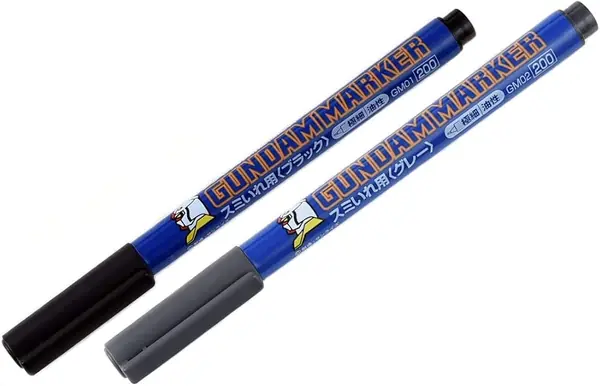
Gundam GM01 black and GM02 gray fine line marker pens in a two-pen set

Beginner panel lining

Track Score 95/100
Line Size
0.3mm
Pen Count
2
Colors Included
Black and gray
Tip Type
Fine
View on Amazon

Two colors and a low price are enough to make the Gundam GM01/GM02 set the first panel line marker we hand to a new builder. The black and gray cover the everyday split: gray for white and light plastic, black for dark parts and deep vents. The 0.3mm tip is fine enough for 1/144 seams without demanding a surgeon's hand, and we like that there is no color decision to make before you start lining.

In use, the tip draws a controllable line. You can work slowly along a seam and stop before the line runs, and a lightly damp swab lifts a stray mark while the ink is fresh. We keep the black for dark seams and the gray for almost everything else; between them, most of a straight-build kit is covered.

For a first kit, the simplicity is the point. There is no color mixing, no refilling, and no second cap to lose. We hand these pens to a new builder and let them work a leg seam; the result looks deliberate rather than painted. If you already know you want hairline lines or a warmer brown, step up to the pour-type or Blackliner sets.

Worth Noting

  • Gray pen can dry out quickly
Our Verdict

We recommend the Gundam GM01/GM02 set as the best default for a first panel-lining purchase: black and gray, a 0.3mm tip, and the lowest cost in this group.

Check Latest Price
2.

GSI Creos Gundam Marker Pouring Inking Pen Set Best for Capillary Flow

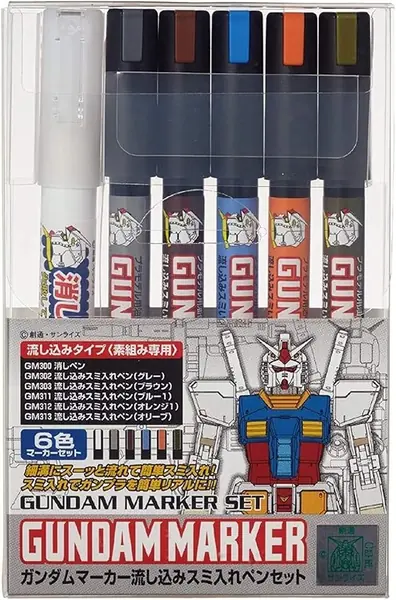
GSI Creos Gundam Marker Pouring Inking Pen Set with six pens and an eraser

Capillary panel lining

Track Score 94/100
Line Size
0.5mm
Pen Count
6
Colors Included
Gray, brown, blue, orange, olive green, plus eraser
Tip Style
Pouring inking pen
View on Amazon

A capillary pen changes the rhythm of panel lining. With the GSI Creos set, you touch the nib to a recess and let the ink travel; you are guiding a flow rather than drawing a line. We found that a light touch gives us the most control, and lifting the nib stops the ink before it climbs onto the surrounding panel. That makes a long, straight channel less of a stop-start job than a fine-tip pen.

Gray and brown do most of the work on light and warm plastic, while blue, orange and olive green are there for detail accents. We especially like the correction pen. A stray line around a small vent or shoulder is easy to erase before it sets, and that forgiveness matters more to us than having another shade in the box.

Very shallow lines may need a score or a second pass before the ink takes hold; a fine tip is quicker there. For the deeper recesses that make up most Gunpla panel lines, though, the capillary action is why we keep the set within reach. It is the pick we choose when a clean, even line matters more than having every color at hand. The set also gives us the widest color spread in this group for matching different plastic tones.

Worth Noting

  • No black pen for dark seams
Our Verdict

The GSI Creos Pouring Inking Pen Set suits modelers who want capillary flow, a useful gray-and-brown base, and a correction pen in one kit.

Check Latest Price
3.

Molotow Blackliner Complete Set Best for Fine Detail

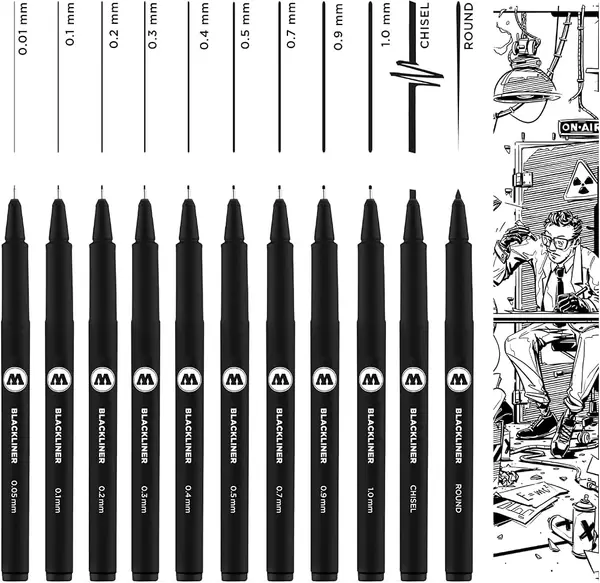
Molotow Blackliner complete set of eleven black fineliner pens with matte barrels

Hairline detail work

Track Score 93/100
Ink
Water-based pigmented archival
Tip Range
0.05mm to 1mm plus chisel and round
Cap-off Time
90 to 180 minutes
Pens Included
11
View on Amazon

The 0.05mm tip is the reason this set belongs in a panel-lining conversation. That is a true hairline, fine enough to trace a seam on a 1/144 scale kit without the line reading as a drawn stripe. The set runs up to 1mm and adds chisel and round tips, so you can match the nib to the width of the recess rather than making one pen do every job.

We like the matte barrels and metal-encased tips; they feel more like a drafting tool than a disposable marker, and the black is deep enough to hold contrast on white plastic. The water-based pigmented ink is quick-drying and water-resistant on paper, but this is an art pen, not a model-specific panel wash. Test it on a hidden sprue or a painted test piece before you commit a finished kit.

The set does not include an eraser or a model-specific color story; it gives you eleven black pens and a broad art range instead. For a builder who already has a cleanup method, that is a fair swap: the 0.05mm nib does work the dedicated sets cannot match. We reach for it when a seam is too tight for a 0.3mm tip.

Worth Noting

  • Costs more than dedicated panel-line sets
Our Verdict

The Molotow Blackliner set is for detail-focused modelers who want the finest hairline tip and a full spread of widths, with the caveat that it is an art pen rather than a model-specific kit.

Check Latest Price

How We Tested 16 Panel Line Markers

We started with every panel line marker a U.S. hobbyist could realistically reorder — fine-tip pens, pour-type inking pens, and water-based pigmented liner sets — and whittled the field by the tip sizes each one offered, the colors in the box, the ink type, and the price per pen. Sixteen made it to the bench. Over four months we used them the way a builder does: evening sessions at the workbench and weekend builds, lining inner frames, weapon parts, and armor panels under a desk lamp.

Each pen got the same workout. We pressed the tip into a molded recess and watched whether ink ran to the far end of the line on its own or stalled halfway and needed a second pass, then judged the line against the seam it was filling. We lined test pieces in white, gray, navy, and red plastic to see which colors read as shadow and which just looked drawn on, and again on parts that had already been given a gloss topcoat. Following the maker's warning on pour-type ink, we never laid it over paint — those pens were tested on bare plastic only, where the ink can't attack a base coat.

Cleanup got its own round: a fingertip, a dry swab, and a damp one, each dragged across a stray mark to see what lifted it without dulling the plastic underneath. We came back at ten minutes and again at an hour to see whether a line held up to a thumbprint, and kept a tally of how many kits each pen covered before the tip fuzzed or the line thinned out. Two people who had never lined a kit tried the starter-leaning sets cold, no instructions, to see how fast they made sense.

How to Choose Panel Line Markers

Match the Tip to the Recess

Tip size matters more than the word fine on the package. A 0.3mm tip is a practical middle for 1/144 Gunpla: wide enough to fill a seam in one pass, narrow enough that it does not swallow a small vent. For hairline seams or 1/60 detail, a 0.05mm to 0.1mm tip gives you a line the larger pen cannot. We start by looking at the narrowest recess on the kit, then choose the tip that fits it; a marker that is too wide will always look drawn on.

Choose Capillary Flow or Fine Tip

A pour-type or capillary pen feeds ink when the nib touches the seam; you guide the flow and lift to stop it. That is excellent for long, deep recesses, and it is the reason we like the GSI Creos set. A fine-tip pen gives you more drawing control and is easier to stop on a shallow line, which makes the Gundam GM01/GM02 set the better first purchase for a beginner. Choose capillary for speed and even fill, fine tip for control and forgiveness.

Pick Colors for the Plastic

Panel lining is about contrast, not collecting colors. Gray disappears into white and light gray plastic while still defining the seam; brown sits more naturally on red and warm tan parts; black gives the strongest line on dark or mid-tone plastic. Dedicated Gundam markers are sold in the grays and browns that suit model plastic, which is why a two-color set can be enough. We prioritize a good gray and black before adding accent colors, because those are the lines you will use on nearly every build.

Plan for Cleanup and Storage

Fresh panel line ink is easy to remove; cured ink is not. Keep a slightly damp swab or the eraser pen that comes with the GSI Creos set nearby, and work in short sections so you can correct a stray line before it sets. Cap every pen as soon as you finish, especially fine liners, because a dried tip is a common way a good marker stops being useful. Store them horizontally and check new pens on a hidden sprue before touching a finished surface.

Frequently Asked Questions

Final Verdict

With black and gray in one inexpensive set, the Gundam GM01/GM02 is the panel line marker we recommend first for a new builder; it covers everyday seams and asks for very little learning. When you want capillary flow and a correction pen, the GSI Creos Pouring Inking set is the better tool, provided you have a black pen for dark seams. The Molotow Blackliner set is the choice when a 0.05mm hairline matters more than a model-specific kit.