Best Model Paints of 2026

A model paint can look perfect in the bottle and still ruin a figure you spent a weekend building. Thin pigment is the quiet failure: you lay down a coat, wait, lay down another, and the panel lines start to fill. You want paint that covers in one or two passes and dries to something you can pick up without leaving a thumbprint.

Chemistry matters more than color count. Water-based acrylics clean up with soap and water and dry fast enough to keep a session moving; solvent enamels give a harder gloss but need real ventilation and more patience between coats. We brushed 14 sets onto primed plastic and sprayed the airbrush-ready ones in a garage booth, and the six picks won on coverage, a palette that teaches a beginner how colors relate, metal that reads as metal, or price per ounce.

Our Top Picks

The Best Model Paints

1.

Vallejo Basic Colors USA Best Overall
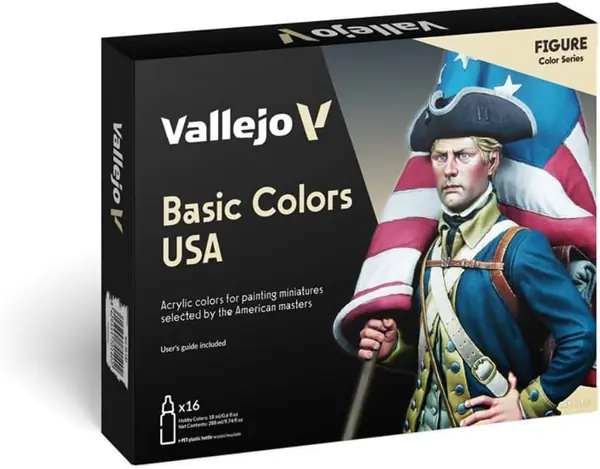
Vallejo Model Color Basic Colors USA set with 16 eyedropper bottles of matte acrylic

Brush-painted scale models

Track Score 96/100
Paint Type
Water-based acrylic, matte
Set Contents
16 bottles x 18 ml (0.6 fl oz)
Surfaces
Plastic and metal
Dispensing
Eyedropper bottle tips
View on Amazon

Open the box and the first thing you notice is that nothing is a jar. All 16 colors come in 18 ml eyedropper bottles, which turns mixing into something you can repeat: three drops white, one drop brown, and the same ratio works again on the next figure in the unit. That one design choice is why this is the set we recommend first.

The colors are aimed at soldiers, vehicles, and groundwork — whites, flesh tones, yellows, browns, and the olive and gray family that covers most of a military kit. They behave the way a good model paint should: thinned a little on a palette, a coat levels out, brush marks fade, and the surface dries flat matte, which is exactly what you want under a wash and a varnish instead of a sheen you have to fight.

Water is the only solvent you need. Thin with a drop or two, rinse brushes in a cup, and there is no odor to manage in a spare room. The same acrylic sprays acceptably once it is cut with water or a medium, so a single set can carry a build from base coat to detail. On primed plastic it lays down evenly and stays where you put it.

What you do not get is the whole range. Sixteen bottles cover a first army or a first kit, not every scheme in a campaign, so plan on adding a few singles and a varnish as you go — the Model Color shades are sold individually, and a set this size leaves room to do exactly that.

Worth Noting

  • Dropper tips can arrive split and leak into caps
Our Verdict

We recommend this as the default model paint set: 16 matte acrylics in dropper bottles, broad enough for a first unit and precise enough for repeatable mixing.

Check Latest Price
2.

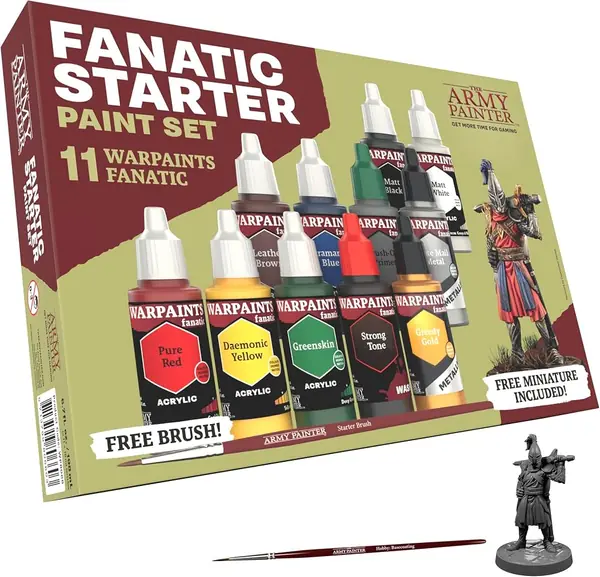
The Army Painter Warpaints Fanatic Starter Set Best Starter Kit

Army Painter Warpaints Fanatic starter set with 11 paint pots brush and miniature

First-time painters

Track Score 95/100
Paint Type
Water-based acrylic, satin finish
Set Contents
11 x 18 ml paints, brush, miniature
Palette System
Flexible color triads
Stated Dry Time
1 hour
View on Amazon

Eleven 18 ml pots, a starter brush, and a miniature to practice on. The Fanatic starter set is the only box here that lets you paint something the evening it arrives — seven colors, two metallics, and a wash covering base coat, armor, and shadow in that order.

What we like most is the triad structure. Colors are grouped in families that share a root, so a base, a lighter tone, and a shadow already agree with one another; paint an orc's skin from a single triad and the shading reads as a decision rather than an accident. That is a small structural thing with a large effect on a beginner's first results, and it is why this set goes to new painters ahead of bigger boxes.

The scope is honest about being a start. Seven colors will not carry a whole army without mixing, and the included brush is a starter tool you replace once you have preferences. Buy it to learn the sequence — prime, base, wash, highlight — then add pots from the Fanatic range as your schemes get more specific. The included guide walks through thinning, priming, and basing, which is the order most people get wrong first.

Worth Noting

  • Seven colors plus wash and metallics is a start
Our Verdict

We hand this to anyone starting from zero: paints, wash, metallics, brush, and a figure arrive together, so the first session happens the same night.

Check Latest Price
3.

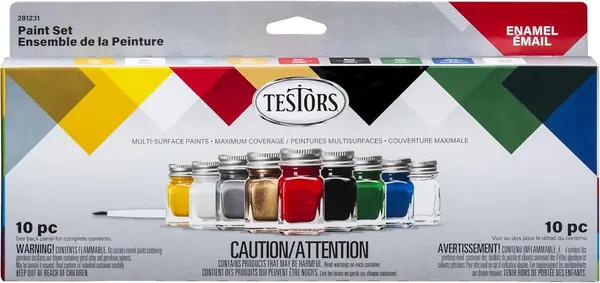
Testors 9146XT Enamel Paint Set Best Enamel

Testors enamel paint set with eight glass bottles of gloss color and thinner

Hard gloss finishes

Track Score 94/100
Paint Type
Solvent-based enamel, gloss
Set Contents
8 x 1/4 fl oz bottles, thinner, brush, tray
Finish
Gloss
Age Rating
14 and up
View on Amazon

Enamel is the odd one out in an acrylic world, and that is the point. These eight quarter-ounce glass bottles dry to a hard, glossy film rather than the flat finish most model acrylics leave, and the bottle of thinner in the box means you can shoot the same paint through an airbrush once it is cut.

The colors are the classic starter eight — yellow, red, dark blue, green, black, white, gold, and silver — plus a brush and a tray. Glass jars mean dipping your brush into the whole supply, which is messier than a dropper and harder on the paint, so keep the brush clean and decant what you need onto a palette. Drying is the variable that splits these bottles: a thin coat sets quickly, while a heavy one can stay tacky far longer than you expect.

It belongs not on figures but on the small, handled parts: metal details, wooden bits, a nameplate that has to keep its shine after being touched. On bare plastic the gloss can scrape or lift, so prime first and let it cure fully, and expect to open a window, since this is a solvent product rated for ages 14 and up. On the right part, none of the acrylics here hold a gloss like it.

Worth Noting

  • Old stock can arrive thickened or skinned over
Our Verdict

For handled parts that need a tough gloss, we keep a set of these on the shelf — ventilate the room and prime the plastic first.

Check Latest Price
4.

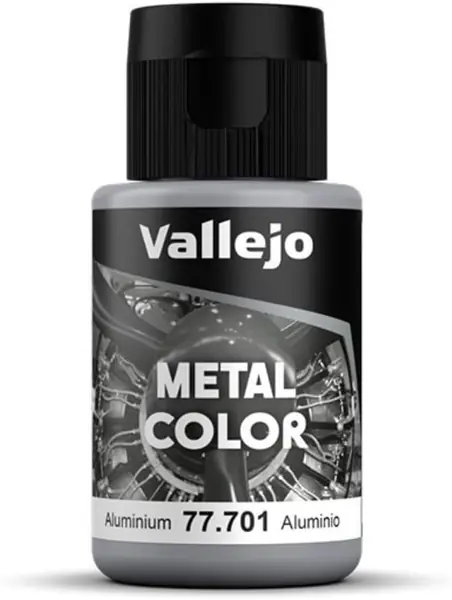
Vallejo Metal Color Aluminium Best Metallic

Vallejo Metal Color Aluminium bottle of airbrush-ready metallic acrylic paint

Airbrushed metal parts

Track Score 93/100
Paint Type
Water-based metallic acrylic
Application
Airbrush-ready
Volume
32 ml (1.08 fl oz)
Shades In Range
17
View on Amazon

One bottle, no mixing, and a finish that does not look like glitter. The Metal Color range is the choice when a kit needs bare aluminum, and this is the Aluminium shade — one of 17 in the line. The 32 ml bottle is already thin enough to spray straight through an airbrush, so there is no ratio to work out before you start.

Metallics are usually where water-based paint falls apart, spraying grainy or drying dull. This one keeps its aluminum pigment in a fine suspension, and thin coats over a gloss black base give the closest thing to polished metal we have gotten out of an acrylic. The label's own caution is worth heeding: wait 12 hours before masking, because tape lifts fresh metallic off the surface.

It is a component, not a kit. One shade in a 32 ml bottle will not cover an engine bay, a landing gear, and a car body, and the paint is thin enough that a loaded brush floods recesses rather than laying a smooth line. Buy the two or three shades your subject actually calls for and keep this one for the parts meant to catch the light.

Worth Noting

  • Too thin for heavy brush application
Our Verdict

If your kit has an engine, a landing gear, or a bare-metal panel, this is the bottle: it sprays unthinned and reads as metal.

Check Latest Price
5.

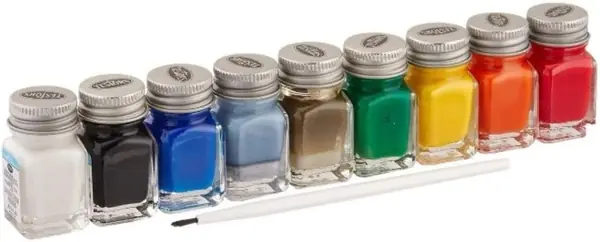
Testors Acrylic Value Finishing Paint Set 9196T Best for Younger Hobbyists

Testors acrylic finishing paint set with nine small bottles and a brush

Younger hobbyists

Track Score 92/100
Paint Type
Water-based acrylic, gloss
Set Contents
9 x 1/4 fl oz bottles and a brush
Surfaces
Wood, plastic, paper, metal, and more
Cleanup
Soap and water
View on Amazon

Nine quarter-ounce bottles and a brush, in a lineup that puts gold and silver next to the usual red, black, gloss blue, orange, green, white, and yellow. It is the plainest packaging on this page and the easiest to hand to someone who has never opened a paint bottle before.

We treat this as the set for a young modeler or a mixed craft table rather than a fine-scale build. It is water-based, non-toxic, low odor, and washes out of brushes with soap and water, which matters when the painter is eight and the workspace is the kitchen. The bottles are small, so white and black run out first on anything large, but for a first snap-together kit or a set of clay ornaments it covers a lot of ground.

Worth Noting

  • Small bottles; white and black run out first
Our Verdict

Nine colors, soap-and-water cleanup, and no solvent smell: that is why we like this set for younger modelers working at the kitchen table.

Check Latest Price
6.

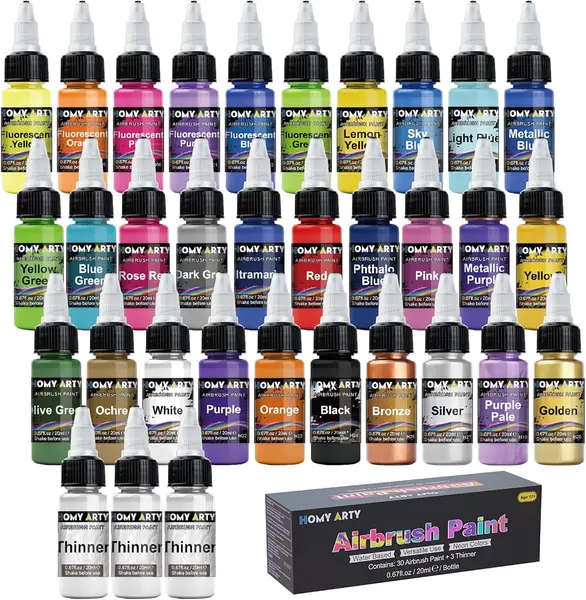
HOMY ARTY Airbrush Paint Set Best for Large Airbrushed Areas

HOMY ARTY airbrush paint set with 30 color bottles and three thinners

Large airbrushed areas

Track Score 91/100
Paint Type
Water-based acrylic, gloss
Set Contents
30 x 0.67 fl oz bottles plus 3 thinners
Application
Airbrush-ready
Shade Mix
19 standard, 6 fluorescent, 5 metallic
View on Amazon

Lay a base coat on a car body or a stretch of diorama wall and the difference between a hobby pot and an airbrush bottle shows up immediately: this set is built for volume. Thirty 0.67-ounce bottles arrive with three thinners, which is a lot of sprayable paint in one box.

Spraying is the part it does well. The paint comes ready to shoot and most of the time it passes through an airbrush without extra thinning, though thickness varies from bottle to bottle, and the label's own advice — one or two drops of thinner to ten drops of paint when your compressor is weak — is worth following. The mix runs 19 standard shades, six fluorescents, and five metallics.

The honest framing is that this is a general airbrush line rather than a miniature paint range. The gloss finish is shinier than most figure painters want, and on bare plastic a sprayed coat can rub away under a thumb, so primer is not optional here. For base coats, terrain, and large flat panels it covers ground cheaply, and we save the small hobby pots for detail while this set handles the background.

Worth Noting

  • No single bottles; a refill means a new set
Our Verdict

When we need to cover a lot of surface in a hurry, this set does the job; prime plastic first and save fine detail for a hobby pot.

Check Latest Price

How We Tested Model Paints

We built the shortlist from the hobby lines painters actually repurchase rather than the biggest sets on the shelf, then filtered by chemistry, bottle format, palette breadth, and price. Anything that took three or four coats to turn opaque on primed plastic was out inside the first week. Fourteen sets went into the test, and we ran them for six months.

Most of that time was brush work at a dining table — primed plastic spoons and spare figures, one color per session, counting coats until the surface went even. The airbrush-ready sets went through a ventilated booth, mask on, thinned drop by drop until they sprayed without spitting or separating. The solvent enamel got its own well-ventilated session, and we kept it away from the younger painters in the room, treating the 14-and-up rating as a floor rather than a suggestion.

We touched painted parts at intervals to see when they stopped feeling tacky, taped over cured paint before masking, thumb-rubbed edges, and knocked finished figures into a parts tray to see what chipped. Colors within a set got compared for thickness too, since one watery bottle throws off a mix. Metallics were brushed and sprayed over a dark base and judged under a desk lamp. We stored every bottle on its side for weeks and checked caps for crusting or leaks, counted drops from dropper tips against pours from jars to see which mixed repeatably, rinsed brushes in soap and water, and worked out how far each bottle went against its price.

How to Choose Model Paints

Acrylic or Enamel First, Color Second

Water-based acrylic is the default for a reason: it thins with water, cleans up with water, dries matte, and lets you layer thin coats without waiting a day. Solvent enamel dries to a hard gloss that shrugs off handling, but it needs its own thinner and a ventilated room, and Testors rates its enamel set for ages 14 and up. The trap is assuming the two swap cleanly: water will not thin enamel, and acrylic sprayed over a tacky enamel coat will not level.

We choose acrylic for anything brush-painted and layered, and enamel for small parts that get touched. If you want one purchase that covers the most ground, buy acrylic first and add a gloss enamel later.

Dropper Bottles, Jars, and Consistent Mixes

A dropper bottle lets you count drops, and counting is how a mix becomes repeatable — the same ratio on the next figure, or on a touch-up months later. A glass jar means dipping a brush into the whole supply, which carries pigment back in and lets the bottle skin over faster. Most miniature paints sold in sets now use droppers; the Testors glass bottles here are the exception.

Check the tips when a set arrives, and store bottles upright: a split dropper cap leaks paint into the lid every time you shake it, and it dries into a crust that fouls the threads. Wipe the tip before capping, and never thin paint inside the bottle.

Brush, Airbrush, or Both

Brush paint is thick enough to stay where you put it; you thin a drop on a palette to roughly skim-milk consistency and build thin coats. Airbrush-ready lines, like the Vallejo Metal Color and the HOMY ARTY set, are cut at the factory so they spray straight from the bottle. Buying the wrong one wastes paint: an airbrush bottle floods detail under a brush, and a brush pot has to be thinned every session before it sprays.

We put more weight on how you paint most of the time. Brush-first painters should buy brush paint and one bottle of thinner for occasional spraying; anyone covering large surfaces should start with a ready-to-spray line and add a few brush pots for detail.

Palette Breadth, Metallics, and Buying Singles

Count colors, then count what you can add later. A 16-bottle set is a working palette, an 11-pot starter covers a first project, and nine small bottles are a shelf rather than a system. The question that matters more is whether the maker sells individual bottles, because white and black run out first and one specific uniform green is always missing.

Metallics deserve their own decision. Two metallic pots in a starter set get you a buckle and a sword; a dedicated line is what makes a bare engine block read as metal. Triad systems, where colors are built from a shared root, are the other shortcut worth paying for.

Frequently Asked Questions

Final Verdict

For most people we recommend starting with the Vallejo Basic Colors USA set: 16 matte acrylics in dropper bottles, coats that level out under a brush, and a palette broad enough to finish a first unit without mixing every shade from scratch.

Two requirements change that answer. If you are buying for someone with nothing at all — no brush, no wash, no figure — the Army Painter Fanatic starter set gets them painting on day one. And if the model will be handled, or needs real gloss on metal and wood, keep a set of Testors enamel on the shelf and prime the plastic first.