Best Hot Air Soldering Stations of 2026

People usually buy a hot air station for the job a soldering iron can't do: a connector a tip can't reach, a row of capacitors, a chip with pads tucked underneath. Hot air lifts those parts without dragging traces with them, and a station is only as good as how steadily it holds heat while the nozzle hovers over a joint.

The display is a starting point, not a measurement. Turn up the air and the nozzle temperature sags, and that sag is where a cheap station gives itself away; on a heavy ground plane, airflow does more than extra heat. Of the 12 stations we used on home and repair benches for eight months, three of the five picks pair an iron with the gun, which helps for mixed work but compromises a bench that mainly reflows.

Our Top Picks

The Best Hot Air Soldering Stations

1.

YIHUA 959D Best Overall
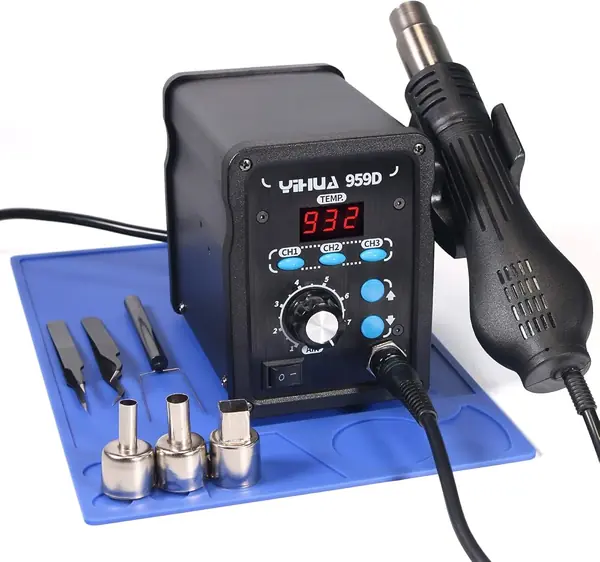
YIHUA 959D hot air rework station with brushed aluminum panel, detachable gun and three nozzles

SMD rework

Track Score 90/100
Temperature Range
212°F–932°F
Wattage
700 W
Preset Channels
3
Max Airflow
120 L/min
View on Amazon

Three preset channels do more for day-to-day rework than any other feature on this station. Save your heat-shrink setting, your leaded setting and your lead-free setting once, then jump between them with a single press instead of dialing temperature and airflow for every joint. On a board that mixes work, that is the difference between a rhythm and a fumble.

As a hot air station rather than a combo, the 959D is the one we reach for when the job is SMD rework and we do not want to pay for a second iron. The gun heats as soon as it leaves the cradle, the airflow is adjustable up to 120 L/min, and the 932°F ceiling leaves real headroom for lead-free work. We were also struck by how legible the brushed panel stays under bench light, which sounds like a small thing until you are reading a setpoint at an awkward angle.

One habit worth building: the number on the display and the air arriving at the joint can drift apart, so check a new setting against a scrap board before you trust it on a customer's PCB. The gap is small enough to miss on a fat pad and large enough to lift a thin one, and a five-minute check settles it for good.

What we came to rely on is the standby that kicks in when the gun goes back in its cradle. The heater idles down instead of sitting at reflow temperature between joints, which is the single best thing you can do for handpiece life on any station.

Worth Noting

  • Hot air only; no soldering iron included
Our Verdict

We recommend the 959D to anyone whose rework is mostly hot air: three presets, 120 L/min of adjustable airflow and a 932°F ceiling for less than the combos cost.

Check Latest Price
2.

YIHUA 995D+ EVO Best 2-In-1 for Daily Iron Work

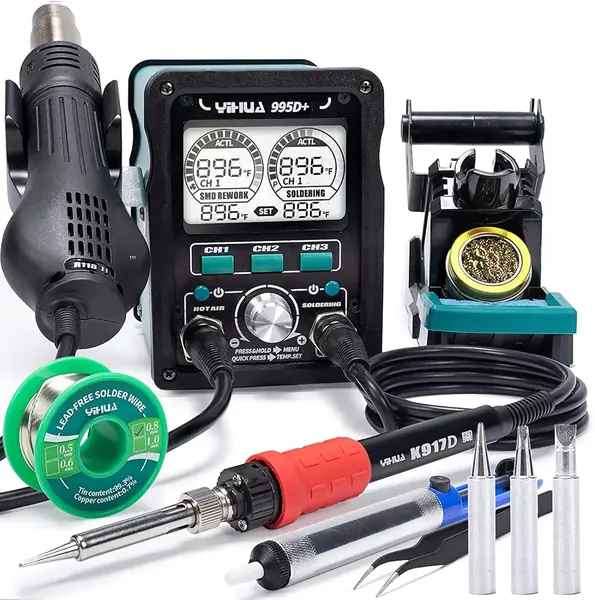
YIHUA 995D+ EVO green two-in-one soldering and hot air station with LCD and iron holder

Mixed rework

Track Score 89/100
Temperature Range
212°F–896°F
Display
LCD with power meter
Iron Power
110 W
Preset Channels
3
View on Amazon

The iron is what you are paying for here, and it is a good one: 110 watts, a substantial handpiece, and a power readout on the LCD that shows how hard the element is working as a joint heats. We found that readout more useful than any number on the spec sheet, because when the watts fall away the joint is wet and you can get off it before the pad cooks.

Both halves carry their own temperature and airflow settings, three presets, sleep and automatic shutdown, so the unit behaves like two tools sharing a box rather than one tool with a spare attached. Heat-up is fast enough that switching off between jobs is no hardship, and the LCD keeps set and actual temperatures for both handpieces visible at once.

That screen is busier than most — power level, set and actual temperature for two tools, air volume, channel number — and it stops feeling cluttered after an afternoon. Going back to a two-digit display afterward feels like flying blind, which is not a thing we expected to care about.

The detail we did not expect to use every session is the holder: it parks five tips across the front of the stand, so a tip change happens without opening a drawer or hunting across the bench.

Worth Noting

  • Heavier handpiece than a standalone iron
Our Verdict

We point daily iron users to the 995D+ EVO: a 110-watt iron and a live power meter you can watch while the joint comes up.

Check Latest Price
3.

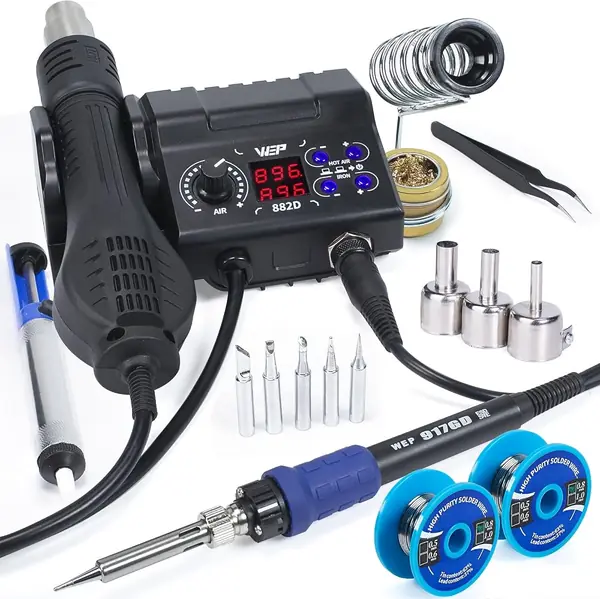
WEP 882D Best Budget 2-In-1

WEP 882D compact two-in-one soldering and hot air station with dual LED displays and accessories

Occasional rework

Track Score 88/100
Wattage
750 W
Airflow Control
Rotary knob
Iron Temperature
392°F–896°F
Hot Air Temperature
212°F–896°F
View on Amazon

Two tools, two displays, two power switches and a chassis that tucks into a corner of the desk without crowding the board. It is the smallest full 2-in-1 in this group, and the separate readouts mean you are never squinting at one shared number trying to work out which half it belongs to.

The box is unusually complete for a budget station: five iron tips, three nozzles, brass wool, tweezers, a desoldering pump and two spools of solder wire. A first project does not start with a second order, which is more than we can say for some of the step-up units here.

Where it earns its place is the hobby desk and the occasional repair — a keyboard switch here, a connector there. Push it onto a big ground plane, the way an HDMI port on a console board sits, and the 882D runs out of headroom; that is precisely where the 995D+ EVO's 110-watt iron and the 959D's airflow stop being luxuries. We think it is the right first station and the wrong only station for anyone taking in paid board work.

Both halves have sleep and standby behavior, so leaving it powered between joints does not sit there cooking the tips while you trace a fault with a meter.

Worth Noting

  • Airflow knob has no numeric setting
Our Verdict

For occasional board work, the 882D gives you a hot air gun and an iron on a small footprint, with the tips and solder to start in the same box.

Check Latest Price
4.

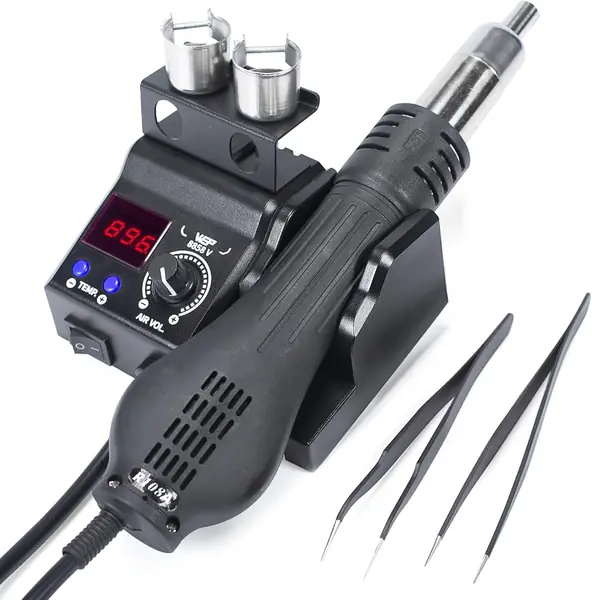
WEP 8858-V Best for Tight Benches

WEP 8858-V palm-sized hot air rework station with integrated gun cradle and nozzle holder

Small benches

Track Score 87/100
Temperature Range
212°F–896°F
Display
LCD
In The Box
3 nozzles and 2 tweezers
Max Air Volume
120 L/min
View on Amazon

The main unit is genuinely palm-sized, with the gun cradle molded into the top and a holder for three nozzles alongside it. It sits next to the board you are working on rather than behind it, and the handpiece is light enough that moving between joints does not wear your wrist out the way a heavier gun does.

It also has the cleanest long-term record of the hot-air-only units here, which matters on a tool whose whole life is heating and cooling. We like it as a second station on a crowded bench, and just as much as the entire setup for someone working small boards in a small room.

Heat that lifts a SOIC cleanly can feel thin on a joint tied to a ground plane, so plan on a preheat or a wider nozzle for heavy copper. Three nozzles and a 120 L/min ceiling suit SMD packages, heat-shrink and small connectors far better than a big through-hole joint on a multi-layer board, and knowing that going in saves a return.

The auto standby when you lay the gun in its holder is what sold us on it for tight spaces: lift it and it is at temperature, set it down and it stops baking.

Worth Noting

  • Hot air only; no soldering iron included
Our Verdict

Where bench space is the constraint, we hand people the 8858-V: a palm-sized hot air rework station that stores its own gun, nozzles and tweezers.

Check Latest Price
5.

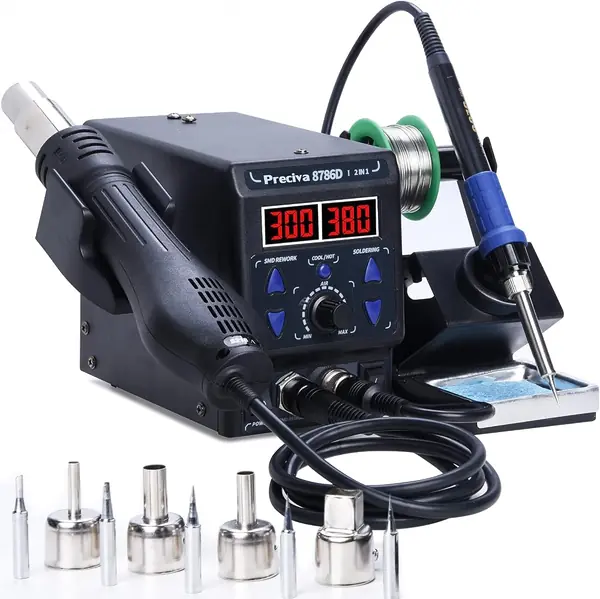
Preciva 8786D

Preciva 8786D two-in-one hot air and soldering iron station with dual LED display and accessory kit

First bench

Track Score 85/100
Iron Power
40 W
Hot Air Power
700 W
Soldering Tips
5
Hot Air Nozzles
4
View on Amazon

The grounding lead is the tell. Budget combos routinely toss in tips and skip the one accessory that protects the parts you are working on, and this box includes an ESD wire alongside five tips, four nozzles, a spool of lead-free solder and an iron stand. We think that says who it is aimed at: someone setting up a first bench, not someone adding to a full one.

The hardware follows the familiar two-in-one formula — 700 watts of hot air, a 40-watt iron, PID control on both sides, sleep and standby — and it behaves accordingly: quick to reach temperature, simple to set, adequate for through-hole work and small SMD parts. The dual LED display keeps both temperatures in view at once, so checking a setting does not mean toggling between the iron and the gun.

What we cannot do is vouch for its long life. This is the least proven station of the five, which makes it a starter rather than a lifetime buy, and the practical note that keeps coming up is the cord: short and permanently attached, so measure your outlet before you commit a corner of the bench to it.

Worth Noting

  • Short power cord that is permanently attached
Our Verdict

We treat the Preciva as a starter kit: two tools, tips, nozzles, solder and an ESD ground lead for less than the step-up combos.

Check Latest Price

How We Tested Hot Air Soldering Stations

We started with spec sheets for every station we could find in the 110–127V range, then narrowed the field on what ships in the box, whether the nozzle and tip assortment was usable on day one, and price. That left 12 stations, which lived on our benches for eight months: a home workbench, a shared repair bench, a kitchen table that gets cleared every night.

Heat-up came first: a thermocouple taped to the nozzle, a timer from cold to the set temperature, then the same reading at minimum and maximum airflow. We pushed each one to its top set temperature to see what the nozzle actually read with the fan wide open. For recovery, we soldered to pads tied to heavy copper planes and timed how long a joint took to wet after the gun had been off the board a few seconds.

Small-package work got its own pass: lifting 0402 and 0603 parts at the lowest airflow each station would hold, checking that nearby components stayed put. We holstered and re-drew each handpiece dozens of times a session, noting weight, footprint, how the gun sat in its cradle, and whether standby or automatic shutdown engaged; cool-down ran to the end before the handpiece went back. Every station was grounded and used on an ESD mat, and we set presets for our three most common joints to see if they held through a power cycle.

Durability ran in the background: a heat-cycle log, a look at the handpiece cable at the strain relief, and a note whenever an element got slower to reach temperature. For the 2-in-1 units we judged the iron on its own, since a weak iron half drags down the whole purchase. Value came last, in what the box covered and what we had to buy separately.

How to Choose a Hot Air Soldering Station

Hot Air Alone or a Combo

If your bench already has a soldering iron you like, a dedicated hot air station puts the whole budget into the gun, the airflow and the heater — that is the case for the YIHUA 959D and the WEP 8858-V here. Starting from nothing, a 2-in-1 like the WEP 882D or the YIHUA 995D+ EVO saves an outlet and a square foot of desk.

Then look hard at the iron half, because it varies more than the air half does. Iron power across this group runs from 40 watts to 110 watts, and the low end is fine for through-hole pads and small wire, while anything tied to a ground plane wants the higher figure.

Airflow Is the Control You Actually Adjust

Temperature gets the marketing; airflow decides whether the job works. Too much air and an 0402 resistor leaves the pad before the solder melts. Too little and a joint on a ground plane never comes up at all.

What you want is a station that goes low and stays steady rather than one with an impressive maximum. The 120 L/min figures on the 959D and the 8858-V are ceilings, not working settings — you spend most of your time well under them, so judge a unit on its lowest usable flow and on how fine the adjustment is near the bottom of the range.

Treat the Display as a Starting Point

Air leaving a nozzle cools as it travels, and a board pulls heat away the moment the air lands, so the number on the panel is a setpoint rather than a measurement of the joint. Check a new setting on a scrap board, or with a thermocouple, before you use it on something you care about.

This matters most on multi-layer boards and anything with a wide copper pour, where the difference between a clean lift and a torn pad is a few degrees and a few extra seconds. A preheater does more for those joints than another 50 degrees of nozzle temperature.

Presets, Standby and the Holder

Repeat work is where preset channels earn their keep. Set your leaded, lead-free and heat-shrink settings once on a station that stores them — the 959D and the 995D+ EVO both hold three — and you stop dialing numbers between joints while the part cools.

Just as important is what happens when the gun goes down. A cradle that triggers standby cools the heater instead of holding it at reflow temperature, and across a year of work that is the single biggest thing you can do to keep a handpiece alive.

Nozzles, Tips and What Ships in the Box

Straight and bent nozzles in two or three sizes cover most SMD work, and built-in nozzle storage such as the 8858-V's holder keeps the one you need visible instead of lost in a drawer. Spare heating elements are worth budgeting for on any of these stations, since the element is the part that wears out.

Look at what arrives on day one. The WEP 882D ships tips, nozzles, brass wool, tweezers, a pump and two spools of solder; some others assume you own all of it. Neither approach is wrong, but a bare box means a second order before the first repair.

Frequently Asked Questions

Final Verdict

We recommend the YIHUA 959D for most people buying a hot air station. Three presets, airflow you can dial down to 120 L/min and a 932°F ceiling cover SMD rework, and because it is a dedicated unit you are not paying for an iron you already own. The standby behavior when the gun goes back in its cradle is the detail that keeps it on our bench.

If there is no iron on your desk at all, the 995D+ EVO's 110-watt side and live power meter justify the step up. And if the work is a few boards a year rather than a few a week, the WEP 882D does both jobs for less, as long as you keep it away from heavy ground planes.