Best Soldering Iron Kits for Hobby Electronics of 2026

Holding heat the moment the tip touches a joint is the whole test of a soldering iron, and it is harder than the wattage on the box suggests. Thin wire melts solder on almost anything. A ground plane or a chunky connector drains a weak iron and leaves a dull, grainy joint that fails a month later.

The highest wattage didn't impress us most. A ceramic element and a tip that seats tightly in the barrel did more for heat recovery than another 20 watts, and a digital display only helps when the number on screen matches the tip. Spare tips, a desoldering pump and tweezers add up when bought separately, so we counted what came in each of 14 kits.

Our Top Picks

The Best Soldering Iron Kits for Hobby Electronics

1.

Q-MING 80W LCD Soldering Iron Kit Best Overall
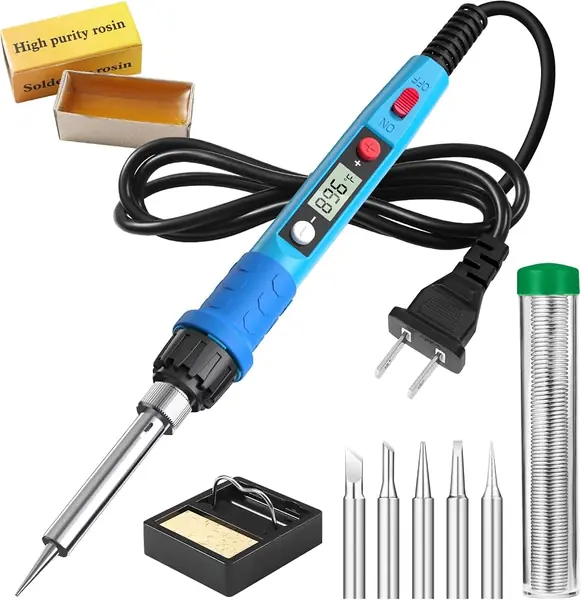
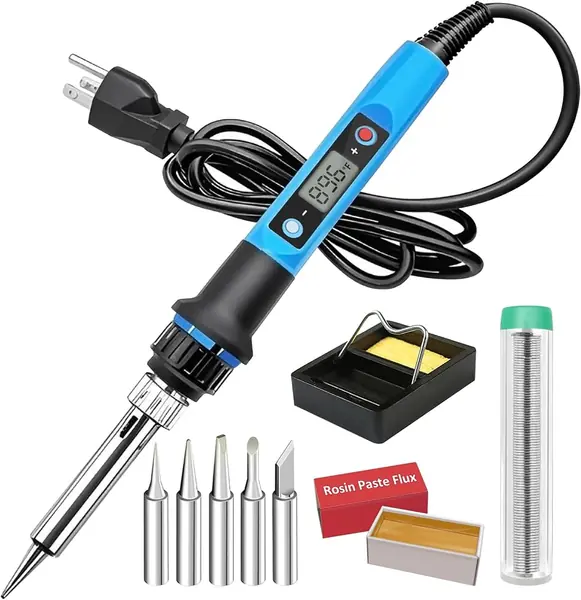
Q-MING 80W digital soldering iron kit with blue handle, stand, and five tips

Everyday electronics

Track Score 94/100
Wattage
80W
Temperature Range
180℃-480℃/356℉-896℉
Kit Contents
Five tips, stand, sponge, solder, flux paste
Display
LCD digital
View on Amazon

An 80-watt ceramic element and a readable LCD are the two details that make this Q-MING kit feel more serious than the usual pencil iron. The display shows the set temperature instead of leaving you to guess from a numbered wheel, and the range runs from 356°F to 896°F. We noticed the iron comes up to heat quickly enough that we stopped planning around a long warm-up, which matters when you are tacking one motor lead and then setting the iron down again.

That combination is why this is our top pick for a first electronics bench. The extra wattage gives it more reserve than a 60-watt iron when a joint starts to sink heat, and the LCD makes it easy to return to the same setting for the next joint. For slot-car wiring and small circuit-board repairs, those two things matter more than a long list of accessories.

The five tips, simple stand, sponge, solder wire, and flux paste are enough for a first repair. We keep the heat lower for small pads and test the first joint on scrap wire before touching a board. The stand does the job while the iron is hot, and the whole kit stores in a small drawer between projects.

We keep the spare tips in a little tin so they do not scatter, and the pencil handle makes it easy to rotate for a fine joint. When we want quick heat without unfolding a station, this is the kit we grab.

Worth Noting

  • No desoldering pump or tweezers
Our Verdict

We recommend the Q-MING 80W kit for hobbyists who want fast ceramic heat and a readable LCD without paying for a station.

Check Latest Price
2.

ANBES 60W Soldering Iron Kit Best Complete Starter Kit

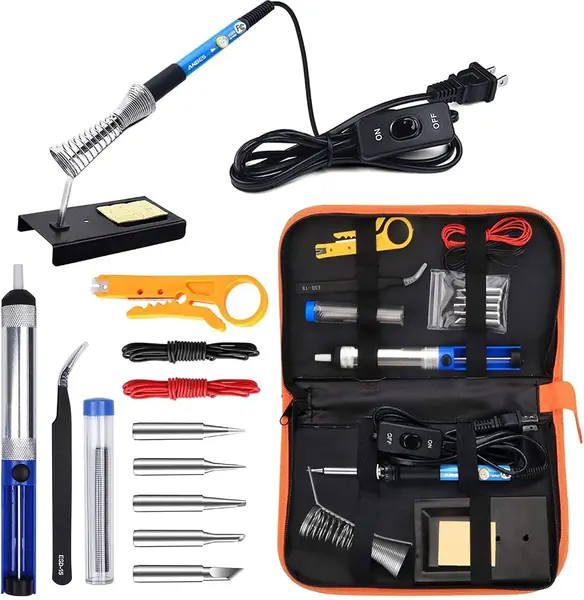
ANBES 60W soldering iron kit with orange handle, pump, tweezers, and tips

First-time soldering

Track Score 93/100
Wattage
60W
Temperature Range
Up to 450°C
Kit Contents
14 pieces including pump, tweezers, five tips
Stand
Dual-spring holder with sponge
View on Amazon

The 14-piece contents are what make the ANBES kit worth a look: five interchangeable tips, a desoldering pump, tweezers, a wire stripper, two lengths of electronic wire, solder paste, and a dual-spring stand with a sponge. For a beginner, that is the difference between opening one box and placing three separate orders before the first repair.

We recommend it for someone who wants to learn on scrap boards and model wiring without hunting down every small tool. The pump is a one-handed metal type, the tweezers reach into tight spaces, and the stand gives the iron a proper place to rest. The controls are simple enough that we did not need a manual for basic temperature changes.

Heating performance is the caveat. Some units can arrive unable to reach soldering temperature, so heat yours on a scrap joint as soon as it arrives; if it will not melt solder, use the return window rather than fighting it. The accessories are also basic rather than premium, which is expected in a starter kit. What we kept using on model work was the wire stripper and the fine tip; they are the two pieces that made the kit feel more useful than a bare iron.

Our Verdict

The ANBES kit puts the pump, tweezers and spare tips in one box for beginners, provided you test the heat on arrival.

Check Latest Price
3.

HANDSKIT 90W Soldering Iron Kit Best for Precision Work

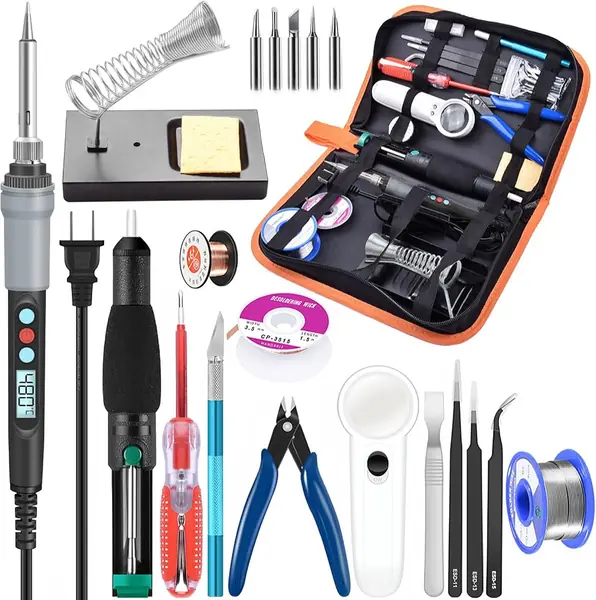
HANDSKIT 90W soldering iron kit with digital handle, six tips, and PU case

Model wiring

Track Score 92/100
Wattage
90W
Temperature Range
Up to 450°C
Kit Contents
21 pieces including pump, tweezers, magnifier, PU case
Tips
Six 900M tips
View on Amazon

Six 900M tips and a small magnifier are the reason we reach for the HANDSKIT kit on model wiring. A fine conical tip gets into a slot-car chassis or a receiver board without bridging nearby pads, while a chisel tip handles a motor lead with more contact area. The 90-watt ceramic element has enough reserve for those quick joints, and the digital handle lets you set a temperature instead of guessing at a dial.

The rest of the 21-piece kit supports that bench work: a desoldering pump, tweezers, a stand, solder wire, and a PU case with a spot for each piece. Temperature calibration, memory, and auto sleep are features we usually expect on a station, and they make the iron easier to live with between sessions. We appreciated the case most because loose tips and tweezers disappear fast in a hobby drawer.

The controls take a learning pass, and the calibration menu is not self-explanatory on the first session. For board work and small wiring, though, the tip selection is the advantage. The magnifier is the extra we did not expect to use as often as we do.

Worth Noting

  • Heat can fall short on large joints
Our Verdict

Six tips, tweezers and a magnifier in a case make the HANDSKIT the kit for model and board work.

Check Latest Price
4.

Liouhoum 80W Smart Soldering Iron Kit Best Smart Features

Liouhoum 80W soldering iron with LCD display and several spare tips

Occasional repairs

Track Score 91/100
Wattage
80W
Temperature Range
Up to 480°C
Display
LCD digital
Smart Features
Auto sleep, temperature memory, calibration
View on Amazon

Auto sleep is the feature that sold us on the Liouhoum iron: set it on the stand for five minutes and it drops temperature instead of cooking the tip. Temperature memory brings back the last setting at startup, and there is a calibration function plus a fault alarm. For a hobbyist who works in short bursts, those small conveniences are more useful than another cheap accessory in the box.

The 80-watt ceramic heater and LCD put it in the same performance conversation as the Q-MING, and the temperature range reaches 896°F. The kit includes several tips, solder, and flux, enough to make a first repair without a second order. The silicone-covered handle is comfortable for fine work, and the 4.3-foot cord gives you some room to move at the bench.

We like it best as the iron that stays plugged in for occasional repairs, because the sleep timer protects the tip when a phone call interrupts a joint. Heating speed is the weak point: some units can struggle to reach temperature, so test yours on scrap wire before the return window closes. If it heats properly, the smart features make it a pleasant bench companion; if not, the extras do not make up for a cold tip.

Our Verdict

Auto sleep and temperature memory matter more than extras to an occasional repairer, and the Liouhoum 80W delivers both.

Check Latest Price
5.

Plusivo 60W Soldering Iron Kit Best Basic Kit

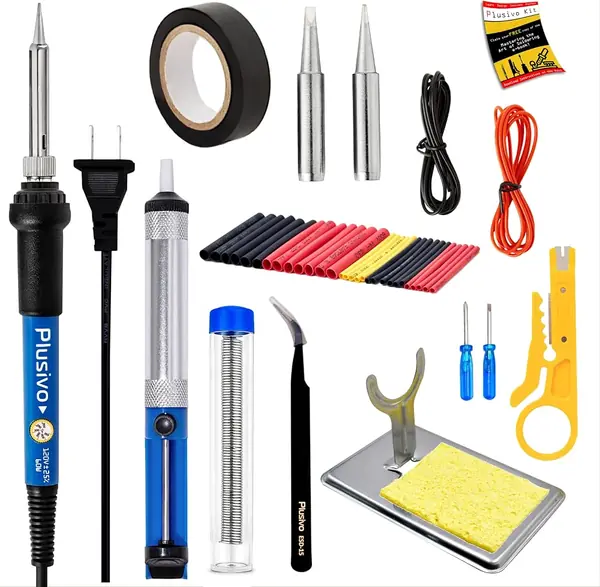
Plusivo 60W soldering iron kit with stand, pump, spare tips, and carton box

Light household fixes

Track Score 90/100
Wattage
60W
Temperature Range
392℉-842℉ or 200-450℃
Kit Contents
15 pieces including pump, solder, heatshrink
Tips
Two replaceable tips
View on Amazon

A small carton is a plain thing to praise, but the Plusivo kit earns it: the box keeps the iron, stand, pump, spare tips, solder, and heatshrink sleeves together instead of scattering them across a drawer. The 15-piece count is broad without turning into a box of novelty extras.

The 60-watt iron uses a ceramic heater and a temperature knob that runs from 392°F to 842°F. Four ventilation holes help move heat away from the handle, and the pencil shape is easy to angle into a tight chassis. We found the dial simple to set by feel, which is useful when your eyes are on the joint rather than the tool.

Light repairs are its comfort zone. The 60-watt element is fine for small circuit boards, pickup wires, and household connectors; it can feel slow on heavier wire or a joint that sinks heat into a metal chassis. Heating performance can also vary, so make a test joint before you trust it on a finished model.

This is the kit we keep for quick household fixes and simple hobby wiring, not for a full restoration bench. The pump and heatshrink sleeves are the two extras that make it more than a bare iron, and the carton makes it easy to put everything away when the table has to become a table again. If you already own a station, it is a sensible second iron to leave in the toolbox.

Worth Noting

  • Only two replaceable tips included
Our Verdict

A simple, organized 60W iron for light household and hobby repairs.

Check Latest Price
6.

LDK 60W Basic Soldering Iron Kit Best Minimal Kit

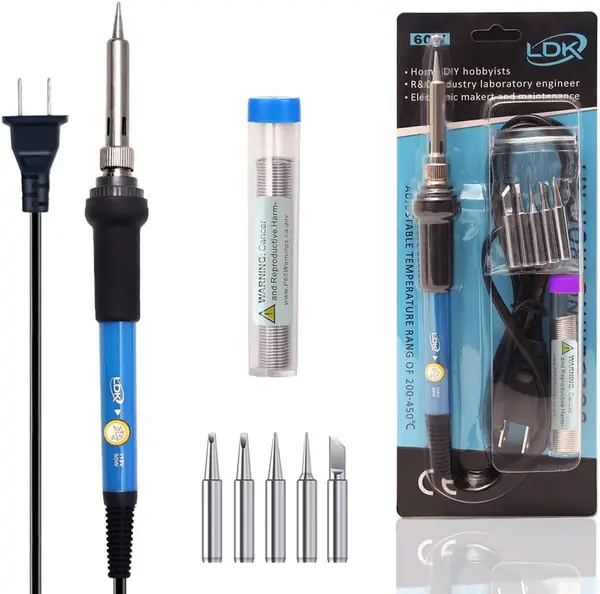
LDK 60W basic soldering iron with five tips and a spool of solder wire

Tight budgets

Track Score 89/100
Wattage
60W
Temperature Range
Up to 450°C
Kit Contents
Iron, five tips, solder wire
View on Amazon

The LDK kit is the one to choose when the iron matters more than the box around it. You get the 60-watt pencil, five replacement tips, and a small spool of solder wire; that is enough for a first repair or a dedicated slot-car toolbox.

It is rated to heat within about a minute, which is not the fastest here but is fine for occasional work, and the knob covers settings up to 450°C. The handle is light and the 4.75-foot cord gives some reach. The five tips cover the common shapes, and the pencil size is easy to keep steady on a small board.

The numbered wheel is a simpler control than the digital panels on the other kits, and for quick jobs we like not having to cycle through a menu. The iron is light in the hand and the five tips swap without tools. It is a basic kit by design, but that focus is also why it fits a small toolbox and a beginner's first repair.

Worth Noting

  • No stand or pump included
Our Verdict

For a buyer who already owns a stand and just needs adjustable heat and spare tips, the LDK costs the least.

Check Latest Price
7.

TOAUTO DS90 Soldering Station

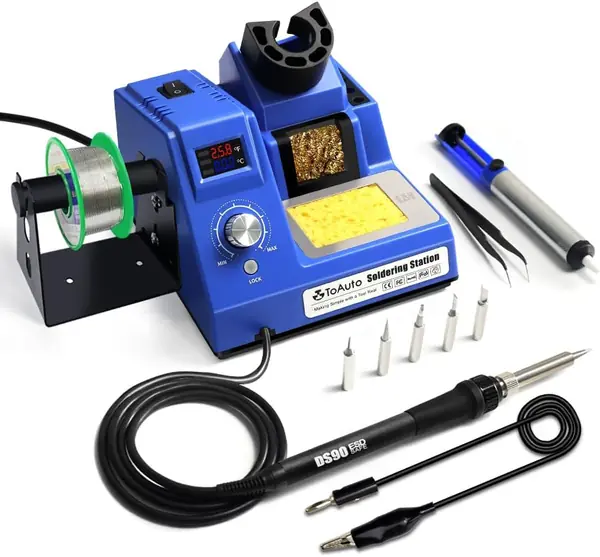
TOAUTO DS90 soldering station with blue case, dual display, and five tips

Permanent workbench

Track Score 88/100
Wattage
90W
Temperature Range
302℉-842℉
Kit Contents
13 pieces including five tips and solder
Display
Dual digital display
View on Amazon

A station is a different purchase from a pencil kit, and the TOAUTO DS90 makes the case for keeping one set up. The 90-watt iron sits in its own bracket, the dual digital display shows Fahrenheit and Celsius, and the PID temperature control is designed to hold a steady set point. For board work and repeated model wiring, that stability is the point.

The 13-piece kit adds five tips, a roll of lead-free solder, a stand bracket, and auto standby and sleep. The 302°F to 842°F range covers everything from delicate pads to heavier joints, and the station layout keeps the controls in view instead of buried in a handle.

We recommend it for a permanent bench where the iron has a home and the outlet is not shared with a kitchen appliance. What we like is the layout: the display stays visible, the iron rests in the bracket, and the controls are not buried in a menu. The anti-static and grounding design is the detail that makes it feel purpose-built for electronics rather than general repair.

Worth Noting

  • Not portable for remote repairs
Our Verdict

We recommend the TOAUTO DS90 for a permanent bench where dual displays and a station format matter more than portability.

Check Latest Price

How We Tested These Soldering Kits

We began with roughly 40 kits, cutting anything without adjustable temperature control, a heat-resistant stand, or a way to buy replacement tips. Price factored in, but so did the accessory list: a kit that left you buying solder or tweezers separately wasn't much of a kit. Fourteen made the cut, from bare-bones pencil irons to a bench station, and we used them for five months.

Testing happened where soldering actually happens: a garage bench, a kitchen table after dinner, and a desk in a one-window apartment. We soldered practice boards, replaced a headphone jack, fixed a guitar pedal cable, and shrank heatshrink onto auto wiring. For heat, we timed each iron from cold to working temperature, then soldered a pad tied to a large copper ground plane and watched whether the tip recovered or the solder went slushy. A thermocouple told us how close the displayed temperature came to the real one at the low, middle, and top of each range.

We noted how each handle felt after 30 minutes of steady work, whether the tip wobbled in the barrel, and how fast tips oxidized when we forgot to re-tin them. Irons advertising auto standby got timed to see how long they idled before dropping temperature. We parked each iron in its stand mid-job to see if the stand moved, inventoried the box, and packed everything back up to judge whether it would survive a drawer or a toolbox.

Safety shaped the routine: irons went back in the stand the moment we set them down, we unplugged between sessions, and we worked by an open window with a fan moving air across the bench. We read the label on every roll of included solder to record whether it was leaded or lead-free, then washed our hands afterward when it was.

How to Choose a Soldering Iron Kit for Hobby Electronics

Heat and Recovery Matter More Than Wattage Alone

A 60-watt iron is enough for small circuit boards, pickup wires, and most slot-car motor leads. The extra wattage in an 80- or 90-watt iron shows up when a joint sinks heat into a motor can or a thick wire, and the iron has to recover. We look for a ceramic element and an adjustable range that reaches at least 842°F; a digital display is a convenience, not a substitute for technique. If you solder only occasionally, a 60-watt kit like the Plusivo will do the job; for more headroom, the Q-MING's 80 watts is a useful step up.

Build a Tip Set Around Your Smallest Joint

A fine conical tip is the one that reaches a pad without bridging, but a chisel tip carries more heat into a wire or a ground plane. We prefer kits with at least three shapes and a standard tip family such as 900M, because replacements are easy to find. The HANDSKIT's six 900M tips are the broadest set here; the Plusivo's two tips are enough for light repairs but limit you on shape. Check the spare tip price before you buy a kit that uses a proprietary fitting.

Choose a Pencil Kit or a Station by Where You Solder

A pencil kit lives in a drawer and comes out for a repair; a station stays plugged in and gives you a stand, a stable base, and often helping hands. The trade-off is bench space and portability. We keep a pencil kit for model wiring at the kitchen table and a station for longer board sessions. The TOAUTO DS90 is the station pick here, while the Q-MING and ANBES are easier to pack away. If you have no permanent bench, start with the pencil kit.

Read the Accessory List and Plan for Tip Care

A pump, tweezers, and a stand are the accessories that change how a kit feels in use; solder and flux are consumables you will replace. Check whether the included solder is labeled leaded or lead-free, and treat an unmarked spool as leaded. Budget for a metal stand if the kit lacks one, and tin the tip before and after every session. Auto sleep and temperature memory are nice, but a clean, tinned tip does more for joint quality than another feature on the box.

Frequently Asked Questions

Final Verdict

After testing the kits here, we recommend the Q-MING 80W as the default for hobby electronics and model wiring. Its LCD, quick ceramic heat, and five-tip set make it easy to move from a motor lead to a circuit board without unfolding a station.

If you want the pump and tweezers in the same box, choose the ANBES; for fine model work with a case, the HANDSKIT is the better fit. The TOAUTO DS90 is the one for a permanent bench.