Best Butane Soldering Irons of 2026

Butane makes sense where an outlet doesn't reach: a trailer-light harness in the driveway, a boat's wiring, a layout in a cold garage. A corded iron means an extension cord through wet gravel and a battery iron means stopping to charge, while a butane tool heats its own tip in under a minute and throws a small flame when you need one.

Torch temperature, the number on the box, is the wrong spec to shop by. A clean joint depends on the tip's heat and how steadily it holds against a terminal. Day to day, the differences are duller: whether the igniter fires on the first click or the tenth, whether you can see the fuel level before starting, whether the safety lock sets with one gloved hand and whether replacement tips are cheap enough to buy.

Our Top Picks

The Best Butane Soldering Irons

1.

LEXIVON LX-770 Butane Soldering Iron Kit Best Overall
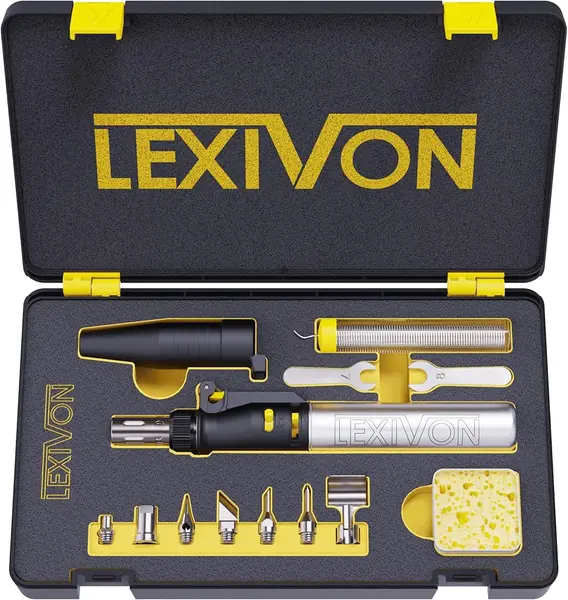
LEXIVON LX-770 black butane soldering iron kit with tips and case

General soldering kit

Track Score 93/100
Runtime
Up to 75 minutes
Soldering Temperature
Up to 1,100°F
Torch Temperature
Up to 2,400°F
Tip Set
7 tips
View on Amazon

The 13-piece kit is the reason this LEXIVON earns the default recommendation. It arrives with seven tips, a self-igniting trigger, a flame-lock button, and enough reach for soldering, heat shrink, and light cutting. The soldering side is rated to 1,100°F and the torch side to 2,400°F, with up to 75 minutes of runtime from a fill. For slot car work, that means you can touch up a controller lead, shrink a piece of tubing over a track connection, and then switch to the torch for a stubborn fitting without hunting for an outlet.

We like the case as much as the tip count. Everything has a place, so the kit stays useful in a toolbox instead of turning into a drawer of loose adapters. The child lock is the one feature we grumble about: it adds a deliberate press every time you light the tool, which gets old during a long wiring session. We accept it because a butane torch that lives near track parts and curious hands should not fire on a stray bump.

Heat control takes a little attention. The soldering tip works best on a low flame, and the torch mode is hot enough that you want to keep it away from insulation and braid until you have the flame where you want it. The ignition system is the other place to stay patient; after the tool has sat for a while, it can take a few clicks before it catches. Once lit, it holds a steady flame, and the broad tip set lets you match the tip to the joint rather than fighting one universal shape. For a kit that has to cover both soldering and heat shrink, that flexibility is the reason it stays on our bench.

Worth Noting

  • Butane fuel sold separately
Our Verdict

We recommend the LEXIVON LX-770 as the default butane soldering kit for most people: it covers soldering, heat shrink, and torch work with a broad tip set and a sensible case.

Check Latest Price
2.

Power Probe PPSK Butane Soldering Kit Best for Automotive Work

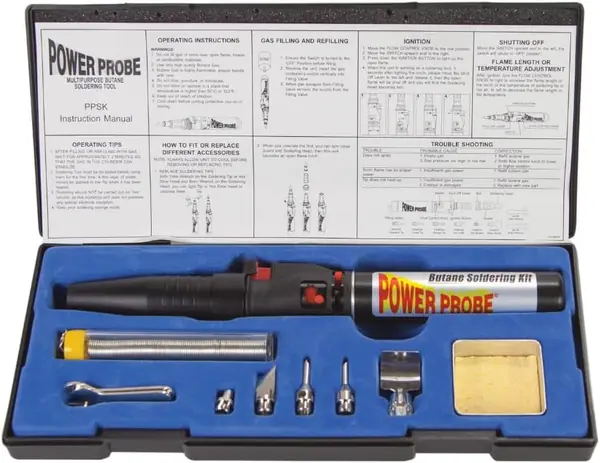
Power Probe PPSK black butane soldering kit with multiple tips

Automotive electrical work

Track Score 92/100
Runtime
Up to 2 hours
Soldering Temperature
Up to 950°F
Weight
12.7 oz
Ignition
Electronic self-ignition
View on Amazon

Two hours on a fill is the number that makes this Power Probe kit worth the premium. The PPSK runs a soldering tip up to 950°F, lights with an electronic ignition, and has an adjustable flame that lets you narrow the heat for a small terminal or open it up for a splice. At 12.7 ounces, it has enough heft to feel stable in the hand without becoming a burden in a tool bag. For automotive wiring, trailer repairs, and slot car controller leads, that combination is close to ideal.

In our testing, the Power Probe heated quickly and held temperature through repeated joints, and the exhaust port did double duty for heat shrink. We especially like that it works from 18-gauge down to 10-gauge wire, which covers the range most slot car wiring and automotive repairs ask for. The kit is more tool than accessory bundle, so you are paying for the iron itself rather than a pile of extras.

The one practical omission is a stand. There is none in the box, so we kept a metal rest nearby and treated the case as storage rather than a workstation. That is easy to work around at a bench, but it is worth knowing if you plan to use the iron on a tailgate or a crowded track table.

Worth Noting

  • Replacement tips wear quickly
  • Ignition can become unreliable with age
Our Verdict

For daily automotive or electrical work, we choose the Power Probe PPSK for its two-hour runtime, fast heat, and comfortable hand feel, provided you are willing to pay for a pro-grade tool.

Check Latest Price
3.

Weller PSI100K Super-Pro Butane Soldering Iron Kit Best for Daily Professional Use

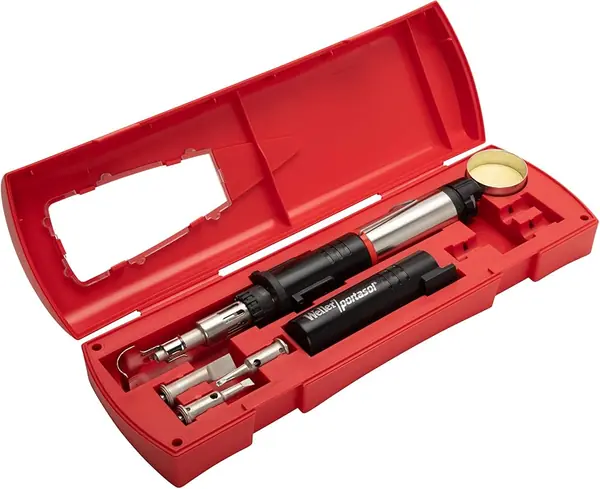
Weller PSI100K cordless butane soldering iron kit with stand and case

Daily professional use

Track Score 91/100
Runtime
Up to 2 hours
Power
125 watts
Fuel Level
Visible window
Temperature Range
Up to 1,076°F
View on Amazon

A fuel window is a small thing until you are midway through a wiring job and trying to guess whether the iron will make it to the last splice. The Weller PSI100K puts the butane level right on the body, and it backs that convenience with up to two hours of runtime, 125 watts of power, and an adjustable temperature up to 1,076°F. The kit includes the iron, a stand, a sponge, extra tips, and a plastic case.

Weller's professional background shows in the way this iron handles. It heats fast, feels balanced in the hand, and has the kind of stable output we want for repeated joints rather than one-off repairs. We also appreciate the auto-switch safety shutoff and the built-in butane filter, which are the sort of details that matter when the tool lives in a service bag. For anti-static soldering, heat shrink, and cutting rope, it has the range to stay useful beyond a single task.

Our judgment is that this is the best choice here for daily professional use. The fuel window and two-hour tank keep a bench session moving, and the case makes the whole kit easy to transport. The case itself is the least impressive part; we treat it as storage rather than protection. That is a minor trade-off on a tool that otherwise feels built for the long haul.

Our Verdict

The PSI100K is the one we trust for repeated professional soldering, with a visible fuel window, auto shutoff, and a two-hour tank that keeps a bench session moving.

Check Latest Price
4.

Master Appliance UT-100SiK Ultratorch Best Flameless Option

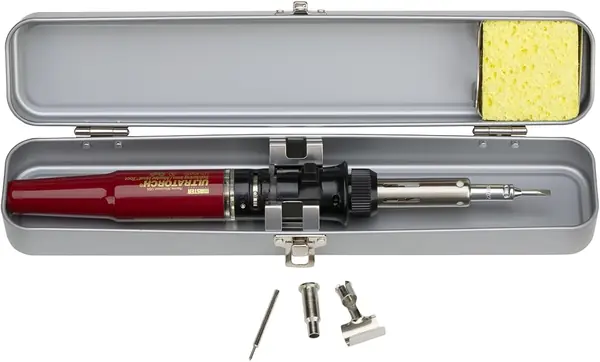
Master Appliance UT-100SiK metal butane soldering iron with storage case

Flameless heat work

Track Score 90/100
Runtime
About 2 hours
Soldering Temperature
Up to 932°F
Heat-up
About 30 seconds
Hot Air Temperature
Up to 1,202°F
View on Amazon

Flameless heat is the feature that separates this Master Appliance tool from the torch-style irons here: there is no open flame at the tip, just a hot soldering tip and a stream of hot air. The UT-100SiK is ready in about 30 seconds, reaches 932°F for soldering, and runs up to 1,202°F in hot-air mode. A full tank lasts about two hours, and the metal case gives the tool a protected home between jobs.

It is the tool for delicate work: small wire, heat-shrink tubing, and connectors in tight places where a visible flame feels like a liability. The flameless tip is the reason. It is rated as a 20-to-80-watt equivalent, and the hot-air mode handles shrink tubing without scorching the insulation. The adjustable temperature lever is easy to set with a thumb, which matters when you are moving between a joint and a piece of tubing.

The catch is the tip ecosystem. The UltraTorch tips are proprietary, so replacement cost belongs in your budget if you solder often. This is also a precision heat tool first, not a broad-flame torch for heavy brazing. For a technician who needs flameless control around wiring, those are acceptable limits; for someone who wants one tool to do everything, the LEXIVON kit is the more flexible buy.

Our Verdict

We like the UT-100SiK when the job calls for flameless precision: it heats fast, handles heat shrink cleanly, and keeps an open flame out of tight wiring.

Check Latest Price
5.

Dremel 2000 VersaTip Soldering Iron Best for Crafts and Detail Work

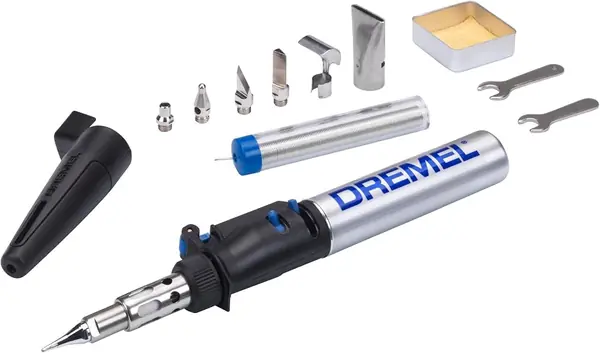
Dremel 2000 VersaTip butane soldering tool with seven interchangeable tips

Craft and detail

Track Score 89/100
Weight
3.39 oz
Ignition
Built-in piezo igniter
Tip Count
7 interchangeable tips
Temperature
Variable
View on Amazon

Seven interchangeable tips turn this Dremel into a soldering iron, a hot knife, and a pyrography tool, which is why it appeals to crafters and detail-minded slot car builders. The VersaTip has variable temperature control, a built-in piezo igniter, and a body that weighs just 3.39 ounces. It runs on butane and comes with a two-year warranty that extends by a year when you register the tool.

We like it best for small work: a fine soldering tip on a controller lead, a touch of heat to shrink tubing, or a hot-cut on a plastic body. The light weight makes it easy to control with one hand, and the seven tips give you more options than the average pencil iron. It is not the tool we reach for when a chassis needs a heavy ground wire or a full day of repeated joints.

The kit is also more creative than electrical. Only some of the seven tips are soldering shapes; the rest are for cutting, welding, and wood engraving. That is fine if you want a single butane tool for a hobby bench, but it is less focused than the LEXIVON kit for pure wiring.

Worth Noting

  • Butane fuel not included
Our Verdict

The VersaTip is our pick for craft and detail work, where seven tips and a light 3.39-ounce body matter more than raw torch power.

Check Latest Price
6.

ravs RBT600B Butane Torch Kit Best Budget Wire-Repair Kit

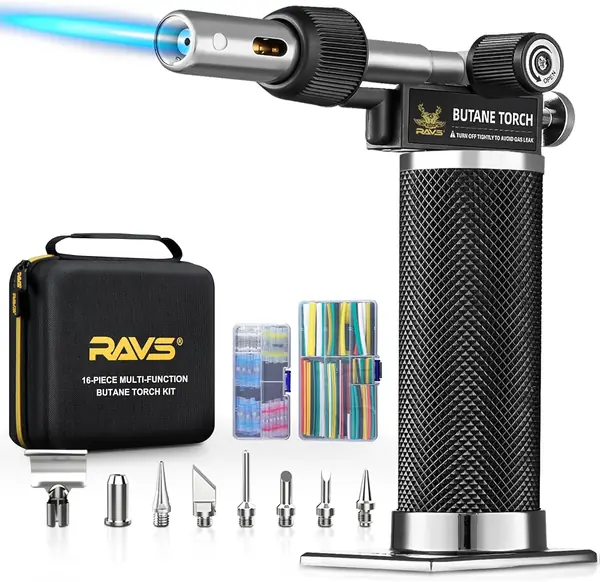
ravs RBT600B black butane torch kit with connectors and storage case

Wire repair kit

Track Score 88/100
Soldering Temperature
950°F
Torch Temperature
2,400°F
Fuel Capacity
24 ml
Wire-repair Extras
100 connectors and 140 heat-shrink pieces
View on Amazon

The box includes 100 waterproof wire connectors and 140 pieces of heat-shrink tubing, which makes this ravs kit a wire-repair station rather than just another butane torch kit. The torch side reaches 2,400°F, the soldering side reaches 950°F, and the 24 ml fuel tank refills in about 15 seconds. Eight replacement tips, a cleaning sponge, and a storage case round out the kit.

We like it for track-side electrical repairs because the accessories match the job. You can solder a lead, slide a piece of heat shrink over the joint, and then use the torch to shrink it without opening another box. The valve opens with a thumb, so one-handed operation is easy when the other hand is holding a wire. The flame adjustment is the weak spot; it can move with a light touch, so we set it before we start and check it again after a refill.

Our judgment is that this is the best budget wire-repair kit in the group. It is not as polished as the LEXIVON or as fast as the Power Probe, but it covers the soldering, heat-shrink, and connector basics for a hobbyist or a small repair bench. If you already have a good iron and just need a torch for heat shrink, the smaller Bernzomatic is easier to tuck away; if you want one box for wiring, this ravs kit earns its place. For a club toolbox, the spare tips and connectors mean fewer trips to the parts drawer.

Worth Noting

  • Butane fuel not included
Our Verdict

This ravs kit is the budget choice for a job that needs wire connectors and heat shrink as much as soldering, and the two-temperature torch covers both.

Check Latest Price
7.

Bernz-O-Matic ST2200T Micro Flame Torch Kit Best for Tight Detail Work

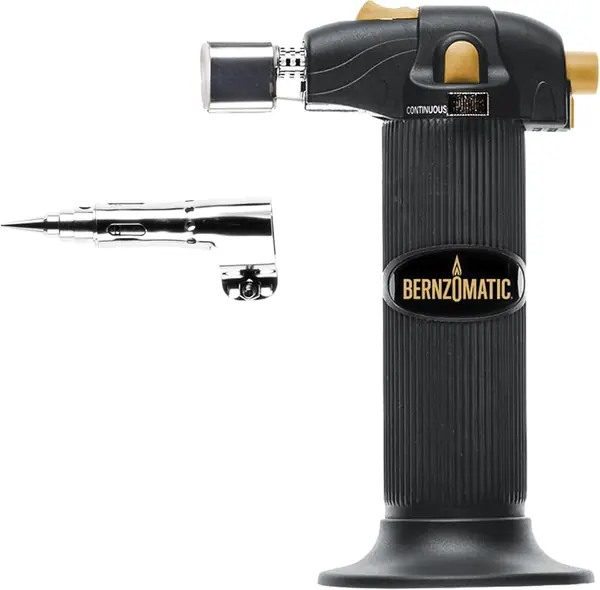
Bernz-O-Matic ST2200T black micro flame butane torch kit

Tight detail work

Track Score 87/100
Weight
8 oz
Ignition
Push-button
Torch Temperature
Up to 2,860°F
Included Tip
3-in-1 tip
View on Amazon

At 8 ounces and roughly the size of a pistol-grip lighter, this Bernzomatic is the one that disappears into a toolbox drawer. The ST2200T has a precision needle flame, a push-button igniter, and a 3-in-1 tip that covers a micro torch, a fine soldering point, and a hot blower. It reaches up to 2,860°F and runs on refillable butane.

It suits small jobs in tight spaces: a bit of heat shrink on a controller wire, a tiny joint on a track connection, or a quick repair where pulling out a full kit feels like overkill. The pistol grip is comfortable, and the needle flame is easy to aim. It is not a full-size soldering iron, though; the body is small, and the heat is better suited to detail work than to a long session of heavier wire.

The igniter gives us pause. It can take several presses to light, and it can stop engaging altogether. That is a real annoyance on a tool that is otherwise handy, especially when you are crouched over a layout and want the torch to catch on the first click. We keep a backup lighter handy for the times when it refuses to cooperate.

Our judgment is that the ST2200T is worth owning as a backup or a detail tool, not as the center of a soldering setup. The 3-in-1 tip and low weight are the reasons it stays in the drawer; the ignition risk is the reason it does not replace a full kit. The needle flame is the part that makes it useful on a crowded layout, where a wider torch would put nearby wires at risk.

Our Verdict

We treat the ST2200T as a compact detail torch, not a main soldering iron: it is handy for tight heat-shrink work and small joints, but it will not replace a full kit.

Check Latest Price

How We Chose and Tested Butane Soldering Irons

We started by rounding up every cordless butane soldering iron we could find from brands sold in the U.S., then narrowed the field to 12 models. Anything that could only throw a flame and not accept a soldering tip was out, as was anything with no stand or case and no replacement tips sold separately. We kept a spread from inexpensive wire-repair kits to workshop-grade tools so there was something to compare at every price.

Testing ran for six months and followed the work rather than a bench. We soldered 14-gauge splices into lamp cords at a workbench, repaired a trailer harness in a cold garage, shrank connectors onto a boat's wiring, and worked under a car's dash. A few of the tools also went to a craft table for jewelry repair and wood burning. We timed heat-up with a stopwatch, from the pull of the trigger until solder actually flowed.

To measure runtime, we filled each tool per its instructions and soldered continuously, counting splices until the flame sputtered, then timed a refill from empty. We clicked every igniter 20 times cold and again right after a refill, noting how many clicks it took to light and whether it needed a second try. After each session we looked for pitting on the tip and priced a replacement. We weighed each tool, set it on its stand and bumped the bench to see whether it tipped, and worked the safety lock with a gloved hand to check whether it set one-handed. Refueling happened outdoors on a metal bench, away from the water heater's pilot light, and no tool went back in its case until the tip was cool to the touch.

How to Choose a Butane Soldering Iron

Look at soldering heat, not just torch temperature

A 2,400°F flame rating can sound like more tool than you need, but it is not the number that solders a wire. The soldering tip runs much cooler: 950°F on the Power Probe, 1,100°F on the LEXIVON, and 932°F on the Master Appliance. Look for a tip temperature that suits your wire and connectors, and an adjustable flame that lets you turn it down for small joints. The torch rating matters for heat shrink and freeing stuck parts, not for the solder itself.

We prioritize a usable low end over a spectacular peak. A tool that idles too hot burns flux and insulation before the joint flows; one with a fine adjustment lets you hold the tip at the edge of the work. If you mostly solder slot car controller leads and motor tabs, a precise low flame is more valuable than a bigger torch head.

Match runtime and refills to your sessions

Runtime separates a bench tool from a field tool. The LEXIVON runs up to 75 minutes on a fill, the Power Probe and Weller run up to two hours, and the Master Appliance runs about two hours. A fuel window, like the one on the Weller, removes the guesswork. Refill speed matters too: some of these kits refill in 10 to 20 seconds, so a spare can of butane is more useful than a bigger tank you have to wait on.

For occasional slot car repairs, 75 minutes is plenty. For a technician or a club that repairs several cars in one session, the two-hour tools earn their keep. Keep a can of refined butane in your toolbox and refill before a long session rather than in the middle of a joint.

Check ignition, safety lock, and control

Self-ignition is convenient, but it is also the part most likely to test your patience. A trigger that lights on the first click is a pleasure; one that needs several presses turns a small repair into a chore. The LEXIVON uses a child lock that adds a deliberate press every time, which slows a long session but makes sense for a torch stored near track parts. The Weller adds an auto-switch safety shutoff and a visible fuel window.

We look for a lock that is easy to operate with one hand and an igniter that does not require a second tool. Test the ignition as soon as the tool arrives, and keep the receipt. If you work around curious kids or a crowded pit table, the extra step is worth it; if you solder all day, a simpler trigger may be the better trade.

Choose tips and kit contents for the work

A butane soldering iron is only as useful as its tips. The LEXIVON and Dremel each include seven tips, while the ravs kit adds eight replacement tips plus 100 connectors and 140 pieces of heat-shrink tubing. More is not automatically better: you want a fine conical tip for small wire, a chisel tip for heavier joints, and a source for replacements. The Master Appliance uses proprietary UltraTorch tips that cost more, which is a real ownership expense.

We prefer a kit with a case because loose tips and hot accessories get lost. A case also gives you a place to put the tool while it cools. Check that replacement tips are available before you buy; a bargain iron with no tip supply is a short-lived bargain.

Think about size and where the tool will live

A pencil-style iron is easier to hold like a pen; a pistol grip is easier to aim at a stubborn fitting. The Dremel weighs 3.39 ounces, the Bernzomatic 8 ounces, the Power Probe 12.7 ounces, and the LEXIVON about a pound. If the tool lives in a drawer, light and compact wins. If it lives on a bench, a stand and a case matter more than an ounce or two.

For slot car work, think about the tightest place you will solder: a controller circuit board, a motor tab, or a track connection under a table. A small tip and a body that fits between the rails are worth more than a big flame. If you also need heat shrink, a kit with a hot-air or heat-shrink attachment saves you from buying a second tool.

Frequently Asked Questions

Final Verdict

We recommend the LEXIVON LX-770 for most buyers. It has the broadest kit here, enough soldering heat for controller leads and motor tabs, and a torch mode for heat shrink, all at a midrange price. If you solder every day, the Power Probe PPSK is the upgrade for its two-hour runtime; if you need flameless precision around delicate wiring, the Master Appliance UT-100SiK is the specialist. The Dremel is the lighter choice for craft work.