Best Fume Extractors for Soldering of 2026

Rosin smoke from a fresh joint never goes where you want. It curls up, then settles around your face, and that is usually when people start shopping for a fume extractor. These units pull smoke in at the source instead of waiting for the room to clear, and a small one on the bench beats an open window and a fan pointed the wrong way.

The category covers a lot of ground, from carbon-only boxes you park a few inches from the joint to three-stage HEPA and carbon units with a hose that bends over a bigger bench. We ran a dozen on cramped benches and crowded shop tables, watching how much suction reached the joint and how long we could stand the fan. Carbon cuts odor and some vapors but doesn't catch everything, so keep the intake close, ventilate the room and replace saturated filters.

Our Top Picks

The Best Fume Extractors for Soldering

1.

KOTTO Solder Smoke Absorber Best Overall
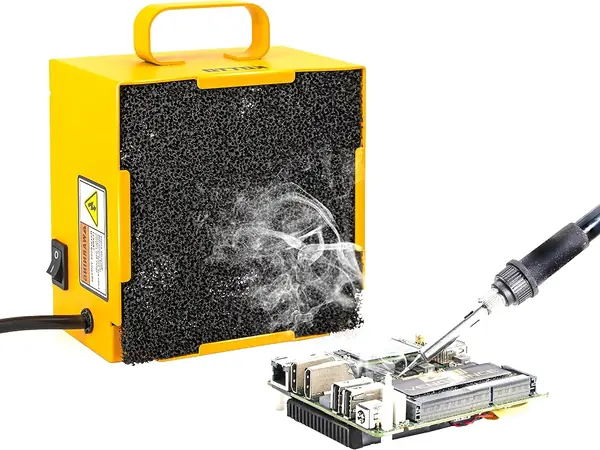
KOTTO yellow solder smoke absorber with metal body and carbon filter

Small soldering benches

Track Score 94/100
Footprint
5 x 3 x 5 inches
Fan Speed
3000 RPM
Filter Type
0.4-inch activated carbon
Capture Distance
5-6 inches
View on Amazon

The KOTTO is a small all-metal box with a carbon pad, and after using it at the bench we think that simplicity is exactly what makes it the best default here. It measures 5 by 3 by 5 inches, weighs 2.2 pounds, and has a 3000 RPM fan that pulls smoke from about 5 to 6 inches away. We kept it close to the joint, where it belongs, and it cleared the visible plume without crowding the iron.

The 0.4-inch activated carbon filter is the part that does the odor work, and KOTTO includes a spare. Swapping it is straightforward, which matters because a saturated carbon pad stops helping. The all-metal case and rubber feet give it a planted feel that we appreciated on a smooth bench; it does not skate when you nudge the cord. The fan is audible, but it is not the loudest unit in this group.

This is a near-field extractor, not a room air purifier. Set it six to eight inches from the solder joint and it earns its place; push it to the far side of a large board and you will want a hose model instead. For light electronics, jewelry, and stained-glass work, that trade is easy to make. It is also one of the least expensive picks here, which puts it first for most hobbyists.

Worth Noting

  • Carbon-only filtration, no HEPA stage
Our Verdict

For most hobbyists, the KOTTO is our top pick: it pulls flux smoke away at close range, stays put in an all-metal body, and costs less than the premium units.

Check Latest Price
2.

FUMECLEAR FC-2001S Fume Extractor Best Multi-Stage Filtration

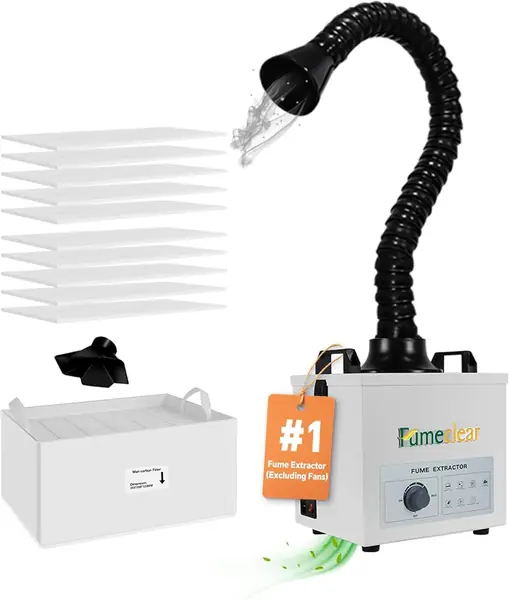
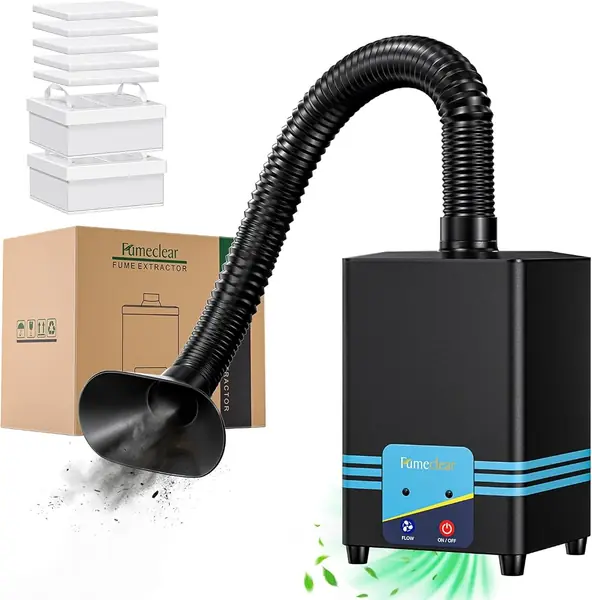
FUMECLEAR FC-2001S black portable fume extractor with hose and filter housing

Multi-stage bench filtration

Track Score 88/100
Filtration
3-stage HEPA + carbon
Airflow
76-99 CFM
Hose
Extendable
Noise Level
55 dB
View on Amazon

A hose is the feature that changes the geometry of a soldering bench: instead of parking a box next to the iron, the FC-2001S lets you drop the hood where the smoke actually rises. The unit is 5 by 5 by 8 inches and weighs 3.52 pounds, so it sits at the back of the bench while the extendable hose reaches in. It has three speeds, a 55 dB sound rating, and a universal 100-240V power supply.

The three-stage filter stack — pre-filter, HEPA, and high-iodine carbon — is what makes this our pick for the best multi-stage filtration here. The 76-99 CFM airflow is enough to pull a visible plume when the hood is within a few inches, and the low setting is the one we used for light work. We also like that FumeClear includes a lifetime warranty, though the hose needs to be aimed deliberately rather than left across the bench. It is the step-up choice for anyone who wants HEPA and carbon without moving to a heavy shop unit.

Our Verdict

When you want HEPA-level filtration and a hose that reaches the joint without taking over the bench, the FC-2001S is our step-up pick.

Check Latest Price
3.

Hakko FA400-04 Smoke Absorber Best Low-Profile Option

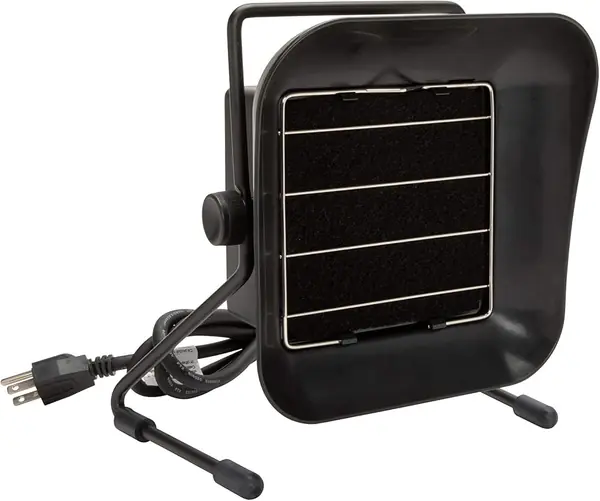
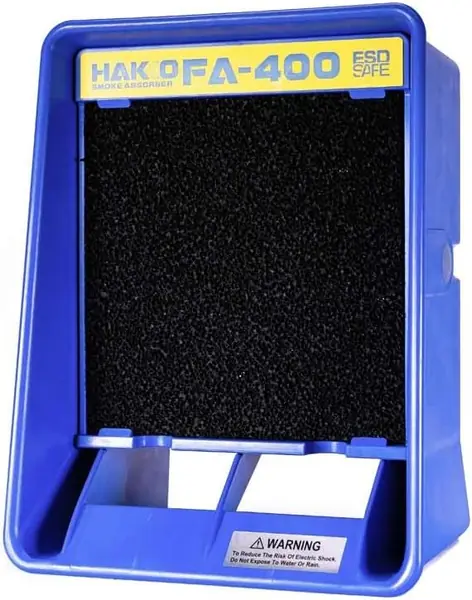
Hakko FA400-04 bench-top smoke absorber with dark plastic housing and filter grille

Low-profile workbenches

Track Score 87/100
Weight
3 lb
Filter Type
Activated carbon (A1001)
Positions
Upright or flat
Low-profile Airflow
2.6x
View on Amazon

Lay the Hakko FA400-04 on its back and it stops looking like a box fan and starts acting like a low-profile fume hood. That trick is why we recommend it for shallow benches: in the flat position, Hakko says airflow increases by about 2.6 times, and the unit slides under a shelf or monitor instead of standing in front of your work. It is the low-profile pick we reach for when vertical space is tighter than horizontal space.

Standing upright, it is a conventional 19-watt carbon absorber with a 10.1 by 9 by 6.7 inch footprint and a 3-pound body. The standard A1001 activated carbon filter handles odors, and an optional high-efficiency filter is rated to remove up to 90 percent of airborne particles. Replacing the filter is a simple access job, which we appreciate because carbon needs to be changed before it stops adsorbing.

It works best close in. Give it a foot or less and it pulls solder smoke away from your face; for a large board, a hose model is more direct. The flat position is the design detail we keep coming back to, because it lets the extractor share space with the work instead of competing for it. The standard filter is easy to replace, and the optional high-efficiency filter gives you a path to better particle capture.

Worth Noting

  • Audible fan at the bench
  • No stated warranty coverage
Our Verdict

Lay the FA400-04 flat under a shelf and it clears close-in solder smoke without blocking your view; that is why it is our low-profile pick.

Check Latest Price
4.

Weller WSA350 Smoke Absorber Best ESD-Safe Option

Weller WSA350 black bench-top smoke absorber with carbon filter and stable base

ESD-sensitive electronics

Track Score 86/100
Filtration
Carbon-activated
Footprint
11.3 x 10.2 x 7.1 inches
Voltage
120V
ESD Safety
ESD safe
View on Amazon

The WSA350 is the pick that puts ESD safety first. Weller builds the housing to be ESD safe, which matters if you work on bare boards and want one less static worry at the bench. It is a 120V, 20-watt unit with a replaceable carbon-activated filter, and it includes one spare filter in the box. The 2-pound body sits solidly, and the simple on/off operation is easy to live with.

We recommend it for electronics benches where ESD protection is a priority and you can keep the intake close to the joint. The 20-watt fan moves enough air to pull flux smoke when it is within a few inches; it is not a room-wide extractor, and the suction falls off if you push it to the back of a large board. We like that the filter is easy to change and that Weller includes a spare. For a bench that handles static-sensitive parts, that combination is worth the larger footprint.

Worth Noting

  • Audible fan at the bench
  • Carbon-only filtration
Our Verdict

We put the WSA350 on electronics benches where ESD safety matters more than quiet operation or a tiny footprint.

Check Latest Price
5.

M-T DP-308 Fume Extractor Best Budget Hose Extractor

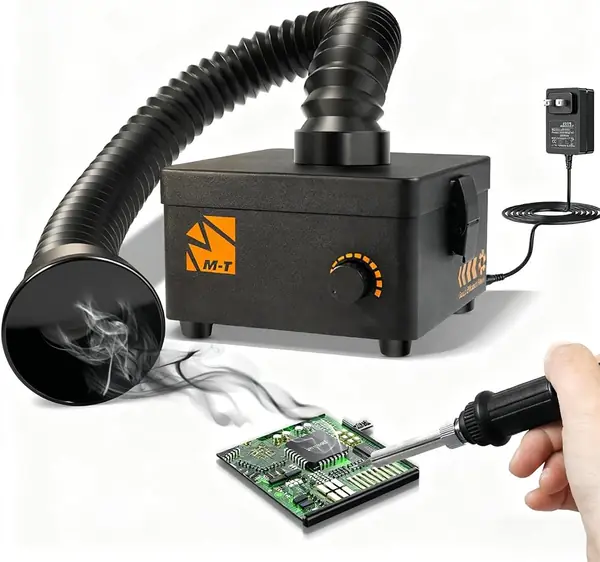
M-T DP-308 black metal fume extractor with flexible hose and filter housing

Budget hose extraction

Track Score 85/100
Filtration
H13 HEPA + carbon
Airflow
168 m³/h
Warranty
3 years
Hose Reach
7-25 inches
View on Amazon

The DP-308 looks like a budget hose extractor until you read the filter stack: a metal shell, a 7-to-25-inch hose, three speeds, and a triple-layer H13 HEPA and carbon filter. It is 3.72 pounds, has an 80-watt motor rated at 168 cubic meters per hour, and comes with a three-year warranty. That is a lot of specification for the money.

Set the hood within a few inches of the solder joint and it pulls the plume into the filter rather than just stirring the air. The three speeds let you drop to a lower setting for light work, and the flexible hose holds a position once you bend it. The metal body feels more substantial than the price suggests, and the 5-foot cord gives you some room to place the unit.

We recommend the DP-308 when you want HEPA and carbon filtration on a hose without paying the premium for a larger shop unit. It is the best budget hose extractor in this group, and the three-year warranty is generous at this price. The metal body and flexible hose make it feel more expensive than it is, and the three speeds cover light and heavier sessions. It is the value pick for a bench that can keep the hood near the joint.

Our Verdict

For HEPA and carbon filtration on a hose without premium pricing, the DP-308 is our budget pick, provided you keep the hood close.

Check Latest Price
6.

SainSmart Magnetic Fume Extractor Best for Tight Benches

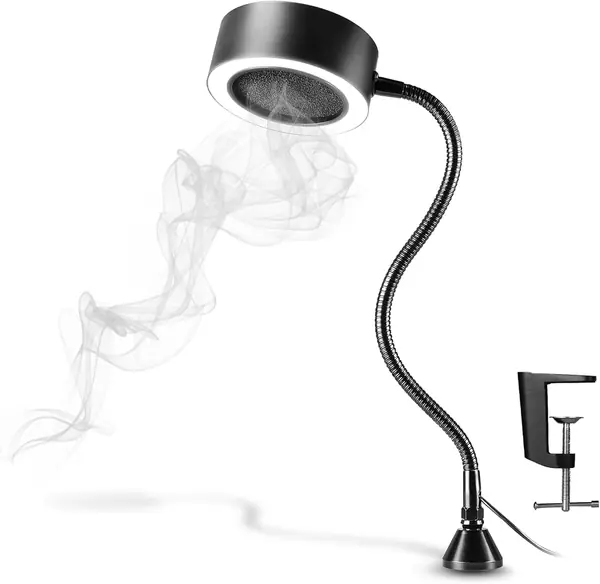
SainSmart portable fume extractor with magnetic base and flexible gooseneck

Tight metal benches

Track Score 84/100
Fan Speed
3700 RPM
Capture Distance
Up to 10 inches
Lighting
3-color LED
Mounting
Magnetic base + clamp
View on Amazon

The SainSmart is not a box you park on the bench; it is a fan on a stainless-steel gooseneck with a magnetic cone base and an extra table clamp. The base sticks to a metal shelf or fixture, the clamp handles a wooden bench, and the 10-inch arm lets you put the intake beside the joint instead of above it. A three-color LED ring around the fan adds light exactly where you are looking.

The 3700 RPM fan moves enough air for light soldering, glue fumes, and craft work, and the gooseneck holds its shape well enough to stay aimed. The carbon filter cotton is a simple pad rather than a multi-stage cartridge, so this is not the unit for heavy flux or continuous production. We like the magnetic mount more than we expected: it gets the extractor off the work surface and out of the shadow of your hand.

We recommend the SainSmart for a crowded bench where mounting and light matter more than raw suction. It is the best pick here for tight spaces, and the built-in lamp is a real convenience for detail work. The limitation is capacity: for a large board or all-day soldering, a hose extractor like the FUMECLEAR FC-2001S does more. For jewelry, small PCBs, and model work, the arm and light earn their keep.

Worth Noting

  • Carbon filter cotton only
Our Verdict

A magnetic arm and a built-in light make the SainSmart our pick for crowded benches where raw suction is not the whole job.

Check Latest Price
7.

FUMECLEAR FC-100A Fume Extractor Best for High-Volume Use

FUMECLEAR FC-100A benchtop fume extractor with hose and filter housing

High-volume shop benches

Track Score 83/100
Filtration
3-stage H13
Airflow
118-152 CFM
Weight
19.5 lb
Power
100W
View on Amazon

The FC-100A is the heavy unit in this group: 19.5 pounds, a 10.6 by 8.7 by 10.8 inch metal body, and a 100-watt motor rated at 118-152 CFM. It ships with 12 H13 filters and a three-layer filtration stack. This is not a unit you tuck into a drawer; it is a piece of bench equipment that stays put.

The extra airflow is the point. Where the compact carbon boxes need to sit within a few inches of the joint, the FC-100A gives you more reach and more reserve for a busy bench. The filter stack is aimed at both particles and odors, and the large filter capacity means fewer changes if you solder often. The high setting is the one that feels purpose-built for sustained work.

We see it as the pick for a shop or a dedicated soldering station that runs for hours, not for a hobbyist who pulls out an iron once a month. It takes up more bench space, and moving it between rooms is a chore. If your work is mostly small PCBs and jewelry, the compact KOTTO or the FUMECLEAR FC-2001S is easier to live with.

We recommend the FC-100A when filtration capacity and airflow matter more than portability. It is the best high-volume option here, and the included filter pack softens the cost of ownership. For a bench that solders daily, that trade makes sense; for occasional light work, it is more extractor than you need.

Worth Noting

  • Heavy 19.5-pound body
  • Noisy on high setting
Our Verdict

For a busy soldering bench that needs serious airflow and filter capacity, the FC-100A is our high-volume pick; compact hobby stations need less.

Check Latest Price
8.

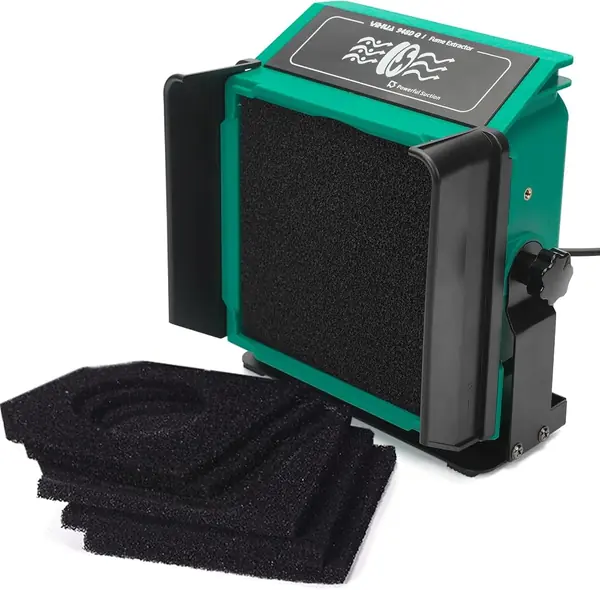
YIHUA 948DQ-I Fume Extractor Best for Light Craft Soldering

YIHUA 948DQ-I compact fume extractor with tiltable stand and side fenders

Light craft soldering

Track Score 82/100
Filtration
Dual carbon adsorbers
Footprint
3.54 x 5.71 x 6.46 inches
Power
5W
Tilt
30°
View on Amazon

The YIHUA 948DQ-I is the smallest unit here, and it is built for the kind of soldering that happens under a magnifier. The body is 3.54 by 5.71 by 6.46 inches, it weighs 2.35 pounds, and the stand tilts through 30 degrees so the intake can face the joint instead of the ceiling. It also comes with side fenders to keep stray air from pushing the plume away.

The filter system uses adsorbers front and rear, and YIHUA includes eight of them. The five-blade fan is rated at 5 watts, and the front and rear adsorbers handle light flux smoke. Set it close, and it pulls smoke away from your face; expect it to struggle with a large board or a heavy flux load.

We like the tilt and the fenders for jewelry, stained glass, and small PCB work. The compact footprint leaves room for a helping hand or a parts tray, and the included filter pack means you are not ordering replacements immediately. The fan is not silent, but it is not the loudest unit here.

We recommend the YIHUA for light, close-in craft soldering where space is tight and you want the head to tilt toward the work. It is the best compact option here for that narrow job. For a larger board or a hose, the FUMECLEAR FC-2001S is the better tool.

Worth Noting

  • 5-watt fan limits it to close work
  • Carbon-only filtration
Our Verdict

For light, close-in craft soldering, the YIHUA's compact body and tiltable head earn it a place, though its 5-watt fan has limits.

Check Latest Price

How We Tested the Fume Extractors

We built the shortlist from spec sheets, not reviews: carbon-only versus multi-stage HEPA and carbon, rated airflow, voltage, whether spare filters ship in the box, and what replacements cost. From that pool we bought 12 units and lived with them for eight months on a basement bench, a garage shop table, a kitchen table where a vintage receiver got recapped, and a 3D printer corner.

Capture was the first thing we judged, because everything else is secondary if smoke still reaches your face. We soldered rosin-core and lead-free at three, five, eight, and ten inches from the intake and watched which way the wisp bent; some pulled smoke from a foot out, others only grabbed it once the iron was nearly on the grille. Three-hour sessions followed, and we logged what the room smelled like afterward — odor is the honest test of whether carbon is still working.

Noise got measured twice: a decibel reading at ear height and a plainer check of whether we could hold a conversation or keep a podcast going. We measured how much bench each unit ate, then clamped, magnet-mounted, or tilted it as the design allows and reached the far corner of the board. We bumped benches mid-session to see what tipped or walked, read every voltage label before plugging in, tracked how often filters loaded up, and priced replacement sets against the unit itself.

Units that survived all that got used alongside static-sensitive boards so we could note which were rated ESD safe, and we compared housing flex and switch feel among the ones that performed alike.

How to Choose a Soldering Fume Extractor

Filtration: Carbon, HEPA, or Both

Carbon is the baseline for solder flux: it adsorbs odors and some vapors, and a thick activated-carbon pad is enough for light, close-in work. HEPA adds particle capture, which is why we step up to a multi-stage unit for heavier flux, larger boards, or a bench that runs for hours. The KOTTO's carbon pad is a good match for occasional hobby work; the FUMECLEAR FC-2001S is the better choice when you want HEPA and carbon in one compact hose unit. Check that replacement filters are available before you buy.

Suction and Capture Distance

Airflow numbers are useful, but placement decides whether the smoke reaches the filter. A small benchtop unit like the KOTTO needs to sit about 5 to 6 inches from the joint; a hose model lets you put the hood closer to a large board without moving the whole unit. We pay more attention to the working distance than to the biggest CFM claim, because a powerful fan pointed at the wrong spot still leaves you breathing the plume. Set the intake beside the joint, not across the bench.

Noise and Bench Workflow

Fan noise is the trade-off most buyers underestimate. A compact carbon box is audible; a high-capacity unit can be louder still on its top setting, and a quiet rating on low speed does not tell you what high speed will do. If you solder beside someone else, look for three speeds so you can drop down for light work. We also consider the cord and switch: a simple on/off is fine, but a speed control and a hose that stays put make a long session easier. Noise is a comfort issue, not a filtration one.

Footprint, Mounting, and Filter Changes

Measure the bench before you choose a form factor. A box like the Weller WSA350 is stable but broad; the Hakko FA400-04 lies flat under a shelf; the SainSmart clamps or magnets to a metal surface and reaches in on a gooseneck. Hose units sit at the back and aim forward. Then look at the filter: carbon pads are simple and affordable, while multi-stage cartridges cost more and may be proprietary. A unit that includes spare filters, like the YIHUA or the FC-100A, is easier to live with from day one.

Frequently Asked Questions

Final Verdict

For most home soldering benches, we recommend the KOTTO: it is compact, all-metal, and pulls flux smoke away within a few inches for less money than the premium units. If you solder larger boards or want HEPA and carbon filtration, the FUMECLEAR FC-2001S is the step up; its hose and three-stage filter are worth it. The Hakko FA400-04 is the low-profile alternative when vertical space is tight.