Best FPV Drones with Goggles of 2026

The first time FPV goggles go live, the field tips sideways and your stomach follows. That's the fun of it, and also how a jittery first flight ends with a cracked frame. A kit you'll fly every week has the goggles, controller, batteries and charger in the box, and a drone calm enough to learn on.

Two spec-sheet numbers mislead. The listed weight usually belongs to the smallest battery in the box, and that weight decides your registration class. Claimed flight time is the other: a half hour rarely survives wind, cold and a nervous thumb. Of the eight kits we flew over nine months, these three suit very different flying, from a nervous first session to fast acrobatic lines and slow camera passes.

Our Top Picks

The Best FPV Drones with Goggles

1.

DJI Neo 2 Motion Fly More Combo Best Overall
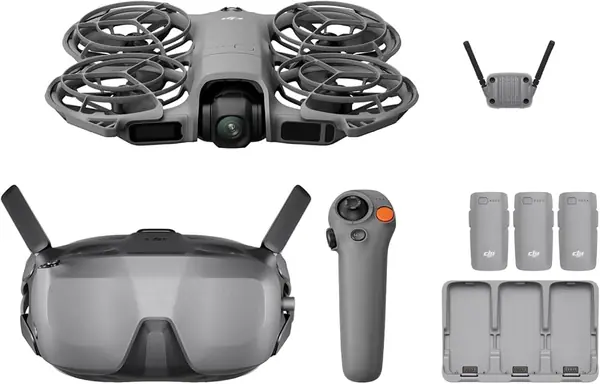
DJI Neo 2 drone with gray propeller guards beside Goggles N3 and RC Motion 3

First-time FPV pilots

Track Score 92/100
Weight
151 g (C0 certified)
Video Resolution
4K
Max Range
10 km
Obstacle Sensing
Omnidirectional
View on Amazon

At 151 grams and C0 certified, the Neo 2 is the kit here that survives a beginner's first week. The propeller guards wrap the entire airframe, so clipping a doorframe is a scuff rather than a repair, and omnidirectional obstacle sensing backs that up before the scuff happens. Palm takeoff and landing mean you launch from your hand instead of hunting for a flat, clear patch of ground, which is the kind of small convenience that decides whether you actually fly or just think about it.

Through the Goggles N3 the view is sharp 4K, and the RC Motion 3 shortens the lesson dramatically: point your hand where you want to go and the drone handles the rest, no throttle stick to learn before your first flight. We kept coming back to the motion controller because it makes that first flight feel like flying rather than operating.

The camera is the reason to bother beyond the novelty. Footage comes out stable and clean enough to use straight off the drone, and the 10 km transmission link is far more than you will ever need — what matters is that the picture stays solid at the distances you actually fly, low to the ground and a hedge line away.

Three batteries and a two-way charging hub come in the box, so a session is a matter of rotating packs and topping all three from one cable between stops. And at 151 grams the whole thing disappears into a jacket pocket, which is why it comes along on days we never planned to fly.

Worth Noting

  • Fixed 49GB onboard storage with no card slot
  • Short flights even with three batteries
Our Verdict

We recommend the Neo 2 combo to anyone buying a first FPV kit: the goggles and motion controller come with it, and the guards make learning cheap.

Check Latest Price
2.

DJI Avata 2 Fly More Combo Best for Immersive Flight

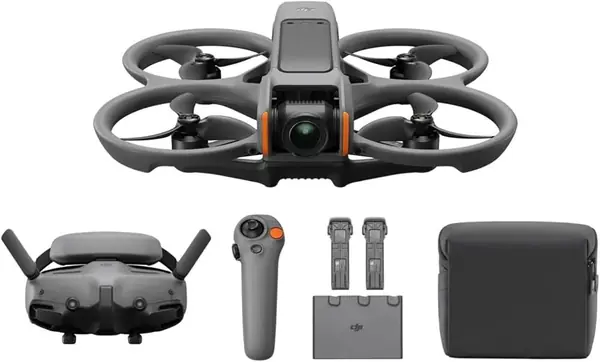
DJI Avata 2 FPV drone in black with built-in propeller guards and Goggles 3

Acrobatic FPV flight

Track Score 91/100
Weight
13.3 oz
Video Resolution
4K/60fps
Flight Time
Up to 23 minutes
Field Of View
155°
View on Amazon

The 155-degree field of view is the number that separates this drone from the rest of the page. A camera drone frames the scene ahead of you; the Avata 2 puts the edges of the world at the edge of your vision, and that width is what turns a pair of goggles into a cockpit.

That is the trade we happily make, because this is the one we reach for when the point of the flight is the flight. The 1/1.3-inch sensor shoots 4K at 60 fps, so low, fast passes still come out clean, and the one-button flips, rolls, and 180-degree drifts put maneuvers within reach on the first battery that would otherwise take weeks of manual-mode practice.

At 13.3 ounces it is not a pocket drone, and there is no obstacle avoidance to lean on — the molded-in propeller guards and your own eyesight do that work, which is exactly why the guards are part of the airframe rather than a clip-on accessory. The listed 23 minutes per battery means three packs cover a proper afternoon, and the included hub recharges them together.

Small inclusions earn their keep too: a spare forehead pad and a pair of -2.0D corrective lenses for the Goggles 3, the sort of thing you notice only if you need it and then cannot do without. With the sling bag, the whole kit carries like a camera bag rather than a toolbox.

Worth Noting

  • No memory card included
Our Verdict

Our pick for anyone who wants the rush of real FPV flight: goggles, three batteries, and one-button tricks that make the first weekend thrilling.

Check Latest Price
3.

Antigravity A1 Pro 8K 360

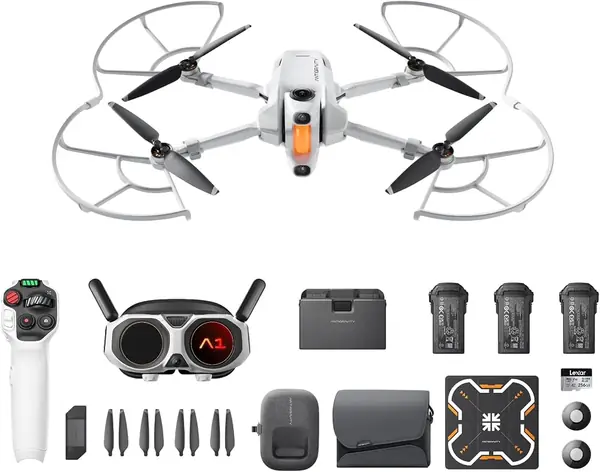
Antigravity A1 360 drone in white with FPV goggles, controller, and carrying case

360-degree video capture

Track Score 88/100
Weight
249 g with standard battery
Video Resolution
8K 360
Flight Time
Up to 39 minutes
Goggle Field Of View
90°
View on Amazon

Most FPV flights are a series of decisions made too fast: aim here, turn now, hope the shot landed. The A1 Pro records a full 360-degree sphere in 8K and lets you choose the camera angle afterward, which turns that scramble into something you do calmly, at a desk, with the footage already safely captured.

The goggles are what sell the idea. Dual 1-inch Micro-OLED panels with a 90-degree field of view give a bright, immediate picture, and we were struck by how much sky you take in without moving your head.

Read the weight and flight-time claims together, because they belong to different batteries. The 249-gram, registration-friendly figure comes with the standard pack; the 39-minute flights come from the high-capacity cells, and the three of those in this bundle tell you which version the maker expects you to fly. FreeMotion's point-to-fly control is the gentlest introduction here after the Neo 2's motion controller, and omnidirectional obstacle avoidance gives a beginner a real margin for error.

What ships in the box is unusually complete — propeller guards, a 256GB card, a charging hub, a case, and a lens kit — so there is very little shopping left after checkout. Antigravity is a newer name than DJI, and Antigravity's local US repair centers matter more coming from a brand you have not owned before.

Worth Noting

  • Premium price for a newer brand
Our Verdict

For creators who want every angle from a single flight, we think the 8K 360 capture and OLED goggles justify this kit's premium.

Check Latest Price

How We Tested These FPV Kits

We started with kits that arrive complete — goggles, a controller, batteries, a charger, and a memory card in one box — and set aside anything that needed a second purchase before the first flight. From that group we flew eight drones over nine months, chosen to cover a spread of weights, control styles, and price tiers.

Most of our flying happened in an open field at a county park, early enough that the dog walkers hadn't arrived, with a second person spotting while the pilot watched the feed. Before each first flight we checked the drone's registration class against the weight with the battery actually installed, then weighed every pack that shipped in the kit. We flew each battery until the drone brought itself down and wrote down the real number, and we ran the same out-and-back line over an empty field until the video began to stutter — a better read on usable range than any spec sheet.

We handed the controls to people who had never flown FPV and counted how many attempts it took to hold a stable hover and complete a lap, using motion control and point-to-fly where a kit offered them. Each tester wore the goggles for a full battery; one of us wears glasses and tried every headset over them, noting field of view, display sharpness, and where the frame pressed. Propeller guards and obstacle sensing got checked after low-speed tumbles in grass, and we looked up what replacement props and guards cost, because that is the real price of learning.

We also filled the included memory card to see how many minutes of footage fit before we had to offload, and tallied what each box contained against what a new pilot would otherwise buy piece by piece.

How to Choose an FPV Drone With Goggles

Check What the Box Actually Contains

Ready-to-fly means different things at different prices. Every kit here includes goggles, a controller, and at least one battery, but the details decide the first month: three batteries and a charging hub turn a short outing into an afternoon, and a motion controller is a far gentler first teacher than a pair of sticks.

Watch the variant name as well. The Neo 2 is sold as a bare drone and as this combo, and the bare version has no goggles in it at all — the same model number can describe two very different purchases.

Weigh It Before You Register It

Under 250 grams is the line that decides whether a drone needs registration in a lot of places, and manufacturers know it. The Neo 2 sits at 151 grams with C0 certification, comfortably inside; larger FPV drones land above the line and come with the paperwork that follows.

The trap is that the headline weight often belongs to the smallest battery fitted. A kit advertised as sub-250 grams may cross the threshold with the pack that gives the long flight time, so compare the number to the battery you plan to fly, then check your own local rules for that figure.

What You Will See Through the Goggles

Camera specs and goggle specs are different things, and the second one is what you feel. The Avata 2's camera takes in 155 degrees, while the A1 Pro's goggles present a 90-degree view; both make the edges of the world slide past you instead of sitting inside a frame.

We weight the goggle view heavily, because a sharp camera behind a dim screen is a chore to fly. Resolution is for the footage you keep; field of view and display quality are for the flight you are having.

Learn on the Controller You Get

Motion control — point your hand, the drone follows — is the fastest route from box to first flight, and it is what the Neo 2 and Avata 2 bundles ship with. Full manual mode, the stick flying that FPV hobbyists chase, is a separate skill that takes weeks of practice and usually a second controller.

Beginner-friendly and thrilling are not opposites. The Avata 2 will flip and roll on a button long before you can do the same on sticks, which is the right order to learn in: get comfortable in the goggles first, then chase the acrobatics.

Plan for Short Flights

FPV drones trade flight time for agility and weight, and none of these fly as long as a camera drone. The listed 23 minutes on the Avata 2 and 39 on the A1 Pro are the figures to plan around, and that gap is the difference between a quick session and a long one.

One big battery is less useful than several ordinary ones: you land, swap, and keep flying while the hub works through the rest.

Frequently Asked Questions

Final Verdict

We recommend the Neo 2 Motion Fly More Combo to anyone buying a first FPV kit: goggles, motion controller, and three batteries in one box, a 151-gram body that survives the learning curve, and 4K footage that looks like more than the money.

If what you want is speed and acrobatics rather than a floating camera, step up to the Avata 2. Its wider view and one-button tricks make it the more thrilling fly, and the molded-in guards take the hits a beginner hands it.