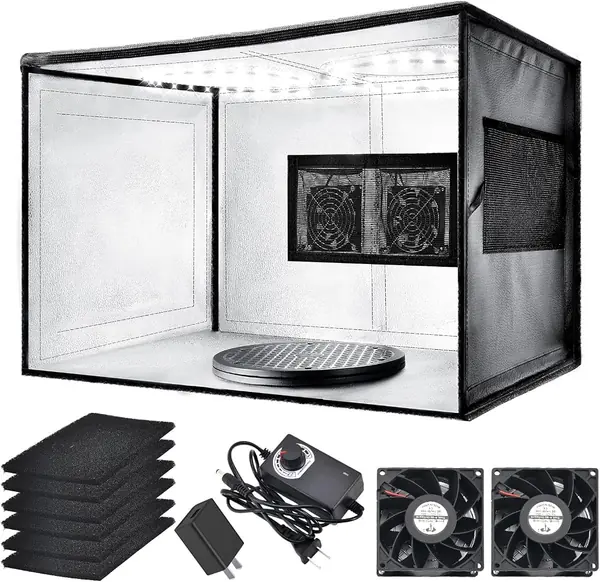
Best Spray Booths of 2026

Overspray is patient. It settles on the garage floor, the car you meant to move and the basement window you forgot was open, all while you're focused on the piece. A powered booth pulls that cloud through a filter and out a window through a hose; a pop-up shelter contains it and gives wet work somewhere to sit. A box fan in a window does neither job well.

The number that matters most never makes the spec sheet: whether the exhaust hose reaches your window without a hard kink, since a strong fan behind a folded hose blows paint back at you. We weighed airflow, work area, hose reach, noise, lighting and setup time on 12 booths and shelters over seven months of real spraying.

Our Top Picks

The Best Spray Booths

1.

Master Airbrush Dual-Fan Spray Booth Kit Best Overall
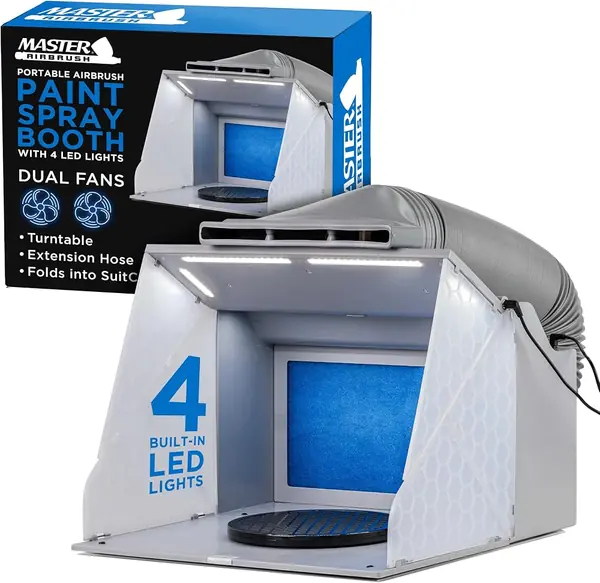
Master Airbrush portable spray booth in gray with dual fans and four LED lights

Beginner airbrush setups

Track Score 92/100
Weight
11.3 lb
Work Area
16 x 18 x 13 in
Exhaust Hose
16 in to 6 ft
Airflow
5.2 cubic meters per minute
View on Amazon

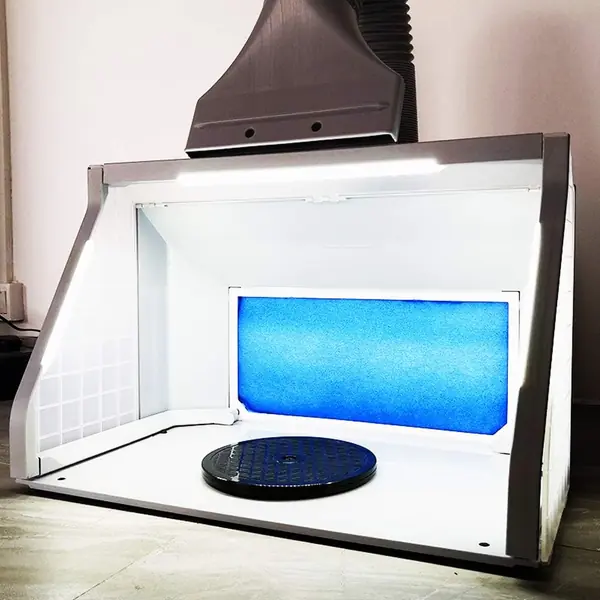
A first booth is really a shopping list: two fans, four lights, something that turns the work, and a hose long enough to reach a window. This Master Airbrush kit arrives with all of it, which is why it is our top pick. No single part is the biggest or the quietest on this page, but the package works the moment you unfold it, and that counts for more than any one number.

The work area is 16 by 18 by 13 inches, so a 1/24 slot car body or a typical model kit sits inside with room to spin on the 7.5-inch turntable. Two exhaust fans move a stated 5.2 cubic meters per minute through a high-density fiberglass filter, and the hose stretches from 16 inches out to 6 feet, with a narrow end shaped to slip into a window or door gap. That gap is what actually gets fumes out of the room, and four LEDs ring the opening for the detail work.

At 11.3 pounds it breaks down flat and takes a shelf or the back of a closet between sessions. The filter is the one consumable to plan for: it loads up with pigment and slowly chokes the airflow, so line up replacements from the start instead of waiting for the mist to stop clearing.

If your projects outgrow a shoebox, the VEVOR below offers a wider bench for about the same money. If space is the real constraint, the compact VEVOR folds to briefcase size. For most people painting bodies and models, this is the box to buy.

Worth Noting

  • Fan noise carries through a quiet room
  • Lights and fan share a single switch
Our Verdict

Start here if you want one purchase to cover the whole setup: two fans, four LEDs, a turntable and a six-foot hose, and it is the booth we hand to first-timers.

Check Latest Price
2.

VEVOR Dual-Fan Airbrush Spray Booth (21.5 in) Best for Big Kits

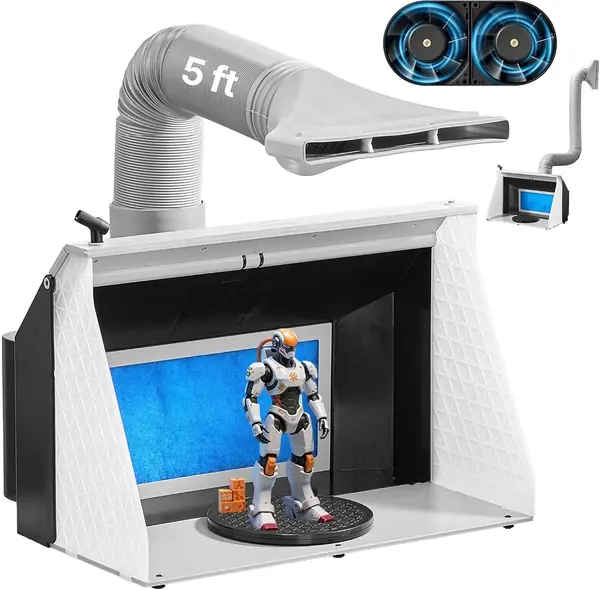
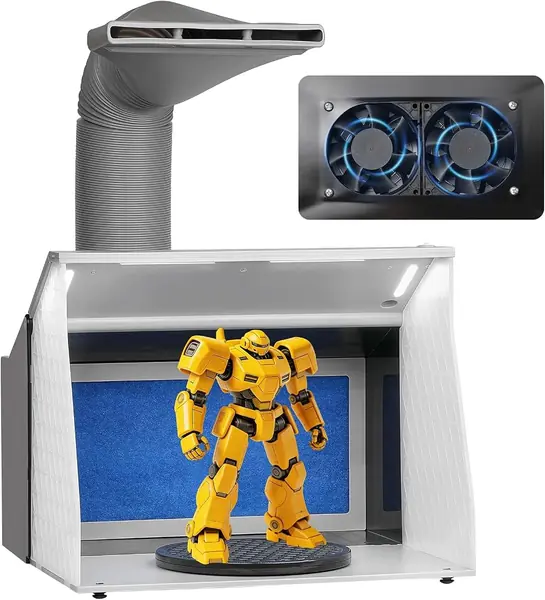
VEVOR grey airbrush spray booth with dual exhaust fans and three LED lights

Large model kits

Track Score 91/100
Weight
13.8 lb
Work Area
21.5 x 18.7 x 14.6 in
Exhaust Hose
5 ft
Airflow
9.2 m³/min
View on Amazon

The work area here is 21.5 by 18.7 by 14.6 inches, the roomiest of the powered booths in this group, and the fan rating is 9.2 cubic meters per minute, nearly double our top pick's figure. Airflow numbers are not measured to a shared standard, so treat both as rough guides, but pairing a bigger box with more fan is the right direction.

We pick it for anything past shoebox size: a 1/8-scale body, a pair of shoes, an RC shell, a helmet. Three LEDs run along the top rather than around the rim, and we like that arrangement on tall pieces because the light lands on the work instead of glancing off its side.

It folds into a case that carries like a small suitcase, so the extra bulk buys bench space rather than taking up the bench. The filter cotton is on the thick side and a spare comes in the box. Noise is the familiar story with these fans: audible while it runs, unremarkable with headphones on.

Worth Noting

  • Five-foot hose is the shortest duct here
  • Heaviest powered booth at 13.8 pounds
Our Verdict

Our pick when kits run large: the roomiest work area of the powered booths here, and the highest airflow figure any of them claims.

Check Latest Price
3.

VEVOR Compact Airbrush Spray Booth Best Budget Powered Booth

VEVOR blue folding airbrush spray booth with four LED lights and turntable

Small workbenches

Track Score 90/100
Weight
10.9 lb
Exhaust Hose
6 ft
Airflow
5.2 m³/min
Dimensions
15.94 x 17.05 x 12.99 in
View on Amazon

This is one of the two least expensive powered booths here, and it is not a stripped one: dual fans rated at 5.2 cubic meters per minute, four LEDs, a six-foot hose and a detachable turntable. Folded it measures 15.94 by 8.66 by 10.63 inches and stows like a thick briefcase; open, the work area runs about 16 by 17 by 13 inches.

We keep it in mind when the bench is small and the budget is smaller: it carries the same fan rating as our top pick and the four LEDs we like for detail work, for a lot less money. What it will not do is give a big piece room to breathe. A 1/24 body is comfortable inside, and anything much wider starts to feel like a squeeze, so measure your widest project against the opening before you order. The six-foot hose is generous for a cabinet this size, which matters if your only window sits across the desk, and headphones help, because the fans are right there at desk height.

Worth Noting

  • Fan noise is audible at desk distance
Our Verdict

The booth we suggest for small benches and smaller budgets: the same fan rating as our top pick in a footprint that folds to briefcase size.

Check Latest Price
4.

T TOGUSH Airbrush Spray Booth Best for Wide Pieces

T TOGUSH plastic airbrush spray booth with dual fans and three-sided LED lighting

Wide projects

Track Score 89/100
Weight
8.38 lb
Work Area
20 x 13 x 11.5 in
Exhaust Hose
5.6 ft
Fans
Two 34-watt fans
View on Amazon

Twenty inches of width is the number that matters here. The booth opens to a 20 by 13 by 11.5 inch work area inside a 21.7 by 18.8 by 14.1 inch case, so a long body can lie across the turntable instead of being angled into it. Two 34-watt fans pull through an outlet at the top rear.

The lighting is the detail we did not expect to care about: LEDs run along three sides rather than in one strip, and on a curved shell that means fewer shadows rolling around as you turn the piece. The hose reaches 5.6 feet, the unit weighs 8.38 pounds, and it folds with a built-in handle.

It is also the most expensive powered booth on this list, and the one where airflow draws the most divided reaction: steady enough for light coats, less convincing when the paint goes on wet and heavy. It still wins when the piece is wide and the lighting matters more than the money. Anyone spraying heavy coats should look at the VEVOR booths first.

Worth Noting

  • Heavy coats can outrun the fans
Our Verdict

We like it for long projects that need elbow room: the widest work area here, lights on three sides, and a folding case with a handle.

Check Latest Price
5.

Wagner Large Spray Shelter Best Spray Tent for Furniture

Wagner white spray shelter tent with built-in floor and roll-down mesh screen

Furniture projects

Track Score 88/100
Weight
6.5 lb
Shelter Size
9 ft W x 6 ft D x 5.5 ft H
Features
Built-in floor and mesh screen
Setup
Two-pole design
View on Amazon

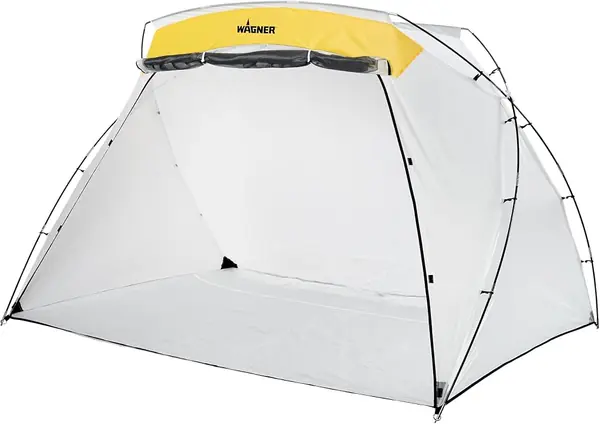
A dresser will not fit on a bench, and that is the entire case for a spray tent. The Wagner opens to 9 feet wide, 6 feet deep and 5.5 feet tall, which is enough room to walk a spray gun around a chest of drawers, and the floor is sewn into the fabric so overspray that misses the project lands on the tent rather than the garage slab.

Setup is two poles and a lot of fabric, closer to a camping tent than to a folding table, and it goes faster with a second pair of hands on a still day. Once it is up, the mesh screen rolls down over the opening to keep dust, leaves and bugs off wet finish, and the shelter weighs 6.5 pounds and packs into its own bag with stakes for grass.

What it does not do is move air. There is no fan and no duct, so the open garage door or the driveway is doing the ventilation, and solvent finishes need that airflow no matter how well the fabric contains the mist. Set up in a closed garage, this is a containment tool, not fume extraction.

Worth Noting

  • Pole sleeves and elastic cords are the weak point
Our Verdict

For anything bigger than a model kit, this is the shelter: nine feet of floor-lined space between your overspray and the garage.

Check Latest Price
6.

Siebwin Spray Paint Tent Best Tent for Solo Setup

Siebwin white spray paint tent with fiberglass poles and front mesh curtain

One-person setup

Track Score 86/100
Shelter Size
10 ft x 6 ft x 6.5 ft
Frame
Fiberglass poles
Assembly
Hooks sewn onto the fabric
Floor Area
75 square feet
View on Amazon

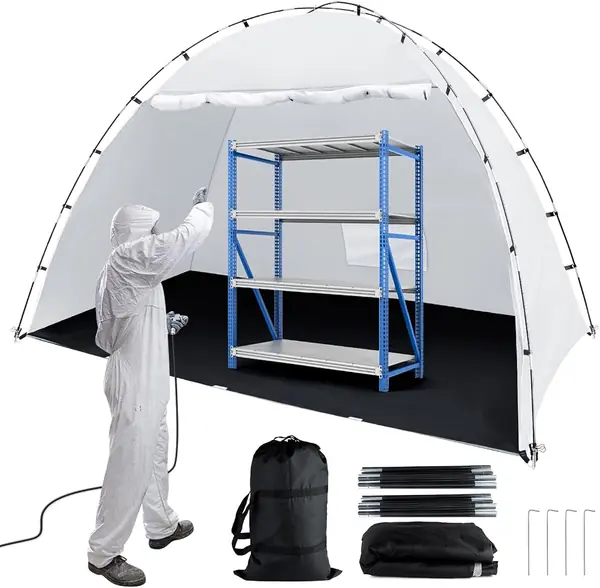
The Siebwin hangs rather than threads. Hooks are sewn onto the fabric, so setup means propping the fiberglass poles and hanging the shell on the frame, with no feeding a pole through a 10-foot sleeve and hoping the elastic holds. It measures 10 by 6 by 6.5 feet, about 75 square feet of floor, with a built-in floor and a small mesh curtain across the front.

That curtain is the part we like for drying: close it and wet paint is shielded from dust and insects while the work sits overnight. The maker rates the tent for indoor use and warns against drafty or windy spots, which matches what a light pole frame can do. Weight the corners and keep it out of the breeze.

For anyone setting up alone in a garage, the hook system is the reason to choose this over the cheaper tents here: one person can raise it without a second pair of hands and a phone call. The fabric and poles still want careful handling, and this is not the shelter to leave out in weather.

Worth Noting

  • Fabric and poles need gentle handling
Our Verdict

We hand this one to anyone setting up alone: the fabric hangs on sewn hooks, so nobody is threading poles through sleeves.

Check Latest Price
7.

PLANTIONAL Portable Paint Tent

PLANTIONAL white portable paint tent with built-in floor and rear vent

Small furniture

Track Score 85/100
Shelter Size
7 x 4 x 4 ft
Frame
Aluminum poles
Features
Built-in floor and mesh screen
Material
Polyester
View on Amazon

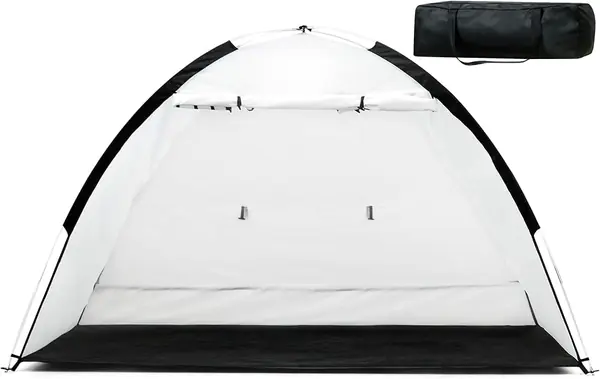
Twenty-eight square feet of floor is the whole proposition: 7 by 4 by 4 feet with the floor sewn in, a breathable rear vent, a mesh door and aluminum poles. It is the smallest and the least expensive way on this page to put a wall between your overspray and everything else in the garage.

What fits: a chair, a nightstand, a lamp, a set of cabinet doors laid flat. Long pieces work best laid down, and 28 square feet goes further than it sounds once the floor is part of the tent rather than the concrete.

Ventilation is a fabric panel at the back, not a fan. With the front open, air moves through and some mist drifts out the opening; with it closed, the tent keeps debris off the work while it dries. Both are useful, and neither is extraction.

We recommend it for the jobs that do not justify a bigger tent or a powered booth: cabinet doors, a chair, a lamp. The money saved buys another can of finish, and it earns its keep as long as you keep the work to furniture parts.

Worth Noting

  • Only 49 inches of headroom
Our Verdict

Our choice when the job is a chair or a set of cabinet doors and the money is tight: a contained, floor-lined space that folds flat.

Check Latest Price
8.

JFLLAJNF Airbrush Spray Booth Best for Tight Spaces

JFLLAJNF folding airbrush spray booth with ring LED lights and filter pads

Tight spaces

Track Score 84/100
Weight
6.19 lb
Work Area
16.5 x 16.5 x 24.4 in
Filters
Six filter pads included
Lighting
Two ring LEDs
View on Amazon

At 6.19 pounds this is the lightest powered booth here, and it is light because the shell is fabric with a foil lining rather than molded plastic. It folds flat, and the foil lining wipes clean after a session instead of needing a scrub.

The interior is listed at 16.5 by 16.5 by 24.4 inches, unusual proportions in a group where most booths are wider than they are tall. Upright pieces get the most out of it; long bodies laid flat do not.

Two ring LEDs adjust color and brightness, the dual fans run independently with stepped speeds, and six filter pads come in the box with a pocket to keep them. Airflow is fine for light coats and less convincing when you lay paint on wet, and since there is no rigid panel under the work, set it on a flat, steady table.

We point traveling painters and small-space hobbyists here: it folds up, it weighs almost nothing, and the ring lights are the most adjustable on this page. Anyone spraying heavy, wet coats should put the difference toward a rigid booth instead.

Worth Noting

  • Fabric top sags between the frame
  • Velcro closures are fiddly
Our Verdict

This is the booth we point traveling painters to: the lightest powered one here, with adjustable ring lights and six filters included.

Check Latest Price

How We Tested Spray Booths in a Working Garage

We split the category into the two things it actually is: powered booths with fans, filters, and an exhaust hose, and pop-up shelters that only contain. From there we filtered by work-area size, hose length, whether replacement filters were easy to find, and price, then bought 12 units and spent seven months with them.

Each one was set up where it would really live: a garage workbench, a basement hobby bench beside a sliding window, and a driveway for furniture. We measured every work area against the largest piece we meant to put in it, a cabinet door for the shelters and a full kit's worth of parts for the bench booths. We timed first assembly solo with a stopwatch and timed breakdown and packing every few weeks after, watching for frames, zippers, and seams that softened or failed.

To read airflow, we sprayed primer on a test panel, then checked the filter pad for captured pigment and the bench edge for drift. Every exhaust hose went to the nearest window or door gap to see whether it reached without a kink, and the fans ran past a decibel meter at arm's length and again from across the room. We priced replacement filter pads and counted how many shipped with each booth.

Because a booth filter traps paint particles, not solvent vapor, every solvent spray test ran with the hose vented outdoors, away from the water heater and any pilot light, and every tent was staked or weighted before we sprayed inside it. For lighting, we sprayed dark detail colors and watched for shadows and glare; for spray control, we noted whether finish lay down smooth or curled back onto the piece. Value came down to filter cost per session and how frames and fabric held up after repeated setups.

How to Choose a Spray Booth

Extraction or Containment?

Two kinds of product share this shelf and solve different problems. A tabletop booth with fans and a duct pulls paint mist through a filter and pushes the rest out of the room, and that duct is what lets you spray indoors at all. A pop-up spray tent has no fan: it walls off a work area so overspray lands on fabric instead of the floor, and it leans on the open garage door for air.

A tent pitched in a closed garage holds vapor in rather than moving it out, so for solvent finishes it is the wrong tool. Containment protects your surfaces; extraction protects your lungs and your room.

Size the Work Area to the Largest Piece

Powered booths here run from about 16 inches wide to 21.5, and shelters from 7 feet to 10. Measure the longest dimension of the biggest thing you plan to spray, not the average one. A 1/24 slot car body disappears in any of these booths, while a 1/8-scale shell wants the 20-inch class.

For furniture, look at door height as carefully as the floor plan. A 4-foot tent is fine for cabinet doors laid flat and awkward for anything you have to stand upright.

Route the Exhaust Before You Buy

Hoses in this group run 5 to 6 feet, and the narrow end is shaped to sit in a window or door gap. Measure from the back of the booth to a window you can actually open, add a foot of slack, and check the gap will take the duct without crushing it. A kinked hose throttles the fan no matter how big the motor is.

Window screens come out, and a piece of foam or cardboard packed around the duct stops the rest of the gap from leaking back into the room.

Budget for Noise and Filters

Every fan-driven booth here is audible, and the smaller cabinets put the noise right at desk height. Site the booth where that matters least, rather than beside a sleeping child or an open call, and treat the sound as the price of moving air.

Filters are the running cost rather than the purchase. Fiberglass and cotton pads load up with pigment and slowly cut airflow, so buy spares with the booth and swap when mist stops clearing from the front of the cabinet.

Weigh Setup Time Against Storage

The booth you use is the one that folds flat and lives under the bench; the one that takes twenty minutes and a second person gets left in the garage. Folded, these run about the size of a thick briefcase, and the lightest here is a touch over six pounds.

Tents are the reverse trade. Pitching one is real work, so most people leave a spray tent standing for the length of a project and work inside it until the job is done.

Frequently Asked Questions

Final Verdict

For models, slot car bodies, and anything that fits in a shoebox, we recommend the Master Airbrush dual-fan kit: fans, four lights, a turntable and a six-foot hose arrive together, and it costs less than the larger VEVOR that makes the bigger airflow claim.

Step up to that VEVOR if your pieces run past shoebox size and you want the bench room. For furniture, skip the bench and put up the Wagner shelter, with the caveat that it contains overspray but does not remove fumes, so the garage door stays open.