Best Airbrushes for Models of 2026

On a 1/72 wing, a good airbrush mist simply disappears. The brush you buy decides how fine that mist gets, how evenly it lands and how long cleanup takes, and the trade is built in: a brush that lays down a hairline won't cover a tank hull in one pass, and one built for coverage spatters when you freehand a camouflage edge.

Needle and nozzle size set the ceiling, and a spare needle only helps if you can also buy the nozzle and head it seats into. Most of the eight here are dual-action gravity feeds, so the differences are in those details. The list runs from a hairline detail brush for figures to a primer-and-basecoat workhorse and a pistol grip for long sessions, and a few ship with the hose and fittings to spray on day one.

Our Top Picks

The Best Airbrushes for Models

1.

Iwata Eclipse HP-CS Best Overall
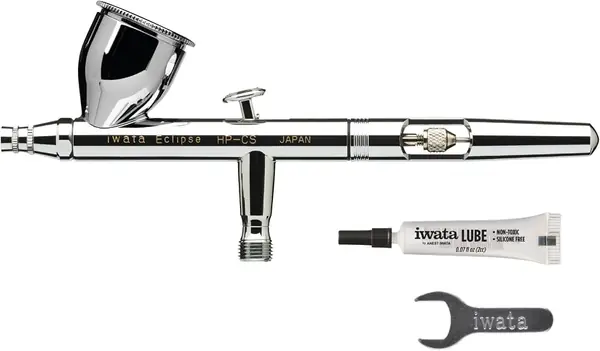
Iwata Eclipse HP-CS chrome gravity-feed airbrush with a 0.24 oz fluid cup

All-around model painting

Track Score 94/100
Nozzle
E3 compression-fit
Feed Type
Gravity, dual action
Fluid Cup
0.24 oz (7 ml)
Weight
1.6 oz
View on Amazon

A single nozzle that goes from a hairline along a 1/35 fender to a wet coat over a whole car body is what the E3 head promises, and that range is why this brush sits at the top of our list. The high-flow design atomizes reduced model acrylics smoothly and copes with paint that hasn't been taken all the way down to skim milk, which saves both thinner and temper on a long night.

What decided it for us is maintenance. The nozzle is compression-fit rather than threaded, so there is no fine thread to cross when you put the head back together, and the cutaway handle gets you to the needle without pulling the whole brush apart. Across a session of color changes that shortcut matters more than anything printed on the box. If you plan to own one airbrush and use it hard, this is the one we point you to.

It is the most expensive brush on this page, and what you're paying for is machining and a nozzle design rather than accessories. If your work is mostly primer and basecoat, the Badger's single 0.5 mm head handles that for a lot less money. If you want a brush you can strip down with your fingers, the Ultra is the friendlier design.

Where it earns the money back is tolerance. Solvent-resistant packings and a spring-steel needle mean lacquer thinner and enamel don't shorten its working life, so you can flush it hard between colors instead of babying it. On a busy bench that's the difference between a tool and an ornament.

Worth Noting

  • Small 0.24 oz cup needs refilling on large jobs
Our Verdict

We recommend the Eclipse to any modeler who wants one brush for hairline detail and full-body coverage, plus a nozzle that comes off without a wrench.

Check Latest Price
2.

Harder & Steenbeck Ultra 2024 Best for Easy Maintenance

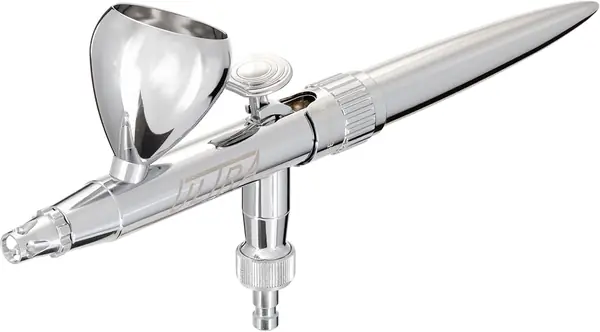
Harder & Steenbeck Ultra 2024 gravity-feed airbrush with a 5 ml paint cup and micro-cup socket

Low-fuss maintenance

Track Score 93/100
Nozzle
0.45 mm self-centering
Fluid Cup
5 ml
Assembly
Tool-free, hand-tightened
Upgrades
Accepts Infinity FineLine headset
View on Amazon

One nozzle, 0.45 mm and self-centering, tells you most of what the Ultra is for: primer, basecoats, camouflage, panel fading — the broad strokes of a model rather than the last hairline. What the number doesn't tell you is that the body accepts the FineLine headset from Harder & Steenbeck's Infinity range, so a finer front end becomes a later purchase instead of a second brush.

The 5 ml cup holds a working session's worth of a mixed color, and there's a built-in socket in the body for a micro-cup when a small part needs only a few drops. Everything comes apart by hand: no wrench, no spanner, nothing small to lose in the carpet. The self-centering nozzle drops into place, which removes most of the irritation from the one job nobody enjoys.

We like it best as the midrange answer for someone who paints a few evenings a week and wants cleaning to be a two-minute habit rather than a project. Nothing on it can be overtightened with a tool, because nothing on it takes one, and that is exactly the habit that kills cheaper brushes. Set against the Eclipse it gives up the widest coverage and the finest line, and it costs meaningfully less.

Worth Noting

  • One 0.45 mm nozzle and no spare needle included
Our Verdict

We point modelers at the Ultra when they want a brush that comes apart entirely by hand and can take a finer headset later.

Check Latest Price
3.

Gaahleri GHAD-39 Best Budget

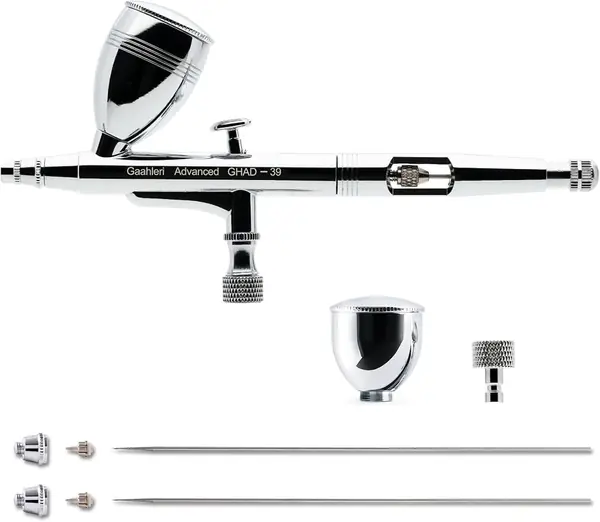
Gaahleri GHAD-39 silver gravity-feed airbrush with two fluid cups and two nozzles

First airbrush

Track Score 92/100
Nozzle
Self-centering drop-in
Warranty
1 year
Fluid Cups
1/2 oz and 1/4 oz
Needles
0.35 mm and 0.5 mm
View on Amazon

Two needles, two cups and a nozzle that drops in and centers itself — the GHAD-39 reads like the spec sheet of a brush costing several times as much, and that is why it is the one we tell people to start with. If you're not yet sure airbrushing will stick, money spent on a spare needle and a second cup in the same box buys you more than money spent on a name.

The 0.35 mm set is the one that stays in the brush for panel lines, shading and thin camouflage edges; the 0.5 mm set takes over for primer, basecoat and clear. The cups run 1/2 oz and 1/4 oz with smooth interiors, so a batch mix doesn't cling in a corner and rinse out cleanly. The self-centering nozzle is the part we appreciate most: it seats without lining up threads, and the brush goes back together in seconds.

Where it asks for care is paint consistency. Thick primer and unthinned acrylic can sputter and clog at the tip, so thin toward skim milk and keep a cup of cleaner within reach mid-session; do that and it sprays well above its class. A hairline finer than a 0.35 mm head will give is simply not on the menu, which is a limit of the size rather than the build.

Worth Noting

  • More small parts to keep track of than a one-head brush
Our Verdict

Our budget pick: two needle sets, two cups and a self-centering nozzle in a box that costs a fraction of the pro brushes.

Check Latest Price
4.

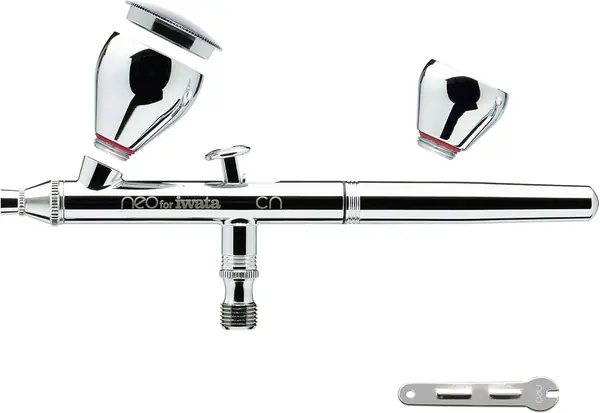
Iwata NEO CN Best for Beginners

Iwata NEO CN silver gravity-feed airbrush with two detachable fluid cups and a lid

New airbrushers

Track Score 91/100
Nozzle
0.35 mm
Feed Type
Gravity, dual action
Fluid Cups
Two detachable sizes
Maximum Pressure
35 psi
View on Amazon

The small cup is the detail we noticed first. When you're mixing three drops of a custom color for a cockpit or a slot car shell, a full-size cup wastes paint and wastes the cleaner you flush it with, and the NEO's smaller cup lifts off the body so you can rinse it under the tap. The larger cup takes a lid and holds enough for a whole kit.

On the brush itself, the main lever is smooth and the trigger is light, which suits the low pressures model acrylics want. It is dual action, so one trigger governs air and paint together, and the removable cup makes the between-color rinse quick enough that you actually do it.

What you have to watch is viscosity. Thick paint sputters and spits rather than atomizing, and the fix is thinner and a strainer rather than more pressure. Get the mix right and the spray is fine and even on small parts, with no blockage in the nozzle that a short soak won't clear.

For a first airbrush we haven't found anything here that is easier to learn on: the controls are simple, the cups come off, and it behaves at the pressures a hobby compressor actually delivers. It is the brush we hand someone who has never airbrushed before. Move up to the Eclipse when the brush, rather than your technique, becomes the limit.

Worth Noting

  • Nozzle and threads are fragile if overtightened
Our Verdict

The friendliest brush here for a first model: light trigger, low-pressure manners, and cups that lift off for rinsing.

Check Latest Price
5.

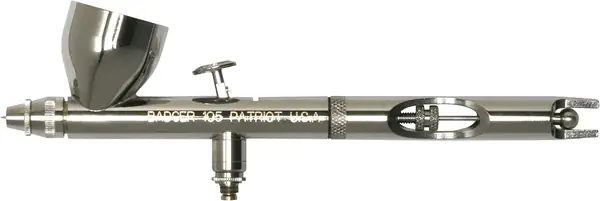
Badger 105 Patriot Best for Primers and Basecoats

Badger Model 105 Patriot stainless steel gravity-feed airbrush with a permanently mounted 1/3 oz cup

Priming and basecoats

Track Score 90/100
Nozzle
0.5 mm
Feed Type
Gravity, dual action
Fluid Cup
1/3 oz, permanently mounted
Warranty
1 year, lifetime factory labor
View on Amazon

One head, 0.5 mm, and a claim that it sprays everything from a Stynylrez primer to a dye without a changeover. On the bench that is the whole appeal: the needle's two-angle tip mates with a cone-shaped nozzle, so a single needle and nozzle set covers the materials a model kit actually throws at you. The color cup is permanently mounted at 1/3 oz and comes with a spill-proof cap, which sounds minor until the first time you tip a loaded brush.

We treat this as the basecoat brush. When a squad of figures or a stack of bodies needs primer and a flat color, the Patriot lays it down evenly and doesn't demand much thinning. It is also one of the easiest brushes here to strip mid-session: the needle slides out the back without a full teardown, so a dried clog is a two-minute fix instead of an overnight soak.

Leave paint sitting in the packing and the needle can stick, so flush after every session rather than every third one. The warranty is the other thing worth knowing: a year against manufacturing defects and lifetime factory labor, which for a brush this simple is a long safety net.

Worth Noting

  • Single 0.5 mm head limits fine detail work
Our Verdict

One 0.5 mm head sprays primer, enamel and acrylic without a swap, which makes this our pick for basecoats and armor.

Check Latest Price
6.

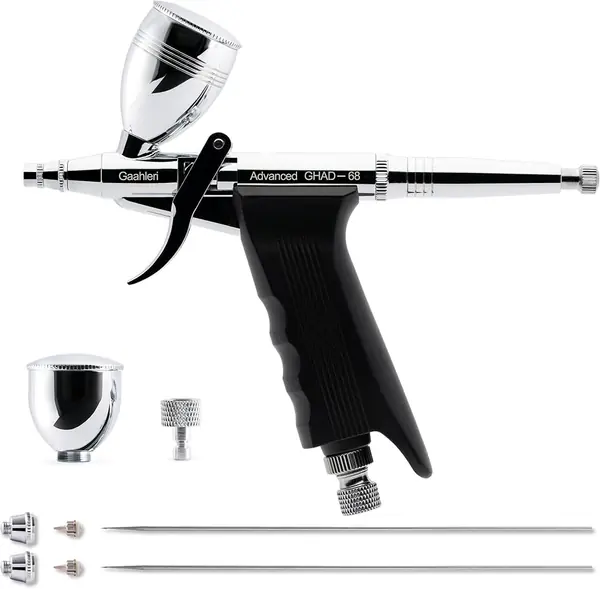
Gaahleri GHAD-68 Best for Long Sessions

Gaahleri GHAD-68 silver pistol-grip airbrush with two screw-on fluid cups

Long painting sessions

Track Score 89/100
Warranty
1 year
Fluid Cups
1/2 oz and 1/4 oz
Needles
0.38 mm and 0.5 mm
Grip
Pistol-style trigger
View on Amazon

The grip is the whole argument. Where most airbrushes ask you to hold them like a pen, the GHAD-68 sits in the hand like a small spray gun with the trigger under the index finger, and across a two-hour session that posture decides whether you finish the batch or call it a night. If a conventional airbrush leaves your hand cramped halfway through a project, start here.

Underneath the shape it follows the same Gaahleri formula: 0.38 mm and 0.5 mm needle sets, 1/2 oz and 1/4 oz cups that thread on and off, and the self-centering drop-in nozzle that keeps cleaning short. The screw-on cups are the practical win — they come off cleanly for washing instead of pulling free with a wobble.

The trade-off sits at the fine end. A pistol trigger gives leverage for broad, even passes but less of the fingertip feel that hairline work wants, and 0.38 mm is coarser than the 0.35 mm heads on our top picks. For armor, vehicles, terrain and slot car bodies the trade is worth it; for 1/72 figures and soft camouflage edges, it isn't.

Worth Noting

  • Pistol grip gives less fingertip control for hairlines
Our Verdict

If a standard airbrush leaves your hand aching, the GHAD-68's pistol grip is the reason we keep it on this list.

Check Latest Price
7.

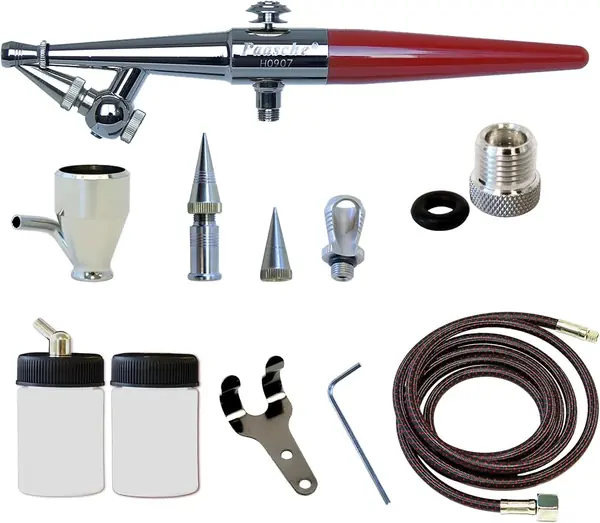
Paasche H Set

Paasche H chrome single-action siphon-feed airbrush with metal cup and one-ounce bottle

Broad coverage

Track Score 88/100
Feed Type
Siphon, single action
Hose
6 ft braided, included
Heads
0.45, 0.65 and 1.05 mm
Spray Pattern
1/16-inch to 1-1/2-inch
View on Amazon

Single action means the trigger does one thing: it releases air. You set paint flow once at the needle and then spray, which is why the H behaves less like a precision instrument and more like a spray can you can aim. There is almost nothing to learn, and for a lot of jobs that is exactly the point.

The set is generous in a way that suits modelers: three heads at 0.45, 0.65 and 1.05 mm, a 1/4 oz metal cup, a one-ounce bottle, a hanger, a wrench and a six-foot braided hose. Patterns run from 1/16 inch to 1-1/2 inches, so you can line a stencil or flood a large surface without changing brushes, and siphon feed from the bottle means a long run without stopping to refill.

Cleaning is the simplest of any brush here: run cleaner through it and you're done, because there is no internal mix chamber to chase paint out of. It is also the least picky about what goes in it — craft acrylics, enamels and primers all pass through without complaint, though anything with coarse pigment wants straining first.

Our honest read is that this is a second brush rather than a first one. Buy it when you are tired of refilling a tiny cup to prime a dozen bases, or when a batch of slot car bodies needs one solid color laid down fast. The build is solid and it will outlast brushes that cost more, but soft camouflage edges and hairline work belong to a different tool.

Worth Noting

  • Too coarse for fine detail and soft camouflage edges
Our Verdict

For solid color, stencils and large surfaces, the single-action H is the least fussy brush here and the easiest to learn.

Check Latest Price
8.

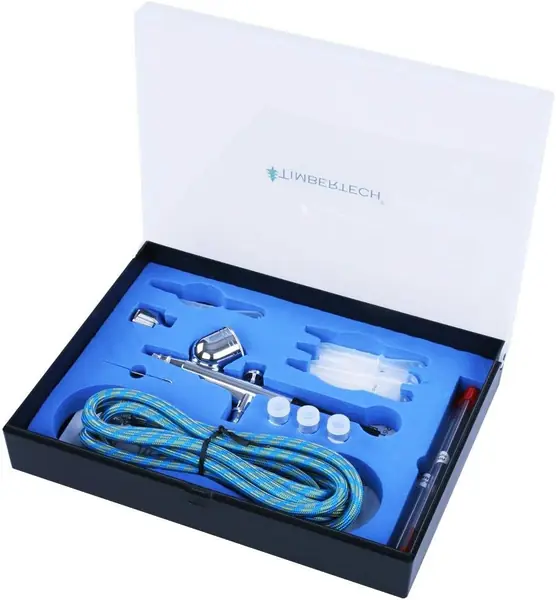
Timbertech ABPST01

Timbertech ABPST01 airbrush kit in a foam-lined plastic case with nozzles and hose

Starter kit

Track Score 87/100
Fluid Cup
5 ml
Hose
2 m included
Nozzles
0.2, 0.3 and 0.5 mm
Air Inlet
1/8 in external thread
View on Amazon

Open the case and there is more inside than the money suggests: three needles and three nozzles at 0.2, 0.3 and 0.5 mm, a two-meter fabric hose with a 1/8-inch fitting, an adapter, four pipettes and a wrench, all sitting in a foam cutout. For someone who has never owned an airbrush, that is the difference between starting this weekend and starting after another order arrives.

It sprays like a competent budget dual action. The 0.2 mm head will draw a fine line, the 0.5 mm head handles general coverage, and there is enough adjustment for a beginner to find a workable setting. The 5 ml cup is enough for a few parts at a time, and with properly thinned acrylics it behaves well above its price. Leave paint in it and it will let you know.

We treat this as a first brush, or as a second brush kept loaded with a different color, rather than a lifetime tool. Learn on it, be a little rough with it while you're learning, and when your technique outgrows the 0.2 mm head you'll know exactly what you want next. It is the least expensive way here to get a brush, a hose and three nozzle sets in one box.

Worth Noting

  • Nozzle can shear if overtightened while cleaning
Our Verdict

A complete starter kit in one box — gun, hose, three nozzle sets and a case — and the cheapest way into airbrushing here.

Check Latest Price

How We Tested Model Airbrushes

We started with a shortlist of about 30 airbrushes and cut it to 12 before buying, judging each on needle and nozzle sizes, feed type, cup volume, parts availability, and what came in the box. Testing ran eight months at a basement workbench, mostly weekend afternoons with a few three-hour weeknights.

Every brush did the same work: a primed sprue, a tank hull that needed a full basecoat, and a figure where the seams and eyes decide whether the paint job reads. We thinned the same acrylics to the same consistency and sprayed detail at 12 to 18 psi, primer and clear at 25 to 30, watching whether paint landed as a smooth wet coat or a grainy edge. To find the finest line a brush could hold, we pulled hairline strokes on primed sheet plastic and measured them, then repeated them on a part where a slip shows. Trigger control got judged there, where a brush either feathers paint on and off cleanly or leaves a visible start and stop.

We broke each brush down after every session without instructions the first time, timing it and counting parts; self-centering drop-in nozzles and compression-fit heads came apart at very different speeds, and cleaning ease followed the head design. We also watched the cup for bubbles while spraying, since a steady bubble usually points to a seal problem, not thin paint, and checked needle tips under a loupe for hooks after the inevitable drops. Price was weighed against the job each brush was asked to do.

Acrylics were sprayed indoors under a vented booth; solvent paints and lacquers went outside with a rated respirator. We noted what shipped in each box and how the brush balanced through a long session with a full cup.

How to Choose an Airbrush for Models

Needle Size Sets Your Ceiling

The needle and nozzle decide how fine a line you can draw and how much paint moves at full trigger. A 0.2 to 0.3 mm head is a detail tool for panel lines, exhaust staining and thin camouflage edges, and it will fight you if you ask it to prime. A 0.35 to 0.45 mm head does the bulk of model work: shading, base colors, touch-ups. A 0.5 mm head is a coverage tool for primer, clear coats, large armor and car bodies.

If you'll own one brush, buy the middle. The Eclipse at the top of this list, the Ultra and the NEO all sit in that band and will spray a whole kit if you thin properly. Move into a 0.5 mm head when you find yourself priming in batches — the Badger's single 0.5 mm head does that one job extremely well and asks for nothing else.

Gravity Feed, Cup Size and How Much You Mix

Gravity-feed brushes drop paint straight into the nozzle from a cup on top, so they spray at lower pressure, waste less paint and clean up faster than siphon-feed designs. Siphon feed pulls paint up from a bottle, and it wins when you want a long run without refilling: the Paasche H, with its one-ounce bottle, primes a dozen bases without a pause.

Cup size is where modelers waste effort. A 5 to 7 ml cup is plenty for a few parts, and the trap is mixing a big batch to save time — thinned acrylic skins over and dries in the nozzle while you're still working. Mix what you'll spray in twenty minutes, and use the small cup when the color is a few drops of custom blend.

Cleaning Design Beats Feature Lists

The biggest quality-of-life difference between one airbrush gun and another is how the nozzle seats. Threaded nozzles are fine until the night you cross a thread; self-centering and compression-fit heads drop in and align themselves, and they come apart without a wrench. That matters more than a spare needle in the box, because you clean the brush after every session and swap needles almost never.

Treat the nozzle as a wear item rather than a permanent part. Anything that small and finely made can be sheared by overtightening, and overtightening is the usual cause. Hand-tighten only, and keep one spare head for the brush you rely on.

Hose, Fittings and Your Air Supply

Every brush here expects a compressor; none of them includes one, and a can of propellant will chill and lose pressure halfway through a kit. Check two things before you order: whether the brush ships with a hose, and whether the fitting matches your compressor. The 1/8-inch thread is the usual standard, but some brushes use a smaller fitting and need an adapter, so confirm it rather than assuming.

For model work a regulator and a moisture trap are worth more than a bigger tank. Water in the line shows up as spatter on a flat coat that you'll be sanding out, and without a regulator you can't take pressure down for a fine line or up for primer.

Frequently Asked Questions

Final Verdict

If you're buying one airbrush for models, buy the Iwata Eclipse HP-CS. The E3 head goes from a panel line to a full body without a swap, the compression-fit nozzle makes the cleaning you'll do every night genuinely quick, and the machining is the best in this group.

Two situations change that. If you want a brush you can strip down with your fingers and upgrade later, the Harder & Steenbeck Ultra is the friendlier design and costs less. If you're just starting out, the Gaahleri GHAD-39 gives you two needles, two cups and a self-centering nozzle for the least money here, and that is the smartest first purchase on this page.