Best Airbrush Compressors of 2026

A bad compressor tells on itself quickly: paint that spits water droplets, a pump that surges halfway across a panel, a motor loud enough that you wait for the neighbors to leave. A good one stays out of the way, with steady pressure at the nozzle, dry air and a fan quiet enough for a late session.

Peak pressure sells machines, but a regulator you can nudge one psi at a time is what lets you pull a hairline. A tank buys reserve air, along with weight and lost counter space. Across 12 compressors run on model parts, shirts, practice skins and a scrap fender, the real differences were bench footprint, sound in a shared room and whether the fittings thread straight onto the brush you already own.

Our Top Picks

The Best Airbrush Compressors

1.

Timbertech ABPST08 Airbrush Compressor Best Overall
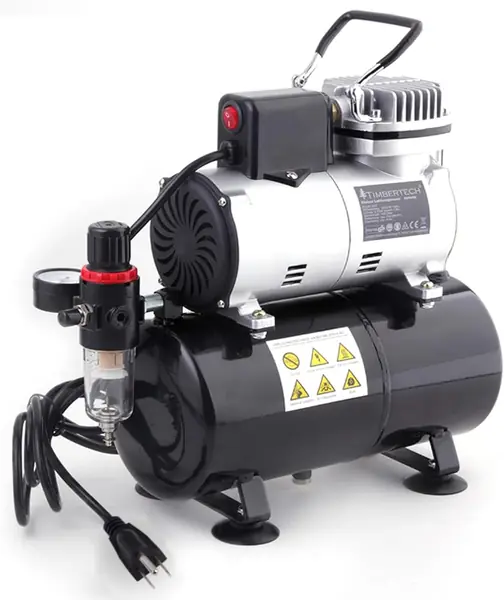
Black Timbertech ABPST08 airbrush compressor with 3-liter tank and cooling fan

Home model painting

Track Score 92/100
Noise Level
47 dB
Airflow
20-23 liters per minute
Weight
11.5 lb
Tank Capacity
3 liters
View on Amazon

The 3-liter tank and extra cooling fan are why we kept coming back to the Timbertech ABPST08. The tank smooths the airflow so it arrives as a steady stream rather than a pulse, and the cooling fan lets the motor run for longer stretches without getting fussy. At 47 dB, it sits among the quietest compressors in this group; a normal conversation can continue while it cycles.

The regulator, gauge, and moisture trap are built in, and the tank gives the motor room to rest between refills. We paid close attention to the regulator because it is the control you touch most often; here the adjustment is straightforward and the gauge is easy to read at a glance. The 11.5-pound body has a carry handle, so moving it from a shelf to the bench is not a chore.

What we appreciate most is how the tank and cooling fan work together. The tank keeps the air even through primer and base coats, and the fan keeps the motor comfortable while you work through a batch. The 3-liter reserve is the reason the motor is not starting from zero every time you pause, which is the kind of quiet convenience you notice after the first hour.

Worth Noting

  • Pump life is the long-term question
Our Verdict

Our top choice for most home painters, the Timbertech ABPST08 pairs a 3-liter tank with a cooling fan for steady, quiet air that lasts through a long session.

Check Latest Price
2.

Master Airbrush TC-320 Cool Runner Compressor Best Tankless

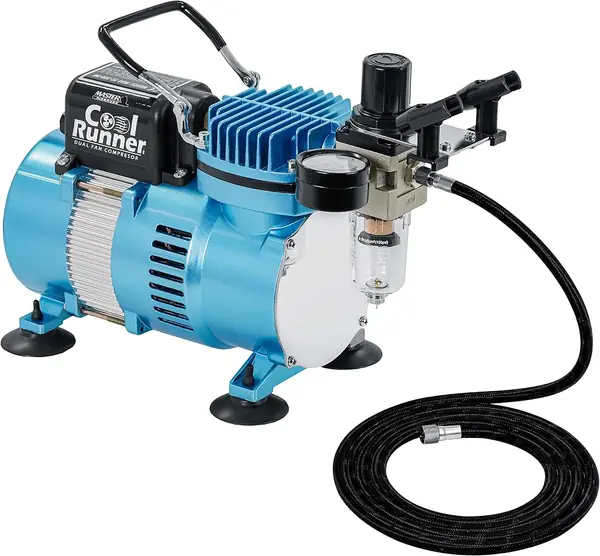
Master Airbrush TC-320 Cool Runner compressor with dual cooling fans and regulator

Small apartment benches

Track Score 91/100
Noise Level
47 dB
Airflow
0.8 cfm
Maximum Pressure
57 psi
Weight
9.5 lb
View on Amazon

Going tankless is the point of the Master Airbrush TC-320. At 9.5 pounds it is easy to lift onto a shelf or tuck beside a monitor, and the two cooling fans are there for longer continuous running. At 47 dB, it is quiet enough for an apartment or a shared room, which is why we suggest it for a small bench.

We liked the locking pressure knob most. Set the pressure you want, push the knob down, and it stays where you put it instead of drifting while you work. The 57-psi ceiling and 0.8 cfm suit model paints, and the direct response is part of the appeal for detail work.

The 6-foot hose and built-in holder are the practical extras we noticed every time we set the brush down between colors. Setup is simple: add your airbrush, set the pressure, and work. That short hose is a good match for a compact bench, where a longer one just coils up behind the machine.

Worth Noting

  • Regulator can be stiff to adjust
  • Tankless design offers less air reserve
Our Verdict

For a small bench or apartment, the Master Airbrush TC-320 is the tankless pick we like: compact, quiet, and easy to live with.

Check Latest Price
3.

Iwata Power Jet Pro Airbrush Compressor Best for Two Airbrushes

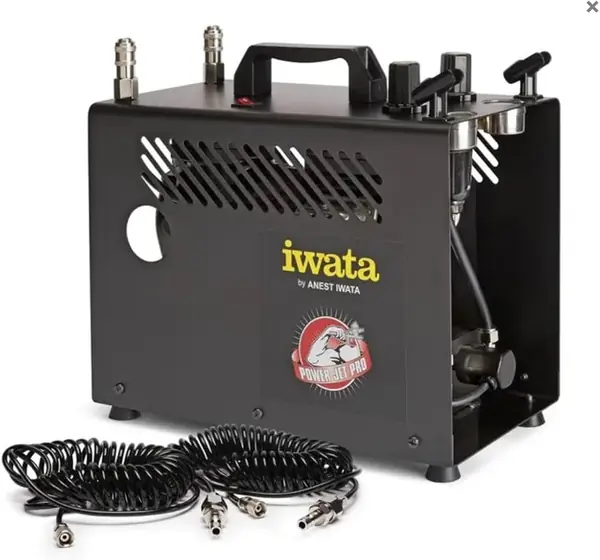
White Iwata Power Jet Pro compressor with dual regulators and two airbrush holders

Two-brush studios

Track Score 90/100
Noise Level
50 dB
Airflow
1.2 cfm
Tank Capacity
2 liters
Pressure Range
1-50 psi
View on Amazon

Two airbrushes can stay connected to the Iwata Power Jet Pro at once, each with its own regulator and gauge. That is the feature we value most, because it turns a single compressor into a small two-person station or lets you keep a detail brush and a primer brush ready without swapping hoses. The 2-liter tank smooths the output, and the 1-50 psi range covers everything from fine line work to broader coverage.

At 50 dB it is quiet enough to sit under a worktable without dominating the room, and the auto shut-off stops the motor when neither brush is triggering. The dual moisture filters are a thoughtful touch for anyone who has watched a water droplet ruin a paint layer. We noticed the two gauges make it easy to check each brush's setting without moving the unit.

The value case is narrow but clear: this is for a studio that regularly runs two brushes or wants independent pressure at each station. For one brush and one painter, the extra regulators are more compressor than the work requires. The independent regulators are the part we miss when we go back to a single-outlet machine, because they save hose swapping and keep both brushes dialed in.

Worth Noting

  • 22-pound body is best kept in place
Our Verdict

Two brushes, two regulators, and quiet, precise air: the Iwata Power Jet Pro is the premium machine we choose for a shared studio.

Check Latest Price
4.

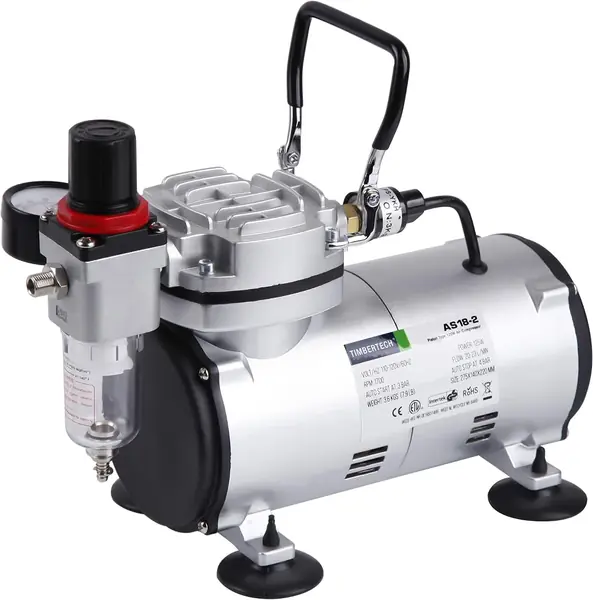
Timbertech AS18-2 Airbrush Compressor Best Budget

Timbertech AS18-2 mini airbrush compressor with carry handle and pressure regulator

Budget first setups

Track Score 88/100
Noise Level
50 dB
Airflow
20-23 liters per minute
Maximum Pressure
4 bar
Weight
8.25 lb
View on Amazon

The Timbertech AS18-2 is the least expensive route into this group, and it keeps the recipe simple: a 1/6-hp oil-free piston, a regulator with gauge and water trap, and a carry handle on an 8.25-pound body. It is a basic piston compressor with no tank, so there is no reserve to find space for and no extra weight to lift onto the bench. The listed airflow is 20-23 liters per minute, with auto start at 3 bar and auto stop at 4 bar.

The auto start-stop does its job, shutting down between spraying bursts instead of running continuously. We noticed the 50 dB rating is low enough for a spare room, and the water trap is already in place for humid days. The regulator gives you a usable range for model paints, though the adjustment is coarser than on the premium picks.

We think the AS18-2 is a fair first compressor because it puts the money into the parts that matter for learning: steady enough air, a clean trap, and a light body you can store. It does not have the refinement of the tank models, and the simple regulator rewards a gentle hand. Without a tank, the motor follows your trigger rather than drawing on a reserve; for short model-painting sessions, that is a trade we can live with.

Worth Noting

  • Hose and adapter not included
Our Verdict

The Timbertech AS18-2 is our budget pick for a first airbrush setup, with a light tankless body that handles basic model painting without fuss.

Check Latest Price
5.

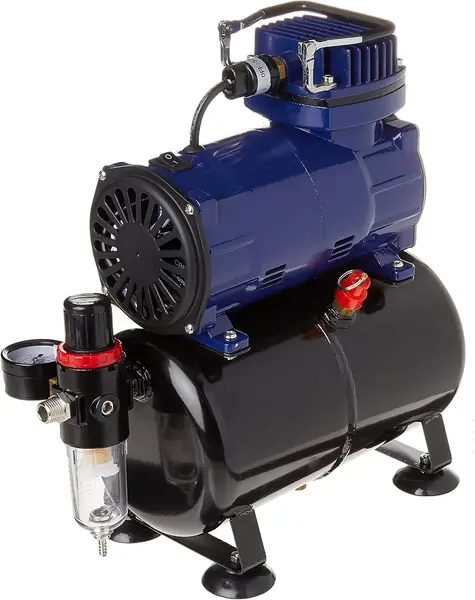
Paasche D3000R Airbrush Compressor Best for Detail Work

Blue and black Paasche D3000R compressor with tank regulator and moisture trap

Low-pressure detail work

Track Score 87/100
Noise Level
47 dB
Maximum Pressure
35 psi
Horsepower
1/5 hp
Tank Capacity
0.75 gallons
View on Amazon

The Paasche D3000R has a 35-psi ceiling and a 0.75-gallon tank, a combination that sets its role in this group. The tank gives it a useful reserve, so the motor is not chasing every trigger pull, and the regulator and moisture trap are part of the package. For detail work, the tank does more for the feel of the spray than a bigger motor.

The 1/8 BSP adapter lets you connect a competitor hose, and the blue-and-black body has a small 10-by-4-by-8-inch footprint. We liked that it does not need much bench space, and the auto shutoff stops the motor when you pause. That is the behavior that makes a tank compressor pleasant to live with.

At 47 dB, it is one of the quieter units here, quiet enough for a spare room or a basement bench. The 1/5-hp motor is modest, but the tank carries the work during a long pass, so the compressor is not straining to keep up with a detail brush. The regulator's low end is the part we paid attention to, because that is where this machine spends most of its time.

What won us over is the combination of a real tank and a low-pressure-focused regulator in a small package. It suits work that is small, controlled, and quiet. The tank and regulator make it feel like a precision tool rather than a scaled-down shop compressor, and the compact body fits on a shelf beside the paints.

Worth Noting

  • 35-psi ceiling limits high-pressure work
Our Verdict

We keep the Paasche D3000R for low-pressure detail work, where its 0.75-gallon tank and 47 dB operation make steady, quiet spraying feel effortless.

Check Latest Price
6.

PointZero Elite-125X Airbrush Compressor Best for Portable Home Setups

Silver PointZero Elite-125X tankless airbrush compressor with regulator and carry handle

Portable home setups

Track Score 86/100
Noise Level
55 dB
Airflow
1 cfm
Maximum Pressure
58 psi
Horsepower
1/5 hp
View on Amazon

The PointZero Elite-125X is built to move: an 8-pound body, a carry handle, and a 10-by-4-by-7-inch footprint that leaves room for a paint tray beside it. The 1/5-hp oil-less motor delivers about 1 cfm and up to 58 psi, with a regulator and water trap to keep the air clean and adjustable. The 1/8 BSP outlet is the common size for hobby airbrushes.

We liked the rubber feet more than we expected; they hold the compressor in place on a slick bench and keep vibration from walking it toward the edge. The automatic on-off and thermal protection are the kind of safeguards that let you work without babysitting the unit. What we appreciate most is the balance: this is a compressor you can carry to the kitchen table, the garage, or a class and set up without a second pair of hands.

On-demand operation means it runs when the brush calls for air and rests when you pause, and the built-in regulator is easy to reach while you work. We noticed the tankless design gives up some reserve; for short sessions and detail work, the lighter body is the better trade. The compact shape is the reason to choose it over a tank model if you share the work surface and have to put everything away afterward.

Worth Noting

  • 55 dB is louder than the quietest picks
Our Verdict

We like the PointZero Elite-125X for a hobbyist who shares the table: it is light, movable, and delivers adjustable air up to 58 psi without much bulk.

Check Latest Price
7.

MEEDEN Airbrush Compressor Best for Beginner Craft Setups

Black MEEDEN airbrush compressor with six-foot hose moisture filter and spray gun holder

Beginner craft setups

Track Score 85/100
Horsepower
1/5 hp
Power
150W
Hose Length
6 feet
Hose Connection
1/8 inch
View on Amazon

The MEEDEN arrives as a working bundle rather than a bare compressor: a six-foot soft hose, a spray gun holder, a moisture filter, and a carry handle are part of the package. The 150W oil-free motor is rated at 1/5 hp, and the 1/8-inch joint takes a standard airbrush connection. The output is aimed at 0.2-1mm tips, which covers most hobby and craft brushes.

We liked that the self-stop function shuts the motor down between spraying bursts, and the external gauge makes it easier to repeat a setting from one session to the next. The six-foot hose is the detail that changes the setup: you can leave the compressor on the floor or at the back of the bench and still move the brush freely. The carry handle is a small thing, but it makes the unit easy to stash when the table has to become a table again.

We think this is a sensible first compressor for someone who wants the basics in one order. The 150W motor is modest, so it suits detail and craft work rather than high-production spraying, and the simple oil-free design keeps maintenance to draining moisture and keeping the vents clear. It is not the pick for someone chasing the quietest possible studio or the widest pressure range, but it gets a beginner painting without a pile of extra shopping.

Our Verdict

Our pick for a simple first order, the MEEDEN bundles an oil-free motor with a hose, holder, and filter for straightforward craft work.

Check Latest Price
8.

Iwata Ninja Jet Airbrush Compressor Best for Compact Premium Studios

Compact Iwata Ninja Jet airbrush compressor with carrying handle and airbrush holder

Compact premium studios

Track Score 84/100
Power
110-120V
Hose
Polyurethane hose included
Motor
Oil-less piston
Airbrush Holder
Built-in
View on Amazon

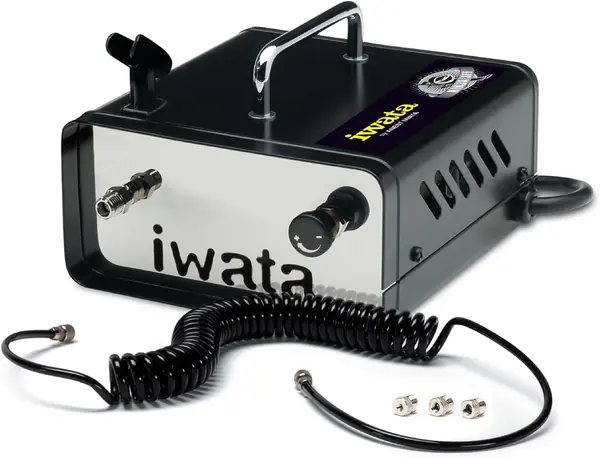
The Iwata Ninja Jet is a compact, maintenance-free compressor with a metal cover, a built-in airbrush holder, and a carrying handle. It is the kind of unit that can live on the corner of a small bench and stay there, which is the main reason we keep it in the conversation. The 110-120V motor is oil-less, so there is no lubricant to check or add.

The included polyurethane hose is made for Iwata airbrushes, and the package includes adaptors for other fittings. We appreciated that the hose and adaptors are included, because a compact compressor often sits close to the work and you do not want to hunt for a second fitting. The built-in holder keeps the airbrush off the table between colors, a convenience that matters more in a tight space.

Adjustable pressure is handled on the unit, and the oil-less piston is designed for low maintenance. We noticed the metal cover protects the motor and gives the small body a finished look. This is a compact compressor, so it suits detail work and smaller sessions rather than continuous production.

We recommend the Ninja Jet when the bench is small and the budget is less of a constraint than the footprint. It is not the compressor for someone who needs two stations or the lowest possible price. What we like is the focus: a tidy, self-contained unit that disappears into a small workspace. The built-in holder keeps the brush where you left it, and that is the kind of small convenience that makes a compact bench work.

Our Verdict

For a tiny studio, the Iwata Ninja Jet is the compact premium compressor we trust to sit on the bench and stay out of the way.

Check Latest Price

How We Tested Airbrush Compressors

We started with spec sheets and manuals, narrowing a long list by the things that decide whether a compressor is usable at all: tank or tankless, a regulator with real adjustment at the low end, a moisture trap built in rather than sold separately, and hoses and adapters in the box. Anything with an unlisted fitting or no service parts was dropped. Before plugging in a single unit, we read the label plate and confirmed it listed the same voltage and frequency as the wall supply.

Twelve compressors came in, and we lived with them for eight months on a spare-room bench. They sprayed thinned acrylic on model parts, base coats on shirts, practice skins, and a scrap fender, in sessions that ran from ten minutes of detail work to an hour of continuous coverage.

We set each regulator to its lowest usable pressure and timed how long it took to settle after an adjustment, then ran the tank dry to time recovery. Every joint got the soapy-water treatment after a session to catch slow leaks, and we took the temperature of the motor housing with an infrared thermometer at 15, 30, and 45 minutes, keeping vents clear and never boxing a unit into a cabinet. Noise was measured at arm's length and from the next room, since the number on the box rarely matches a small room at 11 p.m. We weighed and measured each one and noted how much of a 24-inch bench it ate.

Hoses got swapped between brushes to see which threads needed an adapter and which just worked. After eight months we checked the fittings for wear and listened for bearing noise on startup. The machines that held a setting, stayed cool, and never put water in the line were the ones we kept reaching for.

How to Choose an Airbrush Compressor

Tank or Tankless: Match the Machine to Your Bench

A tank gives you a buffer of compressed air, which smooths the output and lets the motor rest between bursts; tankless units are lighter and less expensive but follow your trigger more directly. For a fixed bench and longer sessions, we lean toward a tank model such as the Timbertech ABPST08 or Paasche D3000R. If the compressor has to share a small desk and come out only when you paint, the Master Airbrush TC-320 is the easier shape to live with.

Look at the Regulator Before the Peak Pressure

Peak psi is a headline; the regulator is what you actually use. A brush that will not settle at 15 to 25 psi is frustrating for fine work, no matter how high the maximum. Look for a gauge you can read and a knob that holds its setting. The Paasche D3000R tops out at 35 psi, enough for detail work but not high-pressure primer, while the Timbertech ABPST08 and Master TC-320 give more headroom.

Noise, Heat, and the Length of Your Sessions

Decibels tell only part of the story: a compressor can be quiet at idle and sharper when the motor cycles. For an apartment or a shared room, aim for the 47-50 dB units here, and give even a mini compressor open space rather than boxing it into a cabinet. A cooling fan and a thermal shutoff are worth having if you spray for more than a few minutes at a time. The Timbertech ABPST08 and Iwata Power Jet Pro are the better choices when a session runs long.

Check the Fitting, the Hose, and the Space It Needs

The most common disappointment is not pressure but connection: a compressor can have great specs and still need an adapter for your brush. Confirm the outlet and hose thread before you order, especially if you use an Iwata or Paasche brush with a different fitting. Also plan for the footprint and weight; a 22-pound unit like the Iwata Power Jet Pro is a fixture, while the eight-pound PointZero is easy to move. Give the machine room for its cord and vents.

Moisture Control Is Part of the Air Supply

Compressed air carries water, and a drop in the line can leave a bloom in a paint layer. A built-in moisture trap is the minimum; an inline filter at the brush is cheap insurance in humid rooms. Drain the tank after a session and keep the trap clean. Models such as the ABPST08 and Paasche D3000R include traps, but the habit matters as much as the part.

Frequently Asked Questions

Final Verdict

For most home modelers, the Timbertech ABPST08 is the compressor we recommend: the 3-liter tank, cooling fan, and 47 dB operation make steady, quiet air the easy part of a painting session. If bench space is tight, the tankless Master Airbrush TC-320 is the smaller, simpler choice. And if you regularly run two brushes, the Iwata Power Jet Pro earns its premium with independent regulators and dual outlets.