Best RC Servos of 2026

A servo is the hardest-working part of an RC build and the one that fails loudest: steering that centers half an inch off, a gear train that strips on the first bad landing, a receiver that browns out because the motor draws more than the BEC can supply. The number on the box doesn't settle it. A good servo points the wheels where you aim, returns to center and keeps doing it.

Travel angle trips up more builds than modest torque, and coreless motors now show up at prices that used to buy a buzzy three-pole can. We measured torque at the voltage each model actually receives on 16 servos, from 9-gram micros for park flyers to a 56 kg·cm brushless unit, in crawler rock sections, 1/10 and 1/8 trucks and on a bench rig. Not every pick is sealed for wet running, but all nine center reliably and kept their gears for a season.

Our Top Picks

The Best RC Servos

1.

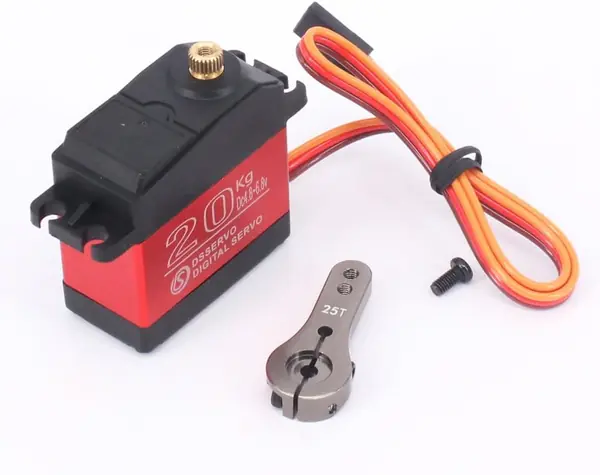
ANNIMOS DS3218MG 20KG Digital Servo Best Overall
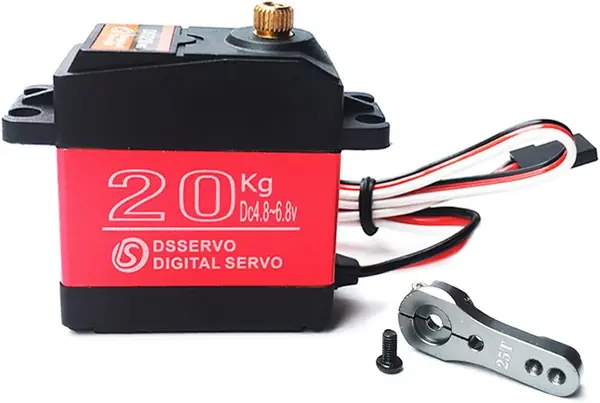
ANNIMOS DS3218MG 20KG metal-gear digital servo with red and black aluminum case

General RC duty

Track Score 94/100
Stall Torque
21.5 kg·cm at 6.8V
Speed
0.14 sec/60° at 6.8V
Gears
Copper and aluminum metal
Travel
270°
View on Amazon

Twenty-one and a half kilogram-centimeters at 6.8V is the number doing the work here. That is more turning force than any standard-size servo in this guide other than the 35 kg and 56 kg models, and it arrives in a 40 x 20 x 40.5 mm case that weighs about two ounces and matches the footprint of the stock servo on most 1/10 trucks. Speed is 0.14 sec/60° at 6.8V, and the case is sealed with rubber gaskets.

We keep recommending it because it covers more ground than anything else at the price. The 270-degree travel is the part we underrated at first — it is what lets the same servo drive a steering rack or a pan-tilt head — and the copper-and-aluminum gear train inside a CNC aluminum middle case feels sturdier in the hand than the plastic-case units further down this list. Ours took wet grass, puddle crossings and a long stretch of trail duty on a 1/10 crawler without complaint.

Durability is the one place it does not give you a clean answer. It is the split topic: units that run for years and units that quit early, with nothing on the spec sheet to tell them apart. If a steering failure costs you a main event, spend more; for club running, practice and a crawler that sees mud, keep a spare in the toolbox and this one is easy to justify.

Worth Noting

  • Speed trails the 35 kg servos here
  • Centering can drift on some units
Our Verdict

We make this our default because 21.5 kg·cm and 270 degrees of travel cover a 1/10 crawler and a robot arm alike, and nothing else here matches that range for the price.

Check Latest Price
2.

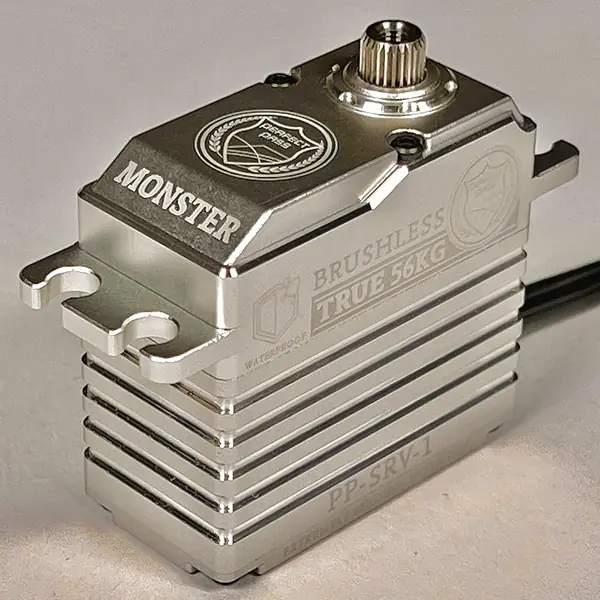
Perfect Pass Monster 56KG Brushless Servo Best for Heavy-Duty Builds

Perfect Pass Monster 56KG brushless waterproof servo with aluminum heat-sink case

Heavy 1/8 builds

Track Score 93/100
Stall Torque
56 kg·cm
Gears
Metal gears and metal shaft
Operating Voltage
6V to 8.4V
Motor
Brushless
View on Amazon

More money buys more servo here, and as far as we are concerned it buys it in the places that matter. The 56 kg·cm rating is well beyond the 35 kg models below, and the brushless motor, metal gears, metal output shaft and full ball bearings are all chosen for the load that kills a budget unit inside a season.

On a 1/8 basher with belted tires, the difference is that steering stops being the weak link. The wheels go where you point them at low speed and come back without the lag you feel in a 20 kg servo, and it held its line through ruts where the cheaper units hunted. It is also the smoothest and quietest servo we ran, which is a brushless motor doing what a brushless motor does.

It runs on 6V to 8.4V and carries waterproof and shockproof ratings with an aluminum heat-sink case, so a wet crawler and a dry race truck are both fair game. Mounting and spline are standard, so nothing needs an adapter, and the metal output shaft means the part that usually fails first on a budget servo is the part you are not thinking about.

Where it stops making sense is a light 1/10 crawler on stock-size tires. The ZOSKAY DS3235 steers that truck for a lot less money and you will not feel the difference on a trail. This one earns its place when the tires are big, the truck is heavy and the last three servos are in a drawer.

Worth Noting

  • Needs a high-current BEC for full torque
Our Verdict

Fifty-six kilogram-centimeters from a brushless motor in a waterproof aluminum case — we fit it when a heavy 1/8 truck has already killed something cheaper.

Check Latest Price
3.

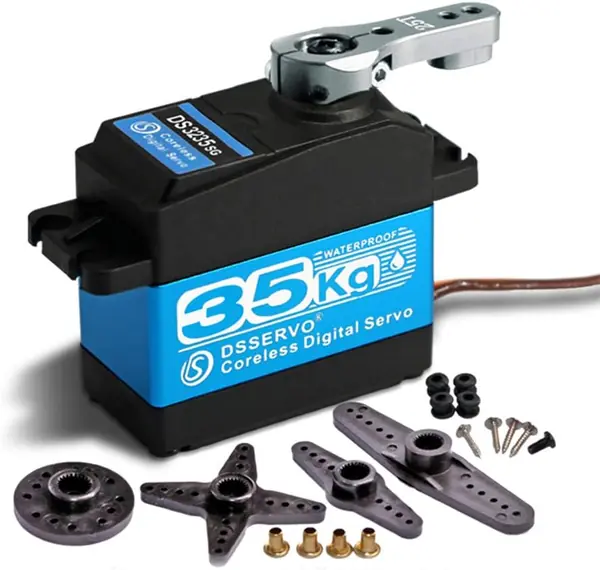
ZOSKAY DS3235 35KG Coreless Servo Best Midrange Upgrade

ZOSKAY DS3235 35KG coreless servo with stainless gears in a blue case

1/8 truggies

Track Score 92/100
Stall Torque
35 kg·cm at 7.4V
Speed
0.11 sec/60° at 7.4V
Gears
Stainless steel and aluminum
Operating Voltage
5V to 7.4V
View on Amazon

Your ESC decides how much of this servo you get, and even at 6V we think it is the right step up for anyone running 1/8-scale tires. The headline 35 kg·cm and 0.11 sec/60° are quoted at 7.4V; at 6V the torque is 32 kg·cm and the transit stretches to 0.12, and at 5V it is 29 kg·cm and 0.13.

The hardware is a level above the budget servos. The gear train is stainless steel and aluminum rather than copper and aluminum, it rides on dual ball bearings at the output, and the CNC aluminum middle case doubles as a heat sink. The coreless motor runs noticeably quieter than the cheaper units we ran alongside it, and the listed 2.3A stall current at 7.4V is the figure to hold against what your BEC can supply.

The 270-degree version we tested sweeps far enough for a robot joint as well as a steering rack, and at 60 g on a standard footprint it swaps into most 1/8 and 1/10 mounts with no adapter. Where it gives ground to the Perfect Pass is sheer grunt; where it beats the 20 kg servos is dragging a heavy truck out of a rut without stalling.

Worth Noting

  • Centering drifts on some units
  • Gears can strip in a hard hit
Our Verdict

We think it is the smart middle step: 35 kg·cm and 0.11 sec/60° at 7.4V, stainless gears and a coreless motor for a midrange price.

Check Latest Price
4.

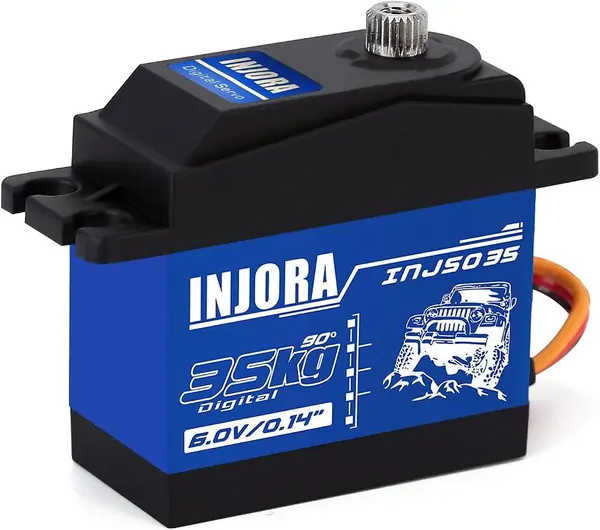
INJORA INJS035 35KG Digital Servo Best Budget High-Torque

INJORA INJS035 35KG metal-gear digital servo in a black and blue case

Budget crawlers

Track Score 91/100
Stall Torque
35 kg·cm at 6V
Speed
0.14 sec/60° at 6V
Operating Voltage
4.8V to 6V
Travel
90° to 120°
View on Amazon

Of the 35 kg servos here, this is the slow one: 0.14 sec/60° at 6V, 0.16 at 4.8V. It is also the one that makes its full 35 kg·cm on a plain 6V feed, which means it asks for no high-voltage BEC and no extra electronics to do the job it was bought for.

We like it for exactly that trade. A heavy 1/10 crawler running a stock 6V BEC gets real steering authority out of it, and the front wheels hold their line against a rock instead of stalling. The metal gear train, the 60 g weight and the standard 40.5 x 20 x 40.5 mm case mean it drops into the same mount as the servo it replaces, and the 260 mm JR lead reaches most receivers without an extension.

Worth Noting

  • Centering wanders on some units
  • Only 90 to 120 degrees of travel
Our Verdict

For a heavy truck on a light budget: full 35 kg·cm on a plain 6V BEC, with speed as the trade.

Check Latest Price
5.

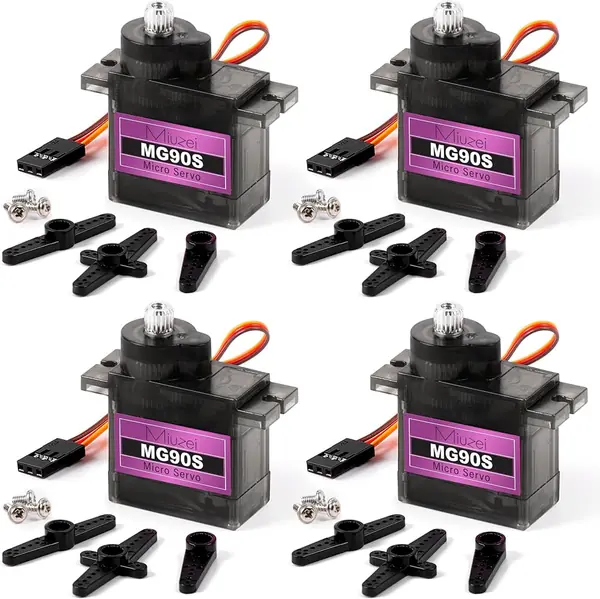
Miuzei MG90S 9g Micro Servo 4-Pack Best for Small Planes

Miuzei MG90S 9g micro servo four-pack with metal gears and horns

Park flyers

Track Score 90/100
Stall Torque
2.0 kg·cm at 6V
Speed
0.08 sec/60° at 6V
Operating Voltage
4.8V to 6V
Weight
0.48 oz each
View on Amazon

Nine grams is the whole point. These fit a foam-board airframe, a 1/18 crawler or the control surfaces of a small glider, and at 0.48 oz each with 2.0 kg·cm of torque at 6V they do not ask much of the model in return. The 0.08 sec/60° transit is quicker than anything else in this guide at 6V.

Metal gears are what sold us on the MG90S over the plastic-geared 9 g servos that cost about the same. The aluminum teeth should outlast nylon, the coreless motor is quiet enough that you will not hear it over the prop, and the 180-degree sweep covers ailerons, elevator and rudder with nothing more than the usual endpoint setup.

A four-pack is the other reason we keep these around: one pack covers a whole airframe with a spare left over, and at this price a servo lost to a bad landing is not a disaster. Test each one on the bench before you glue it into a wing, because consistency across a pack is the weak spot.

Worth Noting

  • Too little torque for 1/10 steering
Our Verdict

Our pick for park flyers and micro builds: nine grams, metal gears, a 0.08 sec/60° transit and four to a pack.

Check Latest Price
6.

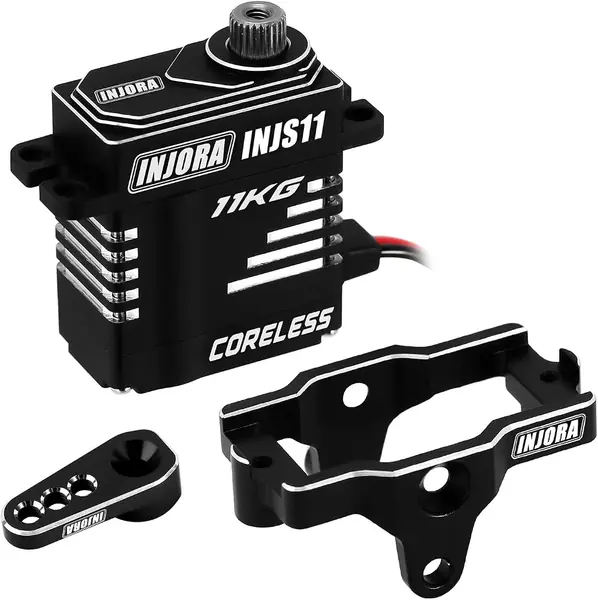
INJORA INJS11 11KG Micro Servo Best TRX4M Upgrade

INJORA INJS11 11KG micro servo with aluminum mount and servo horn

TRX4M upgrades

Track Score 89/100
Stall Torque
11 kg·cm at 8.4V
Speed
0.074 sec/60° at 8.4V
Operating Voltage
6V to 8.4V
Size
32 x 12 x 27 mm
View on Amazon

It ships with the two parts that make a micro servo swap irritating: an aluminum mount and an aluminum servo horn. Both replace the plastic originals, and neither is compatible with the stock TRX4M pieces — that is the point, you are replacing the mount rather than reusing it. The servo itself is 32 x 12 x 27 mm and 21 g.

Torque is 8 kg·cm at 6V, 9.5 at 7.4V and 11 at 8.4V, with transit times of 0.106, 0.085 and 0.074 sec/60° at those voltages. Stainless gears, two ball bearings and a coreless motor are a real step up from the stock micro servo, and the mini 25T spline matches the horn that comes with it.

On the trail the difference shows up as steering that holds under a bind instead of stalling, and a quicker return to center than the truck had before. It is the priciest micro servo in this group, and on a truck with weighted wheels we think the extra buys you a steering servo you stop thinking about rather than one you nurse.

Worth Noting

  • Stock micro ESCs may not power it reliably
Our Verdict

The TRX4M upgrade we fit when the stock servo gives up: 11 kg·cm at 8.4V, stainless gears, and the aluminum mount and horn in the box.

Check Latest Price
7.

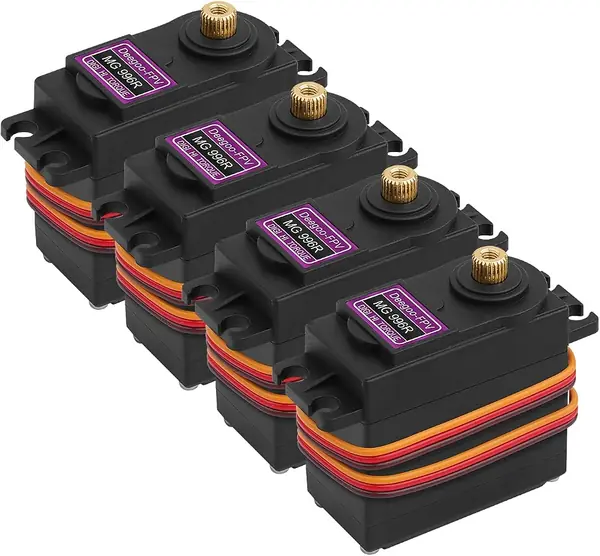
Deegoo MG996R 4-Pack Best for Multi-Servo Projects

Deegoo MG996R metal-gear digital servos shown as a four-pack

Multi-servo projects

Track Score 88/100
Stall Torque
12 kg·cm at 6V
Speed
0.17 sec/60° at 4.8V
Gears
Metal
Pack
4 servos
View on Amazon

Four servos, one pack. A robot arm with six joints, a plane with four control surfaces and a basher that eats steering servos all want multiples, and buying them one at a time gets expensive in a hurry.

Each unit is a standard-size 55 g servo with a coreless motor and a metal gear train, rated 12 kg·cm at 6V and 13 kg·cm at 7.2V. The three-wire connectors are the standard type that fits Futaba, Hitec, Sanwa and GWS receivers, so they drop into most builds without an adapter.

The 0.17 sec/60° transit at 4.8V is the figure to read twice. It is the slowest published speed here, and it tells you these belong in projects where holding a position matters more than snapping to one — landing gear, camera mounts, a walking frame.

We keep the pack for exactly those projects, and for the spare that saves a session when a gear strips. A servo that is a little slow beats a project that is grounded waiting on a delivery.

Worth Noting

  • Wants its own 3A 5V supply
Our Verdict

We keep a four-pack around for robot arms and multi-surface planes, where four metal-gear servos beat one expensive one.

Check Latest Price
8.

ZOSKAY DS3218 20KG Servo Best for Budget 1/10 Builds

ZOSKAY DS3218 20KG metal-gear digital servo with a black metal case

Budget 1/10 builds

Track Score 87/100
Stall Torque
21.5 kg·cm at 6.8V
Speed
0.13 sec/60° at 6.8V
Travel
180°
Water Resistance
IP67
View on Amazon

180 degrees is the whole difference between this and our top pick. Both are DS3218-class servos making 21.5 kg·cm at 6.8V, both run a metal gear train in a CNC aluminum middle case and both weigh about 60 g — but this one stops at 180 degrees, which puts it in steering duty and out of robot joints.

Where it edges ahead is transit speed: 0.13 sec/60° at 6.8V, a hair quicker than the ANNIMOS, and it carries an IP67 water-and-dust rating. The 280 mm lead is longer than most, which reaches a receiver in a 1/10 buggy without an extension.

Mounting is the standard 40 x 20 x 40.5 mm pattern, so it drops into the same holes as whatever it replaces, and the lead terminates in the usual three-wire connector.

We steer people to it for 1/10 buggies, trucks and anything where the extra 90 degrees would go unused, because it is cheaper and marginally faster than our top pick. If you are building an arm or a pan-tilt head, buy the 270-degree version of the same servo instead — it is the same case and the same torque with the travel you want.

Worth Noting

  • Centering and sweep vary from unit to unit
Our Verdict

The same 21.5 kg·cm as our top pick, slightly faster and cheaper, as long as 180 degrees of travel is all your model needs.

Check Latest Price
9.

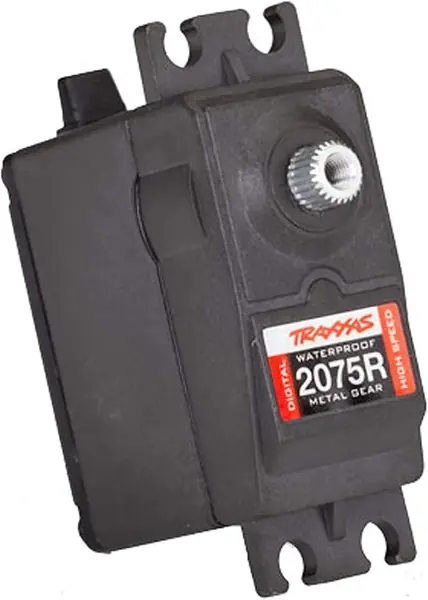
Traxxas 2075R Digital Servo Best for Traxxas Replacements

Traxxas 2075R waterproof metal-gear digital servo with blue case

Traxxas replacements

Track Score 86/100
Gears
Metal, ball bearing
Water Resistance
Waterproof
Torque
125 oz-in at 6V
View on Amazon

Nothing about this servo is exciting, and that is the pitch. It is the part number that came in the truck, so the spline matches the horn you already own, the lead reaches the receiver, and the mounting tabs line up without a shim.

The spec is 125 oz-in of torque at 6V through a metal gear train on ball bearings, in a waterproof case. The case is blue, which is how you tell it apart from the standard unit on the shelf.

In use it is the least dramatic servo here: it centers cleanly, sits quiet at rest and comes back to the same place every time you let go of the wheel. That is exactly what you want in a truck you hand to a kid or loan to a friend for an afternoon.

What you are paying for is the fit and the support behind it. There is no measuring, no adapter, no trimming a mount, and no waiting on a part that turns out to be the wrong spline.

We buy it when the goal is getting back to the parking lot by the end of the afternoon rather than going faster. If you have already moved to bigger tires or a heavier wheel set, this is not the servo that will keep up with them.

Worth Noting

  • Modest torque for the money
Our Verdict

Our choice when a stock Traxxas servo dies and you want the truck running today: correct spline, correct lead, waterproof, no measuring.

Check Latest Price

How We Tested RC Servos

We started with spec sheets — torque at the voltages our models actually run, gear material and motor type, output bearings, case dimensions, spline, lead length, and what ships in the box — then narrowed to 16 servos spanning what a shopper actually faces: 9-gram micros, budget metal-gear standards, coreless midrange units, and one brushless heavyweight. Every one was bought at retail.

Testing ran six months across a crawler course, two 1/10 trucks, a 1/8 truggy, a park flyer, and a bench rig. We measured stall torque at the voltage each model's BEC actually supplies and timed transit over a 60-degree sweep, so the torque-versus-speed trade showed up on the same unit. Transmitter endpoints went in on every install before anything ran, so the linkage never stalled a servo at full lock; we then watched current draw while steering against a load to see how much BEC headroom each one left.

Travel angle got swept end to end and then dialed back at the transmitter to see how much usable rotation a linkage could take before the horn overtraveled. Crawlers went through rock sections and repeated full-lock steering, the trucks took jumps and curb strikes, and the flyer's micros logged a season of control-surface cycles; we sprayed the sealed units, ran them through wet grass, and opened the cases afterward to check for moisture and gear shavings. Centering was checked by returning to neutral from both directions to see how far the horn drifted, and holding quality by parking on a slope with the wheels loaded.

Last came fit and value: case size against the mounts we had, spline and horn compatibility, lead length, and a count of what arrived in the box — a four-pack of standards is a different proposition than one servo with no hardware. Anything that ran hot, drifted off center, or needed shimming came off the list regardless of its torque rating.

How to Choose an RC Servo

Read Your BEC Before You Read the Torque

Every torque figure comes with a voltage attached, and that voltage is the one thing you cannot change later. A 35 kg·cm servo fed 6V makes 32 kg·cm; feed it 5V and it is 29. Look up your ESC's BEC output and its amp rating before you compare anything, because a stock 1/10 unit often supplies 6V at 2 or 3 amps — comfortable for a 20 kg servo and marginal for a 56 kg brushless one.

If the numbers are close, an external BEC costs far less than the servo it saves. It is also the difference between a servo that browns out your receiver mid-corner and one that simply works.

Torque and Speed Trade Against Each Other

They do not scale together, and the balance you want depends on what the servo moves. Big tires on a heavy truck need torque; a 1/8 truggy on a high-grip track needs transit speed to catch a slide. A 0.14 sec/60° servo in a trail crawler is invisible, and the same servo in a race truck feels lazy.

If you can only have one, take torque in anything with big tires and speed in anything with small ones. The crawler that stalls is stuck; the basher that is a hundredth of a second slower is just a hundredth of a second slower.

Gears, Bearings and the Motor

Metal gears are the floor, not the ceiling. Copper and aluminum is the budget standard, stainless steel shows up in the harder-hitting servos, and the difference appears after a season of contact rather than on the first run. Dual ball bearings on the output matter as much as the gear material, because that is where side load from the linkage lands.

A coreless or brushless servo motor is smoother and quieter than a standard DC one, and it accounts for most of the price at the top of this guide. Pay for it when the servo is working constantly; skip it when the model only steers.

Fit: Case Size, Spline and Lead Length

Standard size is 40 x 20 x 40.5 mm and covers most 1/10 and 1/8 mounts; micro servos run closer to 32 x 12 x 27 mm and 21 g, and the 9 g class is smaller again. Three checks before you order: case dimensions against your mount, spline count against the horn you already own, and lead length — 260 mm is common, and a short lead means buying an extension.

A servo that fits the mount can still foul the body, the battery tray or the steering link at full lock, so look at the space above and behind it as well as the hole pattern.

Water, Dust and Where It Lives

A bare waterproof claim tells you less than a rating does. IP67 means it survives a dunking and a rinse; IP66 handles spray and splashes. If your running involves creeks, snow or a hose at the end of the day, buy the higher rating, and dry the case before the truck goes back on the shelf.

Sealed servos still have an output shaft that water can find its way past, so avoid leaving one submerged longer than the crossing takes.

Frequently Asked Questions

Final Verdict

The ANNIMOS DS3218MG is the one we point most people at, because 21.5 kg·cm and 270 degrees of travel cover a 1/10 crawler, a basher and a robot arm without changing part numbers, and it costs less than the other high-torque servos here.

Step up to the ZOSKAY DS3235 if your truck runs 1/8-scale tires, or to the Perfect Pass Monster if it is heavy enough to have killed everything cheaper. For a TRX4M or a park flyer, the INJORA micro and the Miuzei four-pack are the right shape, the right weight and the right place to start.