Best ESCs for RC Cars of 2026

A burnt ESC has a smell of its own, and it tends to arrive at the far end of a parking lot with a full battery and no daylight left. The speed controller decides how much of the battery's power reaches the motor. A good one pulls the car away cleanly, holds the brakes on a slope and keeps the steering servo from browning out mid-corner.

The biggest number on the box is the peak rating. The one that decides whether you finish a pack is the continuous rating, and only if the case can shed the heat behind it. Waterproofing works the same way: the rating covers the case, not your exposed connectors. We ran 12 controllers in a 1/10 basher on gravel, a brushed crawler over creek rock and a heavier 1/8 build, judging feel at walking pace and whether the tuning app or card was worth using.

Our Top Picks

The Best ESCs for RC Cars

1.

Hobbywing Quicrun WP 10BL120 G2 Best Overall
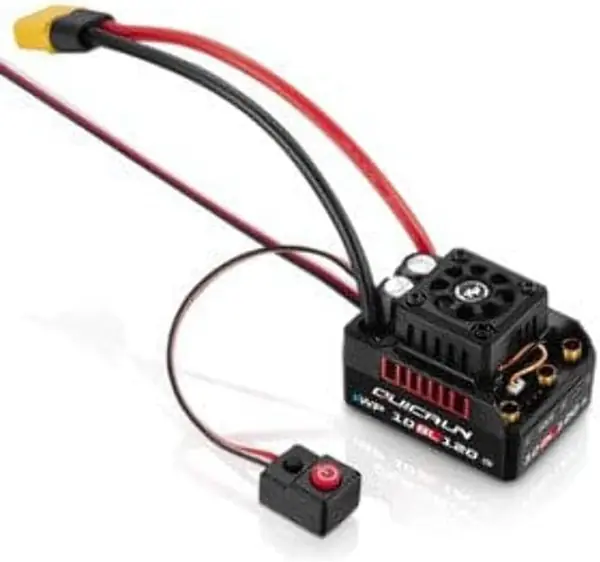
Hobbywing Quicrun WP 10BL120 G2 brushless ESC in black with sealed case

1/10 brushless bashers

Track Score 92/100
BEC Output
5A continuous / 10A peak; 6V / 7.4V
Battery Support
2-4S LiPo
Motor Limit
3S: ≤4000KV 3660; 4S: ≤2600KV 4268
Continuous/peak Current
120A / 760A
View on Amazon

The 4S motor limit is what makes the Quicrun WP 10BL120 G2 our default for 1/10 brushless bashers. Hobbywing rates it for 2-4S LiPo, with a 120A continuous and 760A peak rating, and caps the motor at 4000KV or less on 3S with a 3660 can and 2600KV or less on 4S with a 4268. We like that spread because it covers a short-course truck on 3S and leaves room for a bigger motor later without making the ESC feel like overkill. The built-in 1640uF capacitor also means one less external part to mount.

Waterproofing and the BEC matter as much as the amp number. The case is sealed against water and dust, and the 5A continuous / 10A peak BEC can feed a strong steering servo at 6V or 7.4V. We paid attention to the protection list too: low-voltage cutoff, overheat, throttle-signal loss, current, and capacitor overheat are all covered, which is the sort of thing you notice only when a pack gets low or a fan stops. The separate programming port makes tuning easier, though you need the LED program card to do it without counting blink codes.

The catch is sensorless operation only. This is not the ESC for a technical crawler or a truck where you want the last bit of low-speed smoothness; the 1080 G2 is the better fit there. For a basher that sees dust, puddles, and 3S packs, the 10BL120 G2 has the headroom and the sealed build we want. It is also an ESC only, so pair it with a motor that respects the KV limits rather than assuming the 120A label covers everything.

Worth Noting

  • Sensorless only so no sensored crawl mode
Our Verdict

Our default for 1/10 brushless bashers is the Hobbywing Quicrun WP 10BL120 G2, with 2-4S headroom, a waterproof case, and a stout 5A BEC.

Check Latest Price
2.

Hobbywing Quicrun WP 1080 G2 Best Brushed Crawler ESC

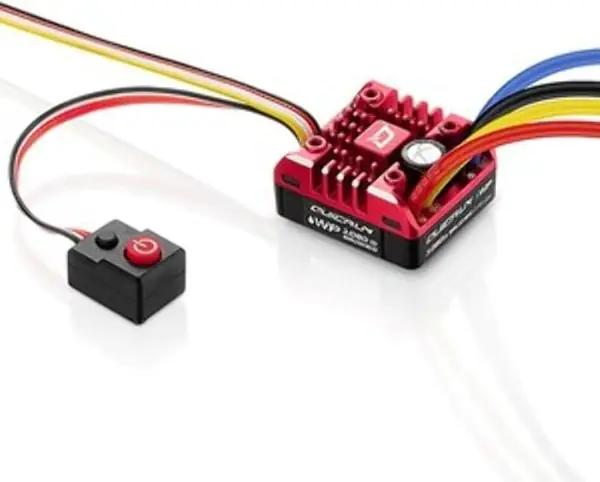
Hobbywing Quicrun WP 1080 G2 brushed ESC with built-in capacitor module

Brushed crawlers

Track Score 91/100
BEC Output
6V / 7.4V / 8.4V switchable
Battery Support
2-3S LiPo
Motor Type
Brushed
Programmable Parameters
15
View on Amazon

The Quicrun WP 1080 G2 is a brushed-only ESC, and that is the first thing to understand about it. It works with 2-3S LiPo and gives you four operating modes, including forward/reverse with brake and a real-car mode that switches motor direction from an open channel on your transmitter. For a scale crawler, that last feature is not a novelty: it lets you back out of a tight line without changing the throttle trim, and it makes the truck feel more like a vehicle and less like a switch.

We like the tuning depth more than the headline modes. There are 15 programmable parameters, nine drag-brake levels, adjustable PWM frequency, and freewheeling that can be turned on or off, so you can dial in the startup and drag brake for a heavy hardbody or a light trail rig. The BEC is switchable between 6V, 7.4V, and 8.4V, which is enough for the high-voltage servos many crawler builds run. We did notice that the real-car and on-the-fly drag-brake features need a free receiver channel, so plan your radio layout before you mount the ESC.

The sealed case and built-in capacitor are welcome on wet trails, and the brushed motor limit keeps the whole package simple. If your crawler still runs a brushed motor, this is the ESC to buy; if you have already gone brushless, the 10BL120 G2 is the more natural fit. The 1080 G2 is not trying to be a basher controller, and that focus is exactly why it works so well at a creep.

Worth Noting

  • Programming card no longer included
Our Verdict

For brushed crawlers, the Quicrun WP 1080 G2 earns our pick with real-car direction switching, deep drag-brake tuning, and a sealed case.

Check Latest Price
3.

XC C8 160A ESC Best for 1/8 Scale

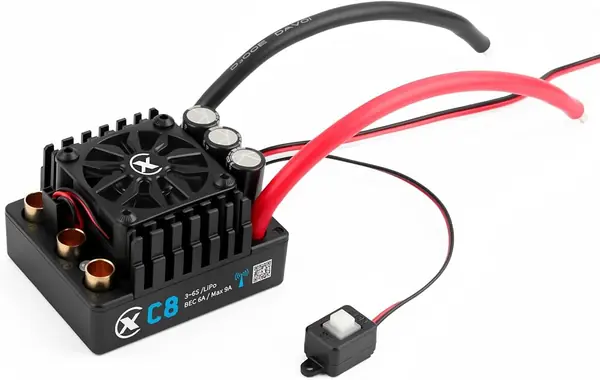
XC C8 sensorless brushless ESC in black metal case with cooling fan

1/8 brushless builds

Track Score 87/100
BEC Output
6V / 7.4V / 8.4V; up to 9A
Battery Support
3-6S LiPo
Current
160A continuous
Waterproof Rating
IP67
View on Amazon

The XC C8 is the 1/8-scale option in this group: 3-6S LiPo, 160A continuous, and a BEC that can be set to 6V, 7.4V, or 8.4V and pull up to 9A. The case is compact for that much current at 2.35 by 1.9 by 1.41 inches and 159 grams, and it is IP67 rated for water and dust. If you are building a buggy or monster truck that will spend time on 6S, those numbers are the reason to look here.

The app control is the feature that separates it from a typical set-and-forget ESC. You connect to the RTR-Link app and change parameters from your phone, with no programming box or module to keep in your pit bag. The protection suite covers low voltage, over voltage, throttle loss, abnormal braking, and over temperature, which is the right list for a high-power build. We also appreciate that the current-control algorithm is there to soften the pulse loads that can beat up a motor.

What we like most is how little the C8 asks of a 1/8 build. The footprint leaves room for wiring, the BEC has enough headroom for a strong servo, and the app makes a gearing change less of a chore. It is a basher ESC rather than a crawler unit, so pair it with a motor and gearing that suit your surface. For a 6S buggy, that is the set of trade-offs we can live with.

Worth Noting

  • No connector included on this version
  • Fan is exposed to debris
Our Verdict

The XC C8 is our choice for 1/8-scale builds that need 3-6S and 160A, especially if you want phone-based tuning instead of a programming box.

Check Latest Price
4.

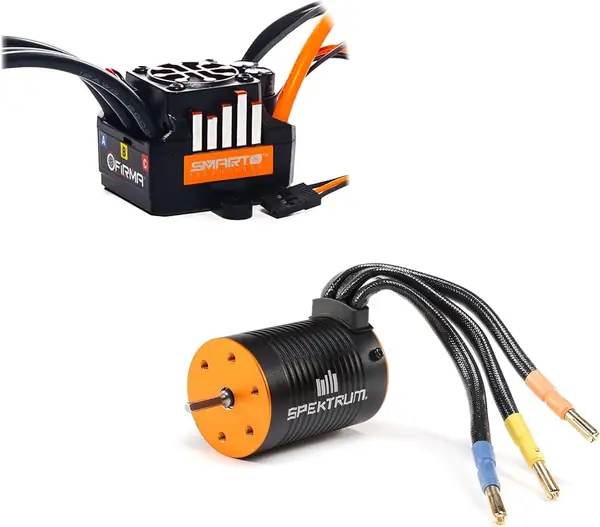
Spektrum Firma 100A/6500Kv Combo Best for No-Prep Drag

Spektrum Firma 100A Smart ESC and 6500Kv sensorless motor combo

No-prep drag racing

Track Score 86/100
Motor
6500Kv sensorless
Application
2S no-prep drag
ESC Current
100A
Programming
Transmitter Text Gen, programming box, or SmartLink
View on Amazon

No-prep drag racing asks for a very specific kind of power delivery, and the Spektrum Firma 100A/6500Kv combo is built for that lane. It pairs a 100A Smart ESC with a 6500Kv sensorless motor, and Spektrum sources the set for Stock Class and Pro Class 2S drag cars. If you are building a drag car, the matching motor and ESC take a lot of the guesswork out of the build.

The Smart side is genuinely useful. You can program through the transmitter with Text Gen, through the Smart ESC Programming Box, or through the SmartLink USB application. The system also carries all-in-one telemetry, so you can see what the car is doing without adding a separate sensor harness. The 32-bit processor and waterproof construction are the sort of details that matter when you are making repeated passes and the electronics are packed tight.

The 6500Kv motor is a 2S drag piece, not a general-purpose basher motor. Put it in a heavy off-road truck or gear it for 3S and the output shaft is the part to watch. The combo is ready to install with no soldering, and the aluminum heat sink and optional fan help, but it still wants gearing and tires that match its class.

What seals it for us is the programming. Being able to change settings from the transmitter at the track is a real convenience, and the telemetry makes the combo feel more integrated than a generic motor-and-ESC pairing. It is not the right first basher setup, but for a 2S no-prep car it is the combo we point to. The Firma is the premium pick here, and that premium buys the Smart ecosystem and the matched 6500Kv motor.

Worth Noting

  • 2S drag focus limits general use
Our Verdict

We like the Spektrum Firma combo for 2S no-prep drag racers: a matched 100A ESC and 6500Kv motor with easy Smart programming.

Check Latest Price
5.

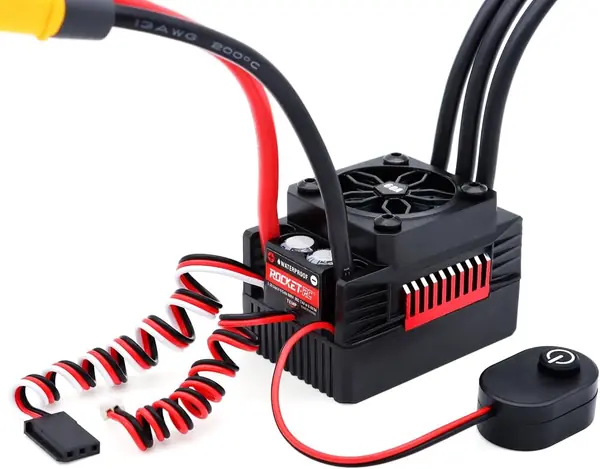
Surpass Hobby Rocket 60A Best Budget Brushless

Surpass Hobby Rocket 60A waterproof brushless ESC with black heatsink

Budget 1/10 brushless

Track Score 80/100
BEC Output
6A continuous; 6V / 7.4V / 8.4V
Current
60A continuous
Waterproof Rating
IP67
Cooling
Integrated heatsink and copper thermal plate
View on Amazon

The Surpass Hobby Rocket 60A is the budget brushless pick, and the 6A BEC is the number that makes it interesting. That continuous 6A output, switchable between 6V, 7.4V, and 8.4V, is more servo headroom than you usually get in this price tier. We also like the IP67 sealing and the ruby capacitors with thermal protection, because a cheap ESC that cooks its capacitors is no bargain. The integrated heatsink and copper thermal plate give it a better chance in a tight 1/10 chassis.

At 60A, it is a milder brushless controller, so it suits a 1/10 buggy or short-course truck rather than a high-power 1/8 build. The stock settings are a sensible starting point, and the protection suite includes low-voltage cutoff and over-temperature shutdown. If you want a first brushless upgrade without paying for app tuning or telemetry, this is the one we point to. Just match the motor and battery to the ESC's limits; the 60A rating is not a free pass to run a hot motor setup.

Worth Noting

  • 60A limits it to milder 1/10 setups
Our Verdict

The Surpass Hobby Rocket 60A is our budget brushless pick, provided your 1/10 motor stays within its 60A comfort zone and you want a strong BEC.

Check Latest Price
6.

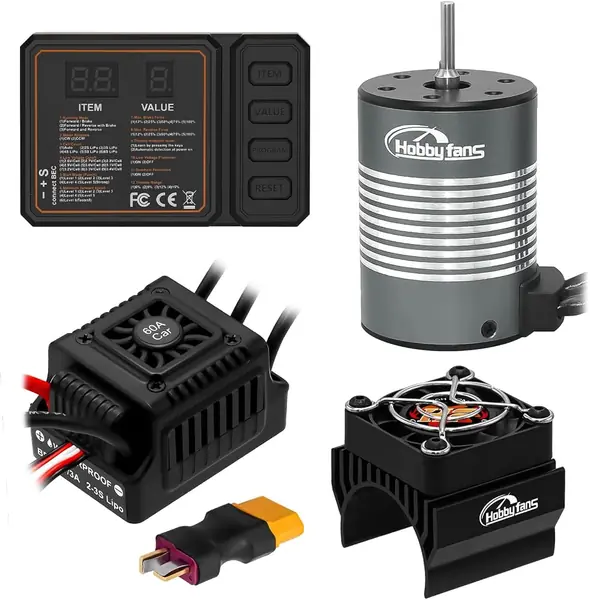
Hobby Fans S3650 4300KV Combo Best Value Combo

Hobby Fans 3650 4300KV brushless motor and 60A ESC combo with heatsink

2S on-road builds

Track Score 79/100
Motor
3650 4300KV brushless
ESC
60A brushless
Included
Motor, ESC, heatsink, and programming card
Shaft Diameter
3.175mm
View on Amazon

The Hobby Fans S3650 combo is a matched brushless set: a 3650 4300KV motor, a 60A ESC, a CNC-machined aluminum heatsink, and a programming card. The motor has a 3.175mm shaft, which fits a lot of 1/10 pinions, and the whole package is aimed at replacing a tired brushed system without making you shop for each part separately. For a first brushless swap, that is a real convenience.

We like that the programming card is included, because it turns the ESC's settings into something you can actually adjust instead of a menu you avoid. The 60A controller and 4300KV motor are a strong value pairing, and the heatsink is more substantial than the stamped pieces on some budget combos. The catch is the motor limit: the 4300KV wind is a 2S on-road choice under the compatibility table, so a 2S or 3S off-road truck needs a lower-KV motor.

The combo is not a crawler setup and it is not a high-power 1/8 system; it is a sensible 1/10 on-road or light-truck upgrade where the included card and heatsink save time. If you already have a radio and battery, this is one of the simpler ways to go brushless. It is also a good reminder that a combo's KV rating matters as much as its amp rating when you are matching it to a chassis.

Worth Noting

  • Fan may not clear every motor mount
Our Verdict

Our value combo choice is the Hobby Fans S3650 4300KV set, which pairs a 60A ESC with a matched motor, heatsink, and programming card.

Check Latest Price
7.

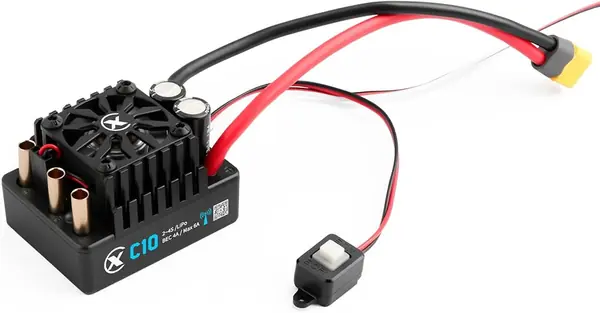
XC C10 120A ESC Best App-Tuned 1/10

XC C10 sensorless brushless ESC in black metal case with XT60 plug

1/10 brushless bashers

Track Score 78/100
BEC Output
6V / 7.4V / 8.4V; up to 6A
Battery Support
2-4S LiPo
Current
120A continuous
Waterproof Rating
IP67
View on Amazon

The XC C10 sits between a basic 60A controller and the bigger C8: 2-4S LiPo, 120A continuous, a BEC adjustable to 6V, 7.4V, or 8.4V with up to 6A, and an IP67 case. At 2.08 by 1.57 by 1.39 inches and 113 grams, it is small enough for a crowded 1/10 chassis. The XT60 version is the one to grab if your batteries already use that plug.

The RTR-Link app is the reason to choose it over a jumper-tuned ESC. You can change parameters from your phone without a programming box, and the protection package covers low voltage, over voltage, throttle loss, abnormal braking, and over temperature. We appreciate the 4S headroom because it lets a 1/10 truck grow from 2S to 4S without changing the ESC, as long as the motor stays within its limits.

What we like most is the balance: 120A and 4S are enough for a 1/10 basher, the case is compact, and the app keeps tuning simple. It is sensorless, so it is not the ESC for a technical crawler. For a 1/10 truck that spends its time bashing rather than crawling, those are acceptable trade-offs. The C10 makes sense when the C8 is more ESC than the chassis needs.

Worth Noting

  • No warranty is stated
Our Verdict

The XC C10 is our app-tuned 1/10 pick, with 2-4S headroom and a compact case for bashers who want 4S without the 1/8 bulk.

Check Latest Price

How We Tested the Best ESCs for RC Cars

The shortlist started as a spreadsheet of spec sheets: motor type, cell count and low-voltage cutoff, continuous and peak amps, KV ceiling, BEC output, connector type, tuning method, and price. We filtered for controllers that fit the builds people actually run — 1/10 bashers, brushed crawlers, a 1/8 buggy, a 2S no-prep drag car — then tested 12 of them over six months, always within the maker's stated cell count, motor KV, and amp limits.

Each one went into a car that matched its intended use: a dirt and gravel lot for the bashers, creek rock and steep clay for the crawler, a flat parking lot for the drag car. After every pack we shot heatsink and motor-can temperatures with an infrared gun, then kept running to see whether thermal rollback stepped in, how much power it pulled back, and how quickly it recovered.

Feel mattered as much as numbers. We crawled at walking pace to catch cogging and hesitation off the line, parked nose-down on a slope to see whether the drag brake actually held, and cycled forward-brake-reverse to check for delay and jerk. To test BEC headroom we held a steering servo against a curb at full lock and watched for receiver brownouts, with only one BEC ever powered in a model.

Water testing meant wet grass, puddles, and a hose splash, followed by a dry-out and a close look at the connectors and receiver, since the case rating doesn't cover either. Over the months we logged fan jams, repeat shutdowns, and any smell of burnt electronics, and we judged value by what came in the box — programming card, heatsink, plug — against what the controller could do without extra hardware.

How to Choose an RC Car ESC

Match the ESC to the Motor and Battery

Start with the motor you have or plan to run. A brushed ESC like the Quicrun 1080 G2 will not drive a brushless motor, and a brushless controller expects a sensorless or sensored motor that matches its mode. Check the ESC's cell count and its motor limit table, not just the amp rating: a 120A unit may still cap you at 4000KV on 3S or 2600KV on 4S with a larger can. If you are upgrading a 1/10 basher, 2-4S and 60-120A covers most builds; a 1/8 truck needs the 3-6S, 160A territory of the XC C8. Buy for the battery you actually own, then leave a little headroom.

Decide How Much Brake and Low-Speed Control You Need

Forward, reverse, and brake sounds simple until you drive a crawler. A basher wants strong brakes and punchy reverse; a crawler wants adjustable drag brake, precise startup, and sometimes a real-car mode that switches direction from the radio. The 1080 G2 is the clear crawler choice here because its drag brake and startup are tunable in fine steps. A sensorless brushless ESC can be smooth enough for trails, but it will not match a brushed crawler controller at a creep. Match the mode set to the driving you do most, not the one on the box.

Plan for Water, Heat, and Space

An IP67 or waterproof rating is worth having, but it covers the ESC case, not your battery plug, receiver, or exposed sensor wire. We still dry and inspect those after a wet run. Heat is the other half: a sealed case with a fan needs clean airflow, and a tall-geared 3S truck can hit thermal shutdown even when the ESC is rated for the voltage. Measure the footprint before you buy, especially in a cramped 1/10 chassis, and choose the connector version you need; some high-power units ship without a plug.

Budget for Tuning and Servo Power

The BEC is the spec people skip until a strong steering servo browns out the receiver. Look for at least 5A continuous on a 1/10 build, and make sure the voltage settings match your servo. Then budget for the tuning method: a programming card, a phone app, or a transmitter-based system. The cheapest ESC is not the cheapest ownership if you have to buy a card separately, and the most expensive one is not automatically the easiest to live with. We prefer a clear tuning path to a long feature list.

Frequently Asked Questions

Final Verdict

We recommend the Hobbywing Quicrun WP 10BL120 G2 as the default for 1/10 brushless bashers. It has the 2-4S headroom, 120A rating, and waterproof build that let a truck grow with your motor and battery collection, and the 5A BEC keeps a strong servo fed.

If your rig is still brushed, the 1080 G2 is the better fit; if you are building 1/8, the XC C8's 3-6S and 160A capacity is the one to choose.