Best RC Buggies for Racing of 2026

Speed is the easy part. Nearly any hobby-grade buggy hits 40 mph in a straight line on a fresh pack, and the box says so in letters four inches tall. It won't say how the buggy steers once the dirt goes loose, whether the shock towers survive a bad landing, or whether the part you just broke costs nine dollars and ships this week.

Scale mattered more than top speed across 12 buggies run on a groomed dirt track, indoor carpet and a backyard course of gravel and hardpack. A 1/24 micro keeps a small space interesting, while a 1/10 4WD needs room to stretch. Box contents matter too: a brushed buggy with a battery and charger runs on day one, and a brushless one with throttle limiting is the gentler step up for a new driver.

Our Top Picks

The Best RC Buggies for Racing

1.

CROBOLL RLAARLO SBK10 1/10 Buggy Best Overall
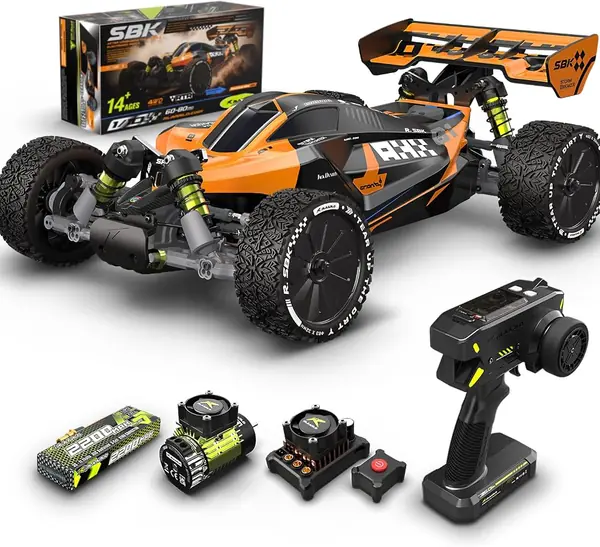
CROBOLL RLAARLO SBK10 orange 1/10 4WD brushless RC buggy with aluminum chassis

Dirt-track racing

Track Score 90/100
Scale
1:10 4WD buggy
Chassis
2.5mm aluminum, 7075-T6 shock towers
Motor And ESC
2852 3100KV brushless, 45A ESC
Radio
6-channel 2.4GHz, 350 m range
View on Amazon

A 1/10 buggy is the class most dirt tracks actually run, and the SBK10 is the only open-wheel buggy here built to that size with a 2.5mm aluminum pan, 7075-T6 shock towers and steel CVDs under a brushless motor. That hardware is why it's our top pick: the parts that take hits are metal, the parts that wear are replaceable, and nothing about the layout is toy-grade. A 2852 3100KV motor and 45A ESC run on the 3S pack that comes in the box, which is the detail that separates it from the ARRMA GROM further down this page.

The radio is better than the price suggests. It's a six-channel 2.4GHz transmitter with a telemetry lead that puts live pack voltage on the screen, so you can watch a pack go soft before the ESC cuts it off in the middle of a corner. Claimed range runs to 350 meters, far more than a buggy track needs; the practical payoff is a link that does not get walked on when a dozen other radios are switched on.

Treat the 40+ mph figure as a target rather than a guarantee, because gearing, surface and pack condition move it more than the spec sheet suggests. The parts to order with the buggy are axles and suspension links, which are what a curb hit at speed tends to claim. Having them in your pit box means a broken run costs ten minutes instead of a week.

Worth Noting

  • Transmitter menus take a session to learn
Our Verdict

Our pick for anyone who wants to race a real 1/10 buggy: brushless power, a 3S pack in the box, and race-grade hardware for midrange money.

Check Latest Price
2.

ARRMA Typhon GROM 223S BLX Best Step-Up Brushless

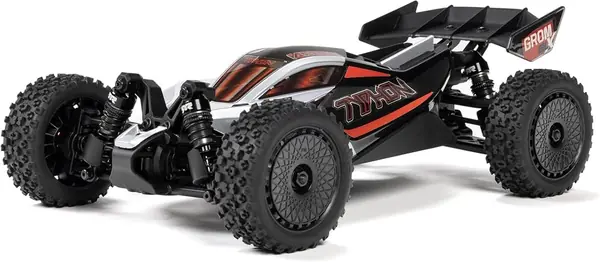
ARRMA Typhon GROM 223S BLX silver small-scale 4WD brushless RC buggy

Learning to race

Track Score 89/100
Motor And ESC
2838 4500Kv brushless, 25A 2-in-1
Top Speed
50+ mph on 3S
Battery
2S and 3S LiPo ready, not included
Stability
Spektrum DSC, four modes
View on Amazon

Dynamic Stability Control is the feature that separates this GROM from every other fast buggy on the page. Four selectable modes and a throttle limiter sit between your thumbs and a Spektrum 2838 4500Kv brushless motor, and the buggy is 2S and 3S ready, so one chassis covers a nervous first lap and a 50+ mph straight.

We think that is the most useful thing money buys in this group. A beginner can start at a limited throttle setting in a stability mode that catches the rear before it steps too far, then hand themselves more as the laps come together, so you learn to race rather than learn to repair. ARRMA also ships the popular option parts already installed, so the upgrades that matter are not a second purchase.

The catch is in the box list: no battery and no charger. You add an IC2-compatible pack, and only on 3S do you get the headline speed; on 2S it is a much calmer buggy. Price the power side in before you compare it with the brushed GROM, which arrives ready to run.

Worth Noting

  • Battery and charger sold separately
Our Verdict

We point new racers here when they want real speed without losing control of it — the stability modes and throttle limiter are worth paying for.

Check Latest Price
3.

ARRMA Typhon GROM 4x4 Brushed Best Complete Starter Package

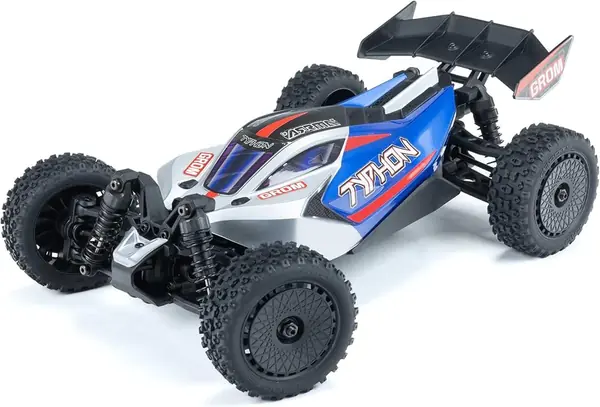
ARRMA Typhon GROM blue and silver small-scale 4WD brushed RC buggy

First-time buyers

Track Score 88/100
Drive
4WD, MEGA 380 28T brushed
Charger
S10 G2 mini USB-C
Drivetrain
Enclosed metal gears
Included Battery
7.4V 1400mAh 2S LiPo
View on Amazon

Everything needed to run is in the box, which is rarer than it sounds in this class: a Spektrum 7.4V 1400mAh 2S LiPo, a USB-C smart charger, and four AA batteries for the transmitter. For a first buggy that means one purchase and a wall socket, with no second order sitting between you and a first run. We think that completeness is the whole argument for this version over the brushless one.

Under the body, the MEGA 380 28T brushed motor drives an enclosed metal gear drivetrain, and the SX110 servo is metal-geared too — the parts that strip on cheap buggies are the parts ARRMA spent the money on. The clipless body mounts earned our appreciation as well: no pins to lose in the grass at a track day, and the shell comes off in a second when something needs checking.

It runs best on prepared ground — short grass, hardpack, pavement — and a rutted, loose outdoor track will find the limits of the small-scale chassis quickly. That is the trade for a buggy you can run in a driveway, and it is why we keep it as the first buggy rather than the race buggy.

Worth Noting

  • Brushed motor caps outright race pace
Our Verdict

The buggy we hand someone who has never owned one: battery, charger and transmitter batteries are all in the box, and the drivetrain is metal where it counts.

Check Latest Price
4.

Losi Micro-B 2WD Buggy Best Indoor Racer

Losi Micro-B white 1/24 scale 2WD RC buggy with aluminum chassis

Indoor carpet racing

Track Score 87/100
Scale
1:24 2WD buggy
Chassis
Aluminum, oil-filled shocks
Top Speed
13+ mph
Runtime
20 minutes per charge
View on Amazon

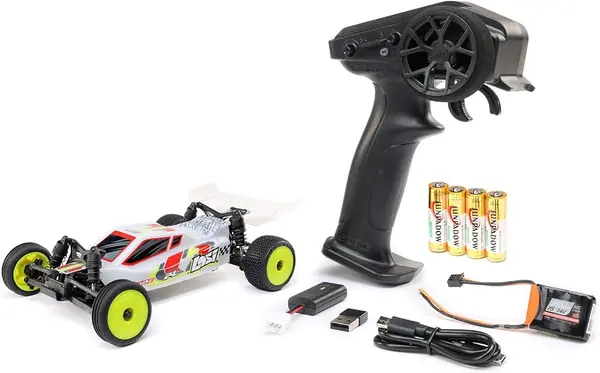
Set out a course with a few books and a stretch of low-pile carpet and the Micro-B makes sense immediately. It is a 1/24 scale 2WD buggy built on the layout of Losi's bigger race cars — aluminum chassis, oil-filled shocks, TLR-inspired geometry — and it rotates off the throttle the way a buggy should rather than tracking like a toy.

What makes it an easy recommendation is how complete it is. Transmitter, 350mAh 2S pack, charger and tools all come with the car, and an hour on the charger buys about twenty minutes of racing. We like that the 65T brushed motor and the 2-in-1 ESC keep the pace in a range you can actually race in a room; 13+ mph down a hallway is a handful, not a bore.

Small scale sets the limits. This is a carpet, driveway and smooth-concrete buggy; loose dirt and gravel bog it, and outdoors it is an easy target for a curb. Spares are inexpensive and the car is designed to be worked on, so treating it as the indoor class rather than a shrunken 1/10 is the right way to buy it.

Worth Noting

  • An hour of charging buys about 20 minutes
  • Top speed only suits micro-class racing
Our Verdict

Our indoor racer: a genuine 2WD buggy scaled down to 1/24, complete in the box, and small enough to build a course in a living room.

Check Latest Price
5.

HAIBOXING 905 Protector Best Value

HAIBOXING 905 Protector 1/12 scale 4WD RC buggy with roll cage and spare wheel

Budget 4WD entry

Track Score 86/100
Scale
1:12 4WD buggy
Top Speed
38 km/h
Motor
390 brushed
Shocks
Aluminum oil-filled
View on Amazon

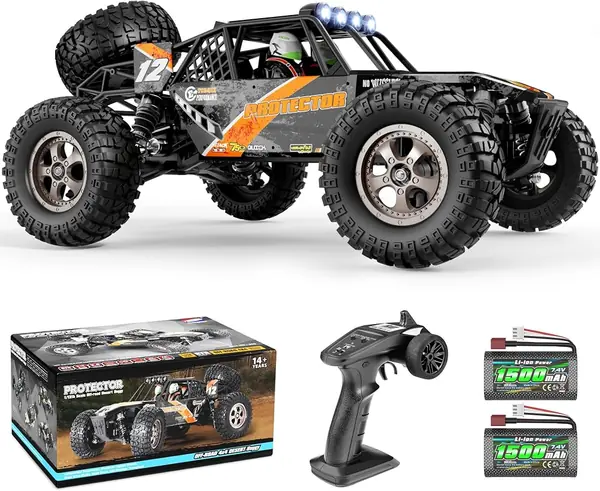
Aluminum oil-filled shocks, a metal differential, ball bearings and a full roll cage are the parts we expect on the 1/10 buggies here, not on the least expensive 4WD in the group. That is the case for the Protector in one line: the money went into the mechanicals.

It is a 1/12 4WD buggy, which suits a backyard course better than either extreme — big enough to see at the far end of a yard, small enough that a modest space still makes a lap. A 390 motor and 7.4V pack are rated at 38 km/h, the 2.4GHz radio claims 260 feet of range, the electronics are IPX4 rated against splashes, and the box carries two batteries, four LEDs on the cage and a serviceable spare wheel.

Where it lands for us is the entry point to a real chassis rather than a toy. You learn throttle control on something with oil shocks and a sealed diff, and the parts that usually get upgraded first are already there. Compared with the Losi Micro-B it is a far bigger buggy for similar money, and the trade is outdoor space instead of indoor convenience.

Worth Noting

  • 38 km/h brushed pace trails the brushless picks
Our Verdict

The least expensive 4WD buggy here, and the hardware list reads like a buggy twice the price: aluminum oil-filled shocks, a metal differential and two batteries.

Check Latest Price
6.

HYPER GO H14BM V3 Best for Rough-Ground Bashing

HYPER GO H14BM V3 black 1/14 brushless RC truggy with aluminum chassis

Rough-ground bashing

Track Score 85/100
Scale
1:14 truggy
Chassis
6061 aluminum
Motor And ESC
2852 4400KV brushless, 45A ESC
Battery
Two 3S LiPo packs
View on Amazon

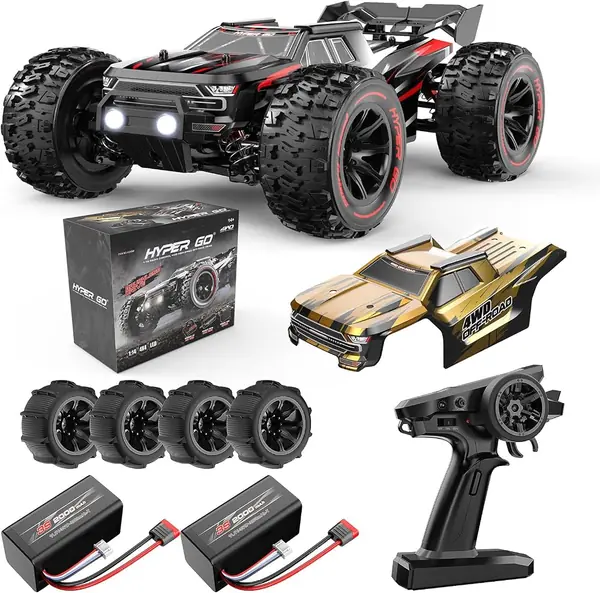
This is not an open-wheel buggy, and we will not pretend otherwise. The H14BM is a truggy, with a wide stance, a body that sits over the wheels and more clearance than a race buggy, so a club running a buggy class will put it in a different heat entirely.

Everything else it does well. A 2852 4400Kv brushless motor, a 45A ESC with 2S and 3S support, a 6061 aluminum chassis, steel differentials and powder-metallurgy gears make it one of the most substantial drivetrains in this group, and the factory 33 mph limit unlocks with five presses of the setup button. Two packs and a generous bag of spare parts come with it.

What makes it easy to live with is the support around it: a second pack, spares in the box, and a parts line that is simple to buy into. We reach for it on days when the track is a dirt lot with a jump in the middle, not on days when there is a timing loop.

Worth Noting

  • Short run times at full throttle
  • Shock and hub parts wear first
Our Verdict

Buy it to bash, not to campaign: this 3S truggy is enormous fun on rough ground and in the air, and a class-legal buggy it is not.

Check Latest Price
7.

RIAARIO 1/10 Brushless RC

RIAARIO black 1/10 4WD brushless RC truck with carbon-fiber chassis

Fun-class 4WD

Track Score 84/100
Chassis
2.5mm aluminum, carbon-fiber deck
Motor And ESC
3650 2650KV brushless, 60A ESC
Stability
Gyro, 0/25/70/100% throttle modes
Servo
11KG metal-gear
View on Amazon

Check the scale label against your class rules before you order. This is sold as 1/10 with a monster-truck shell rather than an open-wheel buggy, which puts it in an open or fun class rather than a buggy heat, and the listed footprint is worth measuring against whatever your rulebook calls 1/10.

The electronics are why it stayed on the list. A 3650 2650KV motor and 60A ESC run on the included 3S pack, a gyro offers 0, 25, 70 and 100 percent throttle modes, and an 11KG metal-gear servo turns tires that are big for the chassis. On loose ground the gyro does real work, straightening the truck when the rear steps out.

Underneath, a 2.5mm aluminum chassis, a carbon-fiber upper deck, a CNC center differential and oil-filled shocks are a genuine step up from the stamped and plastic hardware on toy-grade trucks. What lets it down is the hardware hanging off that chassis: suspension links, axles and the servo mount are where a curb hit lands, and they are the parts to keep spare.

Our read is that this is the big forgiving 4WD of the group — the one to put a new driver in on a loose surface, and the one to leave in the car for a rough lot on a Saturday. It rewards you with composure rather than lap times, and that is a fair trade for what it costs.

Worth Noting

  • Stock battery runs about ten minutes
  • Transmitter programming is hard to follow
Our Verdict

Race-grade electronics — gyro, 60A ESC, 11KG servo — in a big 4WD package that suits a fun class more than a buggy main.

Check Latest Price

How We Tested the Best RC Buggies for Racing

We started with spec sheets and parts diagrams, because the second document tells you more. Any buggy can list a brushless motor and an aluminum chassis; we looked for models whose exploded views showed replacement shock towers, arms, hubs, and axles you can actually order, then filtered by scale, ESC headroom for 2S and 3S packs, and whether a battery and charger came in the box. That left 12 buggies, which we ran for six months.

Testing happened where these things actually get driven: a groomed dirt lot, a carpeted course set up in a garage on rainy weekends, and the gravel-and-hardpack mix most people call a backyard. We ran each buggy in back-to-back packs, timing run time from a full charge to the low-voltage cutoff so battery life was a measured number rather than a claim, and clocked top speed with a GPS unit. Steering got judged in loose dirt at part throttle — the place where a twitchy buggy gives itself away — and we cycled through every stability and throttle-limit mode on the models that had them.

Then we crashed them, deliberately and otherwise. Repeated bad landings on the same corner told us which shock towers and hubs held up, and every break got logged with the time it took to fix and whether the part was in stock. We also swapped shock oil, serviced diffs, and changed wheel hexes and tires to see how much setup a model would take. Packs were charged outside the vehicles on a concrete slab, never unattended, and the fast ones only ran on closed courses away from traffic and bystanders.

How to Choose an RC Racing Buggy

Match the scale to the space you race in

Scale decides where a buggy works before any other specification matters. A 1/10 buggy is the class most dirt tracks run and the one with the deepest supply of tires, bodies and spare parts. Buggies around 1/14 to 1/16 fit smaller lots, and 1/24 micros are built for carpet indoors. Buying a micro to race outdoors, or a 1/10 to run in a hallway, is the mismatch we see most often.

Start from the ground and the grid. A yard, a driveway and a hardpacked lot all suit a 1/10; a garage suits a mini; a rug suits a micro. If there is a local track, ask which classes actually get entries rather than which ones appear on the schedule — a class with three cars is a practice session with a timing loop.

Brushed or brushless, and how much voltage you need

Brushed motors are cheaper and smoother off the line, and they are entirely adequate for a first season. Brushless motors make more power for their size and hold it longer, which is why the fastest buggies here run one. The ESC is what sets the ceiling: a 45A or 60A unit with 2S and 3S support leaves room to grow, while a 25A 2-in-1 is a fixed quantity.

More voltage is not automatically more usable speed. A 3S pack turns a mild buggy into one that spins all four wheels on loose dirt, and it shortens every run. We prefer a buggy that handles both: start on 2S, move up when the laps are clean, and save 3S for the days when the surface has grip.

Stability control and throttle limiting earn their keep

The most useful feature on a fast buggy is one that takes power away. Stability systems such as ARRMA's DSC and the gyro in the RIAARIO intervene when the rear steps out, and throttle limiting caps top speed at a percentage you choose. On loose dirt those two are worth more to a new racer than another few miles per hour.

Use them. A buggy running clean lines at half throttle teaches more in an afternoon than one that spends it on its roof, and the settings give you a way to hand the transmitter to a friend without wincing.

Buy for the parts you'll break

Every buggy here will break something; the question is whether the replacement is on a shelf. Front shock towers, suspension links, axles and wheel hubs take the abuse, and a hard hit on a molded-in tower can mean a chassis swap rather than a bolt-on part.

Before you order, find the parts page for that exact model and confirm that arms, links and towers are listed. Then buy the two or three pieces you are most likely to need along with the buggy. We treat a spares order as part of the purchase rather than an afterthought, and it is the single biggest difference between a hobby that keeps going and one that stalls.

Setup and tires decide more than the motor

Two buggies with identical motors can drive nothing alike. Oil-filled shocks let you change how the car lands and how much weight moves into a corner, a sealed differential puts power down predictably, and tires decide whether any of it reaches the dirt in the first place.

Look for shocks you can rebuild, a diff you can service, and a common wheel hex so you can change compounds. The 12mm hex on the HYPER GO truggy lets you tune it rather than live with whatever came in the box.

Frequently Asked Questions

Final Verdict

The SBK10 takes our top spot because it is the only buggy here built to the class most tracks run, with the metal and the radio to last a season and a 3S pack in the box. If you have never raced, take the ARRMA Typhon GROM with DSC instead: the stability modes and throttle limiter will teach you more in a month than raw speed will. Race indoors and the Losi Micro-B is the honest answer.