Best RC Buggies of 2026

A good bash session is a gravel lot, a charged pack and forty minutes where nothing else matters. The box rarely tells you whether a charger is included, whether the drivetrain survives a season of cartwheels or whether the speed on the sticker fits anywhere you can drive. "Ready to run" rarely means ready to drive.

Scale should follow your ground, not your ambition. The big 1/8 buggies are thrilling and need open space; a 1/10 or 1/12 model gets driven far more often because it fits a backyard. Eight months on a dirt lot, a mowed field and a cul-de-sac at dusk with nine buggies left four that earned another pack: a first hobby buggy, a serious-speed build, a budget basher and a platform for a tinkerer.

Our Top Picks

The Best RC Buggies

1.

ARRMA Typhon GROM 223S BLX Best Overall
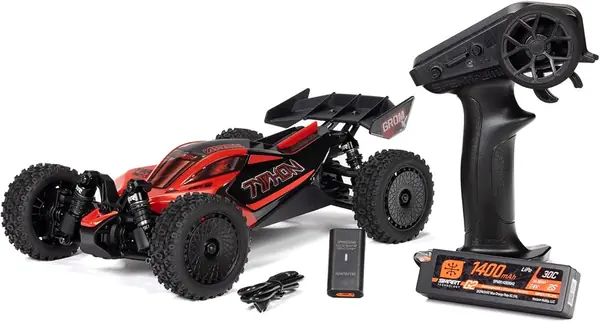
Red ARRMA Typhon GROM small-scale 4WD brushless buggy with battery and charger

First hobby buggy

Track Score 90/100
Top Speed
50 mph
Power System
2838 4500Kv brushless with 25A 2-in-1 ESC
Battery Included
7.4V 1400mAh 2S LiPo and USB-C charger
Driver Aids
DSC stability control and throttle limiting
View on Amazon

The best buggy here is the one you can drive the minute the box is open. ARRMA ships the Typhon GROM 223S BLX with a 7.4V 1400mAh 2S Spektrum pack and a USB-C charger, which removes the most common reason a new buggy sits on a shelf for a week waiting on a second order. We like the small-scale size for the same practical reason: it turns a driveway, a cul-de-sac, or a hard-packed dirt lot into a course.

Small does not mean toy. The 2838 4500Kv brushless motor and 25A 2-in-1 ESC give it real punch on 2S, and the DSC stability control plus throttle limiting are what make it teachable. We spent our first packs on 2S with the limiter dialed back, and that is the right way in: the buggy stays predictable while you learn what the steering does, and you are not chasing it into a hedge every run.

Move to a 3S pack and ARRMA's 50 mph rating stops looking optimistic. The ESC is built for both cell counts, so the upgrade is a battery rather than a new buggy, and the whole thing runs on Spektrum Smart packs and chargers — the same system ARRMA fits to its larger cars. It also fits in a backpack, which is why it is the one we reach for when a lunch break is the only driving window we get.

Ground clearance is the trade for that size. On pavement, concrete and packed dirt the GROM is planted and quick; loose gravel and thick lawn knock a small buggy off line, and that is the honest boundary of what this one is for. Inside that boundary we have not found anything in this group that is as easy to live with.

Worth Noting

  • Short runtime on the single included pack
Our Verdict

We recommend the Typhon GROM to most people: it is the one buggy here that arrives complete and still has a 3S ceiling to grow into.

Check Latest Price
2.

ARRMA Typhon 6S V5 BLX Best for Serious Speed

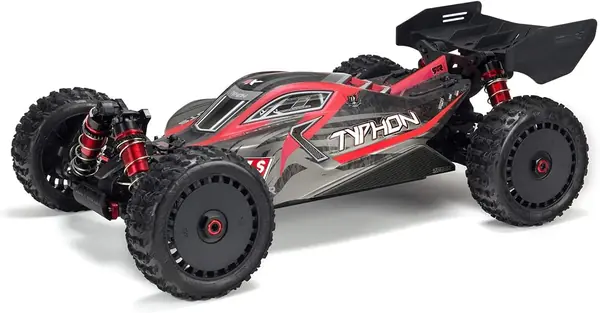
Black and red ARRMA Typhon 1/8 4WD buggy with Spektrum electronics installed

High-speed bashing

Track Score 89/100
Top Speed
70+ mph on 6S with optional pinion
Scale
1/8
Power System
Spektrum Firma 150A Smart ESC, 2050Kv brushless
View on Amazon

Seventy miles an hour is the number that sells the Typhon 6S, and ARRMA is careful about how it is stated: 70+ mph in optimum conditions, on a 6S pack, with the optional speed pinion fitted. Fair enough — those are the conditions. What is easier to miss is that no pack comes with it at all, so the buggy, a 6S LiPo and a charger are three purchases, not one.

We are comfortable with that trade for the right buyer, because the 1/8 Typhon is a serious piece of hardware: a Spektrum Firma 150A Smart ESC, a 4074 2050Kv brushless motor, an S652 metal-geared servo, and an EXB-compatible front brace. This is the buggy in this group that still feels quick when the others have run out of road.

Composure is where it asks for attention. On 6S there is a lot of speed in a 1/8 package, and the buggy will flip, wander, or unload a tire if the surface and setup are not right. On 4S it becomes the more usable machine — still faster than anything else here and far easier to keep pointed straight. Our advice is to run 4S first, learn the chassis, and move up only when the ground in front of you is long enough to justify it.

Worth Noting

  • Battery and charger sold separately
Our Verdict

The Typhon 6S is the raw-speed pick: 70 mph potential on 6S, at the cost of buying your own packs.

Check Latest Price
3.

HAIBOXING 2995 1/12 Buggy Best Budget Buggy

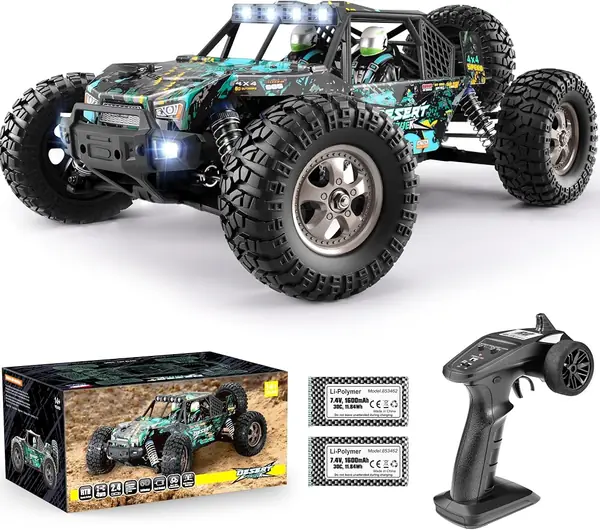
Green and black HAIBOXING 2995 1/12 desert buggy with aluminum oil-filled shocks

Budget bashers

Track Score 88/100
Top Speed
42 km/h
Scale
1/12
Motor
550 brushed
Shocks
Full-aluminum oil-filled
View on Amazon

The 2995 is the least expensive buggy here, and it is the one that made us re-check the spec sheet: a 550 motor, a center differential, and full aluminum oil-filled shocks is unusual hardware at this end of the market. The center diff is the part we care about most. It lets the front and rear axles work against each other instead of fighting, which is exactly where cheap 4WD buggies usually feel clumsy on loose dirt.

It is no slouch either. The 550 motor is rated to 42 km/h, and HBX stretches the wheelbase close to 1/10 proportions, so it tracks straighter across bumpy ground than most 1/12 buggies manage. On a dirt lot or a short grass run it feels bigger than it is, and the IPX4 splash-rated electronics mean a damp morning is not automatically a no.

The trade is plastic where the ARRMAs use metal, and a 550-class drivetrain that will not shrug off abuse the way a 6S buggy does. We are more cautious about it for that reason: this is a buggy for dirt and short grass rather than skate-park concrete, and it asks you to look over the drivetrain after a hard hit. For a first hobby-grade buggy, we think the trade is worth it — you learn what breaks, you learn to fix it, and you have not spent Typhon money finding out.

Worth Noting

  • Durability record is mixed at this price
Our Verdict

We point budget-minded bashers at the 2995: 550 power, a center differential, and oil-filled aluminum shocks for less than anything else here.

Check Latest Price
4.

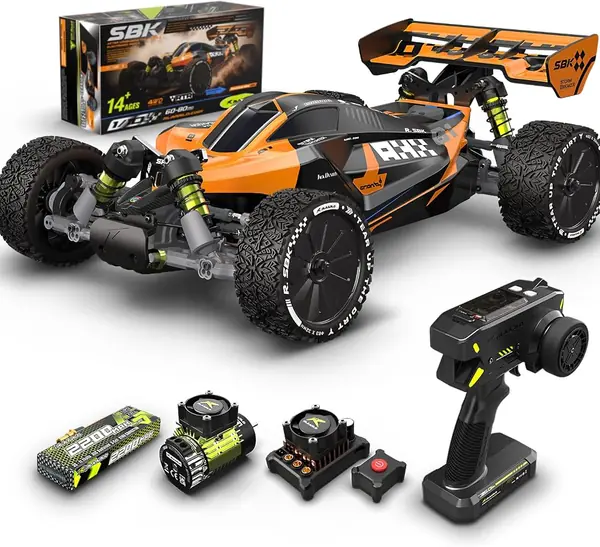
CROBOLL SBK10 1/10 Buggy Best for Budget-Minded Tinkerers

Orange CROBOLL SBK10 1/10 4WD buggy with aluminum chassis and brushless motor

Budget-minded tinkerers

Track Score 85/100
Top Speed
40+ mph
Scale
1/10
Power System
2852 3100Kv brushless with 45A ESC
Battery Included
3S LiPo
View on Amazon

The SBK10 is the only 1/10-scale buggy in this group, and its hardware reads like a much more expensive car: a 2.5mm aluminum chassis, 4mm 7075-T6 shock towers, and carbon steel CVDs and dog bones. We were not expecting that parts list from a company that, by its own account, did not exist before 2022.

The drivetrain backs the hardware up. A 2852 3100Kv brushless motor and 45A ESC run on the included 3S pack, and the six-channel radio has a 350-meter range plus a telemetry lead that puts live pack voltage on the screen. That last detail is more useful than it sounds: you can watch the pack sag and bring the buggy in before the ESC cuts power mid-corner.

What holds it below the ARRMAs is history, not hardware. CROBOLL is a young brand, the SBK10 has a much thinner record than either Typhon, and the durability notes that do exist split down the middle. Long-term parts supply is the open question, and that is what you are accepting in exchange for the price.

For a driver who enjoys wrenching and wants 1/10 hardware and a 3S brushless drivetrain without the 6S outlay, we think that is an easy trade. If you would rather not be an early adopter on a buggy, the Typhon GROM is the safer buy for a little more money.

Worth Noting

  • May fall short of its claimed 40 mph
  • Plastic suspension mounts are the weak point
Our Verdict

The SBK10 is the buggy we suggest for tinkerers: 1/10 aluminum-and-brushless hardware with a 3S pack, from a brand still proving itself.

Check Latest Price

How We Tested RC Buggies

We built the shortlist from spec sheets and parts catalogs, then cut anything we couldn't picture ourselves repairing: a discontinued parts line, a drivetrain with no spares listed, a chassis that comes apart only with proprietary tools. Nine buggies made it to testing, and we ran them for eight months, from spring into fall, on a dirt lot, a mowed field, a gravel parking area, and a quiet cul-de-sac after dinner.

Every buggy got the same treatment. We marked out a straight run and logged top speed with a GPS unit, then drove a full pack in mixed conditions — grass, hardpack, jumps off a low ramp — and timed it down to the low-voltage cutoff, recharging on a fire-resistant surface with someone in the room the entire time and never running a pack past what the speed control was rated for. We turned hard on loose gravel to see which ones traction-rolled, and watched how they landed off the ramp: nose-down, flat, or bouncing. Across the season we checked for slop in the driveshafts, worn diff gears, bent shock shafts, and cracked body mounts, and noted how scuffed each shell looked after a dozen rollovers. The fast ones only went out on open ground, well away from anyone.

Then we took them apart. Each buggy came down to the differential at least once so we could count the tools required and judge how readable the manual was, and we ordered a common spare — an A-arm, a set of tires — to see what it cost and how long it took to arrive. The four that made the list are the ones we kept charging packs for.

How to Choose an RC Buggy

Let Scale Follow Your Ground

Scale shapes everything else. A 1/8 buggy such as the Typhon 6S needs a track, a large lot, or a long run of hardpack to be anything other than frustrating, while a 1/10 model fits a park or a ballfield, and small-scale buggies like the Typhon GROM turn a driveway into a course. The trap is reading compact as capable everywhere: small wheels and low clearance bog down in thick lawn and lose their line in loose gravel, so a small buggy is a hard-surface tool rather than a trail vehicle.

Work backward from the surface within five minutes of your door. If that is pavement or packed dirt, a small brushless buggy will get more use than a big one ever will; if it is rough grass or a proper dirt lot, go up in scale.

Brushed or Brushless, and How Much Voltage

Brushed motors cost less and deliver power more linearly, which is why a budget buggy like the HAIBOXING 2995 runs a 550 can and why new drivers find it easy to modulate. Brushless motors are more efficient and much faster, and they drag a voltage question along with them: 2S is mild, 3S is a real step up, and 4S or 6S belongs in a 1/8 chassis engineered for it.

The trap is treating a 3S-ready ESC as a 3S buggy. The Typhon 6S ships without any pack at all, and the GROM arrives on 2S with 3S as your upgrade. Buy for the cell count you will actually run, and treat the top-speed figure as the ceiling on a perfect surface rather than a promise for your driveway.

Ready to Run Rarely Means Ready to Drive

Ready-to-run means assembled, not necessarily complete. The Typhon GROM includes a battery and a USB-C charger, the SBK10 brings its 3S pack, and the Typhon 6S arrives expecting a 4S or 6S LiPo you already own. Compare two buggies on the real out-the-door cost rather than the sticker, because the difference can be substantial.

Then check connectors before you commit. The ESC, the packs you already own, and the charger all have to agree; an adapter is a cheap fix, but a charger that will not talk to your packs is a dead end.

Buy for Repair, Not Just for Speed

Every buggy here will break something eventually, and that is the useful difference between hobby grade and toy grade: the broken piece is a suspension arm, not a whole car. Arms, shock towers, driveshafts, and steering links take the hits, and on a supported model they are separate parts you swap in an evening.

Before you buy, confirm that the model's spares are listed and easy to find. A buggy with no parts behind it is a disposable toy at hobby prices. And resist replacing every plastic part with metal — arms that flex and give are often what saves the chassis behind them.

Frequently Asked Questions

Final Verdict

The ARRMA Typhon GROM 223S BLX is the buggy we recommend to most people. It is the only one here that arrives complete with a battery and charger, it runs in space you probably already have, and its 3S ceiling means you are not shopping again in a month. That combination of complete, usable, and upgradeable is hard to beat.

If you already own 4S or 6S packs and have somewhere to use them, the Typhon 6S is the faster, tougher machine and worth the outlay. Shopping on price, the HAIBOXING 2995 hands you a center differential and aluminum oil-filled shocks for the least money here.