Best Large Resin 3D Printers of 2026

In resin printing, a bigger plate has a cost. Stretch a screen to fit a big single piece and the same pixel count spreads thinner, so fine detail softens toward the edges, and the machine gets heavier and fussier about sitting level. Moving up from a small printer means more setup to get wrong.

The K count on the box means little alone; your eye reads pixels per inch, and a small screen can beat a big one. Over eight months in a ventilated workshop and a cool basement corner, we watched how much of each plate filled in one run, how detail held at the corners, how long leveling took, how loud the fans were and whether prints stayed stuck. All five picks print big and hold detail, and past that they suit different jobs.

Our Top Picks

The Best Large Resin 3D Printers

1.

ANYCUBIC Photon Mono M7 Max Best Overall
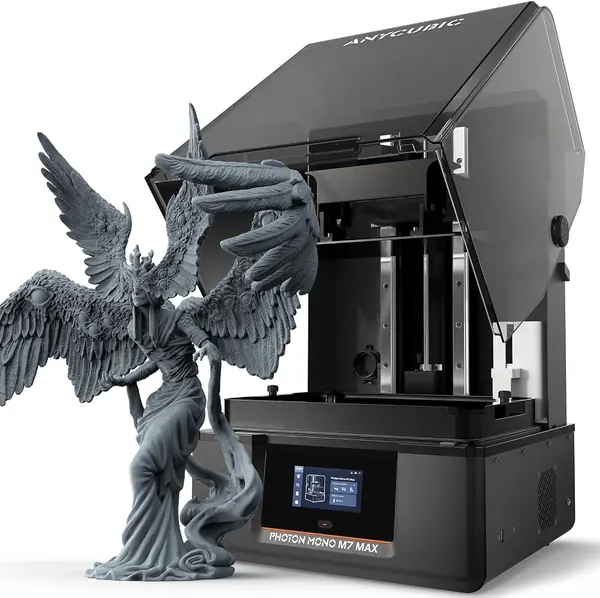
ANYCUBIC Photon Mono M7 Max resin 3D printer with 13.6-inch 7K mono LCD and build platform

Big single-piece prints

Track Score 84/100
Build Volume
298 × 164 × 300 mm (11.73 × 6.46 × 11.81 inches)
Screen
13.6-inch 7K mono LCD (6480 × 3600)
XY Resolution
46 × 46 µm
Max Print Speed
60 mm/h
View on Amazon

At 298 × 164 × 300 mm, the Photon Mono M7 Max is the second-largest machine in this group, and the 300 mm of Z height is the number that changes what you can make: a full helmet, a big terrain piece, a housing that doesn't have to be split into four parts and glued back together.

What makes it our default is how little it gives up for that space. The 13.6-inch panel runs 7K (6480 × 3600), which works out to 46 µm pixels — coarse next to the 10-inch 16K machine, but even enough that panel lines and rivets survive across a plate roughly twice its area. Chase faces the size of a grain of rice and that trade reverses; for anything you print at this scale, it doesn't.

Two conveniences we ended up valuing more than the headline specs. The vat is temperature-controlled and tracks resin level, which counts for a lot in a garage that runs cold overnight, and the plate can be left hanging at an angle after a job so resin drains back into the vat instead of down the front of your bench.

Against the alternatives, the Phrozen goes 32 mm wider and 21 mm deeper for a big step up in price, and the 10-inch machines are sharper but make you split parts. For props, terrain, prototypes, and short production runs, we think most people should start here.

Worth Noting

  • Heavy 60.9 lb body needs a solid bench
Our Verdict

We recommend the M7 Max as the large resin printer most people should buy: a 13.6-inch plate, 300 mm of height, and a heated vat for less than the mega-format machines.

Check Latest Price
2.

Phrozen Sonic Mega 8K S Best Mega-Format

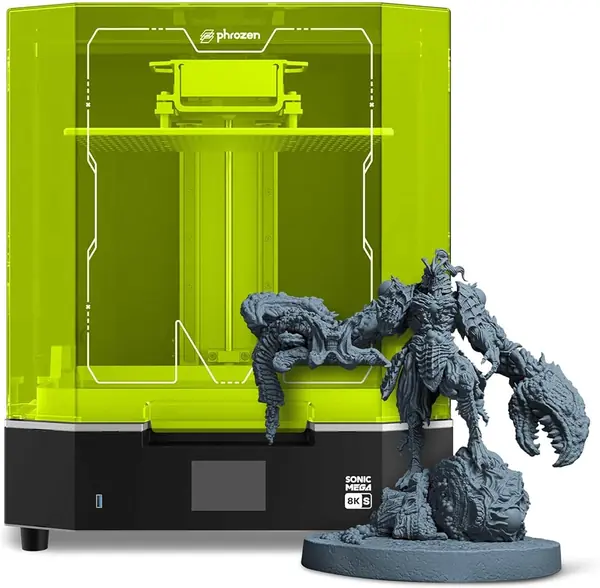
Phrozen Sonic Mega 8K S large resin 3D printer with 15-inch mono LCD and lift-up lid

Mega-format single pieces

Track Score 83/100
Build Volume
12.99 × 7.28 × 11.81 inches
Screen
15-inch 8K mono LCD
XY Resolution
43 µm
Machine Weight
57.3 lb
View on Amazon

Nothing about this machine is desk-sized. The plate measures 12.99 × 7.28 inches, the panel behind it is 15 inches across, and at 57.3 lb it wants a bench that doesn't flex — not a folding table in the corner of a spare room.

That surface area goes straight into throughput. You can nest a full set of parts and print them in one run instead of three, and the 8K panel keeps 43 µm between pixels, so detail holds up even though the screen dwarfs everything else here. The 13.6-inch ANYCUBIC packs more pixels into every inch; none of those pixels will print a piece this wide without a seam.

The lift-up lid and the built-in metal drip hanger are the two details we appreciate most, because they answer the two things that actually annoy you at this size: a lid that doesn't need clearance above the machine, and somewhere to hang a dripping plate that isn't over the vat or your floor.

If your work is big single pieces and short production runs, nothing here does more per job, and the vat to match takes a serious first pour of resin as part of working at this width. If you print batches of 32 mm figures, you are paying for plate you won't fill, and one of the 10-inch machines serves you better.

Worth Noting

  • Needs a matching large wash-and-cure station
Our Verdict

We point to the Mega 8K S when a part will not fit anywhere else: a 15-inch panel and the widest plate in this group for oversized single pieces.

Check Latest Price
3.

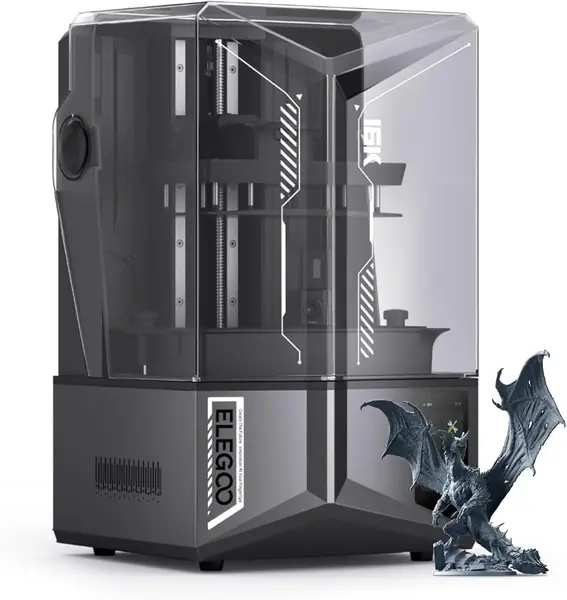
ELEGOO Saturn 4 Ultra 16K Best for Fine Detail

ELEGOO Saturn 4 Ultra 16K resin 3D printer with 10-inch mono LCD and flip-up lid

Miniatures and masters

Track Score 82/100
Build Volume
8.33 × 4.66 × 8.66 inches
Screen
10-inch 16K mono LCD
Leveling
Automatic
Resin Heating
Held at 30 °C
View on Amazon

Sixteen thousand pixels across ten inches is a strange thing to get excited about until you compare results: this panel resolves detail the bigger machines here can only approximate. Add auto-leveling that checks itself before every print, a vat held at 30 °C, and a camera that flags a plate that came up empty or a print that has peeled loose, and we think it is the least fussy machine in this group.

The tilting vat is the part we noticed most in use. Rather than peeling each layer straight up off the film, the vat rocks to one side, which takes load off thin supports and lets the machine move faster between layers. It is the kind of mechanism you stop thinking about, which is the whole point.

Reliability is the caveat. Print failures can arrive after months of clean running, so put a few full plates through it inside the return window and don't hand a client deadline to a machine you have owned for a week. Where the work is small, detailed, and repetitive — miniatures, masters, small mechanical parts — nothing here does it better.

Worth Noting

  • Smallest build plate in this roundup
Our Verdict

For fine detail and hands-off setup at 10-inch scale, we pick the Saturn 4 Ultra 16K — the sharpest and least fussy machine in this group.

Check Latest Price
4.

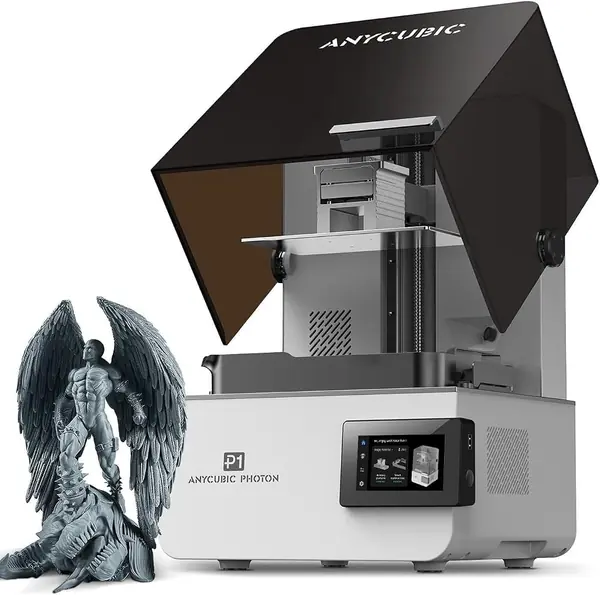
ANYCUBIC Photon P1 Best for Engineering Resins

ANYCUBIC Photon P1 14K resin 3D printer with ball-screw Z axis and build platform

Filled engineering resins

Track Score 81/100
Build Volume
8.78 × 4.96 × 9.05 inches
Leveling
Automatic, factory-calibrated
Resolution
14K
Max Resin Viscosity
8,000 cps
View on Amazon

The Photon P1 is the one machine in this group built around rigidity. Ball screws and precision guide rails carry the build plate, and Anycubic rates the machine for resin up to 8,000 cps — the thick, filled, engineering-grade material that punishes a Z stage with any slop in it.

That is why it earns a place here. On a tall print, a stage that flexes shows up as banding across every layer, and a rigid one is what lets you push viscous, filled resin without tearing the part off the film. We like it for exactly that kind of work: functional parts, jigs, mold masters, anything where the resin is doing as much as the resolution.

Wave Release is the other half of the idea — the plate lifts in a way that pulls a little air under each layer, and Anycubic puts the reduction in release force at 60 percent. The number is the company's; what matters is that thick resin on a tall part is exactly where release force bites.

Around that frame you get 14K resolution over an 8.78 × 4.96 inch plate, factory-calibrated leveling that rechecks before each print, and inspection that confirms the plate is seated before the first layer. The plate is the same 10-inch class as the ELEGOO machines and a little over half the area of the 13.6-inch ANYCUBIC, so a helmet still needs splitting. What you are buying is a machine that behaves with awkward resin, not one that prints bigger.

Worth Noting

  • Print workflow centers on Anycubic's slicer
Our Verdict

Our pick for engineering and filled resins: a rigid ball-screw stage, auto-leveling, and support for 8,000 cps resin in a 10-inch frame.

Check Latest Price
5.

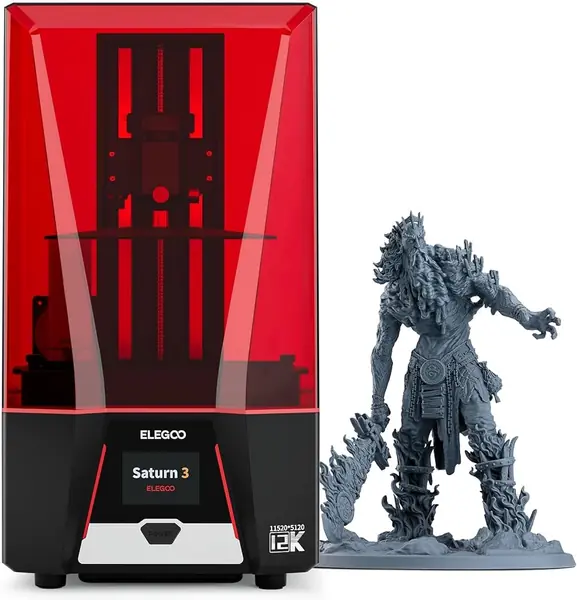
ELEGOO Saturn 3 12K Best Budget

ELEGOO Saturn 3 12K resin 3D printer with 10-inch mono LCD and metal resin vat

First large printer

Track Score 80/100
Build Volume
218.88 × 122.88 × 250 mm
Screen
10-inch 12K mono LCD (11520 × 5120)
XY Resolution
19 × 24 µm
Slicer
Voxeldance Tango
View on Amazon

The Saturn 3 is the cheapest way into a 10-inch MSLA plate here, and it makes its case with numbers: a 12K panel (11520 × 5120) for 19 × 24 µm pixels, a 218.88 × 122.88 × 250 mm build volume, and a laser-carved build plate that grips the first layer.

Detail stays consistent from the middle of the plate out to the corners, which is what the Fresnel collimating light source is for, and that consistency is what separates a workable budget machine from a frustrating one. Setup is quick and the whole thing weighs 33 lb, so one person can get it onto a bench.

We keep it on the list because of the Z height. At 250 mm it clears tall parts that the dearer Saturn 4 Ultra tops out on at 220 mm, so if your work runs vertical — statues, long brackets, tall molds — the budget machine is the one that fits.

Where it fits: a first large printer, a second machine for overflow work, or a workshop that would rather have two 10-inch plates than one big one. The prints are the same class of detail as the pricier 10-inch machine here; the difference is in the automation, not in whether a miniature comes out clean.

Worth Noting

  • Print failures can follow months of clean running
Our Verdict

We call the Saturn 3 12K the value pick: 10-inch 12K detail, 250 mm of Z height, and the lowest outlay in this roundup.

Check Latest Price

How We Tested Large Resin Printers

We built the shortlist by reading through every large-format resin printer we could find, then filtering on build volume, pixel size, whether the machine heats its resin, how much bench it eats, and what it costs to keep running. Anything without a monochrome LCD was out; automatic leveling counted in a machine's favor but never as a requirement. We tested eight printers for eight months.

Setup came first. We timed each machine from unboxing to first successful print and leveled every plate ourselves before opening the manual, noting how many attempts it took and whether we reached for a wrench, a shim, or nothing at all. Then we printed the same pieces on all eight: one large single-part bust, a full plate of miniatures, and a set of small mechanical parts in a filled resin. We compared edge sharpness at the center of the plate against the corners under a loupe, drained every print that came off, and logged anything that stuck to the film instead of the plate.

Over the months that followed, the printers lived on a ventilated shop bench and, in winter, in a cool basement corner where resin heating earned or lost its keep — we checked vat temperature and noted which runs came out sludgy or failed outright. We measured fan and motor noise at arm's length and again from the next room, since a lot of this work happens overnight. We tracked film and screen wear, weighed each machine before a two-person lift onto a shelf, ran the same file through each stock slicer to see how much tweaking the defaults needed, and counted the gloves, IPA, and wash-and-cure cycles a month of printing burned through. Gloves and eye protection stayed on for every session, solvent went back into closed containers, and nothing went down a drain.

How to Choose a Large Resin 3D Printer

Start With the Plate, Not the Screen

A 10-inch panel does not mean a 10-inch part. Across the 10-inch MSLA machines here, plate width runs from about 8.3 to 8.8 inches; the 13.6-inch ANYCUBIC gives you 11.73 inches and the 15-inch Phrozen gives you 12.99. Height swings just as widely, from 8.66 inches on the Saturn 4 Ultra to 11.81 on the ANYCUBIC and the Phrozen.

Measure the biggest single piece you intend to print, add an inch on each side for supports and the plate's edge, and buy the machine that clears it. The trap is reading large as a promise about parts when the maker only means the screen.

Resolution Is a Trade Inside the Plate

More pixels over a bigger panel still leaves bigger pixels. The 12K panel in the Saturn 3 puts 19 × 24 µm between pixels, the 13.6-inch 7K in the M7 Max sits at 46 µm, and the 15-inch 8K in the Phrozen at 43 µm. On a 32 mm figure that is the difference between reading a maker's mark and merely knowing it is there.

Which one you want depends on the scale of your work. Miniatures, masters, and anything with fine text want the smallest pixel; props, terrain, and prototypes run out of plate long before they run out of 46 µm. We don't pay a premium for pixels we won't see, and we don't buy a small plate for a big part.

Heat and Leveling: The First Hour

Resin thickens as it cools, and thick resin is slow to level between layers and stubborn to peel. That is why the M7 Max's temperature-controlled vat and the Saturn 4 Ultra's 30 °C tank heating earn their money in an unheated garage or shop, and matter less in a warm spare room.

Auto-leveling is the other feature you notice every time you move the machine or reseat a plate, and the Saturn 4 Ultra and the Photon P1 both handle it themselves. Whatever you buy, watch the first twenty layers of a new resin in person — that is where a bad level shows up.

Weight, Clearance, and Where It Lives

These are appliances, not gadgets. The picks here run from 29.7 to 60.9 lb and up to 31 inches deep, so plan a bench that does not flex and a route to it that clears stairs and doorways before the box arrives. The Phrozen's lift-up lid is the one design here that needs no open space above the machine.

Ventilation is not optional. Resin and IPA both give off vapor, so the printer belongs in a space with outside air and a door between it and anywhere people eat or sleep. A garage, utility room, or workshop beats a bedroom every time.

What It Costs to Keep Running

The printer is the first purchase, not the last. Budget for resin, gloves, a jug of IPA, replacement release film, and a wash-and-cure station sized to the parts you intend to make. A 15-inch plate needs a station big enough to hold those parts, which is a different class of equipment from a miniatures setup.

Price the whole first year before you decide. The budget Saturn 3 and the premium Phrozen end up closer than their sticker prices suggest once the accessories are in the cart, and a machine that saves you a tank clean every month is worth more than the one that doesn't.

Frequently Asked Questions

Final Verdict

The Photon Mono M7 Max is the large resin printer we recommend to most people. A 13.6-inch plate, 300 mm of Z height, a heated vat, and 46 µm pixels cover props, terrain, prototypes, and batch parts without asking you to split the model first, and it costs less than the machine that beats it on width.

If a single piece has to come out whole at 15-inch scale, the Phrozen earns its premium. If the outlay is the deciding factor, the Saturn 3 12K is the one — just give it a few full plates before you trust it with a deadline.