Best Filaments for RC Car Parts of 2026

Print a suspension arm Friday night, drive the car Saturday, and it can crack at the mount before the battery is half empty. That snap has less to do with your driving than with the filament. The right material gives you a part that flexes and comes back instead of a car sitting on three wheels.

The stiffest spool is rarely the one that survives a bad landing; carbon fiber buys rigidity, not forgiveness. Moisture matters too. Nylon and TPU often arrive damp, and a wet spool prints parts that pop and split along the layers. After nine months of printing the same A-arms, shock towers, bumper mounts and battery trays and driving them until something gave, these seven were chosen on toughness, heat resistance and how well a spool feeds at hour ten.

Our Top Picks

The Best Filaments for RC Car Parts

1.

SUNLU ASA Filament Best Overall
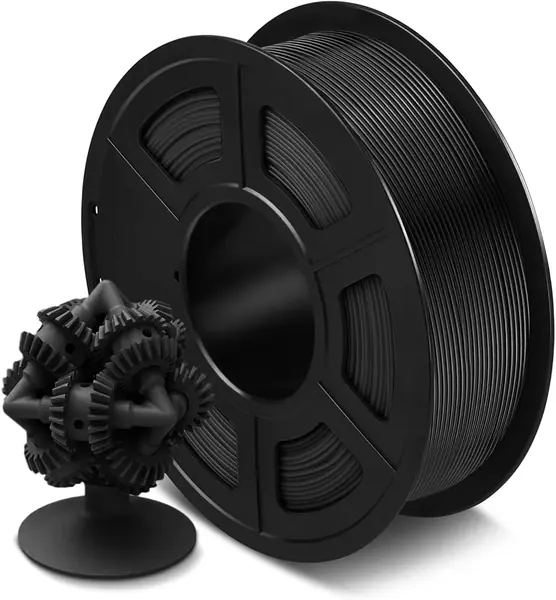
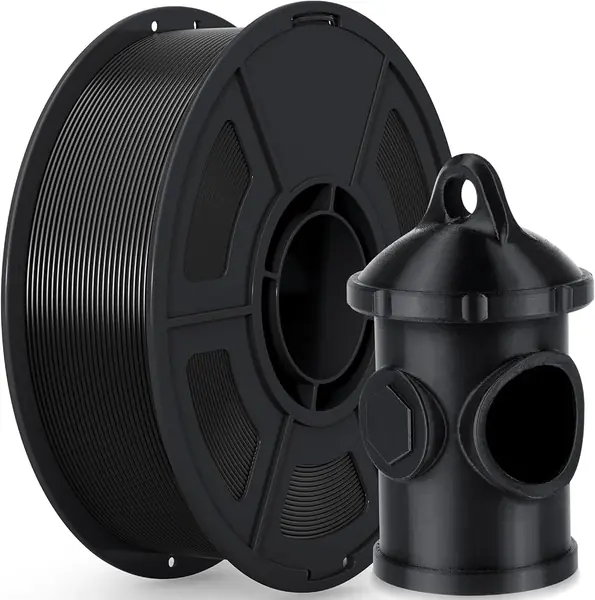
SUNLU black ASA 3D printer filament on a 1 kg spool

Outdoor RC bashers

Track Score 92/100
Material
ASA
Diameter
1.75 mm
Spool Weight
1 kg (2.2 lb)
UV/weather Resistance
UV, rain, and heat resistant
View on Amazon

The balance we want in an RC filament is outdoor toughness without a boutique price, and SUNLU ASA is the closest match here. A 1 kg spool gives you enough material for a chassis brace, a set of arms, and a few spares, so you can replace a broken part instead of rationing filament. Its UV, rain, and heat resistance are the point: this is for a car that sits in the sun and takes a curb hit, not a shelf model.

The 1.75 mm filament is wound on a high-temperature spool with a multi-hole design, which matters if you feed it from an AMS or AMS Lite. Dimensional accuracy is listed at +/- 0.02 mm, and that consistency is what keeps small RC parts fitting after a print. ASA still wants an enclosure and a hot bed, and this spool is no exception; the difference is that you are not paying premium money for the privilege.

What we appreciate most is the ownership detail: the newer spool is sturdier than the flimsy cardboard some ASA arrives on, and the multi-hole core helps it dry evenly. That is a small thing until a long print jams because the spool is binding. For a basher that lives outdoors, this is the spool we keep on the bench.

Worth Noting

  • Layer adhesion varies with printer settings
  • Can print brittle on some setups
Our Verdict

We recommend SUNLU ASA as the best all-around filament for RC car parts: it's tough, UV- and heat-resistant, and priced to keep a 1 kg spool on hand.

Check Latest Price
2.

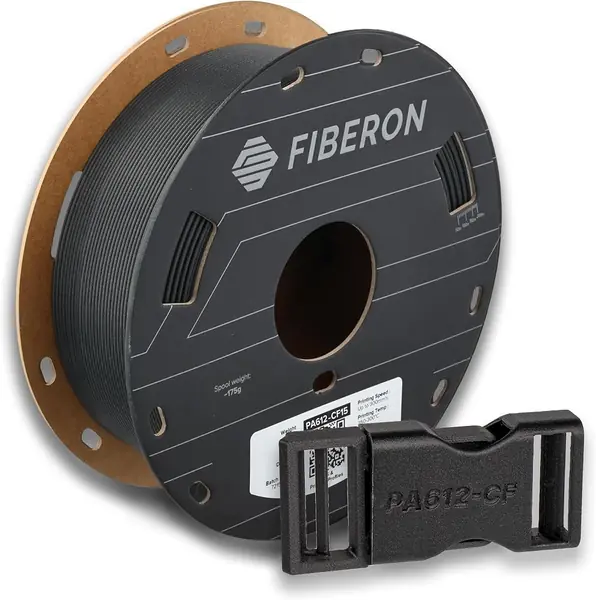
Polymaker Fiberon PA612-CF15 Best for Maximum Strength

Polymaker Fiberon PA612-CF15 black carbon fiber nylon filament on a 0.5 kg spool

High-stress chassis parts

Track Score 90/100
Material
PA612 nylon with 15% carbon fiber
Nozzle Temperature
250–300°C
Heat Deflection
175°C after annealing
Tensile Strength
91.9 MPa dry X-Y
View on Amazon

Fiberon PA612-CF15 is a long-chain PA612 nylon loaded with 15% carbon fiber, and its numbers explain why it belongs in an RC discussion: 91.9 MPa dry X-Y tensile strength, 83.1 MPa after annealing and moisture conditioning, and a 175°C heat deflection temperature after a 16-hour anneal at 100°C.

We recommend it for the parts where flex is the enemy—chassis braces, suspension arms, motor mounts—because that combination of stiffness and heat resistance is the strongest package here. It is also less moisture-sensitive than PA6 nylon, which makes it easier to live with than older nylon blends. The trade is that it is still hygroscopic, so dry storage is part of the job, and the rated heat performance assumes you follow the anneal schedule.

The 0.5 kg spool is a small batch, so we plan a focused set of parts rather than a whole car. For a racer chasing a lighter, stiffer chassis, that trade is worth it; for a basher that just wants replacement arms, ASA is the easier call. The payoff is a part that feels closer to machined composite than printed plastic, with less flex under load.

Worth Noting

  • Requires all-metal hotend and hardened nozzle
  • Needs dry storage and annealing
Our Verdict

We pick this carbon-fiber nylon when an RC part needs to be as stiff and strong as possible; just know it demands a high-temp, hardened-nozzle setup.

Check Latest Price
3.

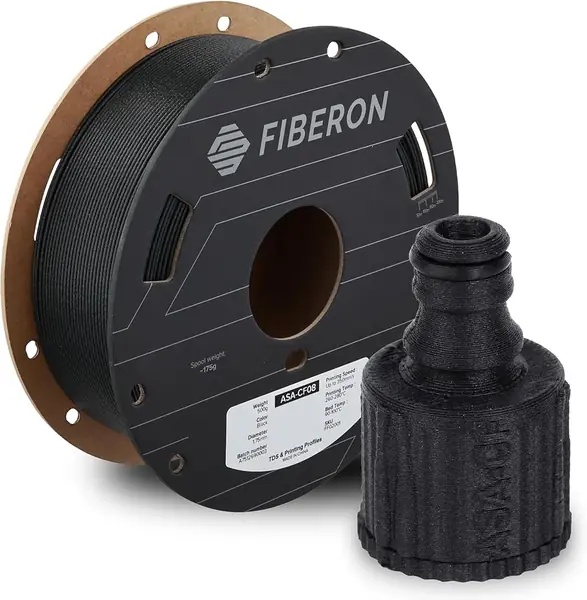
Polymaker Fiberon ASA-CF08 Best for Rigid Parts

Polymaker Fiberon ASA-CF08 black carbon fiber ASA filament on a 0.5 kg spool

Stiff outdoor brackets

Track Score 89/100
Material
ASA with 8% carbon fiber
Spool Weight
1.1 lb
Nozzle Temperature
260–280°C
Young's Modulus
3.61 GPa X-Y
View on Amazon

The 8% carbon fiber in Fiberon ASA-CF08 is there to do one job: make ASA hold its shape. The listed 3.61 GPa X-Y Young's modulus and 69.1 MPa bending strength put it in a different stiffness class from plain ASA, while the ASA base keeps the UV and weather resistance that makes it useful outdoors.

The matte finish is a nice bonus on visible parts, and the 260–280°C nozzle range and 90–100°C bed are standard ASA territory. We like that it prints with the cooling fan off and an enclosure, because those are the conditions that keep a large bracket from warping. It is a deliberate, rigid material rather than an all-purpose replacement for regular ASA.

We recommend it for stiff brackets, mounts, and chassis braces that need to stay true outdoors. The one handling note is that the filament itself is rigid enough to snap if your feed path makes a sharp turn, so keep the run from spool to extruder smooth and avoid a tight reverse bend. For small, stiff parts that need to stay true, that is a fair trade.

Worth Noting

  • Requires a wear-resistant nozzle
  • 0.5 kg spool is a small batch
Our Verdict

For stiff brackets and mounts that must hold shape outdoors, we choose this carbon-fiber ASA, provided your printer has a hardened nozzle.

Check Latest Price
4.

iSANMATE ASA Filament Best Budget ASA

iSANMATE black ASA 3D printer filament on a 1 kg spool

Budget outdoor spares

Track Score 88/100
Material
ASA
Diameter
1.75 mm
Spool Weight
1 kg (2.2 lb)
Dimensional Accuracy
+/- 0.02 mm
View on Amazon

One kilogram of black ASA, a +/- 0.02 mm diameter tolerance, and a matte finish that suits RC bodies and brackets—that is the iSANMATE proposition. The 240–270°C nozzle range and 80–100°C bed are standard ASA territory, so it fits the same printer setup as our top pick.

We recommend it as the budget ASA in this group because it covers the outdoor basics without asking you to spend premium money. The matte surface is a good match for black RC parts because it doesn't show scuffs the way a gloss finish does, and the 1 kg spool gives you room for spare arms and mounts. It still wants an enclosure, and it is not a material to run in a cold garage.

This is the spool we hand to someone building a first outdoor RC car, because a failed part costs less to replace and the filament is easy to restock. For critical suspension arms, we still prefer the top pick. The iSANMATE is the practical choice when you want to keep several colors or a spare spool on the shelf without tying up much budget.

Worth Noting

  • Bed adhesion can be inconsistent
  • Filament may arrive brittle
Our Verdict

We keep this ASA on the bench for affordable outdoor parts; it prints well and resists UV, though bed adhesion can need attention.

Check Latest Price
5.

PRILINE 98A TPU Best for Tires and Bumpers

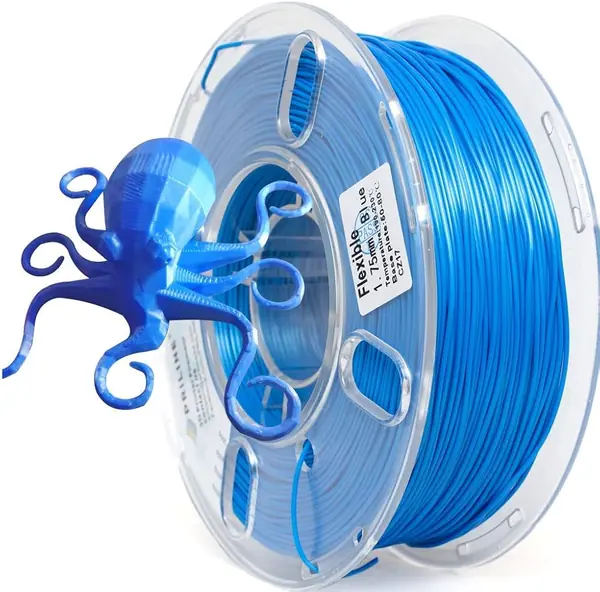
PRILINE blue 98A TPU flexible 3D printer filament on a 1 kg spool

Tires and bumpers

Track Score 87/100
Material
98A thermoplastic polyurethane
Diameter
1.75 mm
Spool Weight
1 kg (2.2 lb)
Shore Hardness
98A
View on Amazon

RC tires, bumpers, and skid plates ask for a different kind of toughness than a chassis brace, and PRILINE's 98A TPU is the pick here for those flexible wear parts. It is a thermoplastic polyurethane with a shore hardness of 98A, so it sits on the firm end of the TPU scale rather than the soft, gummy end.

The 98A rating is why we like it for parts that need to hold a screw and still flex under a hit. It prints more like a stiff PLA than a wet noodle, and the 1 kg spool gives you enough material for a set of bumpers and a few tire experiments. The blue color is also easy to spot in a parts bin, which sounds trivial until you are digging for a small spacer.

We keep it for bumpers, skid plates, and firm drift tires, where the extra stiffness is a feature. It holds a screw better than a softer TPU and still gives when it hits a curb. For the parts that need to bend and take a hit without turning into a noodle, this one earns its place.

Worth Noting

  • Not the softest TPU for high-grip tires
  • Layer adhesion can need tuning
Our Verdict

We reach for this 98A TPU for bumpers, skid plates, and firm tires; it is tough and printable, but not the softest TPU.

Check Latest Price
6.

iSANMATE Carbon Fiber ASA Best for Large Stiff Builds

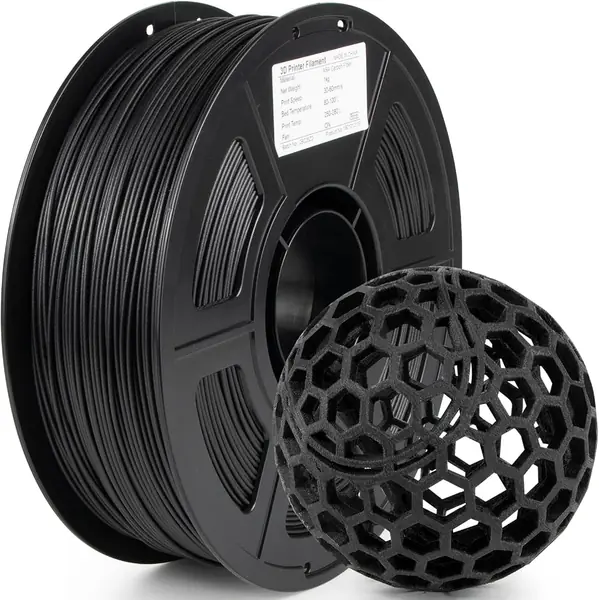
iSANMATE black carbon fiber ASA 3D printer filament on a 1 kg spool

Large stiff builds

Track Score 86/100
Material
ASA with carbon fiber
Diameter
1.75 mm
Spool Weight
1 kg (2.2 lb)
Nozzle Temperature
240–270°C
View on Amazon

A full kilogram of carbon-fiber ASA is the appeal here. The carbon fiber reinforcement is there to raise rigidity and dimensional stability, while the ASA base keeps the UV and weather resistance that makes outdoor RC parts possible.

The 240–270°C nozzle range and 80–100°C bed are standard ASA settings, and the matte carbon finish gives brackets and mounts a purposeful look. We see it as the value route to a full spool of CF ASA, especially for larger projects that would burn through a 0.5 kg spool. The matte surface also hides layer lines on visible chassis parts, which is a small bonus.

We recommend it when you want the stiffness of carbon-fiber ASA and enough material to print a whole set of parts, not just one bracket. The usual ASA enclosure rules still apply, and the full kilogram is the difference between experimenting and finishing the car. For a large outdoor build, that matters more than a fancy spool.

Worth Noting

  • Requires a wear-resistant nozzle
Our Verdict

This spool suits a build that wants carbon-fiber ASA stiffness and a full kilogram for a larger outdoor RC build.

Check Latest Price
7.

SUNLU PLA+ 2.0 Best for Indoor Prototypes

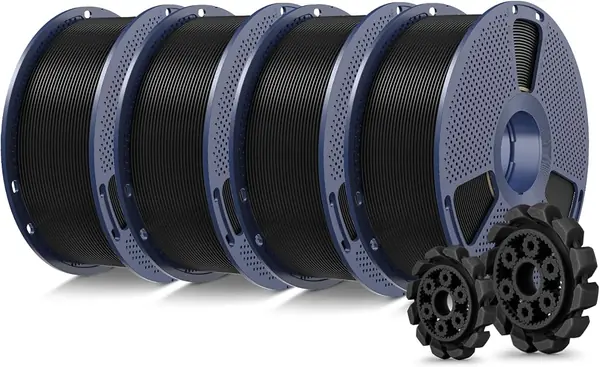
SUNLU black PLA+ 2.0 3D printer filament in a four-spool 4 kg pack

Indoor prototypes

Track Score 85/100
Material
PLA+ 2.0
Diameter
1.75 mm
Spool Quantity
4 x 1 kg
Max Print Speed
300 mm/s
View on Amazon

PLA+ is not the filament we choose for a car that will see sunlight, heat, or a hard curb strike. It is the filament we load when we are checking whether a new chassis design fits before committing expensive ASA or nylon to the job.

SUNLU's PLA+ 2.0 is tougher and less brittle than standard PLA, and it prints fast—up to 300 mm/s on a printer that can keep up. The four 1 kg spools make it easy to burn through fit checks and indoor display parts without thinking about cost, and the +/- 0.02 mm tolerance is tight enough for small brackets and body accessories.

The winding is neat and the spools are individually vacuum-packed, so the pack stores well between projects. We also like the deep black color for hiding layer lines on prototypes, and the fast printing means a test fit does not turn into an all-weekend project.

Our verdict is that this is a bench-stocking filament for the design phase. The four spools and fast printing make it easy to iterate, and that is the job we keep it for. If you want one filament for the whole car, this is not it; if you want a cheap way to get the fit right, it is.

Worth Noting

  • Can still be brittle in the feed path
Our Verdict

This four-spool PLA+ pack is for fit checks and indoor RC projects; it is cheap, fast, and tougher than basic PLA.

Check Latest Price

How We Tested Filament for RC Car Parts

We started with research — every spool we could find that a manufacturer rates for outdoor or mechanical duty, or that RC builders keep coming back to — then filtered by what our printers can actually run: ASA, ASA reinforced with carbon fiber, carbon-fiber nylon, a 98A flexible, and one PLA+ blend for indoor prototyping. Anything that demanded a hotend, bed, or enclosure beyond our machines' limits came off the list. Fifteen spools made the cut, and testing ran nine months.

Each spool ran on the same two printers with the makers' own temperature and cooling settings — ASA inside a ventilated enclosure, nylon and TPU dried before the first print and stored in dry boxes between sessions, carbon-fiber spools behind a hardened steel nozzle. We measured filament diameter with calipers at the start, middle, and end of every spool to see whether it wandered, then printed the same A-arms, shock towers, and bumper mounts on textured PEI, noting whether the first layer stuck or curled at the corners, whether a 12-hour print finished without a tangle or a jam, and whether the surface came out smooth or stringy from one print to the next. Every part got flexed by hand before it went on a car, which is how we sorted the rigid prints from the ones with some give.

Then we drove them. Arms and chassis braces went onto our bashers and into curbs, off the end of a driveway, and across grass at full throttle until something cracked; we noted whether parts snapped clean, bent, or held. Motor mounts and ESC trays ran back-to-back packs in summer heat to see whether screw holes sagged or a part lost its shape. Brackets spent eight weeks bolted to a south-facing rail in the sun and rain, where we watched for color shift, a chalky surface, and brittleness. Spools were weighed before and after so we could price the list per usable part rather than per gram.

How to Choose Filament for RC Car Parts

Match the Material to the Part

An RC car is not one material problem. A chassis brace wants stiffness, a suspension arm wants impact resistance, a bumper wants flex, and a body shell mostly wants easy printing. That is why we do not recommend buying one spool and treating it as a universal kit. Start with ASA for outdoor structural parts, step up to carbon-fiber ASA or carbon-fiber nylon for stiffness-critical pieces, and keep TPU for bumpers, skid plates, and tire experiments. Tough PLA+ is fine for fit checks and indoor models, but it is not the material for a hot motor mount or a sunny parking lot.

Weather and Heat Are the Real Tests

UV exposure and heat are what separate a part that lasts a season from one that turns chalky or sags. ASA is the practical baseline because it combines ABS-like toughness with weather resistance; standard ABS has the toughness but not the UV stability. If your parts sit near the motor or ESC, look at heat deflection rather than just tensile strength. Polymaker's PA612-CF15 reaches a 175°C heat deflection temperature after annealing, which is why we treat it as a high-heat material; plain ASA is the better value for most outdoor bashers.

Stiffness Versus Impact: Choose the Failure Mode

Carbon fiber is not a free upgrade. It raises stiffness and dimensional stability, but it can also make a part more brittle and the filament itself more likely to snap in a tight feed path. We like carbon-fiber ASA for brackets and mounts that must hold shape, and carbon-fiber nylon for high-stress chassis parts. For arms and bumpers that need to absorb a hit, regular ASA or TPU usually makes more sense. If you are choosing between two carbon-fiber spools, check the base material and the reinforcement percentage, not just the word carbon on the label.

Check Your Printer Before You Buy

ASA and ABS want an enclosure, a heated bed, and a ventilated space; carbon-fiber filaments want a hardened steel or ruby nozzle; nylon wants an all-metal hotend that can reach 250–300°C and a dry box. If your printer is an open-frame machine with a stock brass nozzle, the practical upgrade path is smaller than the marketing suggests. Buy the filament your hardware can actually print, or budget for the enclosure and nozzle before you order the spool. Our top pick is chosen partly because it asks for standard ASA hardware, not a specialty setup.

Spool Size, Moisture, and Cost per Part

A 0.5 kg spool is a focused batch, a 1 kg spool is a working supply, and a 4 kg pack is for prototyping volume. We compare the price per usable part, not just the sticker on the spool, because a cheap filament that fails a long print is not cheap. Nylon and TPU are the moisture-sensitive ones, but ASA also benefits from dry storage. If you print in bursts, a sealed box with desiccant and a filament dryer will do more for part strength than another slicer profile.

Frequently Asked Questions

Final Verdict

Start with SUNLU ASA. It is the best balance of outdoor toughness, UV and heat resistance, and a 1 kg working supply, and it prints on standard ASA-capable hardware.

If you are chasing maximum stiffness for a high-stress chassis, move up to Polymaker Fiberon PA612-CF15 and accept the high-temp, hardened-nozzle setup. For bumpers and tires, PRILINE 98A TPU covers the flexible parts that ASA cannot.