Best Glue for Model Airplanes of 2026

Model airplane glue is really three products, and the parts decide which one you need. Thin solvent cement doesn't sit between two pieces of polystyrene so much as melt them into one; cyanoacrylate grabs in seconds and leaves a hard, brittle bead; wood glue needs porous balsa to bite into. The right bottle keeps a wing root and a strut exactly where the plans put them.

Applicators matter more than any claim on the label, since one careless drop of CA can fog a canopy. We timed how fast each of 14 glues set, watched whether it wicked into a seam or ran down a fuselage, and checked whether it still flowed after a month in a drawer. The picks cover polystyrene scale kits, balsa airframes and the quick field repairs that keep a flying day going.

Our Top Picks

The Best Glue for Model Airplanes

1.

Starbond Medium CA Glue Best Overall
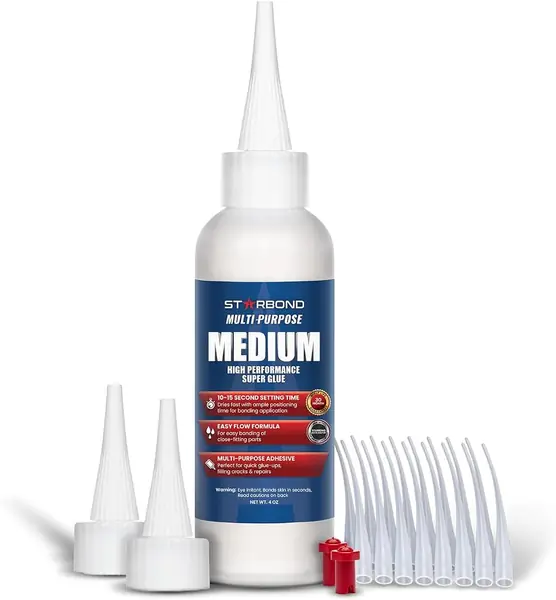
Starbond medium CA glue bottle with microtips, applicator nozzles, and pin caps

Mixed-material model building

Track Score 97/100
Bottle Size
4 fluid ounces
Viscosity
Medium
Set Time
10 to 15 seconds
Tip Kit
16 microtips, 3 nozzles, 2 pin caps
View on Amazon

Medium viscosity is why this bottle comes first. It's thick enough to sit where it lands on a vertical fuselage side, thin enough to flow off a microtip onto a strut or a seat frame, and the 10- to 15-second set leaves time to slide a part into alignment before it grabs.

What sold us, though, is the tip kit: 16 microtips, three applicator nozzles, and two pin caps. Anyone who has built models for a season knows the real enemy is a nozzle that cured shut between sessions, and having a spare tip on the bench turns that from a project-ending annoyance into a five-second swap. The four-ounce bottle is big enough that you stop rationing, too — a drop per joint instead of a squeeze and a prayer.

It's a surface adhesive, not a weld. On a highly stressed styrene joint like a wing root or a landing gear mount, a solvent cement still makes the stronger and cleaner bond, because it fuses the plastic instead of sitting on it. Medium CA earns its place on everything else: resin cockpits, photo-etch harnesses, balsa bracing, printed conversions, and the repairs that show up after the finish goes on.

Set against the gel picks here, it flows and wicks; set against Tamiya, it glues materials Tamiya can't touch. That range is why it's the first bottle we tell a model airplane builder to buy.

Worth Noting

  • Adhesive bond rather than a solvent weld
Our Verdict

Our default for model airplanes: medium CA is the one bottle that handles styrene, resin, photo-etch, and balsa, and the microtips make it precise enough for 1/72 detail.

Check Latest Price
2.

Tamiya Extra Thin Cement Best for Polystyrene Kits

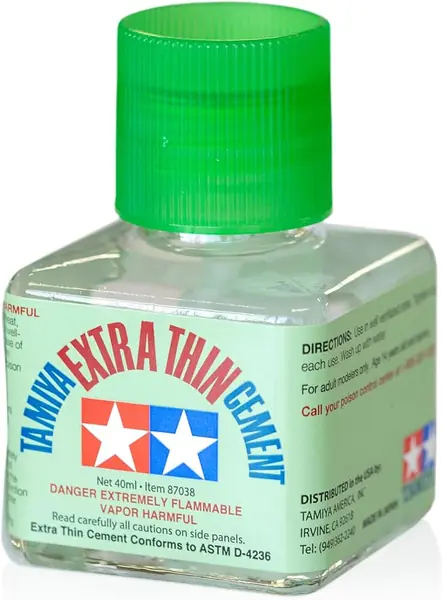
Tamiya Extra Thin Cement 40 ml bottle with pointed brush applicator

Polystyrene scale kits

Track Score 96/100
Bottle Size
40 ml
Viscosity
Extra thin
Applicator
Pointed brush
Compatible Material
Plastic (styrene)
View on Amazon

Technically this isn't glue. It's a solvent that softens two styrene faces until they fuse, which is why a cemented joint disappears under paint while a super-glued one leaves a ridge to sand. Dry-fit the parts, touch the loaded brush to the seam, and capillary action carries the cement into the gap. That is the cleanest joint we've gotten out of anything on this list.

The technique has a floor. The parts need to fit — bare, unpainted, and touching — because the cement fills nothing. On a warped or gapped joint it does nothing at all, so a loose fit reads as a failed bond rather than a bad joint. Cement the airframe, then switch to CA for the resin seat, the photo-etch belts, and anything that isn't styrene.

The 40 ml bottle and its pointed brush are the other half of why we like it. You can meter a fraction of a drop into a 1/48 cockpit without flooding the surrounding detail, and one bottle sees several kits through. If you've only ever used tube glue, the first seam is a small revelation.

Worth Noting

  • Welds polystyrene only and nothing else
  • Strong solvent fumes at the bench
Our Verdict

We keep this cement for polystyrene scale kits: it wicks into a dry-fitted seam and welds it, leaving no bead to sand.

Check Latest Price
3.

Titebond III Ultimate Wood Glue Best for Balsa and Wood

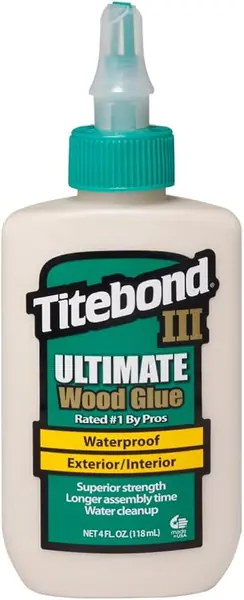
Titebond III Ultimate Wood Glue four-ounce bottle with tan waterproof formula

Balsa airframes

Track Score 95/100
Bottle Size
4 fluid ounces
Water Resistance
Type I waterproof
Cleanup
Water
Minimum Use Temperature
45°F
View on Amazon

Balsa builders fight the clock with most adhesives. This one gives some of it back: lay a bead along a spar, drop the ribs in, and you still have time to slide each one square before the glue grabs. For a wing that has to go together straight, working time is worth more than a fast set.

It's a PVA-type formula rated Type I waterproof, it applies down to 45°F, it cleans up with water, and it sands without softening — which matters when a glue line has to vanish under tissue or film. Keep the bead sparing on thin sheet balsa, though; the water in it can pull a panel out of shape if you lay it on heavy.

We keep it for the structural woodwork that never shows: motor mounts, wing joiners, laminated doublers, firewall plates. It's heavier than CA and it isn't instant, so it doesn't belong on tail surfaces where every gram counts, and it stays in the shop rather than the flight box — which is the right division of labor, wood glue at the bench and small CA tubes in the field.

Worth Noting

  • Full cure takes 24 hours
Our Verdict

For balsa airframes and wooden jigs we keep a bottle of this on the bench — it gives you minutes to line up a joint and sands clean.

Check Latest Price
4.

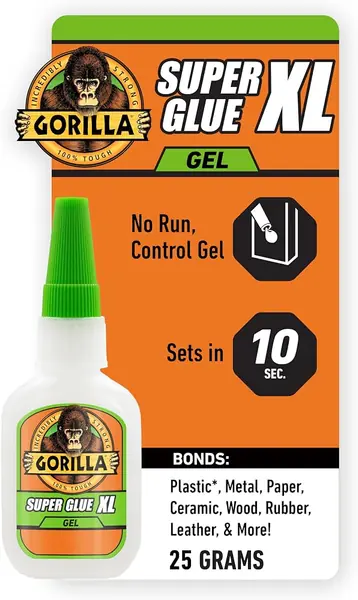
Gorilla Super Glue Gel XL Best No-Drip Gel

Gorilla Super Glue Gel XL squeeze bottle with metal pin cap

Vertical joints

Track Score 94/100
Bottle Size
0.88 oz
Set Time
10 to 45 seconds
Cap
Metal pin anti-clog
Form
No-run gel
View on Amazon

A no-run gel earns its keep the first time you glue something overhead. Gear struts, a cockpit tub that slides in sideways, a former you can only reach from above: with a watery CA you get a run down the inside of the fuselage and a scar to sand out afterward. This one stays where it lands.

It sets in 10 to 45 seconds without clamping, dries clear, and is reinforced for impact rather than formulated to be brittle. The 25-gram squeeze bottle is a size you can finish, and the metal pin in the cap seals the nozzle so the bottle doesn't weld itself shut between projects.

The trade-off is that a gel doesn't wick. On a hairline seam between two well-fitted parts, a thin CA or a solvent cement finds its way in and this doesn't — it sits on top and cures into a small mound. Reach for it where the joint is open and reachable.

That's the split we've settled into: this bottle lives on the bench for anything vertical or gap-filling, the Starbond handles the tight work, and the small Gorilla tubes go in the field box. For someone buying a first bottle, it's also the more forgiving of the two Gorillas.

Our Verdict

The gel we hand anyone gluing a joint they can't lay flat: it stays where it lands, and the pin cap keeps it usable.

Check Latest Price
5.

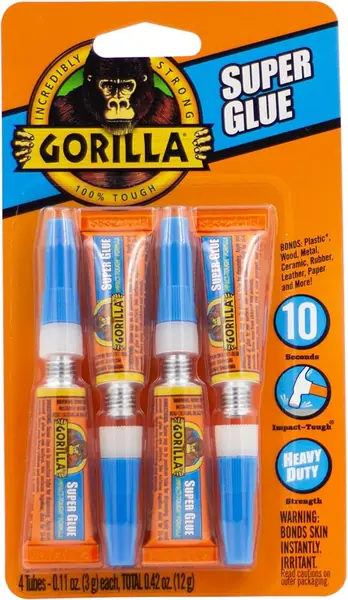
Gorilla Super Glue 3g Tubes Best for the Flight Box

Four small Gorilla Super Glue tubes with metal pin caps

Field repairs

Track Score 93/100
Set Time
10 to 45 seconds
Cap
Metal pin anti-clog
Total Volume
0.42 fluid ounces
Tubes Included
Four 3-gram tubes
View on Amazon

Every modeler has thrown away a bottle of super glue that set solid in the nozzle. Four sealed 3-gram tubes solve that by making the container disposable: open one, use it for a session, and the other three stay pristine until you need them.

The tubes carry the same impact-tough, clear-drying formula as Gorilla's larger bottles, each with a metal pin cap, and they set in 10 to 45 seconds. What makes them useful on a model rather than around the house is the tip — small enough to place a drop on a seat frame or a 1/72 landing gear leg without flooding the detail around it.

Heat is the enemy of a sealed tube, so keep them out of a hot car or a sunny windowsill; if one opens clumped, squeeze the first bit onto a scrap rather than onto the model. Otherwise, a sealed tube is the only super glue here that can't dry out on you before you get to it.

Worth Noting

  • Three grams goes fast on large airframes
Our Verdict

We like these for the flight box: four sealed tubes mean there's always fresh CA, even if your big bottle always dries shut.

Check Latest Price
6.

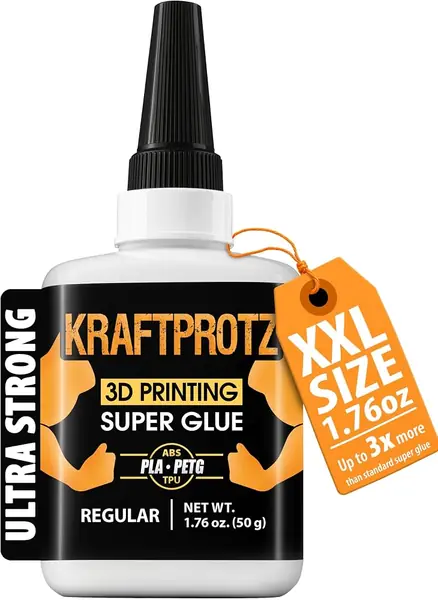
KRAFTPROTZ 3D Printing Super Glue Liquid Best for Tight Seams

KRAFTPROTZ thin CA glue bottle with precision needle tip

Tight seams

Track Score 92/100
Bottle Size
1.76 fluid ounces
Viscosity
Ultra thin
Applicator
Precision needle tip
Heat Resistance
Up to 110°C
View on Amazon

Thin CA behaves less like glue than like a liquid tool. Touch the needle to a closed seam and it disappears into the joint by capillary action; hold two parts together and a drop on the outside will find the gap between them. If you're used to brushing solvent cement into a plastic joint, this is the closest a super glue gets to that feeling.

The bottle holds 1.76 ounces behind a precision needle tip with an anti-clog cap, and the formula is rated to hold up to 110°C, which matters for motor mounts and speed controllers more than for a static display model. It's also about five times the volume of a typical thin CA bottle, so the per-drop cost stays low.

It sets fast enough that you line the part up first and glue second, and it's thin enough that anything vertical is a chance for a run to reach the paint. Work flat where you can and keep a paper towel under the joint.

Where it earns a spot for us is detail assembly: tacking a photo-etch seatbelt, running glue along a resin wing root where a brush won't fit, sealing a hairline crack in a printed part. It's the bottle we keep next to the solvent cement, not instead of it.

Worth Noting

  • No gap filling so parts must fit
Our Verdict

We use this water-thin CA where a solvent cement can't go — it wicks into tight seams, and the needle tip keeps it off the paint.

Check Latest Price
7.

ARKA Super Glue All-Purpose Liquid

ARKA all-purpose liquid super glue bottle with long anti-clog tip

Bulk assembly

Track Score 91/100
Bottle Size
1.76 fluid ounces
Viscosity
Medium
Applicator
Anti-clog long tip
Water Resistance
Waterproof
View on Amazon

Some jobs aren't detail work. Laminating balsa doublers, hinging a foam-core wing, building a jig, running a fillet along a printed fuselage in sections — for those you want volume and a nozzle you can squeeze without counting drops. That's the job this 1.76-ounce bottle is built for.

It's a medium-viscosity liquid that dries clear, carries an anti-clog cap with a long tip that reaches into a fuselage without a bamboo stick, and shrugs off water and heat, which suits outdoor and RC airframes better than a static display model.

The bottle we hand a beginner is this one, because nothing about it is precious: you can lay a generous bead, make a mistake, and redo it without wincing at the bottle. What it won't do is the work of a thin CA in a tight seam or a solvent weld on a styrene airframe, so it's the third bottle in the drawer rather than the first.

Worth Noting

  • Runs down vertical faces before it sets
Our Verdict

When a build needs glue by the ounce instead of the drop, this is the bottle: the workhorse for big airframes and shop jigs.

Check Latest Price

How We Tested Model Airplane Glue

We built the shortlist by reading spec sheets and hobby-forum threads, then narrowing on the things modelers actually compare: what material a glue is formulated for, whether it's thin, medium, or gel, what the applicator looks like, and how much usable glue you get per dollar in a bottle that won't dry solid between builds. That left 14 bottles and tubes — thin solvent cements, medium and gel cyanoacrylates, and a waterproof wood glue — which we used for six months.

Most of the work happened at a bench, assembling polystyrene scale kits and patching balsa ribs, with a stopwatch running to record how long each glue took to grab and how much time it left to nudge a part before it locked. We dry-fitted pieces, then touched glue to the seam to see whether it wicked in by capillary action or sat on the surface, and we trimmed microtips and needle tips to place a single drop in a gap narrower than a matchstick. On vertical fuselage sides we watched whether a gel stayed put or a thin liquid ran.

Bottles were capped and left in a drawer for a month, then opened to see whether the tip had clogged, and we counted roughly how many models each one got through before it ran low. For strength, we glued scrap joints, let them cure fully, then flexed and twisted them until they let go, noting whether the failure was in the glue line or in the wood. We worked with a window open and a fan pulling fumes off the bench, kept bottles capped and well out of reach of kids, and never spread CA with a finger. Cured beads were sanded and primed to see whether they showed under a finish, and the wood glue joints were wiped down with water.

How to Choose a Glue for Model Airplanes

Start With the Material, Not the Bond Strength

Nothing fails quite like a very strong glue applied to the wrong plastic. A solvent cement softens polystyrene until the two faces fuse, which is why a cemented seam vanishes under paint. Put the same cement on resin, photo-etch, or balsa and it does nothing at all. A CA glue is the opposite: it bonds almost anything but sits on the surface of styrene rather than melting into it, so a wing root glued with CA is only as strong as the skin it grabs.

The trap is the word model on a label, which tells you nothing about what the bottle actually bonds. Look for the compatible-material line instead, then decide: styrene kits need a solvent cement, resin and photo-etch need CA, and balsa needs a wood glue.

Match the Set Time to the Assembly

Speed isn't a virtue in the middle of a wing. A thin CA grabs in two or three seconds, which is perfect for tacking a photo-etch buckle and disastrous for lining up four ribs on a spar. Medium CA runs ten to fifteen seconds, a gel ten to forty-five, and a PVA wood glue gives you minutes of adjustment.

Buy for the slowest joint in the build. If you build both ways, that's the argument for a thin bottle and a gel rather than one compromise formula in the middle.

Viscosity and the Applicator Decide Where the Glue Ends Up

Viscosity is what keeps glue out of places you can't sand. Thin cement and thin CA travel by capillary action into a closed joint, medium CA bridges a small gap and holds on a strut, and a gel sits on top and fills. The applicator matters just as much: a brush or a needle tip lets you place a fraction of a drop, while a wide nozzle gives you a flood to clean up.

Buy a Format You'll Actually Finish

Super glue rarely fails in the joint; it fails in the nozzle. A large CA bottle that sits between builds will skin over, clog, and eventually cure solid, and the money you saved per ounce goes in the bin with it. Small sealed tubes and a pin cap are the practical answer, and a swappable microtip saves a bottle that would otherwise be lost to one hardened nozzle.

Solvent cement is the exception here — a sealed bottle keeps far longer than any CA. Water-based wood glue is more forgiving still, as long as the cap seals and the bottle never freezes.

Plan for Fumes, Cleanup, and What Shows Under Finish

Solvent cement and CA both give off fumes worth respecting, so keep a window or a fan going and don't lean over the work. Cleanup splits by chemistry: wood glue wipes off with water while it's wet, and cured CA is a sanding job. What shows under a finish differs too — solvent cement leaves nothing behind because there's no adhesive layer, while a CA fillet can sit proud on a seam and needs shaving back before primer. On balsa, PVA sands without softening, which is why wood builders tolerate the slow cure.

Frequently Asked Questions

Final Verdict

Most model airplane builders should start with the Starbond medium CA. It's the one bottle that bonds plastic, resin, photo-etch, and balsa, and the tip kit is what makes it usable on parts the size of a seat frame.

If your shelf is full of polystyrene scale kits, add the Tamiya cement and save the CA for the upgrades — a solvent weld is still the better joint on bare styrene. If you're framing in balsa, the Titebond does the structural work no CA does well.