Best Dual-Action Airbrushes of 2026

A dual-action airbrush asks a lot of one finger: press down for air, pull back for paint, and hold both while your other hand steadies a model three inches from the nozzle. The brush decides whether that becomes a habit or a fight. It needs a trigger that moves smoothly between the two, a nozzle that atomizes thin paint instead of spitting it, and a body you can strip and clean before the paint dries inside.

Cup size mattered far less than a nozzle you can clean without a wrench. Check what's in the box before ordering: some of these brushes arrive with a compressor and hose, others need one before they spray a drop, and more than one manual assumes you already know how far to thin your paint. Over eight months of model kits, cosplay panels and a couple of T-shirts, these seven kept spraying cleanly and cleaning up in minutes.

Our Top Picks

The Best Dual-Action Airbrushes

1.

Iwata Eclipse HP-CS Best Overall
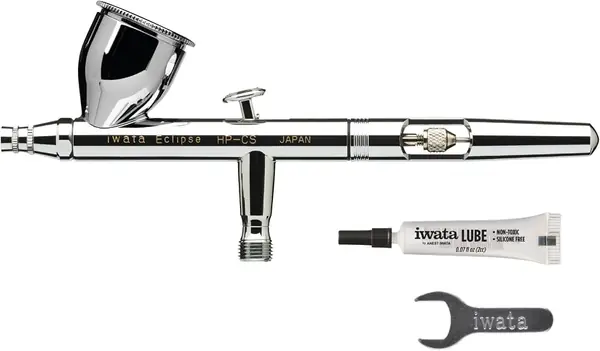
Iwata Eclipse HP-CS gravity-feed dual-action airbrush with compression-fit E3 nozzle and 0.24 oz cup

Detail and coverage

Track Score 95/100
Feed
Gravity feed, dual action
Nozzle
E3 compression-fit
Weight
1.6 oz
Fluid Cup
0.24 oz (7 ml)
View on Amazon

The Eclipse is the airbrush we point people toward when they want to buy once. Its E3 nozzle seats with a compression fit instead of threads, so pulling the head for a between-color rinse takes seconds and there is nothing to cross-thread when you press it back in. The cutaway handle exposes the needle for a fast flush without a full teardown.

What sold us is how little thinning it asks for. The 0.24 oz (7 ml) gravity cup and high-flow atomization push model and craft acrylics that finer brushes here need cut much thinner, and one needle takes you from a pencil line to a broad panel pass. On slot car shells and miniatures it laid down even coats without the spitting we were braced for. At 1.6 oz it also disappears in your hand after a few minutes of work.

The cup is the one thing we noticed on long jobs: spraying a full body shell means a top-up or two, which is the price of a reservoir that stays out of your sightline. That is a fair trade for the control. The parts that wear, from needle to packings, are replaceable and easy to find, which is what keeps a brush like this on the bench instead of in a drawer.

Worth Noting

  • No compressor or hose in the box
Our Verdict

This is the airbrush we tell people to buy once: it sprays finely, cleans in minutes, and forgives paint that is not thinned perfectly.

Check Latest Price
2.

Iwata Revolution CR Best for Broad Coverage

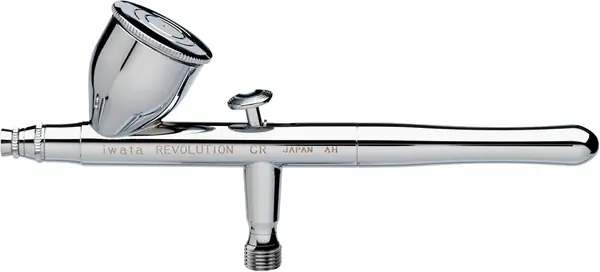
Iwata Revolution CR gravity-feed dual-action airbrush, a metal-bodied brush for broad coverage work

Broad coverage work

Track Score 94/100
Feed
Gravity feed, dual action
Item Weight
8.8 oz
Product Dimensions
4.4 x 7.8 x 2.2 inches
View on Amazon

Where the Eclipse chases hairline detail, the Revolution CR is the Iwata for a whole panel. It throws an even cone of paint across a shell and holds it, which turns priming and base-coating a stack of bodies into one sitting at the bench rather than an afternoon of passes.

Thick paint is where it earns its keep. Model enamels and heavier acrylics that need real thinning in a finer brush move through this one with less fiddling, and the shallow cup rinses clean in a couple of flushes rather than a scrub. You can work the trigger hard on a primer coat and the brush stays composed.

Control is where the difference between this and a budget brush shows. Feathering the trigger gives you a soft edge that fades instead of stepping, and you can creep up on a tight area around a wheel arch without lifting your mask.

Cleaning is straightforward and familiar: the head comes apart simply, and replacement needles and nozzles are available when one eventually bends. That last point matters more than any figure on this page, because a brush you can keep running is a brush you will actually use.

Worth Noting

  • Not the pick for hairline detail
Our Verdict

If your work is primer, base coats and broad blends rather than hairline detail, we think this is the Iwata to buy.

Check Latest Price
3.

Gaahleri GHAD-39 Best Value

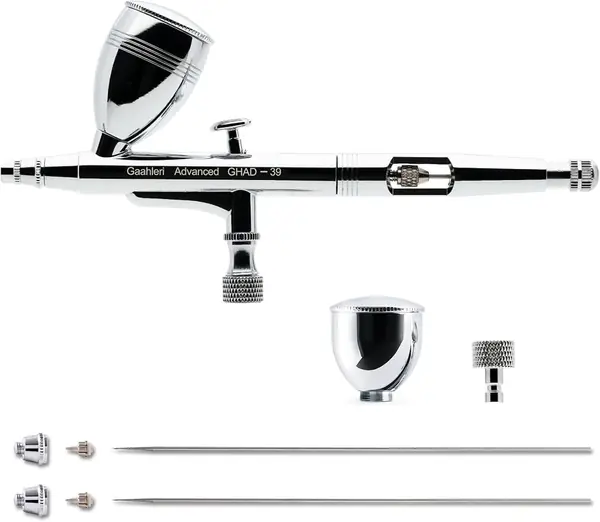
Gaahleri GHAD-39 dual-action gravity airbrush in silver with two fluid cups and spare nozzle set

First serious airbrush

Track Score 93/100
Feed
Gravity feed
Nozzles
0.35 mm and 0.5 mm
Warranty
1 year
Fluid Cups
1/2 oz and 1/4 oz
View on Amazon

Two needles, two nozzles and two cups come in the box: a 0.35 mm setup for general work, a 0.5 mm for primer and clear, and 1/2 oz and 1/4 oz cups you swap by hand. That is an unusual amount of choice to get with a first airbrush.

The nozzle drops in and centers itself, and that is the detail we appreciated most after a long session. There are no fine threads to cross when you reassemble it tired, and a flush between colors takes about a minute.

In our hands it sprayed primer and base coats evenly and without the pulsing we expected at this end of the market, and the polished cup rinses out without a brush. It is also the pick that best survives being somebody's first airbrush: a spare set of O-rings and a wrench come in the box, the warranty runs a year, and a mistake costs you a needle instead of a weekend.

The one habit worth building is thinning. Thick primer straight from the pot will clog the 0.35 mm head, so strain it and cut it the way you would for any detail brush.

Worth Noting

  • More small parts to keep track of
Our Verdict

We recommend it as a first dual-action airbrush because it arrives with two nozzle sizes, two cups and performance that holds up well past its price.

Check Latest Price
4.

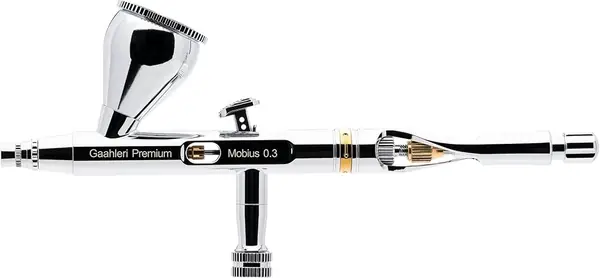
Gaahleri Mobius 0.3 Best for Fine Detail

Gaahleri Mobius 0.3 premium airbrush with cutaway rear ring and polished gravity-feed cup

Fine shading work

Track Score 92/100
Nozzle
0.3 mm spiral MAC
Weight
10.9 oz
Warranty
1 year
Cup
Ultra mirror-polished
View on Amazon

The first thing your finger notices is the lever. It is squared off rather than round, and it moves without the grainy take-up cheaper triggers have, which is exactly the feedback you want when you are feathering paint into a panel line.

We liked it for the in-between work that fills a build: shading a cockpit, tinting a stack of bodies, laying a soft edge where a 0.2 mm head would take all evening and a 0.5 mm would flood the line. The spiral nozzle holds a steady pattern on properly thinned paint, and the mirror-polished cup empties so completely that a rinse is usually enough.

Cleaning is easier than the price suggests. The nozzle assembly unscrews quickly by hand, and the open cutaway shows you what is happening in the chamber instead of making you guess.

Spec for spec it sits between the budget Gaahleri and the Eclipse, and for a lot of painters that is the right place to land: more control than an entry gun and a trigger you will not be fighting. For a mid-priced brush it feels closer to a tool than a toy.

Worth Noting

  • Not the brush for large priming jobs
Our Verdict

For shading and soft edges on model bodies, this is the mid-priced brush to buy, and its trigger is the reason.

Check Latest Price
5.

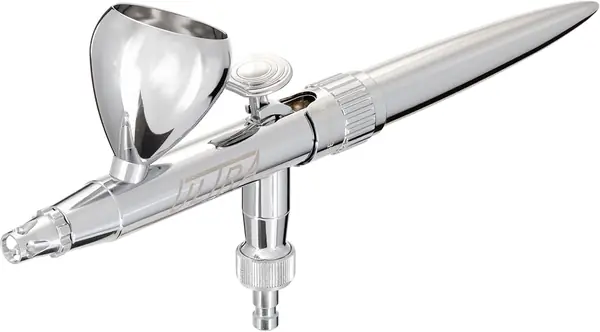
Harder & Steenbeck Ultra 2024 Best Upgrade Path

Harder & Steenbeck Ultra 2024 gravity-feed airbrush with 5 ml cup and self-centering nozzle

Beginners who upgrade

Track Score 91/100
Nozzle
0.45 mm self-centering
Fluid Cup
5 ml
Trigger
Dual action
Maintenance
Tool-free disassembly
View on Amazon

The micro-cup socket machined into the body is the detail we keep coming back to. For a few drops of paint, whether that is a test spray, a touch-up on a fender or a color you will mix twice, you skip the 5 ml cup and rinse a thimble's worth instead of a cupful. It is a small thing that saves real paint over a season of touch-ups.

The rest is built the way H&S builds its pricier models. The 0.45 mm nozzle self-centers, taking the guesswork out of reassembly, and the whole brush comes apart by hand with no wrench, no spanner and nothing small to lose on the floor. That middle size is forgiving for new hands too: fine enough for detail and open enough for background coverage.

Its real strength is the upgrade path. The front end accepts the FineLine head from the Infinity, so a beginner can grow into finer work without replacing the body, and the trigger stop keeps a new hand from dumping too much paint on a first layer. That is the modularity we wish more mid-priced brushes offered.

Worth Noting

  • Setup guidance is a QR code not a manual
Our Verdict

We like it as a first serious brush: tool-free, forgiving on nozzle reassembly, and able to take finer H&S heads later instead of being replaced.

Check Latest Price
6.

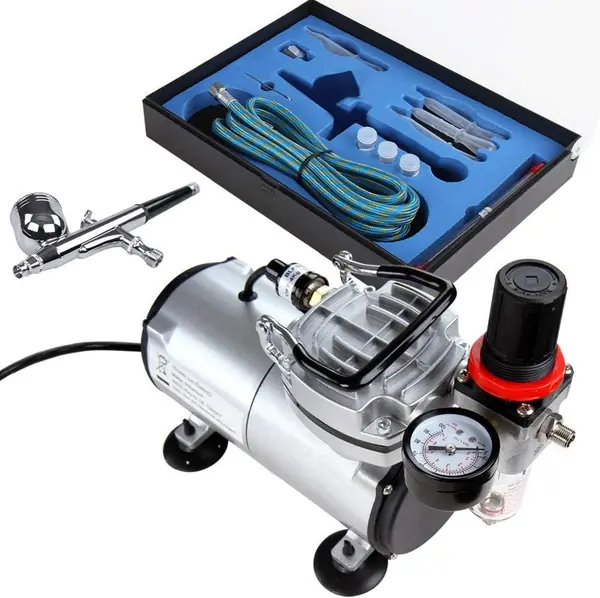
TIMBERTECH Airbrush Kit with Compressor Best Beginner Kit

TIMBERTECH airbrush kit with silver gravity-feed brush, oil-free compressor and air hose

Starting from scratch

Track Score 90/100
Fluid Cup
7 ml
Nozzles
0.2 mm, 0.3 mm and 0.5 mm
Noise Level
50 dB
Maximum Pressure
2.5 bar
View on Amazon

Quiet is the first thing you notice, and it is the main reason we point beginners at this kit. The oil-free compressor cuts in only when pressure drops and hums at a level you can talk over, so it can live in a spare bedroom instead of a garage. Everything else is there too: regulator, gauge, moisture filter, hose, pipettes, and a 0.3 mm brush already mounted, with 0.2 mm and 0.5 mm nozzle and needle sets bagged alongside.

Those three nozzle sizes do more work than the spec sheet suggests. On a slot car build, 0.5 mm handles primer and clear, 0.3 mm covers color, and 0.2 mm gets into panel lines, and swapping between them takes a few minutes and the supplied wrench rather than a second brush.

Set-up is quick and mostly self-explanatory, and the auto start-stop means the compressor is silent between passes rather than running until you finish. For someone who has never held an airbrush, that quiet rhythm makes practice a lot less self-conscious. The moisture filter earns its place during long sessions, so drain it when you are done.

Worth Noting

  • Included brush is the entry-level piece
Our Verdict

We recommend this kit to anyone starting from nothing: quiet, complete, and flexible enough to cover primer through panel lines.

Check Latest Price
7.

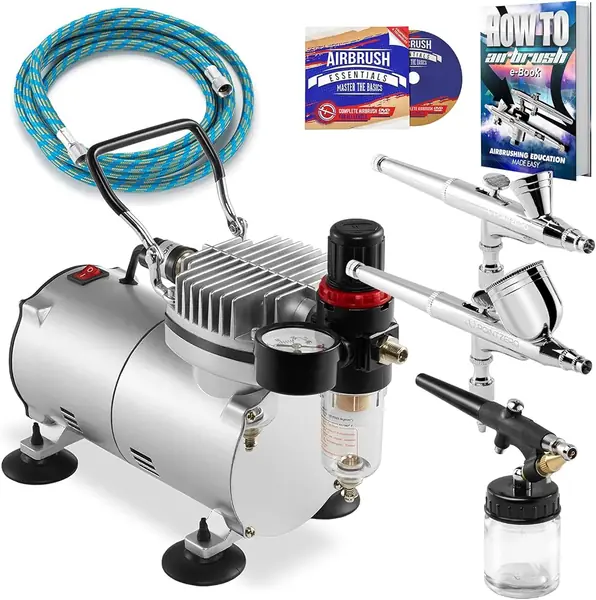
PointZero Airbrush Kit with 3 Airbrushes Best for Two-Person Benches

PointZero airbrush kit with three airbrushes, a compressor and a two-gun holder

Two-person benches

Track Score 89/100
Weight
11 lb
Hose
6 ft braided
Holder
2 guns, compressor-mounted
Airbrushes
PZ-260, PZ-270 and PZ-276
View on Amazon

Three airbrushes in one box looks like padding until you picture the bench: one gun loaded with primer, one with color, and a third for whoever is learning. The PZ-260, PZ-270 and PZ-276 cover both single- and dual-action work, and two of them hang on a holder mounted to the compressor.

The compressor is the part we were happiest with. It holds steady pressure through a long session, runs quietly enough for an apartment, and arrives assembled with its fittings, so there is nothing to chase down before your first spray.

Handing the single-action gun to a beginner while you keep a dual-action brush in your own hand is a nice way to run a shared session. It is one of the few kits here that assumes more than one person will use it.

The brushes themselves are a solid first set rather than a forever set, and the compressor is the piece you keep when you eventually upgrade the guns, which is the right way round for a kit at this level. For a club bench or a parent painting alongside a kid, that ordering makes a lot of sense.

Worth Noting

  • Instructions are thin beyond the basics
Our Verdict

We like it for a bench where two people paint at once, or for keeping primer and color in separate guns.

Check Latest Price

How We Tested Dual-Action Airbrushes

We started with every dual-action gravity-feed brush we could find in the range a serious hobbyist would pay, then filtered by nozzle size, whether a second needle and nozzle set was included, whether the brush came with air or needed a compressor of its own, and whether replacement needles, nozzles, and seals were listed as available. Anything with no parts support and no clear nozzle spec came off the list. That left 12 brushes, which we used for eight months.

Testing happened where airbrushes actually live: a garage bench with the spray booth running, weekend sessions on model kits and cosplay armor panels, and a few long evenings of two- and three-hour shading runs. We thinned craft acrylics and model lacquers to the consistency of milk and noted which brushes demanded more reducer than their neighbors, watching for spitting, spidering, and dry tip. Stirring paint in the cup showed whether trapped bubbles turned into a sputter halfway across a panel. For the trigger, we pressed and pulled on mottled scrap, counting how much travel passed before paint appeared and whether a trigger stop helped hold a thin line.

After every session we tore each brush down, timing a full clean and noting whether the nozzle was threaded or self-centering, whether the needle came out without tools, and how much paint hid in the cutaway. We weighed each one and ran two-hour stretches to see which made a hand ache, set up every kit using only its own manual, and measured compressor noise on a phone app. Needles got honest treatment — a drop or two on the bench, a bent tip or three — then we checked whether replacements were in stock. We sprayed only with ventilation running and respirators on, and kept every paint-loaded brush away from cake and cosmetics work entirely; flushing one out does not make it food-safe.

How to Choose Dual-Action Airbrushes

Start With the Air

The airbrush gun is the cheap half of getting started; the air is where first-timers stall. A standalone brush such as the Eclipse or the Mobius assumes you already own a compressor, a hose with the right fitting, and a way to hold pressure steady. A kit like the TIMBERTECH or the PointZero solves all of that in one order.

Read what is inside a kit before you buy it. You are usually paying for the compressor, and the included brush is the entry-level half of the package, which is fine as long as you know which half you will replace first. If you already own a shop compressor, add a regulator and a moisture trap before anything touches a body shell.

Match the Nozzle to the Job

Nozzle size decides what a brush is good at, and no single head does everything. A 0.2 or 0.3 mm setup gives you a pencil line for panel lines, shading and fine camouflage; 0.35 to 0.45 mm is the all-round middle where most model and slot car work lives; 0.5 mm moves primer and clear without endless thinning.

The trap is buying a detail brush for a job that begins with primer. A 0.3 mm head will clog all afternoon on paint that has not been cut, and you will blame the brush. If you are unsure, buy a set with two heads, like the Gaahleri GHAD-39, rather than a second brush.

Cleaning Design Beats Feature Lists

You will clean this brush far more often than you use it, so the head design matters more than any marketing line. Compression-fit and self-centering nozzles drop in and sit square with no fine threads to cross; threaded nozzles are the part beginners strip. A cutaway handle lets you flush the needle path without a teardown.

We put real weight on these details, because the brushes that stay on our bench are the ones where a color change takes a minute. A tool-free body like the Ultra 2024 makes the whole routine faster still.

Learn the Trigger, Then Judge the Brush

Dual action means press for air, pull for paint, and the two together are a skill. A smooth lever and a trigger stop help a lot; a gritty one teaches bad habits. The stop limits how far the needle retracts, so a new hand can lay a thin coat without flooding a panel.

None of this is difficult, but budget an evening with water or thin paint on scrap before you point the brush at a shell you care about. Learning on a body you have already painted badly is a cheap lesson; learning on a finished one is not.

Buy for the Parts You Can Replace

Needles bend and nozzle tips crack. That is normal wear rather than a defect, and what separates a brush you keep from one you throw away is whether the maker sells the needle, nozzle, packing and O-rings separately for that exact model. Search the model number for a spares listing before you order.

Both Iwatas here have replacement needles and nozzles available, and the Gaahleri brushes ship with spare O-rings and a year of coverage. A budget brush with no parts behind it is a disposable brush, whatever it costs.

Frequently Asked Questions

Final Verdict

The Eclipse HP-CS is the dual-action airbrush we recommend to almost everyone. Its compression-fit nozzle makes the cleaning routine short enough that you will actually do it between colors, and it sprays modeling acrylics with less thinning than the rest of this group. Those are the two things that decide whether a brush gets used or lives in a drawer.

If your work is mostly primer, base coats and broad blends, the Revolution CR is the better fit. If the budget is the constraint, the Gaahleri GHAD-39 is the one to start on, and the TIMBERTECH kit covers the people who have no compressor yet.