Best Airbrush Cleaners of 2026

A cleaner strong enough to break up a week-old plug of dried acrylic is also strong enough to cloud a clear part or swell the o-ring behind your nozzle. That trade runs through every bottle here, and it is why the formula that rescues a neglected brush isn't automatically the one to leave sitting in the cup.

Read the paint family on the label before the word "cleaner". Most of these bottles handle fresh acrylic; fewer can take on paint that has already cured, which is what an after-dinner cleaning delay produces. Across 16 formulas we tracked how far a bottle goes, how the smell behaves in a small room and what each one did to rubber seals and clear plastic.

Our Top Picks

The Best Airbrush Cleaners

1.

Medea Airbrush Cleaner 16 oz Best Overall
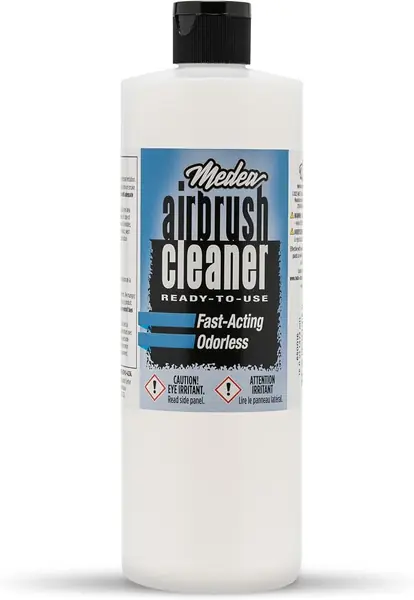
Iwata-Medea 16-ounce airbrush cleaner bottle for acrylic, oil, and water-based paints

Mixed paint types

Track Score 96/100
Volume
16 fl oz
Paint Types
Acrylic, oil, water-based paints, inks, dyes, watercolors, and gouache
Sizes Sold
4, 8, 16, and 32 fl oz
Form
Ready-to-use liquid
View on Amazon

Acrylic on Monday, oil on Wednesday, water-based ink on Friday: this is the bottle that does not care what went through the brush. Medea's cleaner is listed for acrylics, oils, water-based paints, inks, dyes, watercolors, and gouache, the widest stated paint range in this group. It also pours ready to use, so there is nothing to measure at the end of a session when you are tired and the cup is full of color.

That range is why it has become our default. When we change paint types we do not want to stop and think about which bottle is safe for whatever is left in the nozzle, and this one covers the everyday cases without drama. It lifts acrylic out of the cup without a long soak, and it has been gentle on the seals — we have not had to baby an o-ring afterward.

The 16-ounce bottle sits in the middle of a line that runs from 4 to 32 ounces. For between-color flushes we cut it half and half with distilled water and keep full strength for the last rinse of the session, which stretches a bottle well past what the size suggests.

Cured paint is where it runs out of steam: leave acrylic in the nozzle overnight and this is the slower route compared with a hot solvent formula. We still start here, and reach for something stronger only when a brush has been neglected.

Worth Noting

  • Faint smell some people pick up
Our Verdict

We recommend this as the default bottle for most airbrush work: it pours ready to use, handles acrylics and oils, and the 16-ounce size goes a long way.

Check Latest Price
2.

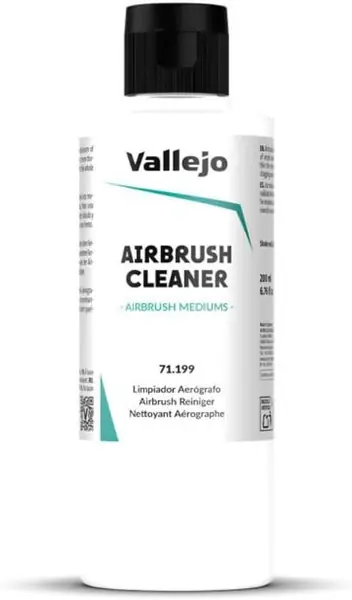
Vallejo Airbrush Cleaner 200 ml Best for Acrylics

Vallejo 200 ml airbrush cleaner bottle for acrylic paints in recycled plastic

Acrylic-only painting

Track Score 95/100
Volume
6.76 fl oz (200 ml)
Paint Type
Acrylic
Sizes Sold
2.87 and 6.76 fl oz
Special Features
Nonflammable, non-toxic
View on Amazon

The smallest bottle here is also the most single-minded. Vallejo's formula is built for acrylics and makes no claims beyond them, and we keep it for exactly that job: it flushes a cup of Model Air more completely than the all-purpose bottles do, and the residue lifts instead of smearing.

What sets it apart is what happens once the paint is gone. The cleaner lubricates the needle and valve as it works, so the action feels slick on the next fill rather than dry, and the maker's guidance is to soak the valve and nozzle rather than dunking the whole brush. It is nonflammable and non-toxic as well, which makes it an easy bottle to leave open on a bench.

Volume is the trade-off. At 6.76 ounces this is a hobby bottle, sized for detail sessions and touch-up rather than a full afternoon of color changes on a body shell, and it is also sold in a smaller 2.87-ounce size. Clean one brush after one small job and it will last; flush four colors an hour and the larger bottles below will outlast it.

Worth Noting

  • Formulated for acrylic paints only
Our Verdict

Our pick for anyone who sprays acrylics and nothing else: it flushes cleanly and leaves the needle feeling slick.

Check Latest Price
3.

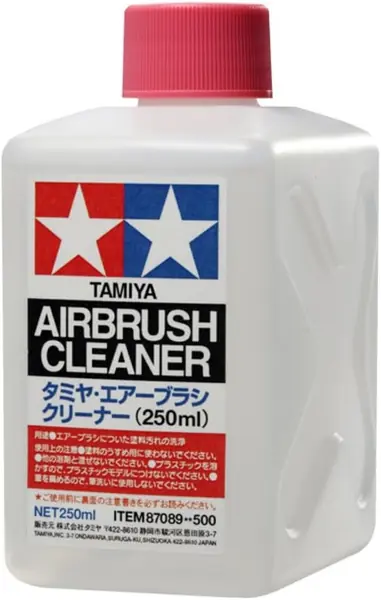
Tamiya Airbrush Cleaner 250 ml Best for Stubborn Paint

Tamiya 250 ml airbrush cleaner bottle for acrylic and hobby paints

Cured, stubborn paint

Track Score 94/100
Volume
250 ml
Paint Type
Acrylic
Model
87089
Age Guidance
14 years and up
View on Amazon

A brush left with acrylic in the nozzle over a weekend is the test that separates cleaners, and Tamiya's formula is built for it. This is the most aggressive cleaner in this group: it goes after paint that has already set, where the water-based bottles need a long soak first.

It is quick between colors too, which is why the bottle does not sit idle between problem jobs. If you spray Tamiya acrylics, this is the obvious match, since the residue in the cup is the kind of paint the formula was designed around. The 250 ml bottle also carries a 14-and-up recommendation from the maker, which tells you something about how they expect it to be handled.

It is a specialist, not a daily driver. When a nozzle has sat with paint in it, this is the bottle we pick up first, and one application has been enough every time so far. For ordinary between-color work on fresh acrylic, the Medea pick is easier to live with; the Tamiya belongs with the neglected brushes.

Worth Noting

  • Fumes are strong without good ventilation
  • Can attack rubber seals and clear plastic
Our Verdict

For paint that has already set in the nozzle, this is the cleaner we trust most in this group.

Check Latest Price
4.

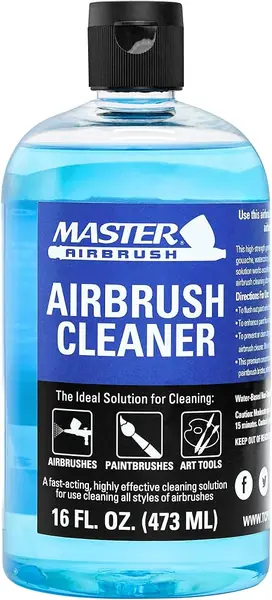
Master Airbrush Cleaner 16 oz Best Value

Master Airbrush 16-ounce pint bottle of water-based acrylic cleaning solution

Soaking dried acrylic

Track Score 93/100
Volume
16 fl oz
Standard
ASTM D-4236
Paint Types
Water-based acrylics, gouache, watercolors, inks, dyes, makeup
View on Amazon

Dried acrylic in the cup calls for a soak, and that is the job Master's bottle is set up for. The guidance for a clogged brush is to take out the needle and nozzle rather than flush harder, and the concentrated formula is meant to soften what has already stuck, not just rinse what is still wet.

The list of what it handles runs long for a water-based cleaner: acrylics, gouache, watercolors, inks, dyes, makeup, tanning solution, and cake decorating colors. It meets ASTM D-4236 and is labeled for ultrasonic cleaning of small parts, which is where a pint earns its keep — fill a small jar, drop in the nozzle, and let it sit.

It is billed as low odor, and next to a solvent cleaner it is, but it is not scentless. In a small room we keep a fan moving and cap the soaking jar between rounds, and that has been enough for us.

What it has going for it is the combination of a pint bottle and a formula that works on the water-based media most hobby painters actually use. If your shelf is all acrylic and you prefer soaking to scrubbing, this is the bottle to buy; if lacquer is also in the rotation, keep a solvent cleaner next to it.

Worth Noting

  • Water-based media only, no solvent paints
Our Verdict

A pint of concentrated water-based cleaner that soaks dried acrylic loose, and we think it is the value pick of this group.

Check Latest Price
5.

Createx Airbrush Cleaner 32 oz Best for Water-Based Custom Colors

Createx 32-ounce water-based airbrush cleaner bottle with citrus scent

Water-based custom colors

Track Score 92/100
Volume
32 fl oz
Standard
ASTM D-4236
Base
Water-based
Scent
Citrus
View on Amazon

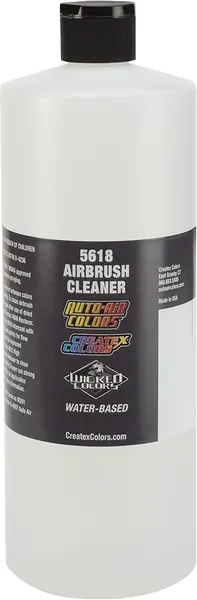
Half of what this bottle does is not cleaning at all. Createx's formula doubles as a reducer for the company's own colors, which is why we like it for custom work: one bottle thins the paint going in and rinses it out afterward, so there is no second product to buy or knock over.

What is in the bottle is a rinse rather than a restorer. It is for flushing color out between coats and cleaning parts after a session, and Createx directs you to its 4008 Restorer for paint that has already dried. The formula is water-based, carries a citrus scent, meets ASTM D-4236, and is listed as compatible with the Airbrush Colors, Wicked Colors, Auto Air Colors, and Illustration Colors lines, plus other water-based paints.

One caveat from the maker belongs on the bottle: if you have mixed 4030 Intercoat into your paint, this cleaner is not recommended, and Createx points you to its 4012 High Performance Reducer instead. Otherwise, for anyone spraying water-based custom color on a body shell, 32 ounces is enough to see a paint job through several color changes.

Our Verdict

If you spray Createx or Auto Air colors, this is the bottle to buy: it rinses between coats and thins the paint going in.

Check Latest Price
6.

Evo Dyne Airbrush Cleaner 16 fl oz Best for Routine Acrylic Flushes

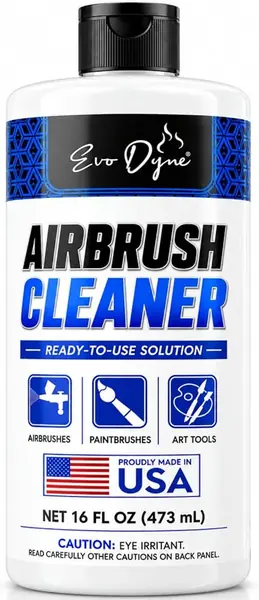
Evo Dyne 16 fl oz airbrush cleaner bottle with a flip-top cap

Routine acrylic flushes

Track Score 91/100
Volume
16 fl oz
Paint Types
Acrylic and water-based media
Dispenser
Flip-top cap
View on Amazon

A flip-top cap sounds like nothing until you are holding a gravity-feed cup in one hand. Evo Dyne's bottle opens to a controlled pour, so you can add a splash, close it, and get back to the brush without hunting for a funnel, and the bottle holds 16 ounces, sold singly or as a two-pack.

As a cleaner it handles the ordinary jobs: paint cups, nozzles, needles, and brushes, and it is fine for makeup airbrushes as well. For someone who wants one bottle by the sink for routine flushes, it does the job, and we like that it sits at the budget end of this group. It is not the bottle for a painter who has not settled on a medium yet; pick the paint first, then the cleaner.

Worth Noting

  • Acrylic and water-based media only
Our Verdict

A simple acrylic cleaner in a generous bottle; we like it for routine flushes and the easy-pour cap.

Check Latest Price
7.

Timbertech Water-Based Airbrush Cleaner 34 fl oz Best for Daily High-Volume Cleaning

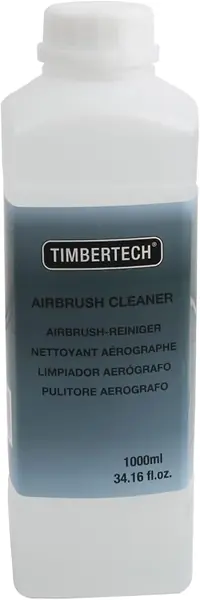
Timbertech 34 fl oz water-based airbrush cleaner bottle for acrylics and inks

Daily high-volume cleaning

Track Score 90/100
Volume
34 fl oz (1000 ml)
Standard
ASTM D-4236
Base
Water-based, non-toxic
View on Amazon

Most cleaners only ever meet the inside of the cup. This one is also meant for the needle itself: a drop inside the needle cap and along the needle keeps ink moving and slows tip dry, a small habit that pays off on a long session with a fine nozzle.

The rest is straightforward. It is a water-based, non-toxic cleaning solution that meets ASTM D-4236, listed for acrylics, watercolors, gouache, inks, and dyes, and it works with any airbrush model as well as synthetic and natural hair brushes. It is labeled for ultrasonic cleaning of technical pens, and it can be used to thin Timbertech's own acrylics.

Thirty-four ounces is the largest bottle in this roundup, and for a bench that cleans every day that is the whole argument: fewer reorders, one bottle on the shelf. We like it best for high-volume acrylic work where the same bottle serves as cleaner and rinse. For cured lacquer, the Mr. Tool Cleaner bottle below is the right tool; this one is a rinse at heart.

Worth Noting

  • Bottle is bulky for a small bench
Our Verdict

The biggest bottle here, with a mild water-based formula that suits a bench cleaning several brushes a day.

Check Latest Price
8.

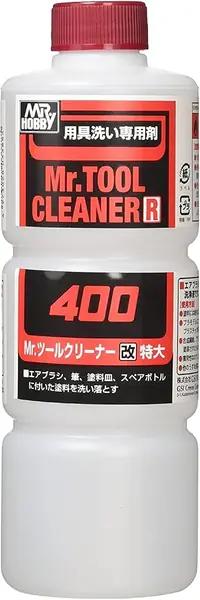
Mr. Hobby Mr. Tool Cleaner 400 ml Best for Lacquer and Enamel

GSI Creos Mr. Tool Cleaner 400 ml bottle for airbrushes and paint tools

Lacquer and enamel

Track Score 89/100
Volume
400 ml (13.53 fl oz)
Paint Type
Universal
Model
T116
Surfaces
Plastic, metal, wood
View on Amazon

If the paint in your brush is solvent-based — hobby lacquer, enamel, the hot stuff — most of this list is the wrong aisle. The water-based bottles that dominate the group are built for acrylics, and running one of them at a lacquer clog wastes cleaner and time.

Mr. Tool Cleaner is the solvent answer: a 400 ml bottle listed for universal paint types on plastic, metal, and wood, made to dissolve paint stains on airbrushes, brushes, paint trays, and spare bottles. It is the kind of bottle that lives next to the lacquer jars rather than by the sink.

We treat it as the specialist's bottle. Buy it if your shelf is a solvent line and you are tired of coaxing dried paint out with a mild rinse; it also handles mixing trays and spare bottles that a cup-and-flush cleaner never touches. If you only spray acrylics, you will never need it; if you spray lacquer, you will wonder how you cleaned without it.

Worth Noting

  • Strong solvent needs a ventilated room
Our Verdict

The solvent specialist: we keep it for lacquer and enamel, where the water-based bottles cannot help.

Check Latest Price

How We Tested Airbrush Cleaners

We built the shortlist from the labels, not the store copy. Every candidate had to name the paint family it dissolves and come in a volume that would survive a month of flushing; we read each maker's safe-handling guidance before buying and noted which bottles are ready to use versus concentrated. That left 16 cleaners, from small art-store bottles to a quart jug.

Testing ran four months on a spare-room bench, through ordinary work: weekend acrylic sessions on model kits and canvas, custom colors mixed from water-based paints, and a few lacquer jobs done with the window open and a fan pulling air out. Solvent-strength formulas stayed away from any pilot light, and we sprayed each one through a brush with ventilation running.

Every bottle got the same drill. We rinsed a gravity-feed brush with a 0.3 mm nozzle using a measured ounce, counted the passes before the spray ran clear, and noted whether old paint lifted in sheets or smeared. Acrylic dried hard for a day on a palette and on spare nozzles; we soaked those parts, never a whole assembled brush, in a small jar, checking twice over the next day. O-rings and a clear plastic part soaked for an hour in the water-based cleaners; the solvent-strength formulas never touched them, per their own labels.

We also watched the small things: whether a bottle gave drops or a flood when tipped into a mixing cup, how many ounces a week of flushing used up, and how far the smell carried once the cap went back on. Anything sold for ultrasonic baths got a run in ours with a clogged nozzle. The ones that stayed on the bench lifted paint in a pass or two, behaved predictably on seals, and didn't make a small room unlivable.

How to Choose an Airbrush Cleaner

Start With the Paint, Not the Airbrush

Every bottle here cleans an airbrush; what separates them is which paint they dissolve. Water-based formulas take acrylics, gouache, watercolors, inks, and makeup, and they are the sensible default for a hobby bench. Solvent formulas go after lacquer and enamel, where a mild rinse mostly moves the residue around. Check that the maker names your paint family: one 16-ounce bottle on this list states that oil-based compatibility has not been confirmed, and that is exactly the line to read before you order.

If you spray both families, we keep two bottles rather than compromise on one.

Ready-to-Use, Concentrated, or Dual-Purpose

Most cleaners pour straight from the bottle, which is what you want at the end of a session. Concentrated formulas can be cut with distilled water for between-color flushes, and that habit stretches a bottle considerably. A few do second duty as reducers for a specific paint line — Createx's cleaner thins Createx colors, Timbertech's thins Timbertech's — and that pairing is worth having if those paints are already on your shelf.

It is not a general permission slip, though. A reducer is matched to its own chemistry, so do not assume any cleaner can thin any paint.

Fresh Paint and Cured Paint Are Different Jobs

Cleaning between colors is a rinse; cleaning a brush that sat for a week is a soak. A mild water-based cleaner will flush wet acrylic all day and stall on a nozzle that has dried solid, while a hot solvent formula goes after the cured film and demands more care in return. If you are disciplined about flushing, buy for the rinse. If brushes get put down wet, buy one bottle with real solvent strength and use it near an open window.

Bottle Size and What It Costs Per Ounce

Bottles here run from about 7 ounces to 34, and the per-ounce math flips the order you see on the shelf: a small hobby bottle at a modest price can cost more per ounce than a much larger one. We work backward from how often we clean. Daily cleaning in a busy booth justifies the biggest bottle, while a few detail sessions a month suit a 200 ml hobby size that stays fresh.

Fumes, Seals, and Parts You Should Not Soak

Solvent cleaners earn their strength with fumes, and a small hobby room needs air moving before you open the bottle. Keep hot formulas off rubber o-rings, clear parts, and anything plated, and do not leave a whole airbrush submerged — Vallejo suggests soaking only the valve and nozzle. Ultrasonic cleaning is fine for metal parts with formulas labeled for it; read the label rather than assuming.

Frequently Asked Questions

Final Verdict

It is hard to argue with a bottle that handles acrylics, oils, inks, and watercolors and needs no measuring, which is why the Medea cleaner is the one we recommend first. Buy it and you can stop thinking about cleaner choice for most sessions.

The exceptions are worth naming. If nozzles sit with cured paint in them, Tamiya's stronger formula earns its place on the problem brushes, and if your paint is lacquer or enamel, keep a solvent bottle like Mr. Tool Cleaner alongside it.