The Best Spray Primers for Miniatures of 2026

A bad primer coat is the one mistake in this hobby you can't paint over. Every chalky speck, every panel line that quietly filled and every patch where paint beaded sits under everything that follows. Primer is also the cheapest thing you'll buy for an army, and the right can makes the next twenty hours easier.

Two thin passes beat one wet coat, and humidity ruins a good can faster than a bad nozzle does. The undercoat color shapes everything above it: black gets an army table-ready fast, white makes bright schemes sing and gray forgives the most. Over six months of infantry blocks, vehicles, resin kits and 3D prints, the gap between a can that mists and one that spits showed in the first batch, and the seven picks were chosen on how those first ten seconds go.

Our Top Picks

The Best Spray Primers for Miniatures

1.

Tamiya Surface Primer L Gray Best Overall
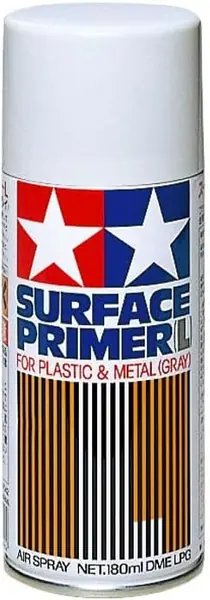
Tamiya Surface Primer L Gray aerosol can of matte light gray model primer

Detailed small figures

Track Score 96/100
Color
Light gray
Can Size
180 ml
Finish
Matte
Surfaces
Plastic, metal
View on Amazon

A primer earns its keep by getting out of the way, and nothing here does that better than the Tamiya Surface Primer L. The mist lands dry and fine, so you can work in two or three light passes and still pick out every strap, eye socket and rivet on a small figure. That is why it is the one we suggest starting with for plastic, resin and metal alike: the coat leaves nothing to fight later, with no pooled panel lines and no softened faces.

Light gray is the other half of the argument. It sits between white and black on the value scale, so it neither washes out a dark scheme nor dulls a bright one, and it shows detail while you work — a missed patch is obvious instead of hidden under a dark coat. Acrylics settle onto it without beading, and it holds on metal parts as readily as on plastic ones.

Under paint, the coat behaves the way a good primer should: thin enough that a wash sinks into recesses rather than sliding off, toothy enough that a base coat does not bead. It will not fill a panel line on a 28 mm figure, which is the entire point of buying it.

Worth Noting

  • Small 180 ml can runs out mid-army
Our Verdict

The finest mist in this group, a neutral light gray, and detail that survives untouched — this is the can we point people to first.

Check Latest Price
2.

Citadel Chaos Black Spray Best Black Undercoat

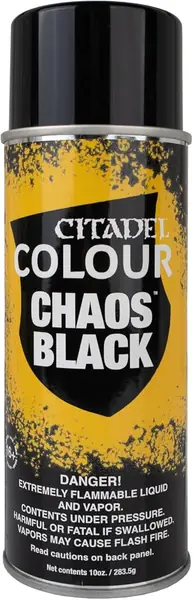
Citadel Chaos Black spray can of matte black miniature primer

Black undercoats

Track Score 95/100
Color
Black
Can Size
10 fl oz
Finish
Matte
Dry Time
0.5 hours
View on Amazon

Black undercoats do something no other color does: they leave the deepest recesses of a model already dark, so a missed cranny reads as shadow rather than bare plastic, and metallics painted over them look heavier and older. Chaos Black is built for that job, and it behaves like a known quantity, which is exactly what you want from a step you repeat on every model in the army.

We keep it on the shelf for the finish. It dries to a true matte rather than the satin that some primers leave, so acrylics grab instead of sliding, and a single pass covers bare plastic without the speckled look you get from a can that is spitting. Half an hour to touch-dry means a squad primed before lunch can be base-coated in the afternoon.

A 10-ounce can goes further than it looks, because one opaque pass is all a figure needs, and it is the most forgiving black in this group on metal, where thin coats matter because a smooth surface gives paint nothing to bite into.

Worth Noting

  • Premium price for a 10-ounce can
Our Verdict

We keep this for black undercoats because the matte finish takes acrylic cleanly and a single pass covers bare plastic.

Check Latest Price
3.

Rust-Oleum Painter's Touch 2X Flat Gray Best Budget

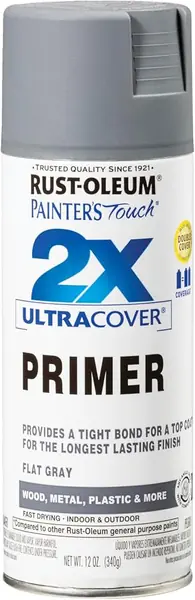
Rust-Oleum Painter's Touch 2X flat gray primer spray can

Armies and terrain

Track Score 94/100
Color
Flat gray
Can Size
12 oz
Dry Time
20 minutes
Coverage
12 sq ft
View on Amazon

Nothing changes how freely you spray like a cheap can. At a fraction of what the hobby brands cost, the Painter's Touch 2X is the one you can point at a full table of terrain, a shelf of 3D-printed ruins and a forty-model conscript squad without flinching at the last third of the can. It is 12 ounces of oil-based flat gray, rated at 12 square feet and touch-dry in 20 minutes.

It sprays from any angle, which matters more than it sounds when you are reaching under a tank hull or into a corner of scatter terrain, and the flat gray shows exactly where the coat has landed — a real advantage over black, where a missed patch looks like a shadow until you start painting. The coat is heavier than a hobby primer's, so keep the passes light and start the spray off the model; that is a technique adjustment rather than a defect.

For plastic miniatures, resin figures and printed parts, we think it is the sensible bulk buy: even coverage, plenty of tooth for acrylics, and no hobby-shop premium on square footage you are about to cover with paint anyway. Save it for the models where detail comes second, and reach for the Tamiya when the figure is a character rather than a rank and file.

Worth Noting

  • Nozzle can clog with paint left in the can
Our Verdict

The can for priming a whole army or a table of terrain without thinking about cost.

Check Latest Price
4.

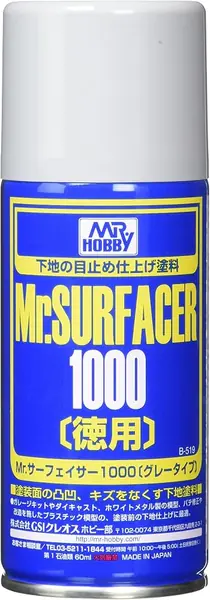
GSI Creos Mr. Surfacer 1000 Best for Filling Print Lines

GSI Creos Mr. Surfacer 1000 gray spray can of modeling surfacer

Smoothing 3D prints

Track Score 92/100
Color
Gray
Can Size
170 ml
Dry Time
4 hours
Grade
1000 (fine)
View on Amazon

Mr. Surfacer is not really a primer in the ordinary sense. It is a surfacer: a filler coat that goes on a little heavier than a plain primer so it can level sanding scratches, faint mold seams and the layer lines on a 3D print, then take paint like any other undercoat.

The 1000 in the name refers to how fine the filler is, and it is fine enough to smooth a print without burying detail — a coarser grade would round off a shoulder pad or fill a shallow recess you wanted to keep. It sprays consistently, and it is hard to flood even if your hand hesitates over the same spot twice.

On a printed miniature with visible layer lines, one pass does more for the final surface than an hour of scraping and sanding, and it covers puttied joins and rescue jobs on badly cast metal without every repair showing through the paint.

It is the can for when the surface is the problem rather than the color — printed parts, filled joins, a model that has already been sanded once and needs to look clean. For a kit that only needs an undercoat, the Tamiya is the better-behaved can and leaves a thinner film.

Worth Noting

  • Premium price for a 170 ml can
Our Verdict

We use it when a 3D print or a scratched kit needs smoothing before paint, and we have not found a can that floods detail less.

Check Latest Price
5.

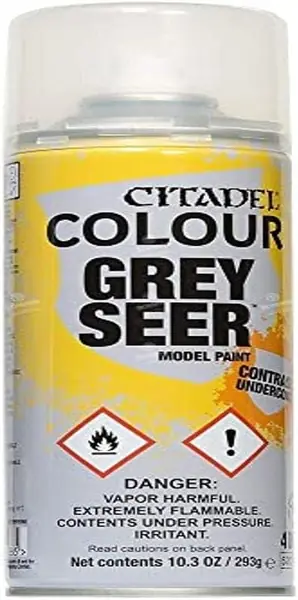
Citadel Contrast Spray Grey Seer Best for Contrast Paints

Citadel Contrast Spray Grey Seer 400 ml can of grey basecoat

Contrast paint schemes

Track Score 91/100
Color
Grey Seer
Can Size
400 ml
Finish
Matte
Surfaces
Plastic, resin, metal
View on Amazon

The difference between Grey Seer and a plain white primer is what lands on top of it. Contrast paint and Speedpaint are built to flow, pool and settle into recesses, and they do that best over a textureless matt coat of the right tone — which is exactly what this can is for. Grey Seer is the colder of the two Contrast sprays, and we think it flatters blue, green and gray schemes better than the white undercoats here.

It comes in a 400 ml can, the largest format here alongside the Vallejo, and it does double duty if you paint the classic way, since it works as an ordinary primer under base, layer and highlight. The finish is designed to go on textureless and matt, with none of the chalky dust that turns a white undercoat into a texture problem.

The catch is that it is a tool for one tone and one method. The cold gray pulls warm schemes — reds, ochres, gold — toward a duller cast, so it is not the can to buy before you have settled on a palette, and a painter who works in warm colors will get more out of a white or a light gray.

Worth Noting

  • Most expensive can in this group
Our Verdict

If you paint with Contrast or Speedpaint, we think this cold gray basecoat is the most reliable foundation you can spray.

Check Latest Price
6.

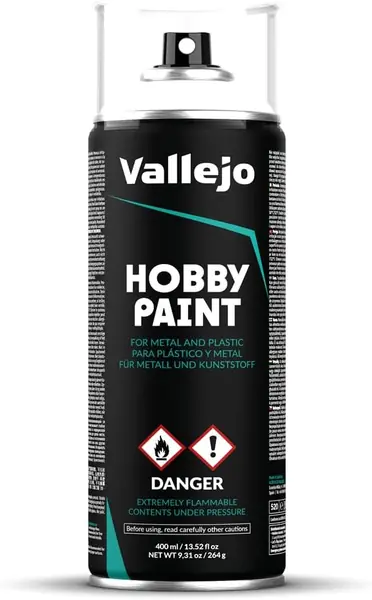
Vallejo Hobby Paint Spray White Best for Bright Color Schemes

Vallejo Hobby Paint Spray white 400 ml can with two nozzles

Bright color schemes

Track Score 90/100
Color
White
Can Size
400 ml
Finish
Matte
Nozzles
Two (low and medium flow)
View on Amazon

Two nozzles come with the can — a low-flow one meant for small, precise work and a medium-flow one for covering area — and on a white primer that is not a gimmick. White is the hardest color to spray well, because every uneven patch and every bit of overspray shows through the bright paint you put on top, so being able to swap to the finer nozzle for a 28 mm face is a genuine advantage.

At 400 ml this is the biggest white can in the group, and the matt finish gives Speedpaint and ordinary acrylics something to hold on to. We like it for bright schemes — reds, yellows, skin — where a black undercoat would take three coats to overcome, and for anyone priming whole units at a time rather than one character.

Treat it with the usual discipline — a full minute of shaking, light overlapping passes, a test spray onto cardboard before you commit a unit — and it does what a white undercoat is supposed to do: vanish under your color and make it read brighter.

Worth Noting

  • Nozzle can leak paint down the can
Our Verdict

We like this for bright schemes: a big white can with a detail nozzle that keeps reds and yellows clean.

Check Latest Price
7.

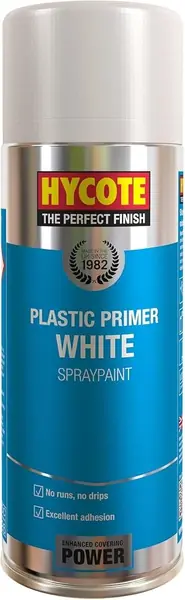
Hycote White Plastic Primer

Hycote white plastic primer 13.5 ounce aerosol can

Stubborn plastics

Track Score 89/100
Color
White
Can Size
13.5 oz
Finish
Semi-gloss
Dry Time
10-20 minutes
View on Amazon

Some plastics and resins actively fight primer. A kit still carrying mold release agent, a vinyl figure with a slick surface, a resin print that has been handled too much — all of them will shed a normal coat in patches, and no amount of shaking fixes it. Hycote's plastic primer is formulated for exactly those surfaces, plastic, PVC, vinyl and resin, as an adhesion promoter rather than a general-purpose undercoat.

It comes in a 13.5-ounce can, touch-dry in 10 to 20 minutes, and it builds a tough, flexible film that takes topcoats from acrylic through lacquer. Coverage is good on flat panels and large parts; on terrain and vehicle shells it lays down evenly and hides small seams and pinholes that a thin hobby primer would telegraph through the paint.

Where it sits in a miniature painter's kit is as a specialist, not a default. We keep it for the parts that fail with everything else — a resin bust that shed its last coat, vinyl accessories, a batch of plastic bases — and for those jobs the adhesion is worth the detour. It is also the can we hand to someone priming a large piece of scenery where a hobby-sized can would run dry halfway.

Worth Noting

  • Semi-gloss finish gives acrylic less tooth
  • Needs 24 hours to harden fully
Our Verdict

We keep a can for resin and vinyl parts that shed ordinary primer, though it is not our first choice for fine figures.

Check Latest Price

How We Tested a Dozen Cans of Miniature Primer

We built the shortlist from the cans that keep turning up in miniature-painting threads, on game store shelves, and on the desks of people who prime a lot of models — hobby primers alongside a few hardware-store cans that plenty of painters quietly keep around. From there we filtered by can size, undercoat color, and cost per model rather than cost per can, and landed on a dozen sprays to put through six months of real work.

Testing looked like a normal Sunday: thirty infantry lined up on a cardboard box in the driveway, a couple of vehicles, a resin kit, and a stack of 3D prints with visible layer lines. We sprayed in short passes from about a foot away and logged temperature and humidity before every session, postponing anything cold or damp rather than risking a chalky coat.

Under a desk lamp we checked each coat for fuzz, grit, and spatter, and looked at whether fine detail survived — faces, fingers, the recesses of a panel line. Once a coat cured, we scratched at it with a fingernail and brushed acrylic over the top to see whether paint gripped or beaded, and we primed identical figures in black, gray, and white so we could compare how the same three colors of paint read over each. We also counted how many figures a can covered before the nozzle sputtered, and noted whether the spray stayed even through the last third of the can.

How to Choose a Spray Primer for Miniatures

Start with the mist, not the brand

Most problems people blame on a primer — soft detail, a grainy surface, paint that beads — start at the nozzle. A can that mists finely lets you build two or three thin passes; a can that spits or drips forces you to choose between a wet, pooling coat and a patchy one. Look for a fine mist and a nozzle that resists clogging before you look at the color on the lid.

The trap is assuming a heavier coat sticks better. It doesn't; it fills panel lines and rounds off edges. Hold the can six to eight inches out, keep it moving, and start the spray off the model rather than on it, so the first wet blast never lands on a face.

Pick the undercoat color for the army, not for the label

Black, gray and white are not interchangeable, and the decision is easier than the advice makes it sound. Black pre-shades recesses, hides the spots you missed, and flatters metal and dark schemes. White makes reds, yellows and skin read bright without four coats. Gray sits between the two and is the safest single can if you paint a bit of everything.

If you are buying one can and you don't know what is next on the desk, buy gray. If you are committed to a single force, buy the tone that suits it and stop worrying about the rest.

Matt beats gloss, and tooth beats both

Acrylic needs a surface with a little texture to key into, which is why matt primers are the standard and gloss or semi-gloss films are a compromise. A glossy coat can look perfectly primed and still let paint slide, and a powdery, chalky coat is worse: it rubs off on your fingers and leaves nothing for the next layer to grip.

Test a scrap of the same material before you commit a unit. If the finish feels slick or dusty rather than evenly matt, you have the wrong can for that model, and no amount of careful spraying will fix it.

Match can size and nozzle to how you paint

A 180 ml hobby can is right for characters and small units; a 400 ml can is right for armies and terrain and costs less per model. Neither is better in the abstract, but buying a small premium can to prime a table of ruins is how people end up resenting the hobby.

The other half of that decision is the nozzle. A can that clogs at the halfway mark wastes more money than a cheaper one that never does, and a two-nozzle design — one fine, one wide — pays off if you paint both characters and vehicles.

Frequently Asked Questions

Final Verdict

The Tamiya Surface Primer L Gray is the can we hand to someone who asks which single primer to buy. Its mist is the finest here, the light gray refuses to bias your palette either way, and on plastic, resin and metal alike it leaves detail that other cans soften.

If the budget points elsewhere, the Rust-Oleum Painter's Touch 2X does the bulk job for a fraction of the cost, and if your armies are dark, the Citadel Chaos Black is the can to buy.