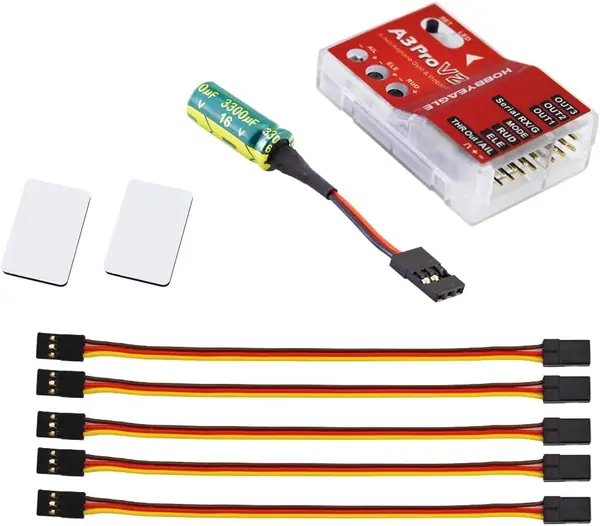
HOBBYEAGLE A3 Pro V2 Best Overall
- Flight Modes
- 6: gyro off, normal, lock, angle, level, hover
- Wing Types
- Standard, delta wing, V-tail
- Receiver Compatibility
- PWM, PPM, S.Bus, DSMX, SRXL
- Sensor
- 6-axis gyro and accelerometer
Six axes is the reason we steer most pilots to this board. A three-axis gyro can only damp a bump; the accelerometers in the A3 Pro V2 tell it which way is up, and that is what makes angle and level modes possible — release the sticks and the plane works its way back to flat. On a gusty afternoon that is the difference between fighting the model and flying it. Normal mode gives you straight rate damping for aerobatics, lock mode holds an attitude, and hover is there for 3D. Six modes sounds like a lot to manage; in practice you will fly two of them and be glad the others exist.
Compatibility is the other half of the case. It takes standard PWM channels, PPM, Futaba S.Bus and the S.Bus clones, Spektrum DSMX and DSM2 satellites, and SRXL — broad enough that you can buy it before you have decided what radio gear your next build will carry. Gains are set per axis, aileron and elevator and rudder separately, which is more work than one trim pot and worth it the first time one surface starts to oscillate before the others.
Put the master gain on a knob and you can turn the whole system up or down in the air instead of landing to hunt for a screwdriver. That is the feature we reached for most, and the one we noticed missing the moment we went back to a board without it.
Standard wing, delta and V-tail are all covered, so a flying wing is no reason to look elsewhere, and the firmware is upgradable — the board can take a fix instead of being frozen at whatever shipped. That matters more to us than another mode on the list.
What We Like
- Six-axis sensor enables self-leveling and hover modes
- Speaks PWM, PPM, S.Bus and SRXL receivers
- Separate per-axis gains plus in-flight master gain
Worth Noting
- Data cable for firmware updates sold separately
Six-axis stabilization, six flight modes and per-axis gains in a board that talks to almost any receiver — this is the one we point most pilots to.
Check Latest Price