Best RC Car Light Kits of 2026

The last of the daylight is the best part of a trail run and the worst part of the drive back. A light kit buys more of it, with headlights that throw down the line, rock lights that show where the front tires are aiming and a roof bar that makes a dark trail readable. Cheap kits give themselves away quickly, usually as a flicker at the connector or a light that quits after one wet drive.

Routing and strain relief matter more than the LED count on the package; the tape in the box won't keep a rock light on through a wet driveway. Any kit also has to match the voltage of your receiver or pack. We mounted 14 kits on the bench, in the driveway after sunset and on a backyard rock pile at full dark, and all eight picks kept their connections through three months of suspension arms snagging at the harness.

Our Top Picks

The Best RC Car Light Kits

1.

ShareGoo 8-LED Kit Best Overall
ShareGoo 8-LED headlight and taillight kit with four white and four red LEDs

Front-and-rear lighting

Track Score 93/100
Input Voltage
3V–7V
LED Count
8 (4 white, 4 red)
Power Source
Receiver-powered
LED Size
5 mm
View on Amazon

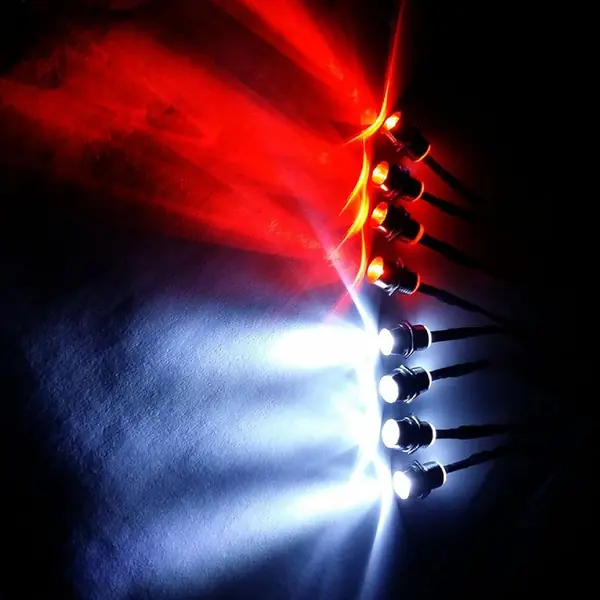
The appeal of the ShareGoo 8-LED kit is what it leaves out: no separate battery, no control box, no programming. Four white LEDs and four red LEDs plug straight into a spare receiver channel and come on with the truck. We like that for a first install because there is nothing extra to find space for behind the body.

The split works well on a 1/10 crawler or short-course truck: four white LEDs up front, four red at the rear, all feeding into one receiver plug. We found the 5 mm LEDs bright enough for slow trail work, but they are not a long-throw beam. That is fine if you are picking your way through roots and rocks; it is not the kit for lighting a wide-open field.

Installation is as basic as the kit suggests: drill holes for the LED holders, push the LEDs in, and route the thin wires away from the wheels and suspension. We added a small loop of slack at each light and taped the leads to the body; that is the kind of detail that keeps a simple kit from becoming a soldering project. The receiver plug is the only connection, so there is no controller to mount or pair.

Where it earns its place is as the baseline before you know whether you want a roof bar, rock lights, or a full light show. It gives you usable front and rear light with the least fuss, and it leaves room to add a bar later. For a first build, that is a stronger value than a box of features you have to learn.

Worth Noting

  • No remote or flashing modes
Our Verdict

We recommend the ShareGoo kit as the default first RC light kit: eight receiver-powered LEDs cover front and rear without a separate battery or control box.

Check Latest Price
2.

INJORA 4-Light Headlight Kit Best Headlight Upgrade

INJORA four-light headlight kit for 1/10 RC crawlers with black brackets and white LEDs

Scale headlights

Track Score 92/100
Input Voltage
5V–7.4V
LED Count
4
Power Source
Receiver-powered
Mounting
Two bracket styles
View on Amazon

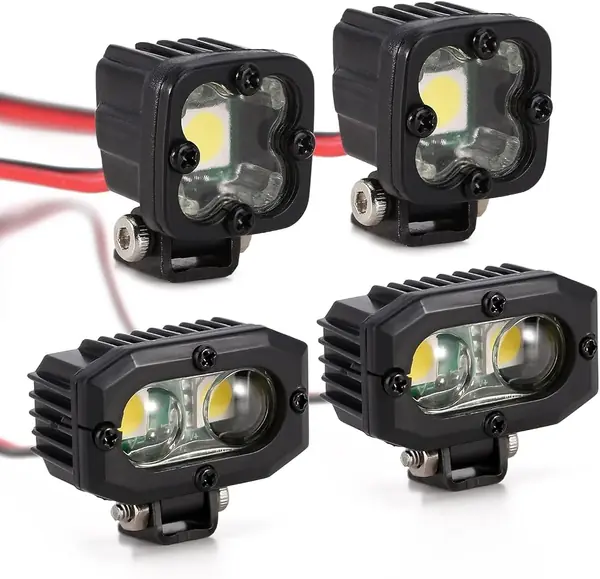
Bare 5 mm LEDs are fine until you want the front of the truck to look like it has actual headlights. The INJORA four-light set gives you four white pods and two bracket styles, so you can fold or angle them instead of simply poking a bulb through the body. That is a small thing on the bench and a much bigger one once the truck is on the trail.

We came back to these because the look holds up at crawling speed: the pods read as scale lights rather than emergency markers, and the brackets let you aim them at the ground or slightly ahead. They run on 5V to 7.4V from the receiver, so there is no extra pack, and the four-light pack gives you flexibility for a second body. The output is bright enough for trail work without flattening every detail in front of the truck.

The trade-off is control: there is no inline switch, dimmer, or remote, so they are on whenever the receiver is on. For a scale truck that is often the behavior you want, and it keeps the install down to one plug. If you need to kill the lights between runs, plan on an inline switch or a receiver channel you can switch off.

Worth Noting

  • Not a long-throw beam
Our Verdict

For proper-looking headlights: four bright pods, two bracket styles, and simple receiver power.

Check Latest Price
3.

MEUS Racing Hive Lights Best Premium Look

MEUS Racing four-piece hive-style LED spotlight kit with silver bezels and clear lenses

Premium scale detail

Track Score 91/100
Input Voltage
6V–8.4V
LED Count
4
Control
Remote on/off via AUX
Lenses
Clear and amber included
View on Amazon

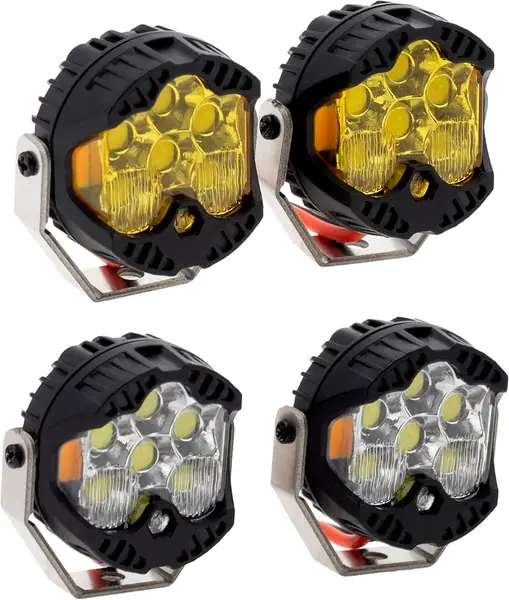
The hive-shaped housings are the first thing you notice, and that is the point. MEUS uses injection-molded shells, an electroplated lens, and a choice of clear or amber lenses, so the four pods look like scale spotlights rather than generic LED pucks.

Brightness is strong for their size, and the included AUX lead lets you turn them on and off from the transmitter instead of reaching for a switch. The 6V to 8.4V input suits most 1/10 and 1/8 crawler setups, and the mounting hardware feels more substantial than the molded housings. We mounted them on a 1/10 crawler and liked how the lenses change the front-end look.

These are the premium pick in this group, and we choose them for a build where the lights are part of the look, not just a way to see the trail. The finish and the swappable lenses do more for a scale truck than another row of bare LEDs, and the transmitter control keeps the installation clean. If you need lights that can shrug off repeated rollovers, this is not the set we hand you first.

Worth Noting

  • Fiddly assembly with tiny screws
  • All four pods share one lead
Our Verdict

We choose these when scale appearance matters most: four detailed pods, amber or clear lenses, and transmitter control in a compact kit.

Check Latest Price
4.

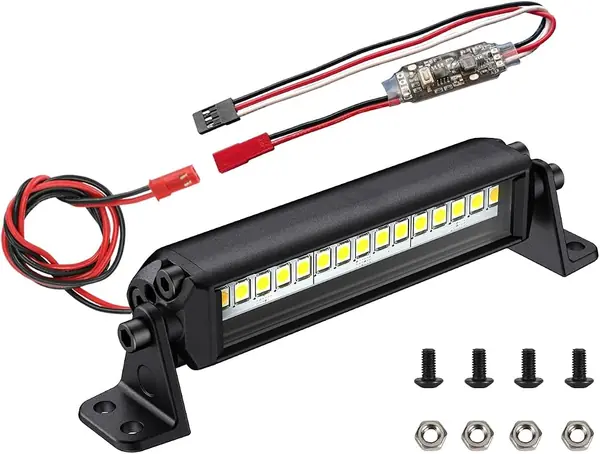
Zhongzhen 15-LED Bar Best Roof Light Bar

Zhongzhen 15-LED aluminum RC light bar with black housing and mounting brackets

Roof light bar

Track Score 90/100
Input Voltage
6.0V DC
LED Count
15
Bar Length
2.9 inches (75 mm)
Mount Options
Roof or hood
View on Amazon

Fifteen LEDs in a 2.9-inch aluminum bar is a lot of light in a small package, and that is why the Zhongzhen bar earns a place for night trails. We like it mounted on the roof or hood, where it throws a bright pool directly ahead without adding much visual bulk.

The beam is not a long-range spotlight, but it does what a crawler needs: it shows the next few feet of roots, ruts, and rock edges. The aluminum housing feels solid, and the included screws and nuts give you a straightforward mount. At 6V, the LEDs run at their rated brightness; lower voltage will dim them, so match the supply rather than assuming any receiver output will do.

Mounting low on the hood protects the bar in a rollover, while a roof mount gives a cleaner look and a little more reach. We prefer the hood position on a crawler that tips, because the body takes the hit instead of the light bar. The extra modes are not the reason to buy it; steady white is the useful setting, and we mostly left it there.

Worth Noting

  • Not sealed for sustained wet use
Our Verdict

We like this bar for night trails: fifteen LEDs in a small aluminum housing put a clear pool of light on the ground ahead.

Check Latest Price
5.

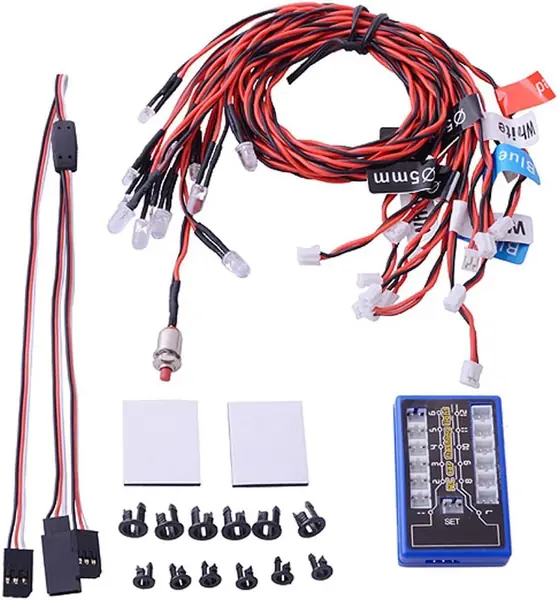
Globact 12-LED Kit Best for Flashing Modes

Globact 12-LED RC light kit with control box and separate front and rear leads

Flashing light shows

Track Score 89/100
Input Voltage
4.8V–6V DC
LED Count
12
Modes
5
LED Wire Length
350 mm
View on Amazon

Five flashing patterns and twelve LEDs make the Globact kit the one for a build that wants to be noticed—a tow rig, an emergency-style truck, or a trail rig with a light show. The control box is small, and the front and rear leads are separate, so you can tuck it into the body without a rat's nest of wires.

We liked the all-on mode for ordinary night driving, but the patterns are the reason to choose it. They cycle through alternating front/rear flashes and synchronized blinks, and you select them from the control box. The effect is bright and attention-grabbing, which is exactly what this kit is for.

The 4.8V to 6V rating is the part to check before you buy. A 2S pack at 7.4V is above that, so this kit wants a receiver output that matches or a regulator; we keep it on a matching receiver output and leave the pack lead alone. The 350 mm leads give you room to reach the corners of a 1/10 body, and the small control box hides easily under a battery tray. For a light-show build, that combination is a sensible package.

Worth Noting

  • Patterns are not brake or turn signals
Our Verdict

Our pick for a rolling light show is the Globact kit: twelve LEDs, five patterns, and a control box that hides easily.

Check Latest Price
6.

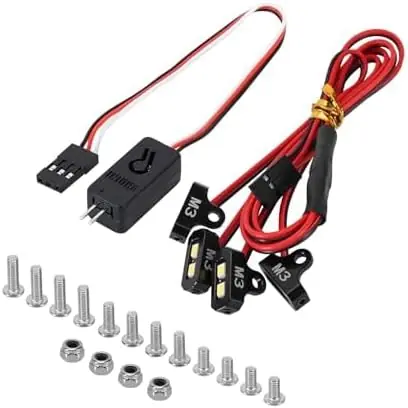
INJORA Rock Lights Best Rock Lights

INJORA four-LED white rock lights with aluminum mounts and inline light controller

Underbody night crawling

Track Score 88/100
Input Voltage
5V–7.4V
LED Count
4
Control
Steady, breathing, strobe
Mount Type
M3 aluminum
View on Amazon

Rock lights are the part of a light kit that changes how the truck looks from the outside and how much you can see directly underneath it. The INJORA set gives you four white pods, aluminum M3 mounts, and an inline controller with steady, breathing, and strobe modes.

The 340 mm leads are long enough to reach from a central controller to the four corners of a 1/10 chassis, and the M3 hardware matches the holes on many SCX10 and TRX-4 builds. The controller can run from its own button or a CH3 channel on the transmitter, which adds useful flexibility.

We like these best for slow night crawling, where the point is to see the ground under the truck rather than to light the horizon. The aluminum mounts feel sturdier than plastic clips, and the controller adds useful modes without taking over the build. The wire exits at the pods are the place to slow down; add a little strain relief there and keep the leads away from the driveshafts.

Our Verdict

We fit these when the trail goes dark and technical: four bright pods, aluminum mounts, and a controller that can switch modes from the transmitter.

Check Latest Price
7.

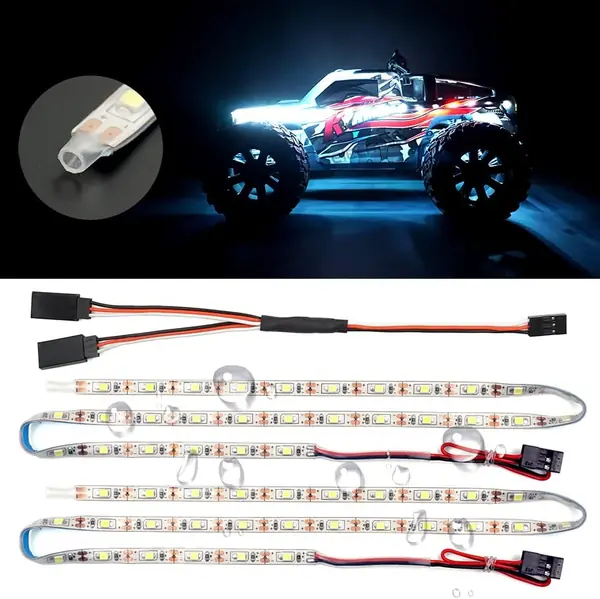
elechawk LED Strips Best for Underglow Accents

elechawk waterproof white LED light strips with Y-cable and clear heat-shrink cover

Underglow accents

Track Score 87/100
Input Voltage
5V–7.5V (5V–6V recommended)
Power
8.5W at 6V (2 strips)
Strip Length
0.5 m (19.7 in) x 2
Water Resistance
Waterproof heat-shrink cover
View on Amazon

Two half-meter strips and a Y-cable make the elechawk set the easiest way to add underglow to almost any RC body. The strips are covered in clear heat-shrink, so they can take splashes and road spray that would finish a bare LED strip, and the white output is bright enough to show the chassis outline at night.

We used them as accent lighting rather than as headlights: they spread light along the body and under the chassis, but they do not project a beam far enough to replace a proper headlight kit. That makes them a good second step for a truck that already has front lights, or a cheap way to make a drift body pop in low light.

Mounting is the part to plan. We added zip ties at the ends and a strip of clear tape along the middle, which keeps the strips in place through vibration and occasional mud. The Y-cable makes the electrical side simple; the mechanical side is where you should spend the extra few minutes.

At their best, these are the add-on that makes a night build look finished without changing how it drives. They suit a body that needs accent light without four more holes drilled for pods. They are not the first kit for a truck with no lights at all, but they are an easy second layer.

Our Verdict

We keep these strips for instant underglow: two waterproof lengths, a Y-cable, and enough brightness to make a body pop at night.

Check Latest Price
8.

elechawk Two-Bar Kit Best for Roof or Bumper

elechawk two-bar RC LED light kit with aluminum frames and clear acrylic covers

Roof or bumper

Track Score 86/100
Input Voltage
6V–15V
Modes
13 switchable
Bar Length
100 mm
Bar Count
2
View on Amazon

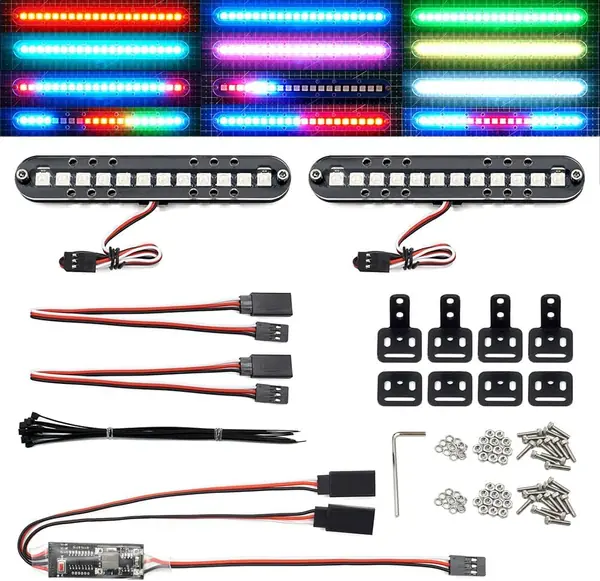
Two 100 mm bars, thirteen switchable modes, and a controller that works from the transmitter or its own button: the elechawk two-bar kit is the most feature-heavy light kit in the group. The bars use an aluminum frame and a clear acrylic cover, and they can be mounted on the roof, hood, or bumper with the included brackets.

The 6V to 15V input is the standout specification. It gives you more headroom than a receiver-only kit and makes the bars easier to pair with a 3S pack or a higher-voltage receiver output. The two bars draw up to 3.3W total when both are set to white, so the load is modest for the amount of light.

The controller is the part that makes the kit feel different from a simple receiver-powered set: you can switch the bars on and off remotely, change colors, or change modes without unplugging anything. That flexibility is useful if you run the same truck in different settings, though it adds a small box and another set of wires to tuck away.

We see this as the pick for the tinkerer who wants options and does not mind a more involved install. The pair is bright, the voltage range is generous, and the remote control is genuinely useful. Mount the controller high and dry, and the bars will be easier to live with.

Worth Noting

  • Thirteen modes take time to learn
Our Verdict

We see these as the feature-first pick: two aluminum bars, thirteen modes, and a controller that works from the transmitter or its own button.

Check Latest Price

How We Tested RC Light Kits

We built the shortlist from kits sold for 1/10 and 1/8 crawlers, trucks, and trail rigs, and dropped anything that didn't publish an input voltage range — a kit you can't safely match to a receiver or pack isn't worth mounting. From there we filtered on mounting hardware, claimed water resistance, control options, and what actually came in the box for the money. Fourteen kits made it to the bench, and we ran them for about three months.

Testing started at the workbench, where we timed each install from box-open to lights-on, counted the holes we had to drill, and noted whether the brackets lined up with the body posts in front of us or needed bending. After dark we pointed every kit at a garage door from ten feet and compared how much of the door it covered, where the beam fell off, and whether the light read white or blue against the paint. Then we drove: driveway laps after sunset, a backyard rock pile at full dark, and a wet lawn with the sprinklers still running.

Every harness was routed clear of wheels and suspension and zip-tied at two points before we ran a pack through, and we checked for flicker after landings and curb hits. Wires got a flex test at the connector and a firm tug at the strain relief; adhesive strips went onto both clean and dusty surfaces and sat overnight. We matched each kit's stated voltage range to the receiver or pack before connecting anything and never ran one past its range, and only kits the maker described as waterproof saw the wet lawn or a spray bottle — nothing sat in standing water. We also cycled every mode, flash patterns included, and noted which ones we'd use on a trail versus at a show.

How to Choose an RC Car Light Kit

Start With Power, Not LED Count

Most receiver-powered RC LED light kits take 4.8V to 7.4V and plug into a spare channel; that is the simplest route because the truck already carries the power. Check the kit's input range against your receiver or pack before you buy. A 2S LiPo is 7.4V nominal, so a 4.8V-to-6V kit needs a receiver output that matches or a regulator, not a direct pack lead.

If your receiver has no free slot, a Y-harness can share a channel, but the lights will be on whenever that channel is powered. Kits with their own controller, such as the elechawk two-bar, accept a wider 6V-to-15V range and give you more flexibility. We choose receiver power for simplicity and a wider range when we plan to run higher-voltage packs.

Match the Light to the Trail

A headlight kit is the first layer: it lights the ground ahead and makes the truck readable at dusk. Rock lights are the second: four pods under the chassis show the line under the tires at crawling speed. A roof or hood bar throws a broader pool ahead, but it sits higher and is more exposed in a rollover.

Fit headlights first on a scale build, then add rock lights if the trails are technical. A bar is the better choice for open ground or a monster truck that covers distance. Underglow strips are decoration first; they make a body pop but do not replace a forward-facing light.

Decide How Much Control You Need

A simple on/off kit is on whenever the receiver is on; a controller adds modes, dimming, or remote switching. If you want to turn the lights off between runs, look for an inline switch or a channel you can switch from the transmitter.

Flashing patterns are fun for a tow rig or emergency-style build, but they are selectable sequences, not brake or turn signals. The Globact kit is the pattern specialist here; the elechawk two-bar is the one with thirteen modes and color changes. For most trail trucks, steady white is the setting that matters.

Plan the Mount Before You Drill

The weak points in this category are the wire exits and the adhesive backing, not the LEDs themselves. Support the leads with a loop of slack and a zip tie, and keep them away from wheels, driveshafts, and sharp body edges.

For strips, treat the adhesive as a placeholder and add zip ties or clear tape. For pods and bars, check the hole size, bracket angle, and body thickness before drilling. A roof bar that sits above the body is exposed in a rollover; a hood or bumper mount lets the body take the hit.

Frequently Asked Questions

Final Verdict

We recommend the ShareGoo 8-LED kit as the best default for most first builds. It is simple, receiver-powered, and covers front and rear without a control box, which makes it the easiest kit to live with while you decide whether you want more.

If scale detail matters more than simplicity, the MEUS Racing Hive lights are the upgrade we choose; if you want a compact roof bar for open trail sections, the Zhongzhen 15-LED is the one to fit.