Best Model Train Track Cleaners of 2026

The worst moment in a running session is a locomotive that slows, hiccups and dies on a switch point. The engine is rarely at fault. Usually it's a film of oxide, dust and room oil on the railhead, often hiding inside a tunnel, under an overhang or between switch points your finger can't reach.

Reach mattered more than grit. A medium abrasive in the right shape beats an aggressive block that can't get to the grime, and a tool that's fine on straight track can fail at a tunnel portal. We judged solvents, abrasive blocks, handled pads and cleaning cars on an HO basement loop, an N scale shelf layout and a G scale garden line, by how much rail each pass removed, what residue it left and whether traction came back after a wet clean.

Our Top Picks

The Best Model Train Track Cleaners

1.

Woodland Scenics Tidy Track Rail Tracker Cleaning Kit Best Overall
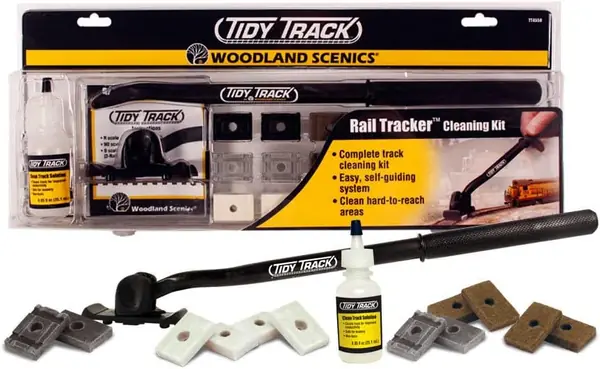
Woodland Scenics Tidy Track Rail Tracker cleaning kit handle with extension arm and pads

Whole-layout maintenance

Track Score 93/100
Scale
All scales
Replacement Pads
Yes
Method
Handled pad with extension arm
View on Amazon

The problem this kit solves is access. On a layout with bridges, tunnels, overpasses, or a thicket of switch points, a bare block only works where your hand fits, and the inches around a switch point are exactly where a hand should not go. The Rail Tracker puts the cleaning pad on the end of a handle with an extension arm, so you can stand over the benchwork and lean the pad onto rail deep inside a tunnel.

That reach is why we made it the top pick. It puts pad pressure on the rail head instead of on your knuckles, and the pads lift dirt, grime, and oxidation with less scrubbing than a bare block demands. We also appreciate that the pads attach and pull off easily, so a loaded pad is a two-minute swap rather than the end of the tool. On a layout where a third of the track sits under scenery, that combination is what turns cleaning from a project into a habit.

Where the kit earns its keep is a long run of hidden track, where cleaning used to mean crawling under the benchwork with a flashlight. If your railroad is a small oval with everything in easy reach, a plain block does the same work and you can skip the arm entirely.

Worth Noting

  • Costs more than a plain abrasive block
Our Verdict

We recommend it as the default because the handle puts pad pressure on rail your fingers cannot reach, and the pads are replaceable rather than glued on.

Check Latest Price
2.

Walthers SceneMaster Bright Boy Cleaner Best Value

Walthers SceneMaster Bright Boy standard grit abrasive block for track wheels and contacts

First-time buyers

Track Score 92/100
Dimensions
3 x 4.25 x 0.25 inches
Grit
Standard (medium)
Also Cleans
Wheels and electrical contacts
View on Amazon

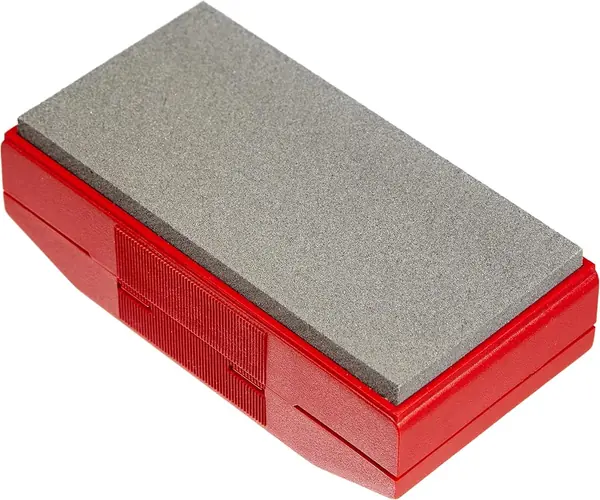
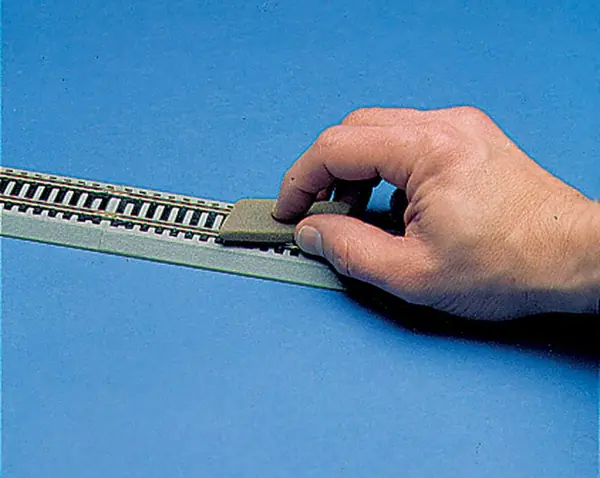
This is the cheapest effective tool in this group, and it is what we tell a new modeler to buy first. Bright Boy is a soft, standard-grit abrasive block about the size of a small eraser, and it handles three jobs: scuffing oxidation off the rail head, cleaning grimy locomotive and car wheels, and scrubbing electrical contacts.

Used with a light hand it is not the rail-scarring monster some modelers worry about. The grit is mild enough that a few passes clean up used track without visible scratching, and we have taken rust marks and dull spots off secondhand rail with it. It is still an abrasive, so let the block do the work instead of leaning on it: two or three passes, wipe the dust away, and check how the locomotives run.

What it is not is a reaching tool. You are the handle, so it is fine along an open straight and awkward under a bridge, and on a big layout you will want the Rail Tracker arm instead. Keep one in the toolbox anyway: there is nothing to refill or replace, it fits between the rails of any gauge, and it is the fastest fix when one section of track goes dead.

Our Verdict

For the money, this is the block we tell new modelers to buy first: cheap, simple, and effective on any scale.

Check Latest Price
3.

Bachmann Hand-Held Track Cleaner 39013 Best for Tight Spots

Bachmann hand-held track cleaner, a slim plastic wand with a replaceable cleaning pad

N and On30 track

Track Score 91/100
Scale
N, HO, and On30
Dimensions
0.5 x 0.5 x 5 inches
Weight
0.64 oz
Replacement Pads
Bachmann item 39014
View on Amazon

Five inches of plastic, well under an ounce, with a small pad on the end: this tool is sized for N scale, and that is the whole point. Where an HO-sized block rides the rails, this wand drops a narrow pad between them and slips into the gap under an overpass, a station canopy, or a tunnel portal.

Bachmann lists it for N, HO, and On30, and replacement pads are sold as item 39014, which matters because a loaded pad ends a tool's usefulness. In N the wand is the difference between cleaning a hidden siding and abandoning it. It is light enough that all the pressure comes from your fingertips, which is fine for scouring a rail head and tiring over a long session. In HO it works, but the head is small enough that a wide layout takes a while.

Our take: this is the pick for anyone in N or On30, and for HO modelers with long stretches of track under scenery. If you are cleaning a wide-open oval where your hand reaches everything anyway, a bigger block is quicker and needs no pad supply.

Worth Noting

  • Not intended for O or G scale
Our Verdict

Our pick for N and On30 track in tunnels and switch work, where a full-size block simply will not fit.

Check Latest Price
4.

Walthers Trainline Track Cleaning Boxcar Best Track-Cleaning Car

Walthers Trainline HO track cleaning boxcar in Conrail paint with metal wheels

HO layouts

Track Score 90/100
Scale
HO
Wheels
RP-25 metal
Road Name
Conrail
Cleaning Method
Spring-loaded abrasive pad
View on Amazon

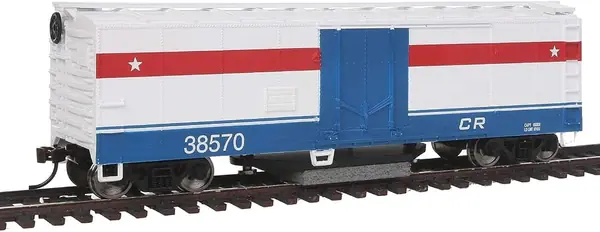
Instead of another evening on your knees, this is a cleaning tool that rides the rails: an HO boxcar with a spring-loaded abrasive pad under the frame, painted and lettered like the freight car it pretends to be. It comes in eight road names, and the one we ran is the Conrail version.

We like what that does to the routine. Put it in the consist, run a few laps, and the pad polishes the rail head while you are operating, so the black film that builds up ends on the pad instead of on your wheels. The body is weighted to hold steady pressure on the rail, and the RP-25 metal wheels are matched to NMRA standards, so it tracks through Code 70 and heavier rail without arguing.

That weight is also the catch. This is a heavy car, so a small switcher will not drag it up a grade; pair it with a locomotive that has some pull and keep it near the head end. Clean the pad when it loads up and swap it when it stops cutting, and this becomes the least annoying part of track maintenance.

Worth Noting

  • Pad can catch on turnouts and derail
Our Verdict

Buy it if you want track maintenance to happen during operating sessions instead of as a separate evening's chore.

Check Latest Price
5.

Bachmann Trains Track and Rail Cleaner Best Liquid Cleaner

Bachmann Track and Rail Cleaner six-ounce bottle of unscented cleaning liquid

Grimy and greasy rail

Track Score 89/100
Scale
All scales
Form
Liquid, unscented
Volume
6 fl oz
Also For
Slot car rails
View on Amazon

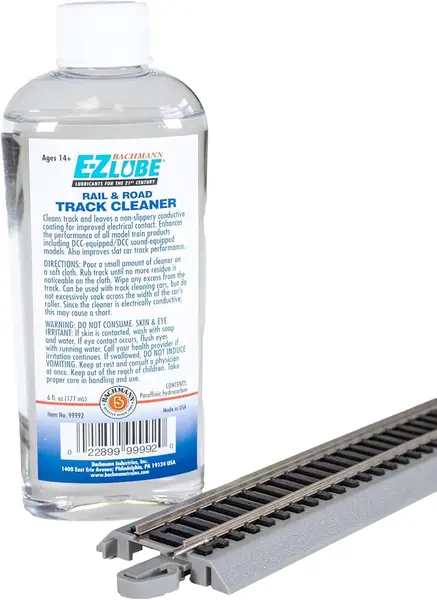
Six ounces of unscented liquid, sold for every scale and labeled for slot car rails as well. This is the wet half of track cleaning: it dissolves the oily film that dust sticks to, along with fingerprints and the general grime of a layout that lives in a basement.

Use it on a cloth or a cleaning pad, wipe along the rail head, then go back over the rail with a dry cloth. That second pass is not optional. Fluid left sitting on the rail attracts dust and can cost traction, and on a grade a slippery rail is worse than a dirty one.

Where a bottle beats a block is the awkward stuff. A soaked swab reaches into a tunnel mouth or around switch points where nothing flat fits, and because you are wetting a cloth rather than flooding the track, six ounces goes a long way.

It is the choice when the rail is greasy rather than dull, and when the dirt is somewhere a pad cannot follow. Treat it as the first step of a two-part routine and an abrasive block as the second.

Worth Noting

  • Won't remove oxidation without an abrasive
Our Verdict

We keep a bottle for greasy rail and dirty wheels, and we always follow it with a dry wipe.

Check Latest Price
6.

LGB Scale Track Cleaning Block Best for G Scale

LGB G-scale track cleaning block with ridged handhold and porous cleaning pad

Garden railways

Track Score 88/100
Scale
G
Weight
3.53 oz
Pad
6 mm, non-abrasive
Width
3 inches
View on Amazon

Weather, brass, and time are what kill current on a garden railway, and this block is aimed at the third. Three inches wide, with a ridged handhold on one side and a coarse, porous pad on the other, it is the first tool we hand anyone running G scale outdoors.

Width is what makes it work. One pass covers the whole rail head, so you are not chasing a narrow block along an inch of brass, and the pad erases dirt and oxidation rather than sanding the rail. Dull, tarnished rail comes back to a shine in a few passes, and the plastic body is comfortable to push with a thumb on the ridge.

It is entirely manual, which we count as a virtue outdoors: nothing to charge, fill, or assemble, and it works the same on an indoor G loop as on a garden line. When one section of track starts hesitating, it is quicker than any powered setup.

Worth Noting

  • Only reaches rail within arm's length
Our Verdict

The first thing we hand a G-scaler: a wide, abrasive-free pad that brings oxidized brass rail back to conductive.

Check Latest Price
7.

Peco PL-41 Rail Cleaner Track Rubber Best for Quick Touch-Ups

Peco PL-41 rail cleaner track rubber, a small abrasive block for all scales

Quick touch-ups

Track Score 87/100
Dimensions
3.15 x 1.57 x 1.18 inches
Weight
0.35 oz
Type
Abrasive rubber block
Scales
All scales
View on Amazon

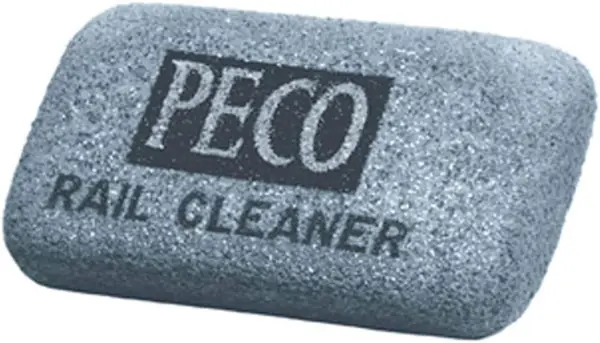
A small abrasive rubber block, and the most traditional tool here. Peco states the job plainly: remove dirt and oxidation from the rail surface and improve running, particularly at slow speeds.

Rubber is what separates it from a grit block. It does not crumble, it keeps its shape, and it lasts, which is the argument for what it costs relative to the rest of this set. It handles rusty old track, clears debris quickly, and its size means it goes anywhere, including a club layout where you are cleaning other people's rails.

We keep one because it is instant: no pads, no fluid, no setup, and it takes less time to pick up than the handled kit does to assemble. It is the tool for the few inches of rail causing the stutter, not for spring cleaning.

Worth Noting

  • Small block is slow across a big layout
Our Verdict

A long-lasting track rubber we keep for quick touch-ups, though it is a small block rather than a whole-layout tool.

Check Latest Price
8.

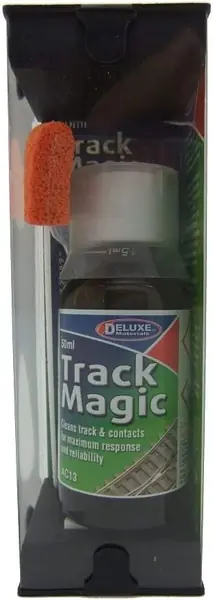
Deluxe Materials Track Magic Best for Contacts and Switch Points

Deluxe Materials Track Magic cleaning fluid bottle with fine brush applicator

Contacts and switch points

Track Score 86/100
Form
Fluid with fine brush applicator
Volume
50 ml
Safe On
Plastic, foam, acrylic, and enamel paint
View on Amazon

Fifty milliliters, a fine brush in the cap, and a coconut scent. Track Magic is the most precise liquid here, and it is aimed at the places where precision is the point: locomotive wheels, electrical contacts, switch points, and the inside of a tunnel.

The compatibility list is unusually broad, covering plastic, foam, acrylic, and enamel paint, which is what you want from a fluid that will end up near scenery. It is also formulated for low-power and confined-space work, the situations where a wet pad cannot follow the current.

Apply it with the brush, a soaked swab, or the supplied sponge, and keep it on the metal. A little goes a long way on a contact, and the brush means you are not soaking an entire switch just to clean one frog.

It excels at the fiddly work: a dead frog, a dirty wheel set, a pickup that fails on one curve. For a full mainline wipe-down, the Bachmann bottle and a rag are the faster route.

Worth Noting

  • Small bottle is for spot work only
Our Verdict

Our choice for contacts, switch points, and confined spaces, where a drop on a brush beats dragging a pad.

Check Latest Price

How We Tested Track Cleaners

We built the shortlist from maker documentation rather than product listings: which scales a tool actually covers, what the cleaning head is made of, whether replacement pads exist and what they cost, and whether the thing is meant to work during a running session or as its own job. That filtering left us with 12 units we bought and used ourselves.

Testing ran eight months across three layouts. On the basement HO loop we cleaned after every session and looked at what came off on the pad; on the N scale shelf layout we worked the tight spots between switch points and under a low overhang; outdoors on the G scale line we dealt with leaf grit and damp rail. Cleaning cars went into a consist mid-session, while blocks, rubbers, and handled pads got a separate pass before anything ran.

For abrasives, we dragged each block over a scrap length of flex track for a fixed number of strokes, then checked the rail head for scoring and flattening — that's how we sorted aggressive from gentle. For liquids, we applied fluid to a pad or cloth, never sprayed or poured it near scenery, kept it on the rail head only, then ran a test locomotive slowly through the cleaned section and counted stalls to judge residue and traction. Along the way we noted weight, how steady each tool felt in the hand, how many pads we burned through, and what replacements cost.

How to Choose a Model Train Track Cleaner

Start With What's Actually on the Rail

Oily, blackened rail calls for a solvent; dull brown or greenish rail calls for an abrasive. A liquid lifts the grime that a dry pad smears around, while a block scuffs away an oxide layer no fluid will dissolve. Most layouts eventually need both, so treat a liquid as the routine step and an abrasive as the occasional one.

Locomotives that hesitate at slow speed but run fine at speed usually point to oxidation, and a block is the first thing to try. Rail that looks greasy and collects fuzz wants a wet clean first.

Reach Matters More Than Grit

The best abrasive only works on rail you can touch, and the hard places are tunnels, overpasses, hidden staging, and the few inches around switch points. A bare block fails there, because you cannot get fingers in without risking a point rail. That is the case for a handled pad with an extension arm, which puts pressure on the rail head from outside the scene.

The trap is buying a block for a layout you cannot reach into. Walk your track and count the stretches you cannot comfortably touch before you decide anything.

Match the Tool to Your Scale

Scale changes the tool more than it changes the technique. In N, a narrow pad on a slim wand gets down between the rails; in HO, a standard block works but covers ground slowly; in G, a three-inch pad spans the rail head in one pass.

A block sold as suitable for all scales will physically fit any of them, but that claim says nothing about coverage or reach. G-scale modelers should buy for width, and N-scale modelers for a small head on a long handle.

Treat Abrasion as a Maintenance Decision

Every abrasive pass removes a little metal and leaves fine scratches that collect dirt faster. That is not a reason to avoid abrasives; it is a reason to use the finest grit that shifts the dirt, keep the pressure light, and stop as soon as the rail is bright. Once a layout is clean, keep it clean with a liquid wipe or a cleaning car instead of reaching for grit every session.

A track rubber like the Peco PL-41 is gentler over years than a coarse block, though it cuts more slowly.

Decide Between Upkeep and a Cleaning Session

A cleaning car changes the arithmetic. Instead of setting aside an evening, you put the car in the consist and let a few laps do the work, which suits a layout that is already in decent shape. Two things to check first: whether your locomotives have the pull for a weighted car, and whether the pad clears your turnouts.

On a railroad with hidden track you cannot reach, a car is often the only realistic way to keep the whole loop conductive.

Frequently Asked Questions

Final Verdict

For most modelers we recommend the Woodland Scenics Rail Tracker kit. It reaches rail a bare block cannot, the pads swap out, and it turns an awkward chore into something you can do standing up.

If your layout is small and open, the Bright Boy does the same work for a fraction of the money. And if an evening of track cleaning is not how you want to spend hobby time, the Walthers cleaning boxcar folds maintenance into running trains.