Best Model Train Scenery for Realistic Layouts of 2026

Every model railroad starts as plywood with track pinned to it and a gap where the hillside should be, and that blank stretch is where many layouts stall. Scenery turns a train set into a place, and it is also where a rushed purchase shows, with turf that reads neon under layout lights and trees that tower over the locomotive.

Compare bags by how far they stretch, not by weight, and check tree heights against your tallest building rather than the scale on the label. The nine picks, from 16 products used on an HO layout, a shelf-sized N layout and diorama bases, are layers rather than whole landscapes: ground cover, a pond, conifers for a hillside and a building to give a siding a purpose.

Our Top Picks

The Best Model Train Scenery for Realistic Layouts

1.

Woodland Scenics Fine Blended Green Turf Best Overall
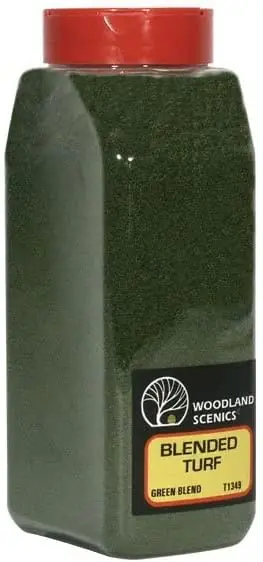
Woodland Scenics fine blended green turf in a 32-ounce bag for model railroad ground cover

Base ground cover

Track Score 94/100
Color
Blended green
Net Weight
32 oz
Turf Grade
Fine blended
View on Amazon

Thirty-two ounces of fine blended green sounds like more than one layout can use, right up until you start covering a hillside. Ground cover is the layer that makes everything else look deliberate — ballast reads as ballast because the ground beside it reads as grass — and this bag goes much further than its size suggests. The fine grade settles into foam and plaster contours instead of perching on top of them, and the blend of greens keeps a lawn from looking like painted plywood.

Application is as forgiving as scenery gets. Paint on scenic cement or thinned white glue, sprinkle until the glue stops showing through, let it cure, then vacuum the loose material up and pour it back in the bag. We like how much of it comes back: one bag keeps working through several evenings of scenery, which is more than we expected from a single 32-ounce purchase. Keep a coarse turf on hand if you want meadow texture, because this grade is fine enough to read as mown grass everywhere it lands.

For a first layout, this is the bag to buy before anything else. Bare foam is what makes a beginner's board look unfinished, and an afternoon of sprinkling fixes most of it. The fine grade suits lawns, embankments, and the ground under trees equally well, and it holds whatever you plant on it afterward. If you want to sample several materials before committing to one, the NWFashion kit below is the cheaper way to try things; if you already know the ground needs to be green, buy this one and get on with it.

Worth Noting

  • One green shade limits natural variation
Our Verdict

We recommend the fine blended green as the first scenery purchase most people make: 32 ounces covers real ground, the color reads natural, and it takes glue without fuss.

Check Latest Price
2.

Woodland Scenics Realistic Water Best for Ponds and Rivers

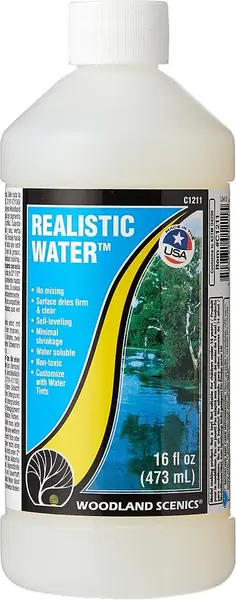
Bottle of Woodland Scenics Realistic Water clear liquid for model railroad ponds and rivers

Ponds and streams

Track Score 93/100
Form
Self-leveling liquid, no mixing
Volume
16 fl oz
Cleanup
Water-soluble
Listed Cure Time
24 hours
View on Amazon

Depth decides everything with this stuff. The label promises 24 hours to dry, and thin pours do come out clear and glassy; anything much deeper than an eighth of an inch can sit cloudy for far longer, which is where pour-in water goes wrong. Treat it as a series of shallow lifts rather than one big pour and the results are convincing enough to fool people at arm's length.

What we appreciate is that there is nothing to mix. The liquid goes straight from the 16-ounce bottle, levels itself into a flat surface, and rinses off hands and tools with water before it sets, so a riverbed does not need special equipment or a separate measuring cup. Tinting the first lift with a little blue or green ink keeps a pond from reading as bare glass, and the color sits under the surface instead of floating on it.

The catch is that a bottle fills a pond or a short stream and not much more, so plan the water you actually want before you start pouring. Sealing the basin first is worth the extra evening: coat plaster or foam with full-strength white glue, let it harden, then pour. For a feature the track crosses on a trestle, though, nothing else in this group looks as much like standing water.

Worth Noting

  • One bottle fills only a small feature
Our Verdict

We keep this on the shelf for any pond or river on a layout, provided you pour it thin and give it days rather than hours.

Check Latest Price
3.

Evemodel 40-Piece Pine Tree Set Best for Conifer Forests

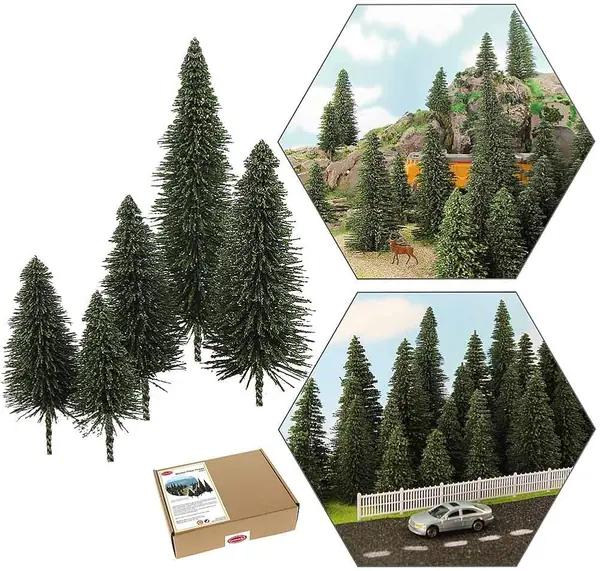
Forty dark green model pine trees in mixed heights for HO scale railroad scenery

Conifer hillsides

Track Score 92/100
Count
40 trees
Material
Plastic branches on wire stems
Height Range
2.05 - 4.96 inch (5.2 - 12.6 cm)
Scale
HO/OO
View on Amazon

Every tree in this set ends in a bare wire stem instead of a plastic base, and that one detail is why we plant them by the dozen: push the stem into foam or plaster and the tree stays where you left it, leaning however you set it. The stems are rigid enough to hold a heavy crown and thin enough to insert with a push rather than a drill bit.

Forty trees across five heights, from about 2 to 5 inches — tall enough to sit behind a station and short enough to plant along a ridge without hiding the track. Clustered together they read as a stand rather than a row of identical trees, and the dark green holds up in the middle distance where a brighter green starts to look like a toy. These are the trees we use to build depth behind the front scenery.

Flocking sheds in the bag, so shake each tree out over a trash can before it goes anywhere near glued ground, then mist the foliage with matte medium and let it dry to lock the rest down. Planted with the smaller trees forward and the taller ones behind, 40 goes further than the count suggests. Leave a few gaps in the cluster; a solid wall of pines looks planted by a machine.

Worth Noting

  • Bare wire trunks are visible up close
Our Verdict

Our pick for a conifer stand: the wire stems plant cleanly into foam, and 40 trees at five heights make a hillside read as forest.

Check Latest Price
4.

OrgMemory 29-Piece Mixed Model Trees Best Tree Assortment

Twenty-nine mixed green and brown plastic model trees in varied heights without bases

Mixed treelines

Track Score 91/100
Count
29 trees
Material
Plastic
Height Range
1.5-6 inch (4-16 cm)
Bases
None included
View on Amazon

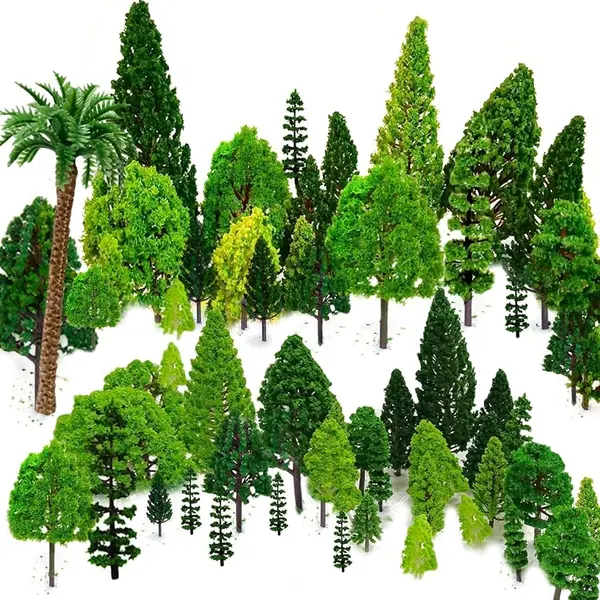
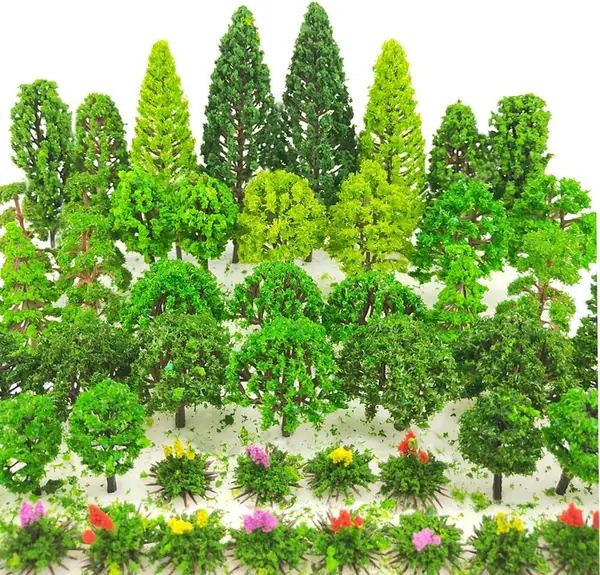
The pines above are a conifer stand; this bag is the rest of the woodland. Twenty-nine trees between 1.5 and 6 inches, most of them broadleaf canopies on brown trunks, with a few that read as birch — exactly the shapes that keep a hillside from looking like a Christmas tree farm. Mixing a handful into a pine cluster is the fastest way we know to make a forest look like it grew rather than got installed.

No bases come with them, which is the one thing to plan for. On a layout that means a dab of glue and a few seconds of holding each tree upright, or a drilled hole if you want to move them later. We do not mind, since scenery trees get glued down anyway, but it does rule out setting a forest up loose on a bare board to see how it looks before committing.

Handling is the other consideration. Trees arrive compressed in a small box and need a minute of gentle reshaping, and repeated handling knocks bits loose — worth knowing before you hand a bag to a child or plan to reuse them between layouts. Planted once and left alone, they look considerably better than their price suggests, and the size range covers everything from saplings to specimen trees.

Worth Noting

  • Foliage sheds when trees are handled repeatedly
Our Verdict

The bag for a treeline that needs broadleaf variety, as long as you are ready to glue each tree down.

Check Latest Price
5.

Warmtree 126-Piece Static Grass Tufts Best for Close-Up Detail

Green and dry yellow static grass tufts for model railroad basing and scenery detail

Foreground detail

Track Score 90/100
Count
126 tufts
Colors
Green and dry yellow
Attachment
Self-adhesive backing
Listed Scales
1:35 to 1:87
View on Amazon

The first tuft out of the bag is smaller than expected: a clump you could lose under a thumbnail. That is the point of them. Each one is a ready-made bundle of fibers on a small sticky pad, and 126 of them in green and dry yellow cover the places where loose turf looks like dust — the shoulder of the ballast, the base of a fence post, the seam where a rock meets the ground.

Placement is quick. Peel, press, and add a dot of glue where the surface is dusty or loose; on foam and painted plaster the pad alone holds well enough to position before you commit. We are fondest of the dry yellow ones, which read as late-summer weeds among the greens and stop a foreground from becoming one flat color. Scattered rather than spaced evenly, they look like they were there before the track was.

They are sized for HO and larger. At N scale a single tuft reads as a shrub, and the maker's 1:35-to-1:87 range is optimistic at the small end — treat the pack as tabletop scenery rather than N-scale ground cover. For anyone working at HO or larger, though, these are the fastest way to make a scene look walked on.

Worth Noting

  • Each tuft is small, so a pack goes fast
Our Verdict

We use these for the last ten percent of a scene — fences, ballast edges, rock crevices — where sprinkled turf cannot reach.

Check Latest Price
6.

NWFashion 9-Bag Scenery Basing Kit Best Starter Kit

Nine small bags of scenery material including grass moss sand and stones for dioramas

Starter sampling

Track Score 89/100
Bags
9
Bag Size
About 10 x 7 cm
Materials
Grass, moss, sand, stone, sponge
Total Weight
10.6 oz
View on Amazon

If your board is still bare foam and you have not decided whether the corner wants a riverbank, a rock cut, or a snowshed, this kit is the cheapest way to find out. Nine small bags, 300 grams in all: grass and moss, blue sand for water, mixed stone, and sponge for hedges and blossom. Nothing in it is enough to finish a scene on its own, which is exactly why it works as a first order.

We like it as a sampler. Each bag holds enough for a small corner or a diorama, so you can test whether loose stone reads the way you hoped before committing to a pound of the stuff. The bags are small — roughly 10 by 7 cm — and only some of them reseal, so have a few zip bags or small jars ready for what you do not use in one sitting.

Paired with a bag of turf, the stone and moss disappear into a scene rather than sitting on top of it, and the blue sand makes a convincing river bottom under a pour of water. Treat the kit as a color study: it tells you which materials you enjoy working with, and that is the decision worth making before you spend real money on a layout.

Worth Noting

  • Colors run brighter than realistic woodland
  • Only some bags reseal for storage
Our Verdict

A cheap, useful sampler for a bare first board: buy it to find the look you like, then restock the materials you actually use.

Check Latest Price
7.

Walthers Cornerstone Merchant Row IV Best Trackside Structure

HO scale Merchant Row IV building kit with three storefronts and colorful decal signs

Trackside towns

Track Score 88/100
Scale
HO (1:87)
Assembly
Kit — glue and paint required
Footprint
10-5/8 x 5 x 4 in (27 x 12.7 x 10.2 cm)
Storefronts
3
View on Amazon

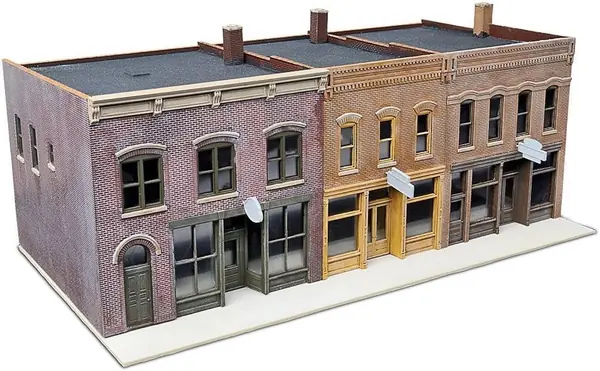
A row of storefronts does something no amount of trees can: it tells you why the track runs past this spot. This HO kit puts three shops under one roof in a footprint of 10-5/8 by 5 by 4 inches, with brick frontage, two different cornices, a back porch, separate stairways and downspouts, and a decal sheet that lets you name each business.

It is a kit, and that means glue, paint, and patience. The walls need holding square while the joints set, so dry-fit everything first and keep clamps or a stack of books nearby; the plastic is molded in a base color that photographs as finished but shows bare edges in person. Budget a first evening for assembly and a second for paint and weathering, and the second evening is the one that makes it look like a building.

The payoff is customization. Two front cornices, separate back stairs and downspouts, and shop signs you apply yourself mean two builders starting from the same box end up with different blocks. We like kits that leave room for that, because a layout's buildings are what visitors look at longest — long after they stop noticing the trees.

At the premium end of this group, it is the purchase we save for last: after the ground is green and the trees are up, when the layout needs somewhere for people to be going. By then you also know what the town should be, which is half the reason to build one at all.

Worth Noting

  • Requires paint and glue before it looks finished
  • Walls need holding while joints set
Our Verdict

The piece that gives a siding a reason to exist, if you are ready to spend a few evenings with glue, paint, and clamps.

Check Latest Price
8.

Tazimi 60-Piece Model Tree Set Best for Bulk Planting

Sixty mixed green plastic model trees in assorted sizes for train scenery

Bulk planting

Track Score 87/100
Count
60 trees
Height Range
1.36 - 6 inch (3.5 - 15 cm)
Color
Green and brown
Branches
Bendable plastic
View on Amazon

Tree packs get sold as HO scale when what they really are is a spread of sizes, and that is the useful way to read this one: 60 trees from about 1.4 to 6 inches, most clustered at the small end. Measure the tallest building on your layout and decide whether the biggest trees clear it — that tells you more than the scale printed on the bag.

Where it earns a place is volume. Sixty trees fill a hillside in one sitting, and the range from seedling to mature lets you plant a treeline that thins out as it climbs the slope. The branches bend, so a few can be splayed or leaned to break the uniformity that gives inexpensive trees away at a glance. If you are planting a whole ridge rather than dressing one corner, that matters more than perfection in any single tree.

Placement does most of the work here. Clustered with the small trees forward, the mix reads as a young stand filling in after logging; spaced evenly at the same depth, it reads as a bag of plastic trees. That is true of every pack in this guide, and it is most obvious with a set this size, where you have enough pieces to make the pattern deliberate.

Worth Noting

  • Only a few trees reach the largest size
  • Loose foliage in the bag on arrival
Our Verdict

A quantity buy for hillsides and background planting, where a few flattened crowns and a lot of small trees will never be noticed.

Check Latest Price
9.

EOIVSH 7-Piece Rocks and Tree Stumps Best for Rock Outcrops

Seven plastic tree stumps and fake rocks for model railroad and terrarium scenery

Rock outcrops

Track Score 86/100
Material
Plastic
Pieces
7 (3 stumps, 4 stones)
Stone Height
1-2 inches
Stump Height
3-4 inches
View on Amazon

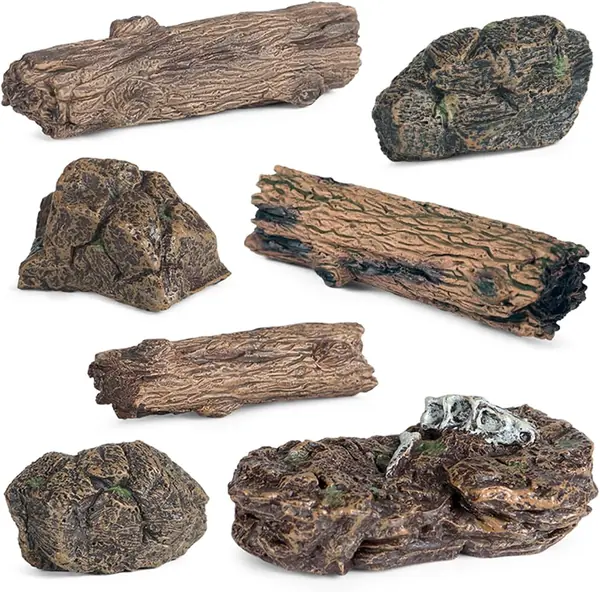
Turf and trees get all the attention; rocks are what stop a hillside from looking like a green blanket thrown over a lump. This little set — three stumps measuring roughly 3 to 4 inches tall and four stones at 1 to 2 inches — is the least expensive piece of scenery in this group and the one we are happiest to have on hand, because it is the sort of diorama supply that sits in a drawer until you notice a bare spot.

The molding is sharper than we expected. Bark lines and root flares are deep enough to reward a dry-brush and a wash, the plastic is heavy enough to sit still on glued ground without tipping, and the pieces wash clean, which matters if they do a turn in a terrarium or a school project before they land on a layout. Pressed into turf at the base of a slope, a single stump looks like it belongs there.

Seven pieces do not go far: a cutting, a stump or two along the line, and one rock outcrop, and you are planning the next bag. For a layout with a lot of bare embankment, buy two. As a way to add instant three-dimensional detail to a scene that is already green, this is the best value of the ones we covered.

Worth Noting

  • Only seven pieces, so scenes repeat quickly
Our Verdict

We think these earn a permanent place in any scenery box: seven ready-made pieces that break up a smooth green hillside.

Check Latest Price

How We Tested Model Train Scenery

We sorted a much longer list of scenery materials into the layers a layout actually needs — ground cover, trees, fine detail, water, structures — then filtered on listed scale, coverage per package, and price, dropping overlaps. Sixteen products came home with us, and we spent four months with them on an HO layout in a spare room, a shelf-sized N layout, and a rotating set of diorama bases on a newspaper-covered table.

Ground cover and trees saw the most use. We spread turf through a shaker, judged color in daylight and under layout lighting, and measured how far a bag stretched on a marked-out square before blending it with a second shade. Trees went in by the handful: we pushed them into foam hillsides, bent branches back into shape, and held them against a station building and a locomotive rather than trusting the label's scale. Each pack was tapped upside down over paper to see how much foliage shed, and the trees left standing were dusted and knocked for weeks.

Water was poured into a disposable mold to the depth the label allowed and left in a closed cabinet away from dust; we checked each pour for leveling and bubbles through its listed cure window and again days later. Tufts were peeled off their backing and pressed into diluted glue at the front edge of the layout, where we could see whether fibers stayed put through weeks of dusting. The structure kit took several evenings of glue and paint, and we noted which walls needed trimming and how much painting time it added.

Between sessions everything went back into its packaging, which taught us which bags reseal and which tufts escape into a drawer. Loose trees and tufts stayed bagged and out of reach of younger kids, and every pour cured behind a closed cabinet door.

How to Choose Model Train Scenery

Buy the Missing Layer, Not the Whole Landscape

Every convincing layout is built in the same order: ground cover, then vertical greenery, then the details, then water and structures where the scene calls for them. A board covered in foam with a dozen trees standing on it still looks unfinished, because the eye reads bare ground as unfinished before it notices anything else. If you own nothing yet, buy turf. If the ground is green and the horizon is empty, buy trees. If both are done, buy the feature a visitor will look at — a pond, a rock cut, a storefront.

That order protects the budget too. Base material covers the most area and costs the least per square inch, while detail items like tufts and stumps go further than their small bags suggest because they are used sparingly. Buying in that sequence means every purchase has somewhere to go the day it arrives.

Match Scale by Eye, Not by the Label

Tree and grass packs are labeled with a scale, but the number that decides the purchase is the height in inches. At HO, a six-inch tree stands in for about 43 scale feet — a mature pine. The same tree at N scale is a redwood, and the smallest trees in a mixed bag become shrubs. Measure your tallest structure and your widest clearance first, then check the height range on the package rather than the scale in the title.

Tufts are the easiest place to get this wrong: a clump that reads as grass at HO looks like a hedge at N. When a range spans several scales — Warmtree lists 1:35 down to 1:87 — buy for the middle of it and let the extremes go.

Read Coverage, Not Just Weight

A bag of fine turf covers far more ground than the same weight of coarse clumps, because fine grades spread thinner and settle into contours. Weight alone will not tell you how far a bag goes. For the base layer, buy the largest bag you can and recycle what the vacuum picks up; save the small shaker packs and tufts for detail work, where coverage is measured in inches.

A workable rule is enough material to cover your largest open area twice. The second pass is what hides the foam and plaster underneath, and it is the step most beginners skip.

Plan a Water Feature Around the Pour

Pour-in water is the most rewarding and least forgiving material in the category. Depth is the whole game: thin lifts cure clear in roughly the time the label promises, while deep pours stay cloudy far longer than anyone expects. Build the basin as a sealed box — a hard, dry coat of full-strength white glue over plaster or foam — and pour in shallow layers with a day or two between them.

Tint the first layer if you want anything other than clear glass, and size the water to the bottle. A 16-ounce bottle handles a pond or a short stream; a river system needs a different plan and a lot more product.

Budget Evenings, Not Just Dollars

The part of scenery that surprises people is the time. A structure kit needs paint, glue, and clamps before it looks like the photograph; a bag of trees needs each trunk glued and held; turf needs a vacuuming the next day. We plan a scene one evening at a time — lay the ground, let it cure, plant, then detail — because rushing the glue stage is what makes a finished scene look scattered.

Buy the big bag of the material you know you will use. Running out of turf halfway up a hillside is the most reliable way to end up with a layout that stays half finished for a year.

Frequently Asked Questions

Final Verdict

Buy the turf first. Of everything we handled, the Woodland Scenics fine blended green is the purchase that changes a layout fastest: one 32-ounce bag, a bottle of glue, and an afternoon turn bare foam into ground you can plant into. Everything else on this list builds on it, which is why it earns the top spot rather than the most exciting product here.

From there the order depends on the scene. The pines and the mixed trees make a wooded ridge, the tufts handle the close work along the ballast, and Realistic Water gives the track a pond to cross. If the layout needs a destination rather than more landscape, the Merchant Row kit is worth the evenings it costs.