Best Model Airplane Kits of 2026

Every model airplane kit looks sharp on the box art. The truth shows up at the joints: press two fuselage halves together without glue and you can feel whether the seam closes flush or leaves a step you'll be sanding for an hour. Starting a returning builder on a 1:48 bomber with poor fit is a reliable way to spend more time filling seams than building.

Scale decides more than subject does, and plenty of kits still sell cement and paint separately. We built 12 kits over six months at kitchen tables and workbenches, from 1:72 snap-fit models to 1:48 jets and bombers with full weapons loads, and the five picks share the thing you can't fix later: parts that line up and instructions that make sense at 10 p.m.

Our Top Picks

The Best Model Airplane Kits

1.

Tamiya 1:48 Grumman F-14A Tomcat Best Overall
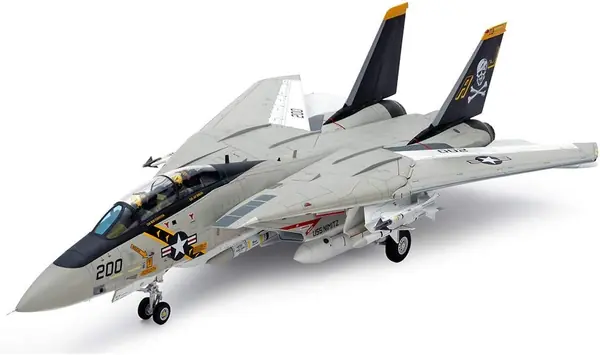
Tamiya 1:48 scale Grumman F-14A Tomcat plastic model airplane kit in Navy colors

Experienced jet builders

Track Score 92/100
Scale
1:48
Aircraft
Grumman F-14A Tomcat
Box Dimensions
15.75 x 11.5 x 3.38 inches
View on Amazon

Seams are where most jet kits lose us, and this Tomcat is the one that changed that. The fuselage halves and the wing roots meet cleanly enough that our evenings went to paint and decals rather than filler and sandpaper, and the panel lines stayed crisp instead of disappearing under primer. At 1:48 the finished jet is big enough to read cockpit detail from a couple of feet away.

Detail is the other half of the argument. Panel lines are fine and consistent, the decal sheet is a feature rather than an afterthought, and the aftermarket has caught up with the kit, so metal detail sets and replacement markings are easy to find if you want to push the same airframe further. We also like that it's a real project: this is a kit that runs across several sessions, not one.

It isn't a beginner's kit. There are a lot of parts, several of them small, and it costs more than anything else on this list — you're paying for tooling that saves you hours of sanding, which is either exactly what you want or money you don't need to spend. If you're coming back to the hobby after twenty years away, start with something simpler.

What kept us at the bench was how little the kit fought back. We could build in subassemblies — cockpit, wings, fuselage — and bring them together at the end without a repair session, which is a luxury on a subject with this many curves.

Worth Noting

  • Highest price in this group
Our Verdict

We recommend it to anyone with a few kits behind them: the fit is the cleanest in this group, and the detail earns the price.

Check Latest Price
2.

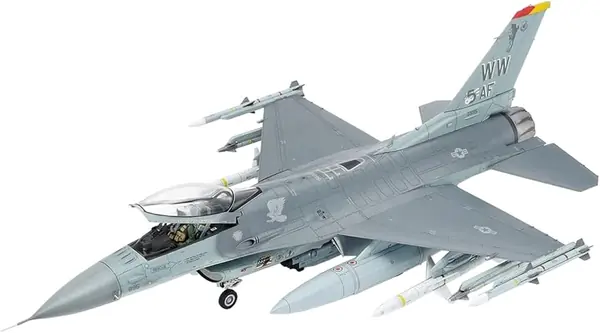
Tamiya 1:48 F-16CJ Best Value

Tamiya 1:48 Lockheed Martin F-16CJ gray plastic model airplane kit with missiles and fuel tanks

Value-minded jet fans

Track Score 91/100
Scale
1:48
Aircraft
F-16CJ Block 50
Decal Options
3 aircraft
Weapons Load
HARM, AMRAAM and Sidewinder missiles, ECM pod, fuel tanks
View on Amazon

Half the money of our top pick buys a different proposition: a smaller airframe, a lighter parts count, and the same discipline in the molding. The F-16CJ goes together with the precision people expect from this maker — joints close, panel lines stay sharp, and the detail lands where your eye goes first, around the cockpit and the intake.

What's in the box is what earns it a place here. You get a full weapons load — HARM, AMRAAM and Sidewinder missiles, an ECM pod and external tanks — along with polycaps at the pylons and tail so stores detach for storage instead of breaking off. The stabilators and flaperons can be posed, the canopy is optional-position, and there's a pilot figure with a choice of helmets. For a single-seat jet, that's a lot of model.

Decals cover three aircraft, including a Misawa-based commander's jet, so you aren't locked into one scheme. The instructions are the weakest link; they're dense in places and assume you know the order of operations, and the tiny parts punish anyone who hasn't built a modern jet before.

For a returning builder who wants one sharp Falcon without the Tomcat's commitment, this is the kit. Loaded, it looks like an aircraft on a mission rather than a stripped airframe, and that's most of what you want from a 1:48 jet.

Worth Noting

  • Instructions are unclear in places
  • Tiny parts punish brand-new builders
Our Verdict

If you want one modern jet that builds cleanly without Tomcat money, this is the kit we point you to.

Check Latest Price
3.

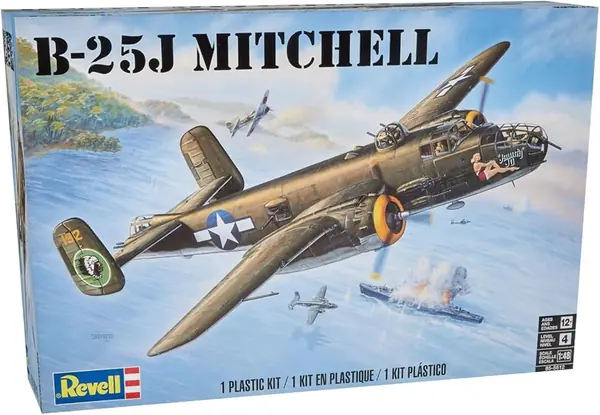
Revell 1:48 B-25J Mitchell Best Big WWII Project

Revell 1:48 B-25J Mitchell bomber model kit molded in light gray plastic

WWII bomber fans

Track Score 90/100
Scale
1:48
Parts
147
Decal Options
Two 345th Bomb Group variants
Finished Size
16-3/4 inch wingspan, 14-1/4 inch length
View on Amazon

One hundred and forty-seven parts is the number that tells you what this Mitchell is: a project, not an evening. Revell's 1:48 B-25J hands you a twin-engine bomber with a glass nose full of machine guns, crew figures, weighted tires and a choice of two Air Apaches marking options, and it asks for patience in return.

The subject is why we picked it. Five nose-mounted .50 calibers behind that clear nose is one of the most recognizable silhouettes of the war, and at 1:48 the finished model spans close to 17 inches — big enough to anchor a shelf and detailed enough that the crew figures read from a few feet away.

Expect to work. The tooling is older, so parts arrive with flash and mold seams to scrape, and the fuselage and clear nose want dry-fitting before any cement goes down; some of those joints need filler to look right. A couple of evenings with sanding sticks handles it, and dry-fitting first is the difference between a bomber and a lump.

What you end up with is a bomber rather than another single-seat fighter, which matters if your shelf is already crowded with jets. Against everything else here, this is the most model in the box — 147 parts, two marking options, and a display piece that takes up real space.

Worth Noting

  • Paint and glue sold separately
Our Verdict

Buy it if you want a real multi-week bomber project; the 147 parts and crew figures deliver a display piece with presence.

Check Latest Price
4.

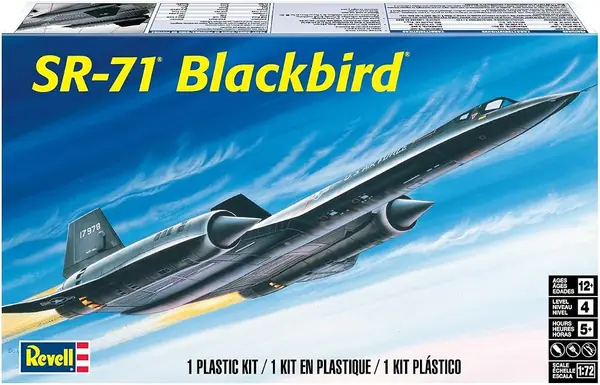
Revell 1:72 SR-71 Blackbird Best for New Builders

Revell 1:72 SR-71 Blackbird model kit molded in black with clear canopy parts

First-time builders

Track Score 89/100
Scale
1:72
Parts
66
Included
GTD-21 surveillance drone with cart
Finished Size
18.5 inch length, 9.25 inch wingspan
View on Amazon

Black plastic is the quiet advantage here. The Blackbird is molded in the color it's supposed to be, so a first glue-and-paint build can skip the step most people dread and still look right on the shelf.

Sixty-six parts make this a two-or-three-evening kit, and the result is 18.5 inches long with a 9.25-inch wingspan — long for 1:72, and unmistakable from across a room. Revell also includes the GTD-21 drone and its cart, which turns a single model into a small scene, plus authentic U.S. Air Force markings.

We rate it a strong first glue-and-paint kit rather than a showcase build. Fit is the area to watch: dry-fit the fuselage halves and wing joints and clean the mating edges before cement, because the tolerances are looser than on the Tamiya kits here. The black finish and clear canopy also mean stray cement shows, so keep your fingers clean around the glass.

Get past that and you own one of the strangest shapes ever to fly, at a size that dominates a shelf. There's no propeller or underwing load to knock loose either, which is more than the fighters here can say.

Worth Noting

  • Cement and paint are extra purchases
Our Verdict

Our pick for a first glue-and-paint build: 66 parts, black plastic, and a finished model with real shelf presence.

Check Latest Price
5.

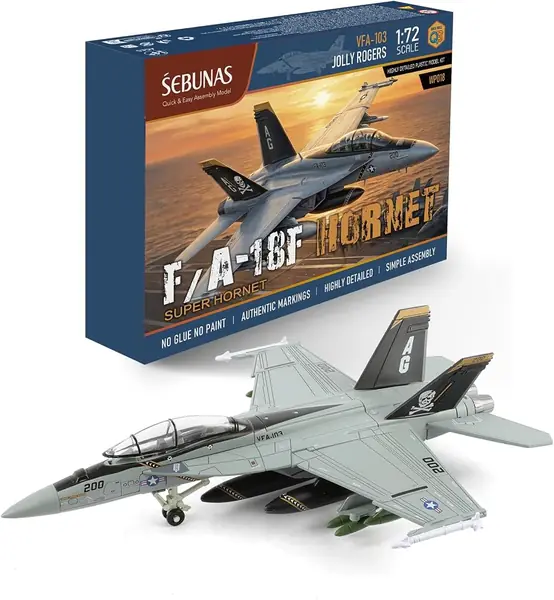
SEBUNAS 1:72 F-18 Jolly Rogers Best for Kids and Beginners

SEBUNAS 1:72 F-18 Jolly Rogers snap-together model kit with black squadron markings

Kids and beginners

Track Score 87/100
Scale
1:72
Included
Display stand
Assembly
Snap-fit, no glue or paint
Markings
VF-103 Jolly Rogers
View on Amazon

No glue, no paint, no knife — the promise on this F-18 is a jet on the shelf in one sitting, and it mostly keeps it. The parts click together, the VF-103 Jolly Rogers markings are already on the plastic, and a display stand comes in the box.

At 1:72 it fits on a desk, it's sturdy enough that a kid can carry it around by the fuselage, and it takes a fraction of the time the Tamiya kits do. The finish is the surprise: the markings are sharp and the gray is even, which is more than we expected from a snap kit.

What it isn't is a scale model. Panel lines are simplified, the cockpit is a suggestion rather than a compartment, and fit is the weak spot — several joints needed trimming before the parts would seat, and a couple of seams stayed open. We hand it to kids and to adults who want to try the hobby without buying cement, not to anyone chasing cockpit detail.

Treat it as a gateway. Build it with a child on a rainy afternoon, put it on the stand, and see whether the bug bites — and if it does, the Revell SR-71 is the natural next step.

Worth Noting

  • Some joints need trimming to seat
  • Toy-grade detail next to scale kits
Our Verdict

We like it for kids and total beginners who want a jet on the shelf today rather than a scale replica for the case.

Check Latest Price

How We Tested the Best Model Airplane Kits

We started with roughly 40 kits in 1:48 and 1:72 and narrowed from there using what the box actually tells you: part count, finished wingspan measured against a normal shelf, the skill level printed on the label, whether cement and paint are inside, and how many marking options the decal sheet covers. That left 12 kits, which we built over six months.

Builds happened at kitchen tables and workbenches, on weeknights after dinner and across a few weekend afternoons, with some models sitting half-assembled for a week between sessions. Before touching cement we dry-fit the fuselage, wings, and stabilizers, then noted where gaps opened and how much filler and sanding each joint demanded. We followed every instruction sheet page by page, flagging steps that skipped a part or left the orientation of a piece unclear, and timed our sessions to see how long a build actually ran.

Cockpits, panel lines, ordnance, and crew figures were judged straight out of the box, before any aftermarket parts entered the picture. We laid the kit decals over those panel lines to see whether they settled down or silvered, and counted how many aircraft the sheet really covered. Finished models got moved between rooms and shelves to see what snapped off — pitot tubes, antennas, and landing gear struts are the usual casualties — and the snap-fit kits went to a younger builder with an adult at the table.

We tallied what wasn't in the box, like cement, paint, and brushes, as part of the real cost, and noted where an inexpensive kit quietly turned expensive. Cement and enamel paint were used with a window open or a fan running, and we kept the age labels in mind throughout. Kits whose wing roots needed filler to look right lost ground; the five that made the list are here because they didn't.

How to Choose a Model Airplane Kit

Scale Comes Before Subject

Scale sets the size of the finished model and, roughly, how many parts you'll handle. A 1:48 fighter is a satisfying size with a cockpit you can see into; a 1:72 jet is cheaper, smaller and quicker to finish. The trap is assuming a smaller scale means a smaller model: Revell's 1:72 SR-71 finishes at 18.5 inches long, while the 1:48 B-25J spans 16-3/4 inches across the wings. Measure the shelf before you order, then pick the subject.

Fit Is the One Thing You Can't Fix Later

Every gap at a wing root becomes filler, sandpaper, and an evening you didn't plan on. We put fit ahead of part count and feature lists because it's the difference between a kit you finish and one that goes back in the box unfinished. The habit that saves any build: dry-fit each joint, scrape the mating edges, then cement. The kits needing the least of that work — the two Tamiya jets here — are the ones to choose if you'd rather enjoy building than fixing.

Skill Level, Part Count, and What's Not in the Box

The skill-level numbers printed on the box don't mean the same thing from one maker to the next, so part count is the more honest guide to what you're taking on, and anything over a hundred is a project. Almost no plastic model kit includes paint and glue, so budget for cement, a few brushes and the colors named on the instruction sheet before you start. A kit that arrives without them isn't a bargain if you can't build it that night.

Snap-Fit Kits and Die-Cast Models Are a Different Purchase

A box that says snap-fit, no glue required, or that sits in a pre-built or die-cast category is a display model rather than a scale build: the parts click together in minutes and the detail is molded in. That's a fine purchase for a child or a desk, and our snap-fit pick is honest about what it is. It isn't a substitute for a kit that teaches you seam work, and a twenty-piece jet won't satisfy anyone who wants a cockpit.

Markings and Decals Do a Lot of the Work

Two marking options instead of one is worth paying attention to, because decals are where a finished model either looks researched or looks like a toy. Kits with a healthy aftermarket — the Tamiya F-14A being the obvious example here — let you re-mark the same airframe years later. And if a subject bores you, you won't finish it; a bomber with crew figures or a Blackbird with its drone will hold your attention longer than a plane you chose because it was there.

Frequently Asked Questions

Final Verdict

If you've built a model before, the Tamiya F-14A Tomcat is the one we hand you: joints that close without filler, detail that rewards the weeks it takes, and a finished jet that still stops people at the shelf. The one reason to look elsewhere is money.

When that's the deciding factor, the Tamiya F-16CJ is the better buy — the same engineering in a smaller airframe, a full weapons load in the box, and a shorter build from the same playbook.