Best Airbrushes of 2026

Inside an airbrush, a stream of air meets a stream of paint at the tip, and how cleanly they meet decides everything else. Nudge the needle back a hair and you get a hairline; pull further and you get a soft edge wide enough to basecoat a kit. Get the mix wrong and you're fighting spatter, tip dry and a cup that bubbles paint back at you.

The nozzle sets the ceiling, not the brand. A 0.2mm brush pulls a lovely hairline and then chokes on primer; a 0.5mm lays a smooth coat but fights you on detail. That is why we favored brushes with a second needle and nozzle in the box, swappable cups and air control you can reach mid-stroke, after six months of acrylics, primers and metallics on model kits, cosplay foam and canvas. Cleanup counted as part of the price.

Our Top Picks

The Best Airbrushes

1.

Iwata Eclipse HP-CS Best Overall
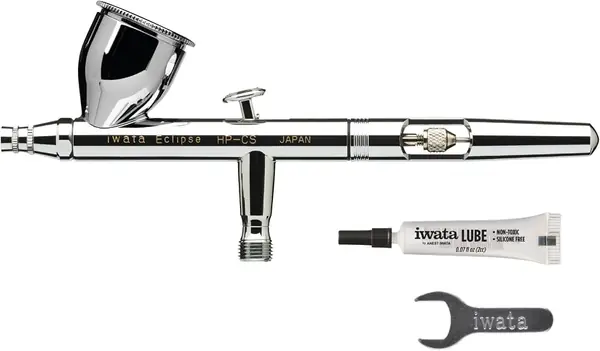
Iwata Eclipse HP-CS silver gravity-feed dual-action airbrush with 0.24 oz fluid cup

All-around airbrushing

Track Score 94/100
Nozzle
E3 compression-fit
Fluid Cup
0.24 oz (7 ml)
Item Weight
1.6 oz
Action
Gravity-feed dual action
View on Amazon

The part that decides whether you keep airbrushing is the nozzle, because it is what you have to clean after every color. Iwata's E3 is a compression-fit piece with no threads to cross, so it lifts straight out, and the cutaway handle exposes the needle for a fast flush of the paint path. That maintenance design, more than any single feature, is why this is the brush we recommend to most people.

It sprays as well as it cleans. The gravity-fed 0.24 oz (7 ml) cup and high-flow nozzle lay down an even coat with less thinning than many brushes need, and the same head pulls down to a fine line for panel shading or a miniature's face. Solvent-based, water-based, and pearlized paints all pass through it, which matters if your shelf holds more than one brand.

Set against the rest of this group, the Procon Boy has the finer nozzle and the on-brush air valve, and the Gaahleri costs a fraction as much. What the Eclipse buys is the middle of the road done properly — a head that handles both detail and general coverage — plus needles and nozzles you can actually order when one bends.

It is the most expensive brush here, and we think that is the right call for a tool you will keep for years. If the budget is not there, the GHAD-39 gets a beginner through the same first projects for a fraction of the outlay.

Worth Noting

  • Small 7 ml cup needs refills on large jobs
Our Verdict

Our default recommendation: the Eclipse sprays detail and coverage equally well, and cleaning it takes minutes, which is why we tell most people to buy this one.

Check Latest Price
2.

Harder & Steenbeck Ultra 2024 Best for Beginners

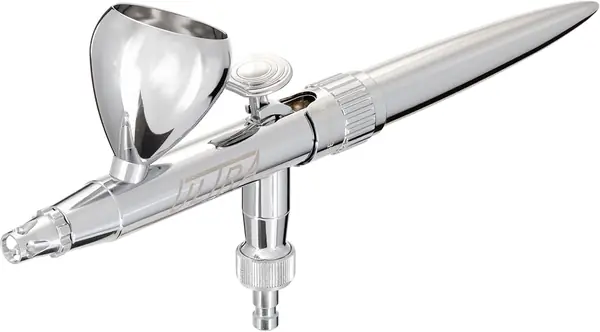
Harder and Steenbeck Ultra 2024 silver dual-action airbrush with 5 ml paint cup

First-time buyers

Track Score 93/100
Nozzle
0.45mm self-centering
Fluid Cup
5 ml plus micro-cup socket
Assembly
Tool-free by hand
Upgrade Path
Accepts FineLine Infinity heads
View on Amazon

The Ultra 2024 is what we put in front of someone who has never held an airbrush. Its 0.45mm nozzle self-centers, so it drops into place without lining up threads, and the entire brush disassembles by hand — no wrench, nothing small to lose on the carpet. There is a 5 ml cup, plus a micro-cup socket machined into the body for a few drops of color.

What we appreciated most is how rarely it punishes a beginner. Wide background coats and fine lines come out of the same head, so you are not swapping nozzles to learn a second skill, and the trigger stop keeps you from flooding a thin layer. It is the least intimidating route into a brush you will not outgrow.

That last part is the real argument for it. The front end accepts FineLine heads from H&S's Infinity line, so a later upgrade is a head change rather than a new brush. If you want more coverage for the same money, the Revolution CR is the faster brush on large surfaces — but it will not hold your hand the way this one does.

Worth Noting

  • 5 ml cup empties quickly on large surfaces
Our Verdict

We hand the Ultra 2024 to anyone buying a first serious airbrush: it goes together and comes apart by hand, and it grows with you instead of blocking an upgrade.

Check Latest Price
3.

GSI Creos Mr. Procon Boy WA Platinum Best for Fine Detail

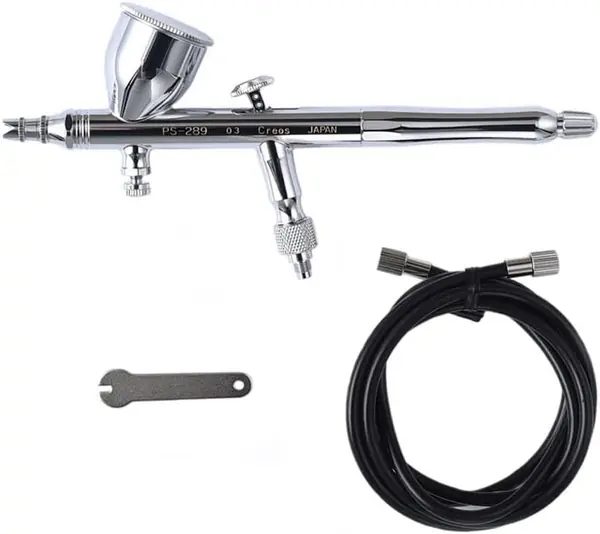
GSI Creos Mr. Procon Boy WA Platinum airbrush with 0.3mm nozzle and 10 ml cup

Fine detail work

Track Score 92/100
Nozzle
0.3mm
Fluid Cup
10 ml
In The Box
PS hose and 1/8 valve
Air Control
On-brush adjustment valve
View on Amazon

There is a small air valve on the body of the Procon Boy WA, and once you have used one you notice its absence on every other brush. You dial flow down for a fine line and open it up for a metallic without touching the compressor. Underneath that sits a 0.3mm nozzle and a 10 ml gravity cup, with a PS hose and 1/8 valve in the box.

The spray itself is why we keep coming back to it. Paint goes down as a fine, even mist, thick primers and clear coats move through without much thinning, and the soft trigger gives you a tactile sense of how much paint is leaving the nozzle. The backwash function flushes the passage without a full teardown.

It is the finest-working brush here, and that is a specific job rather than a general one. Miniatures, small-scale armor, and jewelry-scale parts are where the 0.3mm head earns its keep; the Eclipse's larger head covers ground faster on a bodyshell or a canvas, and it costs more. Between the two we take the Procon Boy whenever the parts are small and there are a lot of them.

Worth Noting

  • 0.3mm tip makes wide priming slow
Our Verdict

If your work is small — miniatures, armor, tiny parts — we think the Procon Boy's finer spray and on-brush air valve are worth the money.

Check Latest Price
4.

Iwata Revolution CR Best for Broad Coverage

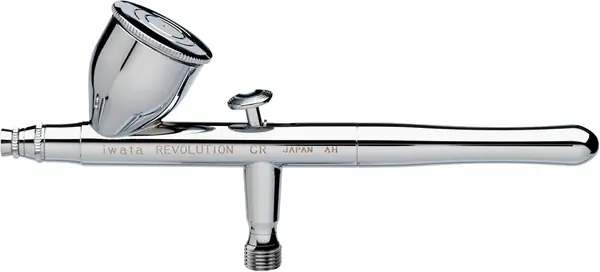
Iwata Revolution CR silver gravity-feed dual-action airbrush body

Broad coverage

Track Score 91/100
Item Weight
8.8 oz
Action
Gravity-feed dual action
Product Dimensions
4.4 x 7.8 x 2.2 inches
View on Amazon

Wide sweeps, hairline highlights, and priming an entire model come out of the same head on the Revolution CR. It throws an even cone of paint, and it does it whether you are detailing a 1/35 scale tank or laying a base coat on a car body.

Our use for it is the second-brush role: someone already owns a detail airbrush, keeps running out of coverage, and wants one gun that will prime, base-coat, and handle thicker paints. It does all three without fuss, and it comes apart in a way that makes a color change quick.

The design is as simple as the job. A gravity-feed dual-action body, a shallow cup that rinses clean, no feature you have to remember to switch on. The one habit it rewards is thinning — run thick paint through a wide pattern and you get spatter instead of a smooth fan, so keep the mix loose and it stays consistent.

Our Verdict

The Revolution suits a job that needs both highlights and full-model priming, since one head covers both without swapping anything.

Check Latest Price
5.

Gaahleri GHAD-68 Best Ergonomic Grip

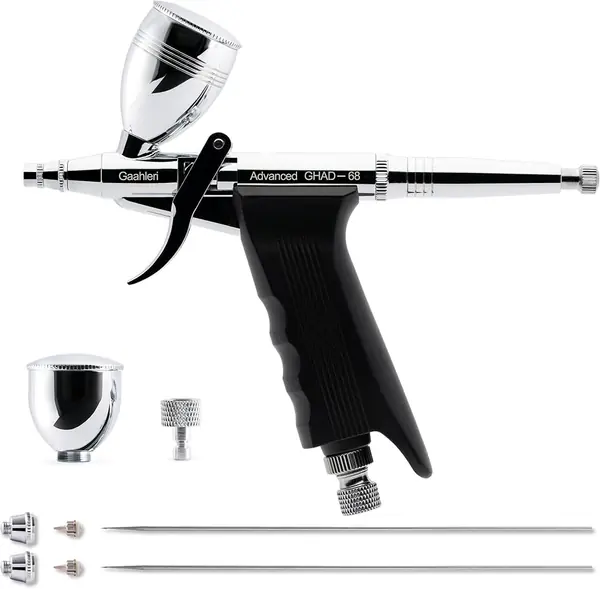
Gaahleri GHAD-68 silver pistol-grip airbrush with two needle sets and two cups

Long painting sessions

Track Score 90/100
Nozzle Sizes
0.38 and 0.5mm
Fluid Cups
1/2 and 1/4 oz
Item Weight
6.77 oz
Grip
Pistol trigger
View on Amazon

An hour of base-coating with the GHAD-68 is what convinced us a pistol grip belongs in this conversation. Your hand closes around it like a drill, the trigger sits under the index finger, and the wrist stays neutral instead of rolling over the top of the body — the position that makes long sessions ache.

The working end is well thought out. The self-centering nozzle drops in and seats itself, so reassembly after cleaning is a rinse and a push rather than a threading exercise, and you get two needle and nozzle sets at 0.38mm and 0.5mm plus 1/2 oz and 1/4 oz screw-on cups. The cup interiors are polished smooth, so paint does not hang up in them.

Cleanup is quick: the nozzle pulls out, the cups unscrew, and a color change takes a couple of minutes. Against the GHAD-39, you are paying for the grip and the slightly larger tip rather than better atomization, which is the right trade if your hand is the thing that gives out first.

Worth Noting

  • 0.38mm tip is coarse for hairline detail
Our Verdict

For long sessions we pick the GHAD-68: the pistol grip keeps your hand relaxed, and the self-centering nozzle makes cleanup quick.

Check Latest Price
6.

Gaahleri GHAD-39 Best Value

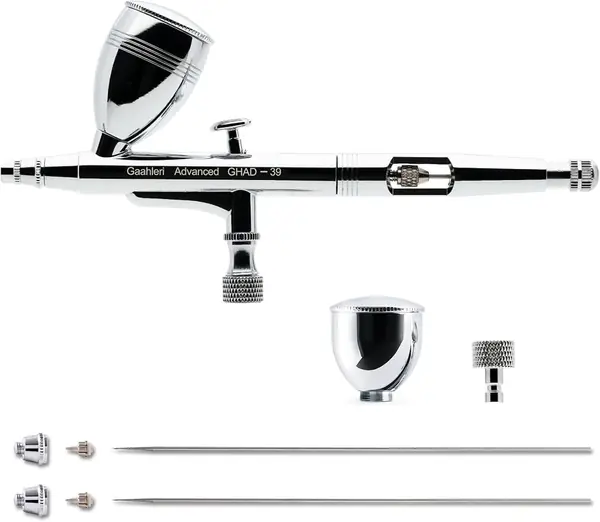
Gaahleri GHAD-39 silver airbrush with two nozzle sets and two fluid cups

Budget setups

Track Score 89/100
Nozzle Sizes
0.35 and 0.5mm
Fluid Cups
1/2 and 1/4 oz
In The Box
Two needle and nozzle sets
Nozzle Design
Self-centering drop-in
View on Amazon

Two needle and nozzle sets, 0.35mm and 0.5mm, plus a 1/2 oz and a 1/4 oz cup, all in one box for less than almost every other brush here. That is the GHAD-39's pitch, and it holds up better than the money suggests.

The nozzle is the same self-centering drop-in design Gaahleri uses higher up its range: it seats itself, which shortens cleaning and removes the chance of cross-threading a part that is easy to order but annoying to wait for. Both needle sets install without tools, and the cup interior is polished so a rinse takes most of the color with it.

This is the brush we point a first-timer at when they want a real dual-action gun without spending real money. It sprays smoothly, handles primers and thicker acrylics, and cleans up fast. What it does not do is flatter you: the trigger is not as refined as the Eclipse's, and you feel the difference on hairline work. For priming, base-coating, and learning the motions, none of that shows up in the result.

Worth Noting

  • Can clog when paint is thick
Our Verdict

We steer budget buyers to this kit: you get two nozzle sets and two cups, and it sprays better than its price suggests.

Check Latest Price
7.

Timbertech ABPST01 Airbrush Kit

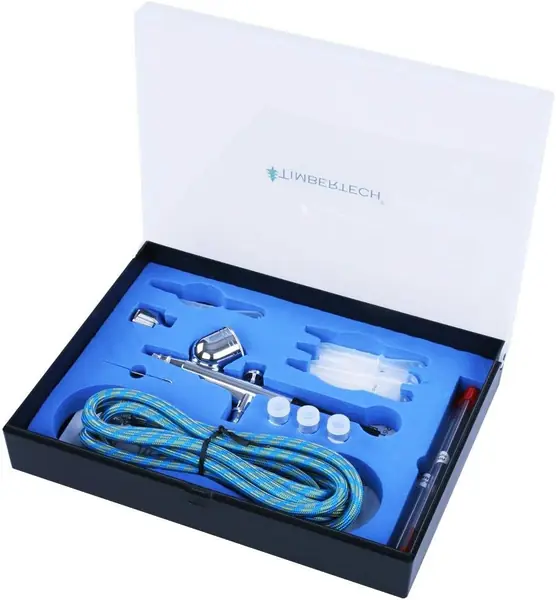
Timbertech ABPST01 airbrush kit with hose, nozzles, needles, pipettes and case

Cheap starter kit

Track Score 88/100
Nozzle Sizes
0.2 / 0.3 / 0.5 mm (0.008 / 0.01 / 0.02 inches)
Hose
2 m fabric hose with adapter
Paint Cup
7 ml
Also Included
Wrench and four pipettes
View on Amazon

Everything needed to start is in the case: the brush, a 2 m fabric hose, three needle and nozzle sets at 0.2, 0.3 and 0.5mm, a wrench, four pipettes, and molded foam to hold it all. That completeness is why this kit makes the list — it is the least expensive way here to get a hose and a range of tips in one purchase.

It sprays the way a basic dual-action gun should. Press for air, pull for paint, and the three tips genuinely change its range: a 0.2mm line for panel lines and small parts, a 0.5mm fan for primer and broad coats. The 7 ml cup is fine for parts and panels; on a full body you will be refilling it.

The parts are small, though, and the two finest needles reward a light hand. Thin the paint, keep the nozzle clear, and it behaves; this is a brush that wants a rinse the moment you stop spraying rather than a soak at the end of the night.

We put it where it belongs: a first kit, or a spare for someone who wants a second gun for messy work. Results are honest rather than expert — you will not get the atomization of the Procon Boy — but the point of this price is that a beginner can learn, bend a needle, and get a replacement without wincing.

Worth Noting

  • Plastic body feels less refined than metal brushes
Our Verdict

We recommend this kit to anyone who wants to try airbrushing with the hose included and no illusions about expert results.

Check Latest Price
8.

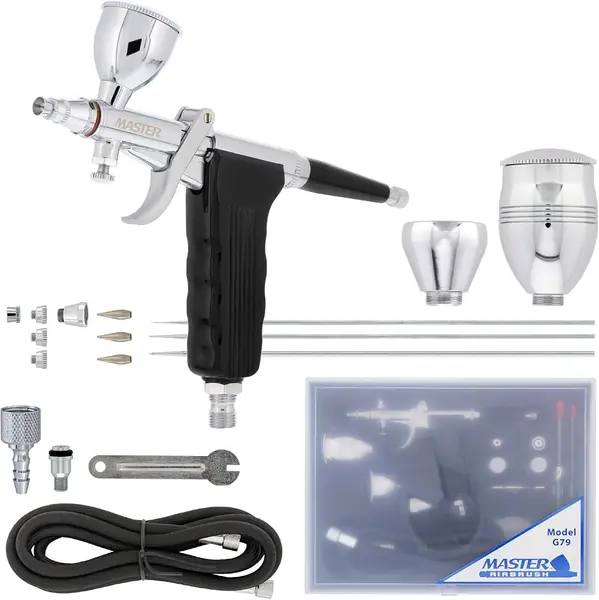
Master Airbrush G79 Best for Primer and High-Build

Master Airbrush G79 black and silver trigger-style airbrush with three fluid cups

Primer and high-build

Track Score 86/100
Nozzle Sizes
0.3, 0.5, 0.8mm
Fluid Cups
1/16, 1/6 & 1/2 oz
In The Box
6-foot braided hose, nozzle wrench, guide, and case
Trigger
Trigger style
View on Amazon

The 0.8mm needle is why the G79 made the cut. None of the other brushes here list a tip larger than 0.5mm, and the big one is what you want for primer, high-build filler, and Cerakote — material that a detail nozzle turns into a clog. Three screw-on cups at 1/16, 1/6 and 1/2 oz let you keep a batch going and still swap to a small cup for spot work.

Trigger-style control suits that job. You pull with the whole hand instead of a fingertip, which is steadier across a long pass, and the nozzles are self-centering drop-ins, so a cleaning strip is quick. The 6-foot braided hose, nozzle wrench, guide, and molded case are all in the box.

It is not a detail brush and does not pretend to be. Fine lines come out coarse next to the 0.3mm Procon Boy, and the needle adjustment has some play in it, which shows up when you try to feather a small area. For primer, base coats, and large coverage, none of that costs you anything.

We treat it as a specialist: the gun that goes to work when a model needs primer and blocking out, not the only brush on the bench. If primer and high-build coats are the job, it does them for a fraction of what a premium detail brush costs.

Worth Noting

  • Replacement parts can be hard to find
Our Verdict

We keep the G79 around for primer and high-build work, where its 0.8mm tip does what no other brush here can.

Check Latest Price

How We Tested Airbrushes

We built the shortlist from spec sheets rather than listing photos: which needle and nozzle sizes each brush offers, whether replacements are sold separately, whether the cup is fixed or swaps, and what actually comes in the box. A brush with no parts pipeline got cut no matter how good its spray pattern looked online, which left 12 that we ran for six months.

Testing happened where these brushes actually live: a bench in the garage on weekend model builds, a corner of the studio for cosplay foam and canvas, and a stack of nail tips for practicing hairlines. We pulled the thinnest unbroken line each brush could hold at its own stated maximum working pressure or below — never above it — then repeated it after the brush sat ten minutes with paint in the cup.

Spray quality got judged on black card and primed scrap plastic, where spatter, tip dry, and metallic flake show up fast: we noted whether coats went down even or mottled, whether primer clogged at the nozzle, and whether paint bubbled back into the cup, a sign of a poorly seated nozzle. We also dialed air to the bottom of each brush's range to see how it handled stippling and close-in work.

Cleaning was timed and done without the instructions: how many parts came off by hand versus needing the wrench, whether paint hid in the cup's corners, and how the nozzle reseated afterward. Across the six months we logged thread and needle wear, confirmed spares were in stock, and judged trigger comfort at the end of two-hour sessions, pistol grip against conventional. Every hose, adapter, and extra needle set in the box was noted and test-fitted to a standard compressor; anything we ran with solvent-based lacquer went into the ventilated booth with organic-vapor respirators on.

How to Choose an Airbrush

Start With the Nozzle, Not the Brand

The nozzle sets what a brush can do. Something in the 0.2 to 0.3mm range lays down fine lines and small dots, which is what minis and scale detail need, but it is slow going on anything larger. A 0.35 to 0.45mm head is the all-round choice: fine enough for panel shading, broad enough to base-coat. Above 0.5mm you are into primer and high-build territory.

If you are buying one brush, buy the middle and accept that hairline work will be a touch coarser than a dedicated detail head would give you. If you already own a detail brush and keep running dry on coverage, shop the other end instead.

Cleaning Design Decides How Much You Use It

The brush you actually use is the one you can clean in two minutes. Self-centering and compression-fit nozzles — the Gaahleri drop-in design, Iwata's E3, the H&S 0.45mm head — pull straight out without threads to cross, and a cutaway handle lets you flush the paint path without a full strip. A polished cup helps too, because paint that sheets off takes the color with it.

Here is the trap: a brush that needs a wrench and a careful sequence every time gets used twice and then lives in a drawer, whatever its spray quality.

Treat Needles and Nozzles as Wear Parts

A bent needle is a normal event, not a defect — the fine ones bend when a brush tips over on the bench. What separates a tool from a throwaway is whether you can buy the replacement: check that nozzles, needles, and O-rings are listed for the model before you order, and put a spare nozzle in the same cart as the brush.

Models with no parts path turn a two-minute fix into a new purchase, which is the most common way a cheap airbrush stops being cheap.

Match the Cup and the Trigger to Your Hand

Gravity-feed cups run from about 5 ml on the H&S Ultra and the Timbertech kit up to 10 ml on the Procon Boy, and several brushes ship with two sizes you can swap. Small cups suit detail and short color changes; large ones suit primer and full coverage. Weight the cup you will use most, not the biggest one in the box.

Trigger style matters just as much. A pistol-grip airbrush gun keeps the wrist neutral over a long session — the GHAD-68 is our pick — while a conventional top lever gives finer fingertip control. Neither is better; they suit different work.

Frequently Asked Questions

Final Verdict

For most people the Iwata Eclipse HP-CS is the answer: it sprays fine detail and broad coverage from one head, and the threadless nozzle and cutaway handle make cleanup the least annoying part of a session. That combination is what keeps a brush in use rather than in a drawer.

Two requirements change the pick. If your work is small and repetitive — miniatures, armor, tiny parts — the Procon Boy's 0.3mm head and on-brush air valve are the better tool. And if you are not sure you will stick with it, the Gaahleri GHAD-39 hands you two nozzle sets for a fraction of the money; upgrade when the brush, not the budget, is what is holding you back.