Best Airbrushes for 3D Prints of 2026

Rattle-can primer is fast and inconsistent on 3D prints. One model comes out velvety, the next pools primer in the armpits and buries detail you spent an hour supporting. An airbrush gives you two controls a can doesn't, paint and air, so a small nozzle can lay a whisper across a face while a wide one floods a batch of terrain.

Clogging is the catch. Thick acrylic primer is the real test, and a nozzle that sprays thin ink beautifully can spit and stall once you pour in something with body. Every pick here is dual-action and all but one is gravity-fed, which makes a color change a quick flush. The differences are in the head: whether the nozzle drops in self-centered or needs a wrench, how fast it comes apart and what's in the box.

Our Top Picks

The Best Airbrushes for 3D Prints

1.

Iwata Eclipse HP-CS Best Overall
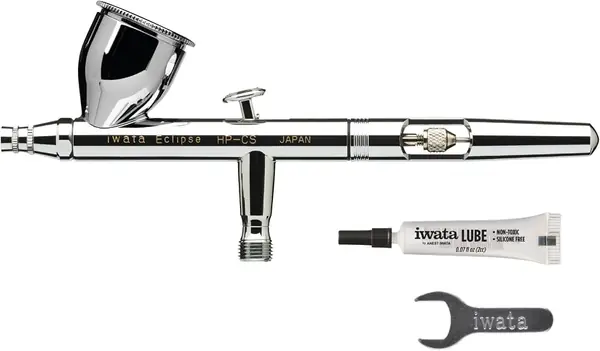
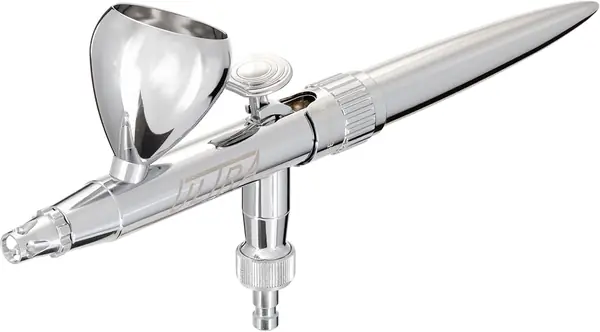
Iwata Eclipse HP-CS chrome gravity-feed dual-action airbrush with 0.24 oz fluid cup

All-around model painting

Track Score 93/100
Nozzle
E3 compression-fit
Feed
Gravity-fed dual action
Fluid Cup
0.24 oz (7 ml)
Needle Access
Cutaway handle, quick flush
View on Amazon

There is no thread on the E3 nozzle. It seats with a compression fit, lifts out with the needle, and the cutaway handle unscrews so the whole paint path is visible and flushable in one motion. For a brush that gets cleaned after every color, that is the design detail we care about most, and the spring-steel needle and solvent-resistant packings mean you are not babying it either.

What keeps this at the top for us is how little it asks of thick paint. Iwata builds the E3 head for high-flow atomization with less thinner, which is exactly the fight 3D printers run into when a bottle of acrylic primer meets a small nozzle. Primer, base coats, and a wet coat across a terrain piece all went down even in our sessions, and a rinse brought the spray back instead of a full teardown.

It costs more than anything else on this page, and that is the honest trade: you are paying for the head, the seals, and the fact that replacement parts exist. If the airbrush is going to live on the bench for years, the math works. If you are still working out whether you enjoy airbrushing at all, it does not.

The part we did not expect to love is the seating itself. Pop the nozzle out with the needle, drop it back in, and it lands the same way every time — no wrench, no threads to strip, nothing to over-tighten at the end of a long night of priming.

Worth Noting

  • 7 ml cup needs refilling on big priming runs
Our Verdict

The brush we tell people to buy when airbrushing is going to be part of their painting, not an experiment: it cleans fast, flatters thick acrylic primer, and shrugs off solvents.

Check Latest Price
2.

Gaahleri GHAD-39 Best Budget

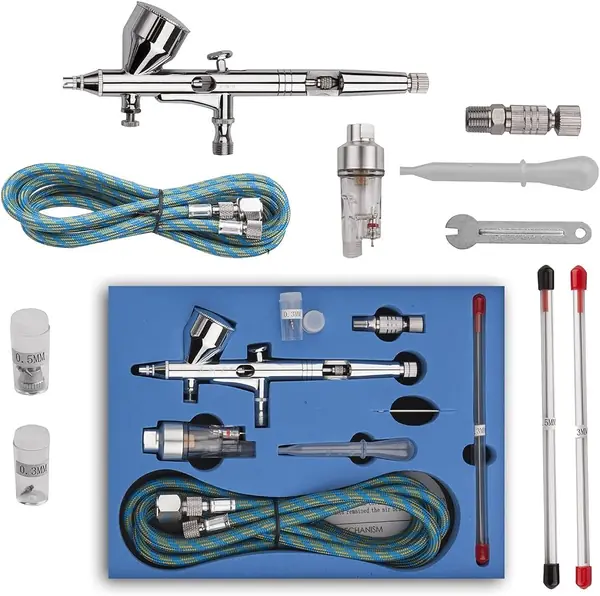
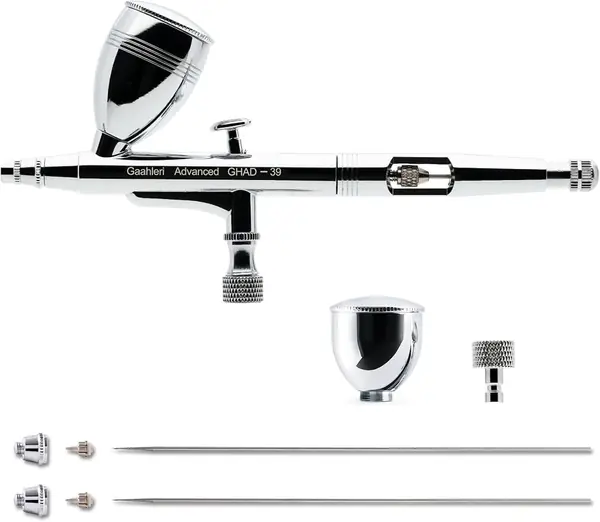
Gaahleri GHAD-39 silver airbrush with 0.35 and 0.5 mm needle sets and two cups

Budget batch priming

Track Score 92/100
Needles
0.35 and 0.5 mm
Warranty
1 year
Nozzle Mount
Self-centering drop-in
Fluid Cups
1/2 oz and 1/4 oz
View on Amazon

This is the least expensive brush here, and it still arrives with a 0.35 mm and a 0.5 mm needle set, two screw-on cups, and Gaahleri's self-centering drop-in nozzle. That is the whole case for it: the two sizes cover primer and base coat on prints, the nozzle comes out without threading, and the money you save buys a spare needle. We recommend it to anyone who is not sure yet how much airbrushing they will do.

The drop-in nozzle is the part we appreciate most. There is nothing to cross-thread, the cup has a smooth bore that rinses clean, and the head comes apart in about the time it takes to change colors. Where it gives ground is thick, cold primer: loaded straight from the bottle into the 0.35 mm setup it can sputter and spit. Thin the primer, give it a little more pressure, and the problem mostly disappears.

The cups are practical rather than generous — the 1/2 oz one gets you through a squad of infantry, the smaller one is right for a single model or a touch-up. If you want one brush for both primer and genuine fine detail, 0.35 mm is the ceiling here, and the Mobius takes that work further. What you get in exchange is a one-year warranty and parts you can actually find.

Worth Noting

  • Detail work stops at the 0.35 mm tip
Our Verdict

Our budget pick, and the one we suggest to anyone unsure how deep they will go: two needle sizes, a nozzle you pull out by hand, and a price that leaves room for spares.

Check Latest Price
3.

Gaahleri Mobius 0.3 Best for Fine Detail

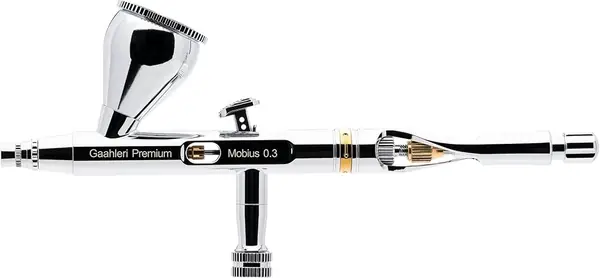
Gaahleri Premium Mobius-03 airbrush with 0.3 mm spiral nozzle and polished cup

Detail and shading

Track Score 91/100
Nozzle
0.3 mm spiral MAC
Warranty
1 year
Lever
Ergonomic square lever
Cup Finish
Ultra-mirror polished
View on Amazon

A 0.3 mm nozzle usually means a slow brush: pin-sharp lines, but you feel every second of coverage. Gaahleri's Mobius 0.3 keeps the fine tip and opens up the airflow, so it moves noticeably more paint than the small-bore brushes we have handled. On a 28 mm figure that reads as a base coat you do not have to fight for, then a tip small enough for edge highlights.

The cutaway body shows the paint chamber and the airflow through a ring at the back, which sounds like styling until you are chasing a sputter and can see where it starts. The cup interior is polished past the usual mirror finish, so dried paint does not cling to the walls. And the square lever takes the stutter out of the trigger — a smooth pull instead of a series of small jumps.

We reach for this one when the model is already primed and the job is shading, panel lines, and thin shadow coats. It is a real step up from the budget Gaahleri in feel, and on fine work we did not feel we had given anything up to the Iwata. Thick primer is the one thing it will not forgive, so keep a 0.5 mm setup for that. What surprised us is how little cleaning it needs: the polished cup and the drop-out nozzle mean a rinse does most of the work.

Worth Noting

  • 0.3 mm tip will not take unthinned primer
Our Verdict

Buy this one if your prints are already primed and the work left is shading and edge highlights — 0.3 mm precision that still moves enough paint to cover.

Check Latest Price
4.

Harder & Steenbeck Ultra 2024

Harder & Steenbeck Ultra 2024 airbrush with 0.45 mm self-centering nozzle and 5 ml cup

Beginners who upgrade

Track Score 90/100
Nozzle
0.45 mm self-centering
Fluid Cup
5 ml plus micro-cup socket
Disassembly
Tool-free by hand
Upgrade Path
H&S FineLine head
View on Amazon

Nothing on the Ultra 2024 needs a wrench. The head, the nozzle, and the needle come apart by hand, which means the brush actually gets cleaned instead of getting a flush and a promise. That single design decision is why it is on this list.

The 0.45 mm self-centering nozzle sits in the sweet spot for printed models: wide enough to lay primer without thinning it to water, tight enough for a clean base coat on a 32 mm figure. The 5 ml cup handles a session, and there is a micro-cup socket machined into the body so a few drops of a mixed color never dirty the whole cup.

Where it stops is finer work. The 0.45 mm head is the only one in the box, and going smaller means adding Harder & Steenbeck's FineLine front end later. We like that the upgrade exists at all, because the brush stays useful as your painting moves toward detail instead of being replaced by something else.

What earns it a recommendation from us is the maintenance, not the numbers: a brush you can strip in your hand gets cleaned, and a clean brush keeps spraying. Next to the Mobius it gives up the last measure of fine control and gains a head that shrugs off primer. And when a part eventually goes, the modular front end means you replace a head, not the whole brush.

Worth Noting

  • 0.45 mm head only until you add the FineLine front end
Our Verdict

We recommend it to anyone who wants one airbrush to learn on and keep: it strips by hand, sprays primer without drama, and takes a finer head when you are ready.

Check Latest Price
5.

Pinkiou SP180KTG Best Starter Kit

Pinkiou SP180KTG silver airbrush kit with three needles hose and moisture separator

Complete first kit

Track Score 86/100
Needles
0.2, 0.3, and 0.5 mm
Body
Copper with stainless needle
Pieces
13-piece kit
Included
Hose and moisture separator
View on Amazon

The Pinkiou kit is the one we hand to someone who has a compressor and nothing else: it arrives with a braided hose and an oil-water separator, so the first session does not wait on a second order. For a beginner, that completeness is worth more than any single feature on the brush.

Three needles come with it — 0.2, 0.3, and 0.5 mm — along with a copper body and stainless needles, and the 0.5 mm setup handles primer and base coats across a batch of prints without complaint. The 0.2 mm needle is the one fitted at the factory, so plan on swapping before your first priming session; it is a two-minute job and the wrench is in the box.

This is a value kit, and the small parts are where that shows. Needles and nozzles are the first things to go if you are rough with them, so order spares with the brush and treat the head gently when you reassemble it; Pinkiou advertises lifetime service, which is a real backstop if a part arrives bad. What keeps us coming back is the completeness: hose, separator, three tips, a case, and a brush that lays base coats down evenly.

Worth Noting

  • Ships with the 0.2 mm needle fitted
Our Verdict

The kit we point first-timers to when they own a compressor and nothing else — hose, separator, and three needles mean you can spray the day it lands.

Check Latest Price
6.

NEOECO SJ83 Best for Large Priming Jobs

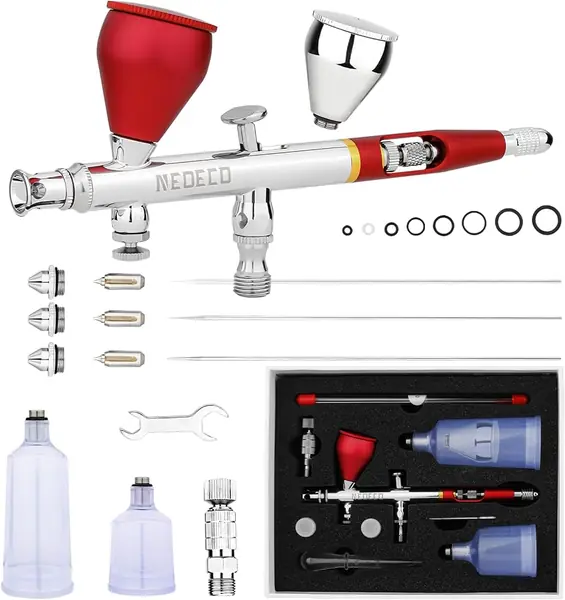
NEOECO SJ83 red airbrush with 0.2, 0.3, and 0.5 mm nozzles and three cups

Large priming jobs

Track Score 85/100
Nozzle Mount
Self-centering plug-in
Cups
9, 20, and 40 cc
Nozzles
0.2, 0.3, and 0.5 mm
Connection
Quick-disconnect coupler
View on Amazon

Three cups — 9, 20, and 40 cc — come with the SJ83, and the big one holds enough primer for a full plate of terrain without a refill. That is the reason it is here: most brushes in this price range make you stop and mix again halfway through a batch.

The nozzle is the same self-centering plug-in design the Gaahleri uses, and you get three sizes — 0.2, 0.3, and 0.5 mm — plus a quick-disconnect coupler and a spare O-ring set. It sprays primer and acrylic model paint well at moderate pressure. Where it is less forgiving is thin, fast paint: clears and metallics can sputter unless you thin them properly and keep the pressure up.

We rank it behind the GHAD-39 as a first brush, mainly because the assembly takes more getting used to — the trigger and the nozzle seating have a feel to learn — but the cup range makes it the one we load when a print run is large. The quick disconnect is the small thing we ended up relying on: you can pull the brush off the hose, set it down, and pick up another without depressurizing anything.

Worth Noting

  • Sputters with some clears and metallics
Our Verdict

Worth it for the cup range alone if you prime in batches; expect to spend an evening learning its trigger and nozzle before it feels natural.

Check Latest Price
7.

Master Airbrush S68 Best for Batch Terrain Priming

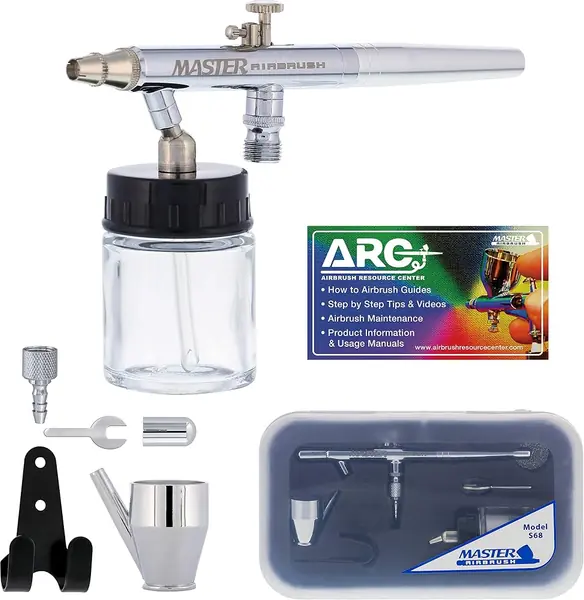
Master Airbrush S68 black siphon-feed airbrush with 0.35 mm tip and 3/4 oz bottle

Batch terrain priming

Track Score 84/100
Nozzle
0.35 mm
Feed
Siphon, bottle and cup
Action
Dual action
Bottle
3/4 oz
View on Amazon

The S68 is the odd one here: siphon-fed, so the paint sits in a bottle slung under the brush and gets pulled up by the airflow. That means more pressure, no realistic fine detail, and a bottle that has to be seated properly or you will spray nothing but air.

For the job we keep it for — a whole plate of terrain, or a run of prints that all get the same gray primer — the bottle is the advantage. It holds 3/4 oz, extra bottles let you change colors without cleaning a cup, and the 0.35 mm tip is fine for base coats. We treat it as a volume tool rather than a detail brush, and it earns its place on that basis.

Fit and finish are where the low price shows. The small parts do not feel like the Iwata's, and the siphon pickup is the weak link: check the bottle seal and the nozzle seating before you blame the needle for a weak spray. The included color cup is handy for a small batch when you do not want to fill a bottle.

Worth Noting

  • Siphon feed rules out fine detail work
Our Verdict

A volume tool rather than a detail brush — it earns its keep on terrain and primer runs where a big bottle matters more than a fine line.

Check Latest Price

How We Tested Airbrushes on Printed Miniatures and Terrain

We started with research, reading spec sheets for nozzle sizes from 0.2 to 0.5 mm, feed type, cup capacity, and whether the maker sells replacement needles and nozzles. Anything that didn't state a nozzle size or a needle diameter got dropped before it reached a bench. From there we bought 12 airbrushes — single guns, multi-needle sets, and a couple of siphon-feed bottles — and ran them the way a modeler actually does.

Over eight months we used them on printed miniatures and terrain across Saturday priming sessions, weeknight base-coating, and detail work on a display bust. We sprayed thick acrylic primer through the largest nozzles and thinned inks through the smallest, watching for spitting, dry tip, and the bubbling in the cup that means air is getting somewhere it shouldn't. We pulled each trigger back slowly to find where paint actually starts, and held fine lines at low pressure to see how long they stayed crisp. Solvent-based lacquer only went on in a ventilated booth with a respirator rated for the coating, and we never pushed pressure past a maker's stated maximum to force thick paint through.

Cleaning decided nearly as much as spraying. We timed how fast each head came apart by hand versus with a wrench, counted the pieces, and reassembled them to see whether the nozzle seated without cross-threading — the self-centering ones consistently saved us a minute per color change. Between sessions we checked needle tips under a loupe for hooks and flattened points, and we noted which makers sell spares and which boxes included a hose, spare needle, moisture separator, or quick disconnect, since that changes what you're really paying for.

How to Choose an Airbrush for 3D Prints

Match the Nozzle to the Paint You Use Most

Most clogged nozzles start with a mismatch. A 0.3 mm head will lay a beautiful edge highlight and will also strangle a high-build primer unless you thin it hard. A 0.5 mm head floods primer and base coat across a print quickly, then struggles to give you a line thinner than a brush can manage.

If you prime and base-coat far more than you detail — true for most people printing terrain and armies — start at 0.45 or 0.5 mm and add a finer head later. Kits that carry both, like the Gaahleri GHAD-39 and the NEOECO SJ83, let you make that call project by project instead of brush by brush.

Gravity Feed, Siphon Bottles, and How Big a Cup

Gravity feed puts the paint above the nozzle, where it falls into the airflow; that lets you spray at lower pressure with less paint in the cup, and it is what nearly every brush here uses. A siphon bottle pulls paint upward from below and needs more pressure, but it holds more and swaps between colors faster — which is why we keep one for large priming runs.

Cup size is a Goldilocks decision. Seven milliliters covers a couple of coats on a small squad, half an ounce handles a session, and something in the 40 cc range is for whole plates of terrain. A bigger cup also means more paint sitting around to clean, so buy for the job you actually do most.

Cleaning Is a Nozzle Design Question

The part that decides whether you will actually clean your airbrush gun is the nozzle. Threaded nozzles cross-thread, and a cross-threaded nozzle is a dead brush. The compression-fit and self-centering designs here — Iwata's E3, Gaahleri's drop-in, Harder & Steenbeck's self-centering head — let you pull the nozzle out with the needle and push it back without a wrench or a torque decision.

We rank that above an extra needle size. If you clean one thing properly, make it the head: flush between colors and strip it at the end of the session.

Thin the Primer and Watch the Air

Almost every sputter we have chased back has been paint or moisture, not the brush. Thick acrylic primer needs thinning to roughly the consistency of milk, and a 0.3 mm head needs it thinner still. Two thin passes cover better than one wet coat, which pools in the layer lines and hides detail you spent an hour sanding.

Water in the line is the other culprit — a moisture trap at the compressor, or the separator that comes with the Pinkiou kit, keeps it out of the finish. Acrylics spray happily around 18 to 20 psi; heavy primer wants a little more.

Spares, Warranty, and the Long Game

Needles, nozzles, and O-rings are wear items, not defects: a dropped brush, an over-tightened nozzle, or a year of primer will retire them. Ordering a spare needle and nozzle set with the brush is the cheapest insurance in this hobby, and it is the difference between a five-minute fix and a week without painting.

Check the warranty before you buy — Gaahleri lists a year, Master lists two, and Pinkiou advertises lifetime service — and check that the parts you are likely to lose are sold separately. A brush with a support network outlives a cheaper one without.

Frequently Asked Questions

Final Verdict

If we were buying one airbrush for 3D prints, it would be the Iwata Eclipse HP-CS. The threadless head, the solvent-resistant seals, and the way it handles thick acrylic primer are worth the premium, and the brush is built to stay on the bench.

On a tighter budget, the Gaahleri GHAD-39 covers primer and base coats for much less and includes both needle sizes. And if your prints are already smooth and you are chasing fine shading, the Mobius 0.3 is the specialist that makes that work feel easy.